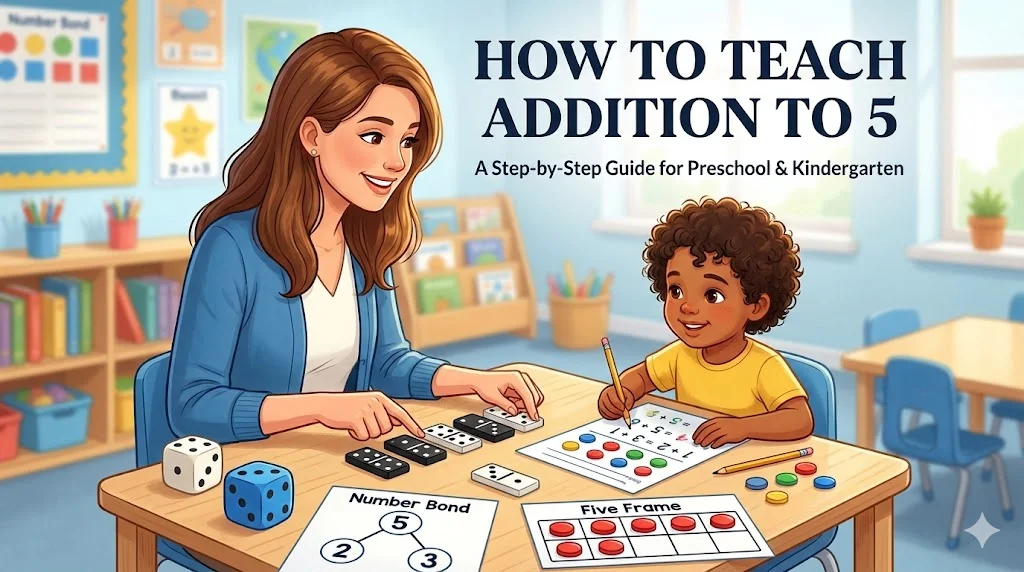
Teaching addition to 5 is one of the most rewarding milestones in early childhood education. It marks the transition from simple counting (“1, 2, 3…”) to actual mathematical thinking (“2 and 3 make 5”).
For many kindergarteners, this leap can be abstract and confusing. That is why experts recommend avoiding rote memorization initially. Instead, a structured, hands-on approach works best.
In this comprehensive guide, we will explore how to master teaching addition to 5 using proven strategies, visual models, and free printable resources that make math stick.
Phase 1: Building Number Sense (The “Why”)
Before a child can solve $2+3$, they need to understand the behavior of numbers. We start with the foundational rules that build confidence.
The Concept of Zero and One
The easiest entry point is the “Identity Property”. Children need to visualize that adding zero changes nothing. Our adding 0 worksheets are designed to reinforce this simple rule. Once they grasp that, we move to the “Counting On” strategy using adding 1 worksheets, which teaches them that adding one is simply jumping to the next number.
Decomposing Numbers (Number Bonds)
This is the secret sauce of math fluency. Children must see “5” not just as a number, but as a whole made of parts. Using a ways to make 5 worksheet, you can show them how 5 breaks down into pairs like 1 & 4 or 2 & 3. This is often taught using “Number Bonds”.
Phase 2: Using Visual Models & Manipulatives
Abstract numbers on a page mean very little to a 5-year-old. When teaching addition to 5, manipulatives are your best friends.
Professional Math Tools
To structure their thinking, we use ten-frames (or in this case, five-frames). A five frame addition worksheet helps students visualize quantities within a defined space. For a more challenging cognitive task, missing addends within 5 worksheets introduce early algebraic thinking by asking “2 plus what equals 5?”.
Game-Based Learning
Math shouldn’t be boring. Incorporating familiar game pieces makes learning natural.
- Dominos: A domino addition worksheet naturally shows two parts making a whole.
- Dice: Rolling and counting dots on dice addition worksheets improves “subitizing” (instant recognition of quantities).
- Tally Marks: Teaching data handling early with a tally marks addition worksheet gives them a new way to represent numbers.
Phase 3: Active & Fun Practice
If a student is struggling with pencil-and-paper drills, it’s time to get their hands moving.
Fine motor skills are crucial at this age. A cut and paste addition activity allows children to physically construct the equation, which can be a breakthrough for kinesthetic learners. Similarly, combining art with math using a color by addition sums to 5 page turns practice into a rewarding puzzle.
Phase 4: Developing Fluency and Speed
Once the concepts are understood, we aim for accuracy and speed. This is where standard formats come into play.
Start with simple horizontal addition to 5 to match their reading direction (left to right). Then, introduce the vertical format with vertical addition to 5 worksheets, which prepares them for column math in later grades.
Finally, for students who are ready to show off their skills, addition speed drills challenge them to recall answers instantly, building the automaticity needed for first grade.
Final Thoughts on Teaching Addition to 5
Mastering these early sums is the gateway to all future arithmetic. By moving from concrete manipulatives to abstract equations, you ensure no student is left behind.
Whether you need hands-on activities or standard drills, our complete collection of resources for teaching addition to 5 covers every step of this journey.
If your students are still mastering the basics of counting, you might want to revisit our [Picture Addition Worksheets] before diving into these abstract drills. For those ready for the next challenge, stay tuned for our upcoming “Addition to 10” series!