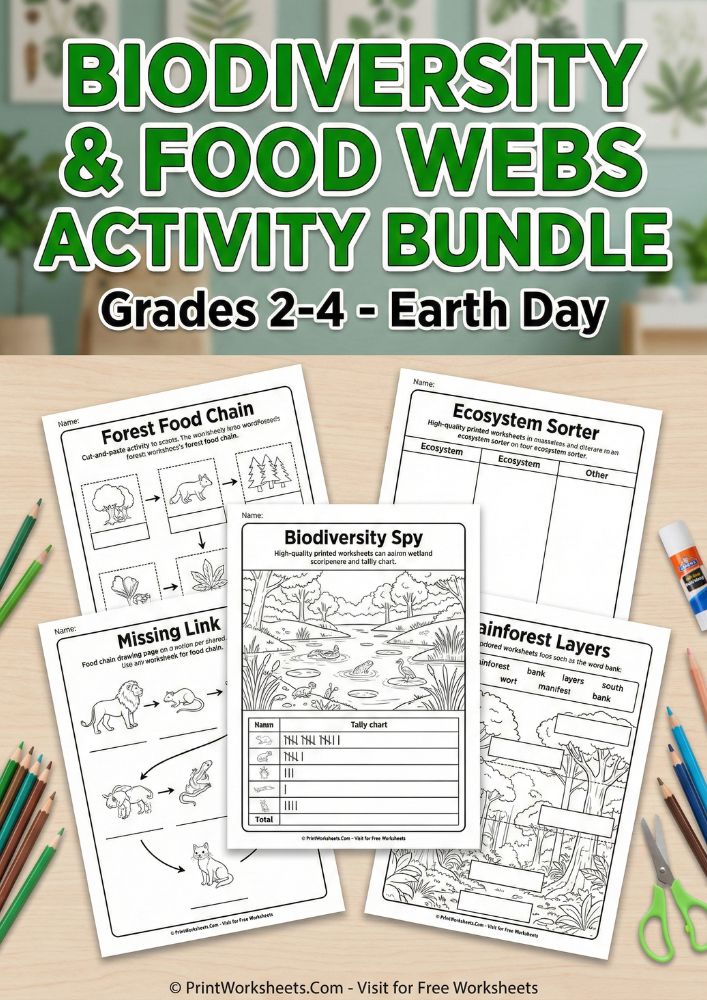


Teaching young students about biodiversity can sometimes feel abstract. How do we explain complex connections in nature to a 2nd grader? The answer is making it hands-on! Our free Food Chain and Ecosystem Worksheets PDF bundle breaks down these big scientific concepts into interactive activities like sorting, graphing, and cutting-and-pasting.
Whether you are planning a unit for Earth Day or strictly covering Next Generation Science Standards (NGSS), this packet is designed to turn passive listeners into active ecologists.
What’s Inside This Free Activity Bundle?
This 7-page printable pack goes beyond simple definitions. It requires students to analyze relationships in nature. Here is what is included:
- Forest Food Chain (Cut & Paste): A hands-on activity where students arrange the sun, plants, herbivores, and carnivores in the correct energy flow.
- Ecosystem Sorter: A classification worksheet to help students distinguish between Producers, Consumers, and Decomposers.
- Biodiversity Spy: A data collection activity using tally charts to count different species in a wetland environment.
- Missing Link: Students draw the missing part of a food chain to understand interdependence.
- Rainforest Layers: A vocabulary matching game focused on the unique structure of rainforest habitats.
How to Use These Worksheets in Your Classroom
1. Interactive Science Notebooks:
The “Forest Food Chain” and “Ecosystem Sorter” pages are perfect for interactive notebooks. Have students cut out the elements and glue them into their journals as a reference for the rest of the year.
2. Habitat Stations Rotation:
Set up different stations in your classroom. While one group works on these food webs, another group can explore where these animals live using our Animal Habitat Activity Pack. This helps reinforce the connection between an animal’s diet and its home.
3. Outdoor Extension:
After learning the theory indoors with these worksheets, take the class outside! Use our Earth Day Nature Scavenger Hunt to find real-world examples of producers (plants) and consumers (bugs/birds) in your schoolyard.
Educational Benefits & Standards
This packet supports NGSS 2-LS4-1 (Make observations of plants and animals to compare the diversity of life in different habitats). By identifying different roles in the ecosystem, students begin to understand why every creature matters.
This is also a perfect segue into discussions about protecting our planet. Once students understand how delicate food webs are, you can introduce our Wildlife Conservation Activities or discuss species at risk with the Endangered Animals Worksheets.
Frequently Asked Questions
What grade level is this for?
This bundle is optimized for Grades 2 through 4. The cutting and sorting activities are great for 2nd graders, while the vocabulary (Producers/Consumers) aligns well with 3rd and 4th-grade science curriculums.
Is an answer key included?
Yes, the cut-and-paste activities are straightforward, but teachers can easily create a master key for self-checking stations.
Can I use this for Earth Day?
Absolutely! While it works for any biology unit, the focus on biodiversity makes it an ideal resource for April 22nd lesson plans.