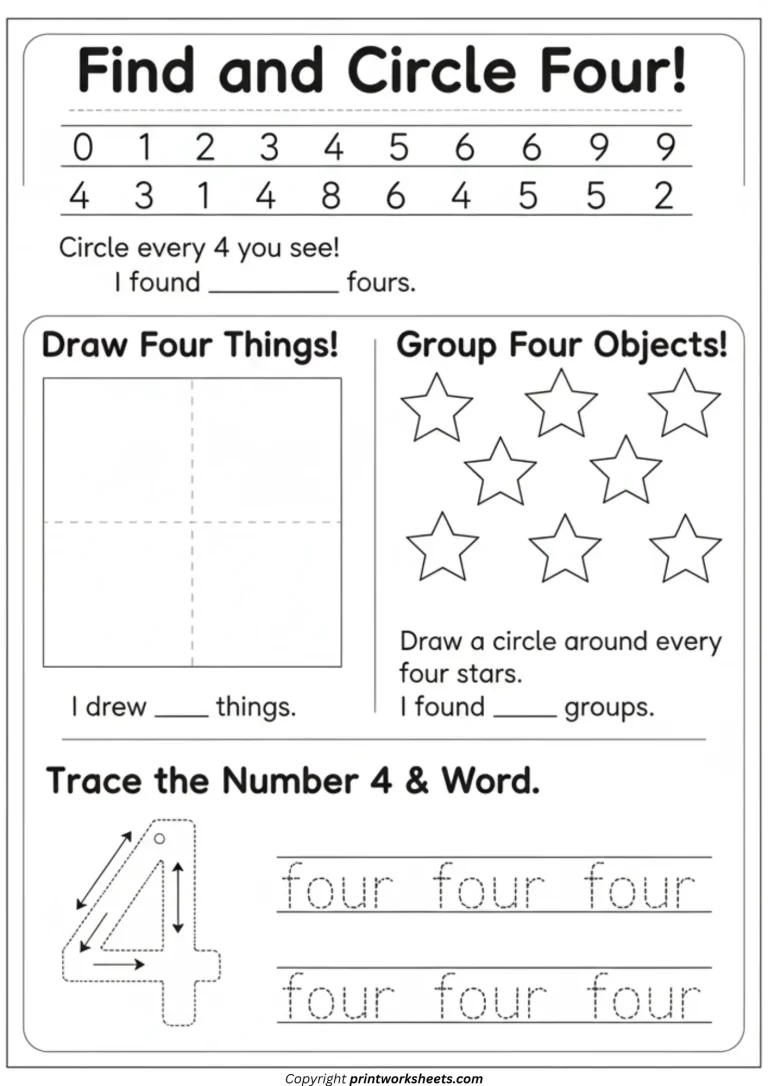
Finding the number 4 amidst a sea of numbers isn’t just a chore; it’s early pattern recognition in disguise. Learning to identify, count, and write the number four is a significant milestone for preschoolers. Our Number 4 Practice Worksheet is designed to help children lean forward, focus, and develop number fluency in a fun, stress-free way.
Whether you are a teacher looking for quiet desk work or a parent homeschooling your little one, this activity sheet covers multiple math skills on a single page.
What’s Included in This Number 4 Worksheet?
This printable isn’t just about writing a number; it is a multi-sensory activity sheet that engages different parts of a child’s brain. Here is a breakdown of the four key activities included:
1. Find and Circle Four (Visual Discrimination)
The top section features a number line and a mix of random digits. Children must scan the row, identify the number 4, and circle it. This “treasure hunt” style activity helps sharpen visual discrimination skills, ensuring students can distinguish the number 4 from similar-looking shapes or numbers.
2. Creative Counting: Draw Four Things
After finding the numbers, students switch to creativity. The “Draw Four Things” box is a blank canvas where they can draw four of their favorite items—cats, clouds, cookies, or whatever brings them joy. This connects the abstract concept of the number “4” to concrete objects they love.
3. Grouping Objects (Introduction to Sets)
Math is all about patterns. In the “Group Four Objects” section, children see a collection of stars. Their task is to count and draw a circle around every group of four stars. This introduces the early math concept of “sets” and grouping, which is foundational for learning multiplication later on.
Looking for more activities like this? Explore our complete collection of Math Counting Worksheets to build a strong foundation in early numeracy.
4. Trace the Number 4 and Word
The bottom section focuses on fine motor skills. It features a large ‘4’ with directional arrows to guide the hand, followed by tracing lines for the word “four.” This dual approach helps children associate the digit (4) with its written word form (four), providing ample support for budding writers without being overwhelming.
Why Use This Worksheet in Your Classroom?
- Builds Focus: The variety of tasks (circling, drawing, tracing) keeps young minds engaged without boredom.
- Develops Fine Motor Skills: Tracing numbers and drawing shapes strengthens hand muscles needed for handwriting.
- Zero Prep: Just print and pass it out! It’s designed with classroom calm in mind—an activity that helps a child quietly say, “I did it!”
If you are focusing specifically on this number for your “Number of the Week” curriculum, check out all our resources tagged under Number 4 Worksheets.
Frequently Asked Questions About Teaching Number 4
How do I teach my preschooler to write the number 4?
The number 4 can be tricky because it involves lifting the pencil. A common teaching phrase is: “Down and over, and down once more, that’s the way to make a four!” Using our tracing worksheet helps muscle memory by following the directional arrows.
What age should a child recognize the number 4?
Most children start recognizing numbers between ages 3 and 4. By age 5 (Kindergarten), they are typically expected to count to 20 and recognize written numerals up to 10.
Is this worksheet suitable for Pre-K?
Yes! This worksheet is designed for Pre-K and Kindergarten levels. The activities are simple enough for beginners but offer enough variety to keep them practiced.