Mastering the Number 4: Tracing, Counting, and Coloring Worksheet
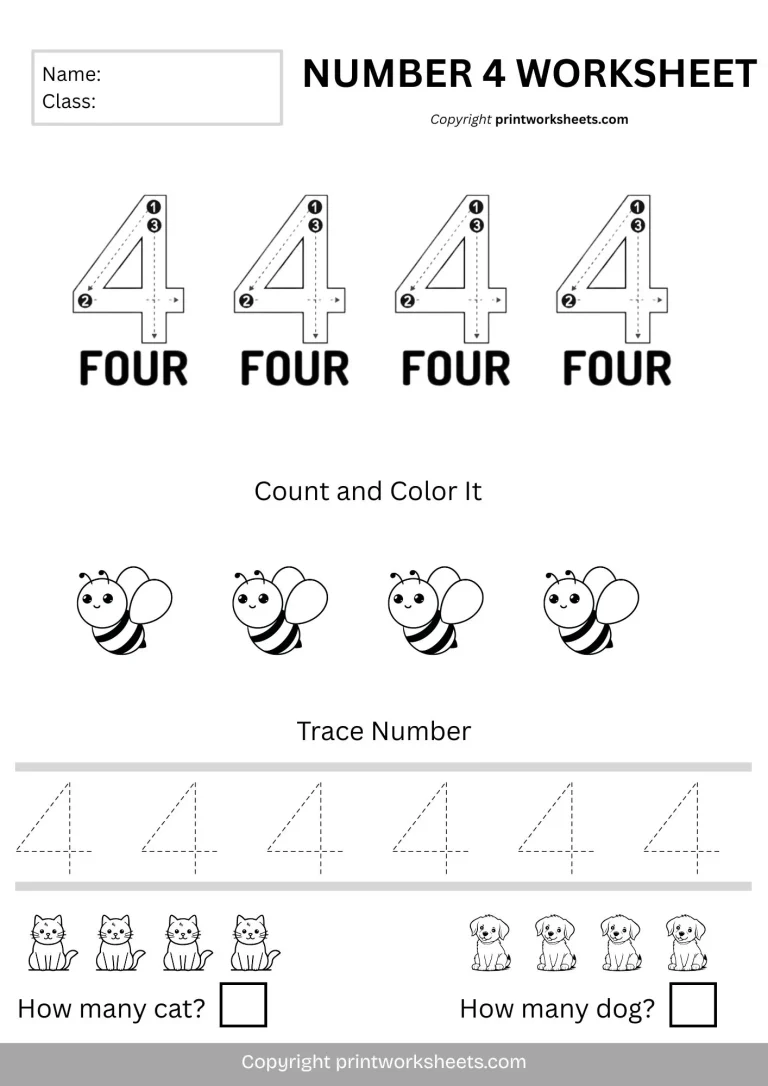
Welcome to our comprehensive Number 4 Worksheet, designed specifically for preschool and kindergarten students. This all-in-one activity sheet is an excellent resource for introducing early learners to the number four. By combining visual recognition, tactile writing practice, and engaging counting exercises featuring friendly animals, this printable ensures a multi-sensory learning experience. Whether you are a classroom teacher or a homeschooling parent, this worksheet provides the structure needed to build early math confidence.
Educational Skills Targeted
This worksheet is more than just busy work; it is carefully structured to develop specific developmental milestones:
- Number Formation & Stroke Order: The top section utilizes directional arrows (labelled 1, 2, 3) to guide children on the correct starting points and directionality for writing the number 4.
- Fine Motor Skills: Tracing the dashed lines in the middle section helps strengthen hand muscles and improves pencil grip and control.
- One-to-One Correspondence: By counting the 4 bees, 4 cats, and 4 dogs, children practice assigning one number word to one object, a foundational math concept.
- Visual Discrimination: Identifying and coloring specific images helps children focus on details and distinguish objects within a set.
How to Use This Worksheet Effectively
To maximize the learning potential of this printable, we recommend guiding your child through the sections in the following order:
- Finger Tracing: Start at the top. Have the child use their index finger to trace the large, hollow number 4s, following the numbered bubbles and arrows. Say the word “Down, over, and down once more, that’s the way to make a four!”
- Word Recognition: Point to the word “FOUR” printed in bold below the large numbers to help associate the numeral with its written word form.
- Count and Color: Move to the “Count and Color It” section. Ask the child to count the bees aloud. Allow them to color the bees to reinforce the quantity creatively.
- Handwriting Practice: Using a pencil or crayon, have the child complete the “Trace Number” line. Remind them to connect the dashed lines carefully.
- Assessment: Finally, look at the bottom section. Ask, “How many cats do you see?” and “How many dogs are there?” Have the child write the number 4 in the provided boxes to answer the questions.
Extension Activity: The “Four-Legged Friends” Hunt
Since the worksheet features cats and dogs, extend the learning offline with a “Four-Legged Friends” investigation. Ask your child to look at their toys or pets and identify which ones have four legs. Gather four stuffed animals and practice counting their legs. This connects the abstract concept on the paper to the concrete world around them.
Frequently Asked Questions
What age group is this Number 4 worksheet best suited for?
This worksheet is ideal for Preschool (ages 3-4) and Kindergarten (ages 5-6) students. It is designed for children who are beginning to recognize numerals and are ready to practice writing them.
How can I reuse this worksheet for repeated practice?
To create a reusable learning center resource, you can laminate the worksheet or place it inside a clear plastic sheet protector. Allow the child to use a dry-erase marker to trace the numbers and circle the cats and dogs, then wipe it clean for future use.
Why is tracing the numbers with arrows important?
The arrows and numbers (1-2-3) indicate the proper stroke sequence. Learning to write numbers with the correct formation prevents bad handwriting habits and increases writing speed and legibility as the child progresses to higher grade levels.