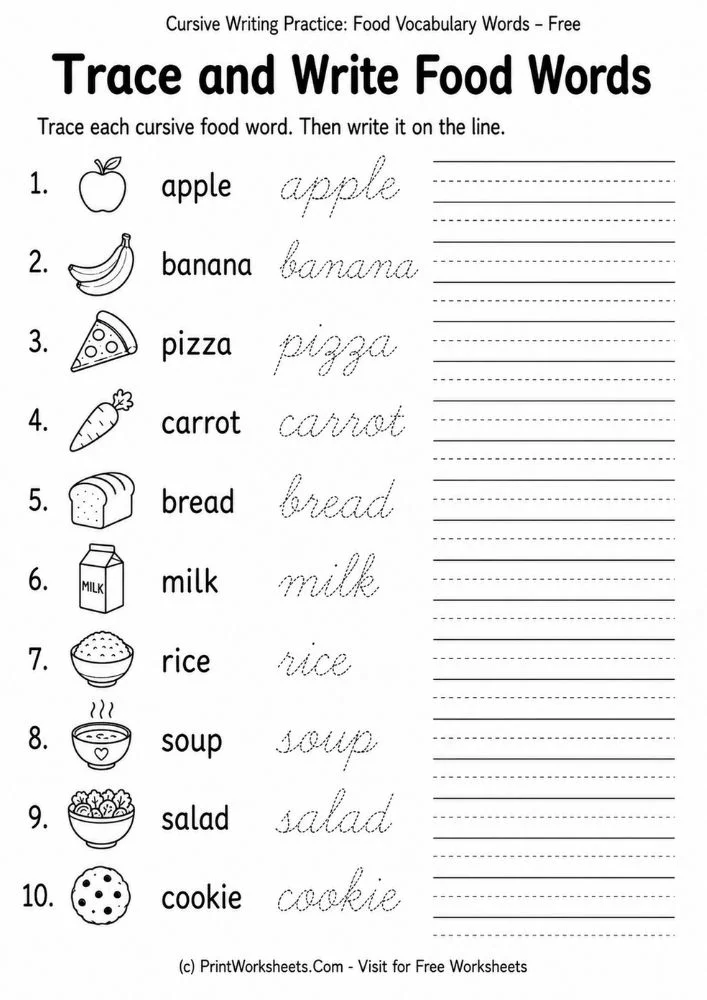
Cursive food words worksheets are targeted cross-curricular handwriting practice printables designed to teach 2nd grade and 3rd grade students how to trace and write standard culinary vocabulary using continuous cursive letter joins. Elementary educators utilize these free cursive tracing printables to seamlessly merge daily life spelling recognition with essential fine motor skill development. By tracing and copying high-frequency food vocabulary, young learners build strong physical muscle memory while permanently memorizing correct spelling patterns. Download this comprehensive cursive handwriting practice PDF from PrintWorksheets.Com to establish rigorous, quiet morning work routines or independent literacy centers in your classroom.
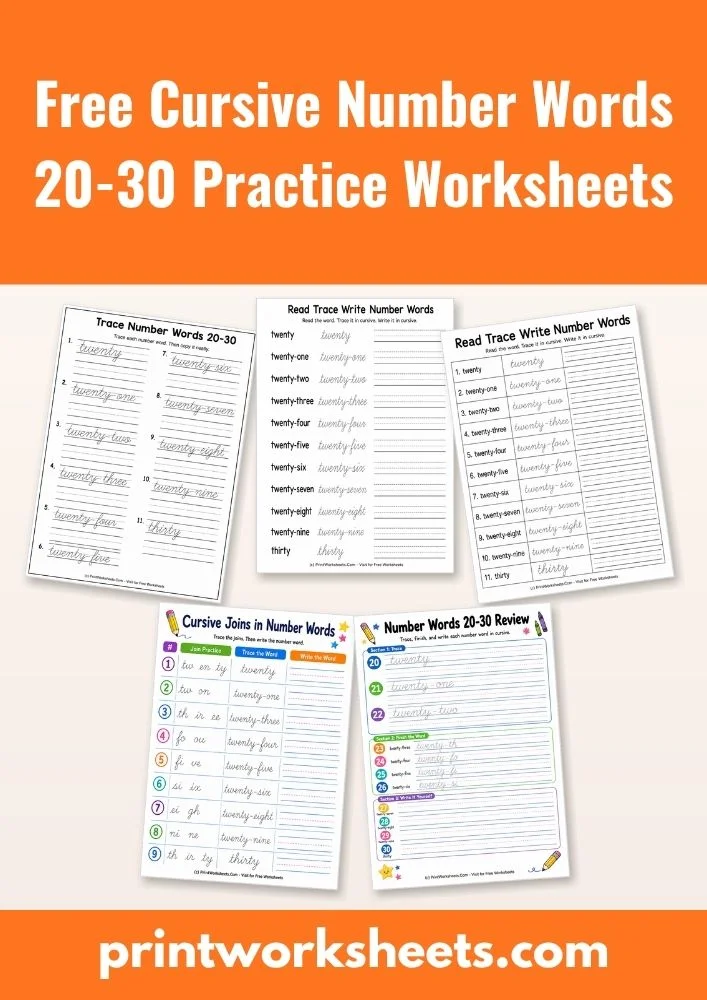
To construct a highly effective, full-year handwriting and vocabulary curriculum, pair these specific health and food printables directly with our cursive number words 20-30 worksheets. Combining numerical vocabulary with daily life reading words ensures students master foundational spelling structures required for academic success across multiple elementary subjects.
What is included in the Cursive Food Words PDF?
This cursive handwriting practice pack features four distinct and highly targeted tracing worksheets. Each printable page is meticulously structured to meet exact English Language Arts handwriting standards while reinforcing 2nd grade and 3rd grade vocabulary. The printable PDF explicitly covers the cursive spelling of everyday items such as apple, banana, pizza, cheese, yogurt, and sandwich.
- Trace and Write Food Words This foundational vocabulary worksheet introduces students to the continuous cursive flow of common nouns. Students practice reading the print word, tracing the dotted cursive text, and independently copying the standard food vocabulary directly onto primary dashed lines. This ensures proper letter height, consistent slant, and correct spacing.
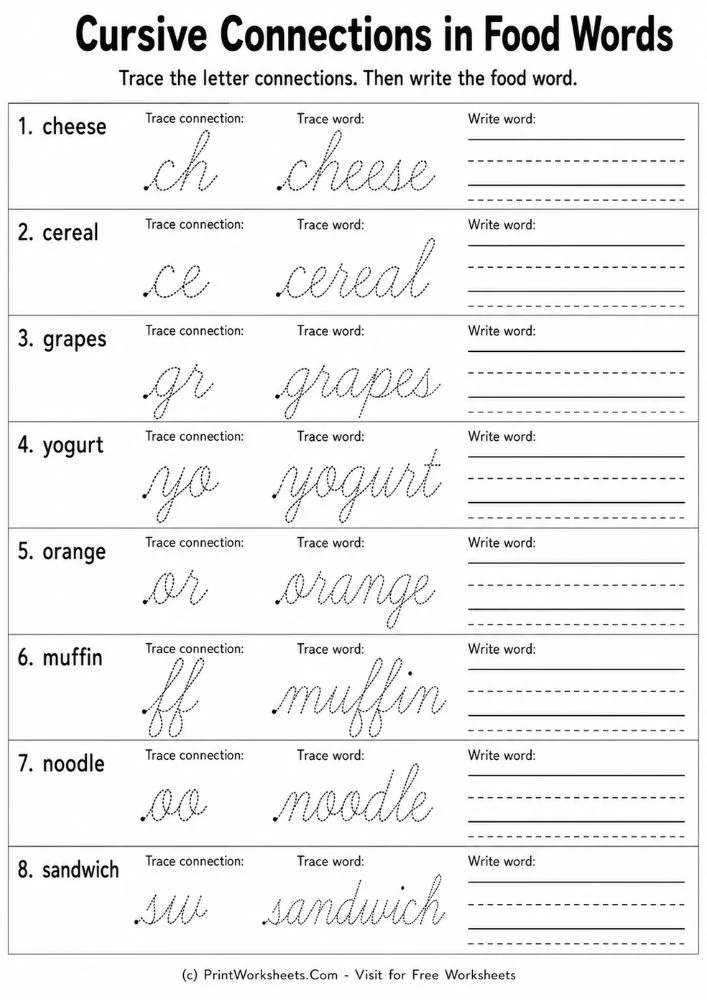
- Cursive Connections in Food Words A highly technical penmanship worksheet. This page isolates the most difficult cursive letter transitions found in standard English spelling. Students practice specific phonetic and structural joins such as “ch” for cheese, “gr” for grapes, “ff” for muffin, and “sw” for sandwich. Isolating and mastering these specific letter connections prevents messy handwriting and improves overall writing speed.
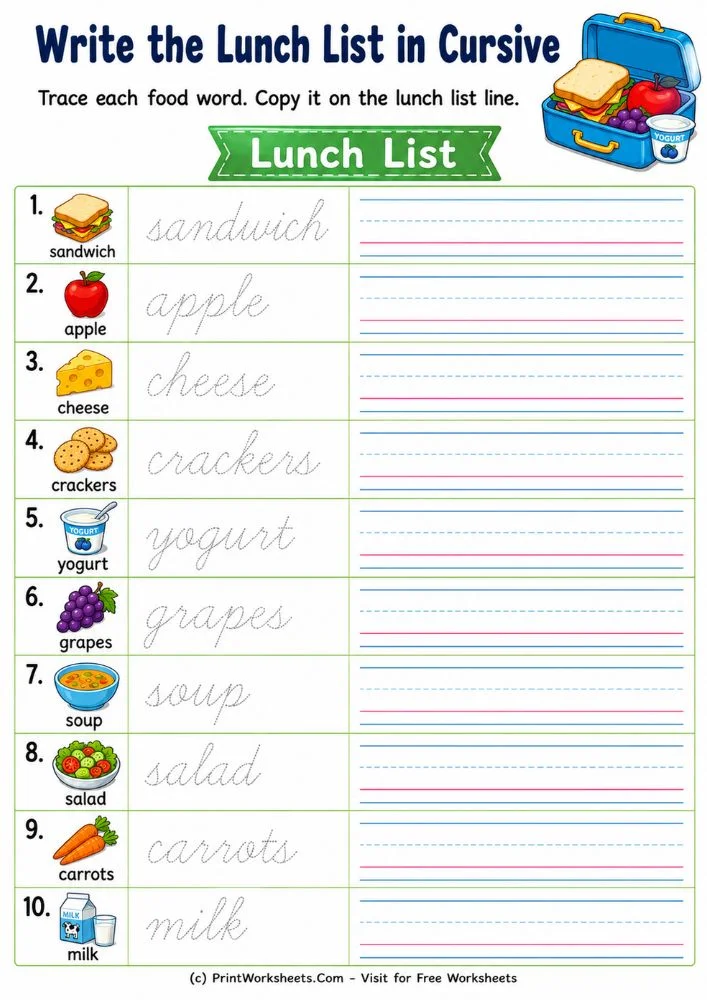
- Write the Lunch List in Cursive Designed for real-world vocabulary application, this specific worksheet requires students to trace standard food words and copy them onto a structured lunch list. Using distinct, color-coded primary lines (blue top line, dotted middle line, red baseline), this page provides strict visual boundaries for students who struggle with spatial awareness and lower-case letter proportions.
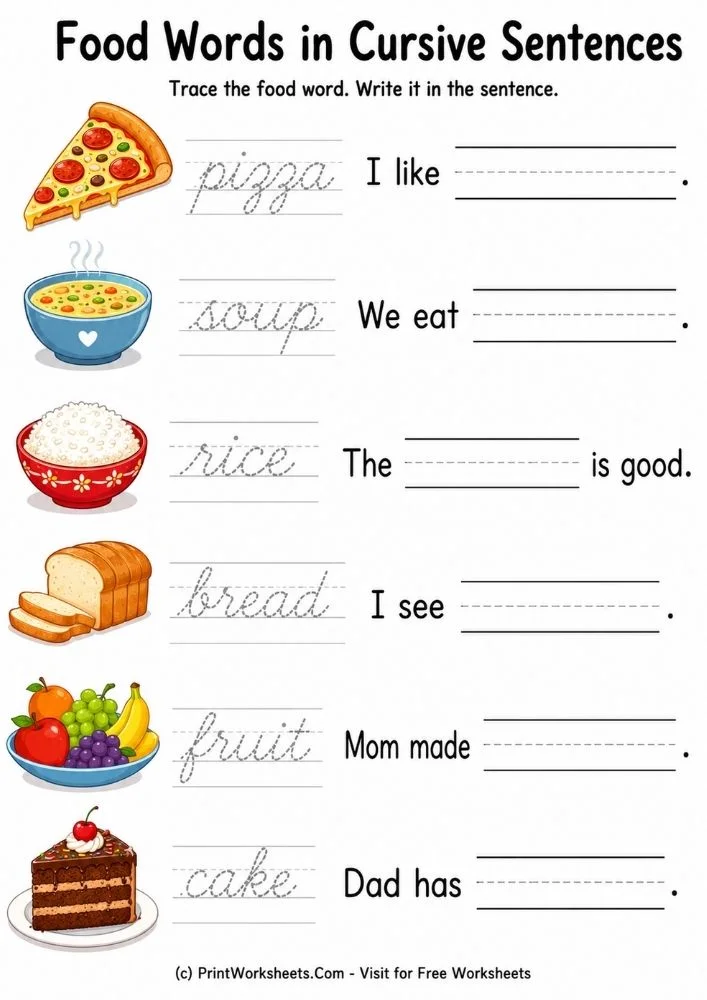
- Food Words in Cursive Sentences A contextual reading comprehension and handwriting worksheet. Instead of writing isolated words, students read a short print sentence with a missing blank (e.g., “I like ___.”). They must trace the cursive food word and write it correctly inside the sentence structure. This integrates reading fluency, spatial word spacing, and end-punctuation awareness into a single handwriting exercise.
The Pedagogical Benefits of Thematic Handwriting Practice
Integrating high-interest thematic vocabulary into handwriting lessons maximizes instructional efficiency in the elementary classroom. When 3rd grade students practice writing words like “yogurt” or “cereal” in cursive, they are performing a dual-cognitive task. They are solidifying the physical muscle memory required for fluid cursive penmanship while simultaneously committing complex spelling variations to long-term memory. Food vocabulary is particularly effective because it utilizes words students encounter daily in their actual lives, increasing engagement and the immediate practical application of their new handwriting skills.
How to Use Printable Cursive Vocabulary Centers
Print these cursive vocabulary writing worksheets on standard 8.5 x 11 copy paper for independent language arts stations, morning literacy rotations, or dedicated penmanship blocks. To maximize your classroom resources and drastically minimize copy machine usage, place the “Cursive Connections” page and the “Cursive Sentences” worksheet inside heavy-duty dry-erase sleeves. Provide students with fine-tip whiteboard markers and felt erasers. This straightforward preparation creates a permanent, reusable 3rd grade handwriting center where students can practice their continuous cursive formatting repeatedly throughout the academic school year.
Frequently Asked Questions
What grade levels use cursive food words worksheets?
Cursive food words worksheets are heavily used by standard 2nd grade and 3rd grade ELA educators. They provide essential handwriting practice that targets required elementary spelling words, complex letter transitions, and daily life vocabulary recognition.
What specific cursive skills do these printables target?
These cursive tracing printables explicitly target complex letter joins (such as connecting s to w or o to r), correct baseline positioning on primary lines, and the continuous cursive word formatting required for advanced elementary writing assignments.
Why is practicing cursive connections important?
Practicing cursive connections is important because the most common errors in cursive writing occur when students attempt to link specific letters together, rather than forming the letters themselves. Isolating tricky joins like “ch” or “ff” trains the hand to move fluidly between characters without breaking the continuous stroke.