What are cursive sight words? Cursive sight words are high-frequency vocabulary words that young students practice writing in continuous cursive script to build muscle memory and reading fluency. Print cursive sight words tracing worksheets to build essential handwriting and spelling skills for second-grade students. Mastering cursive writing requires young learners to fluidly connect letters while simultaneously memorizing the spelling of common sight words. This printable literacy PDF delivers rigorous learning centers focusing heavily on targeted word tracing, sentence writing, and penmanship self-evaluation. By engaging with these specific handwriting activities aligned with standard cursive writing practices, educators ensure children develop the fine motor skills necessary for advanced literacy. Printing these targeted cursive sight words tracing worksheets guarantees your students can accurately write and recognize high-frequency words.
Educators and homeschool parents rely on structured handwriting practice during morning work, independent literacy rotations, and dedicated penmanship blocks. Consistent exposure to cursive sight words prevents messy writing and aids in faster spelling recall. To construct a complete baseline for early childhood literacy, pair this handwriting pack directly with our cursive animal words worksheets. Securing smooth handwriting alongside vocabulary expansion establishes the ultimate core language framework required for primary grade success.
Inside the Cursive Sight Words Worksheets PDF
Clear formatting, structured primary dashed lines, and repetitive tracing blocks make these printables highly effective for elementary classrooms. The layouts minimize visual clutter to maximize focus on proper letter formation and sight word recognition. Each printable activity page targets specific 2nd-grade handwriting goals.
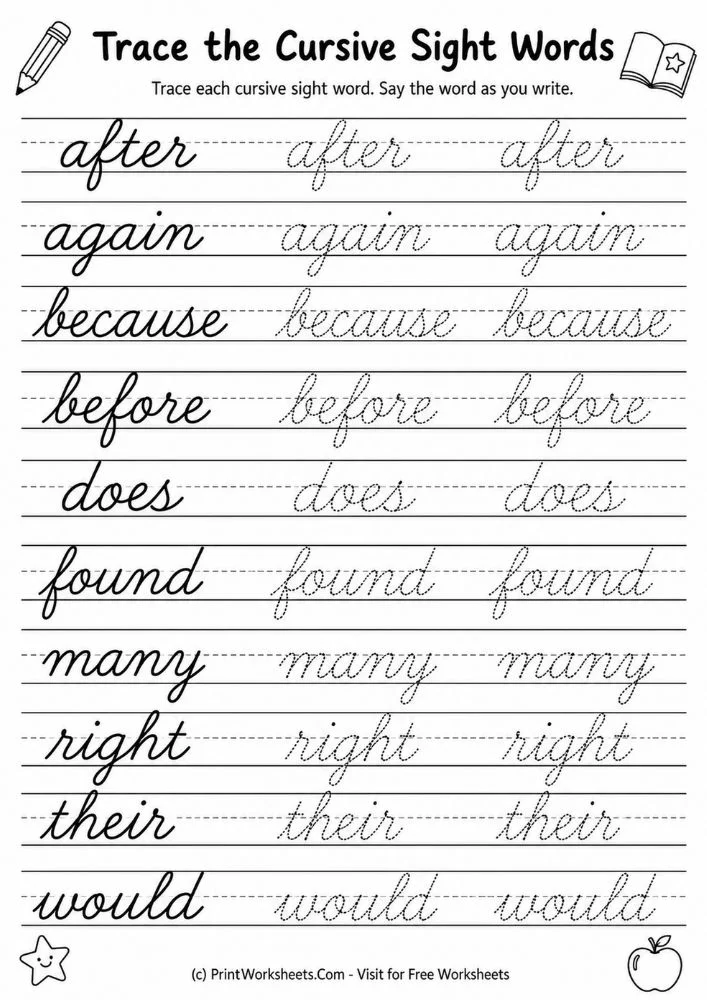
- Trace the Cursive Sight Words A foundational handwriting worksheet. Students practice high-frequency words like “because,” “found,” and “would.” They trace the dotted cursive words multiple times across the primary lines to establish baseline muscle memory.
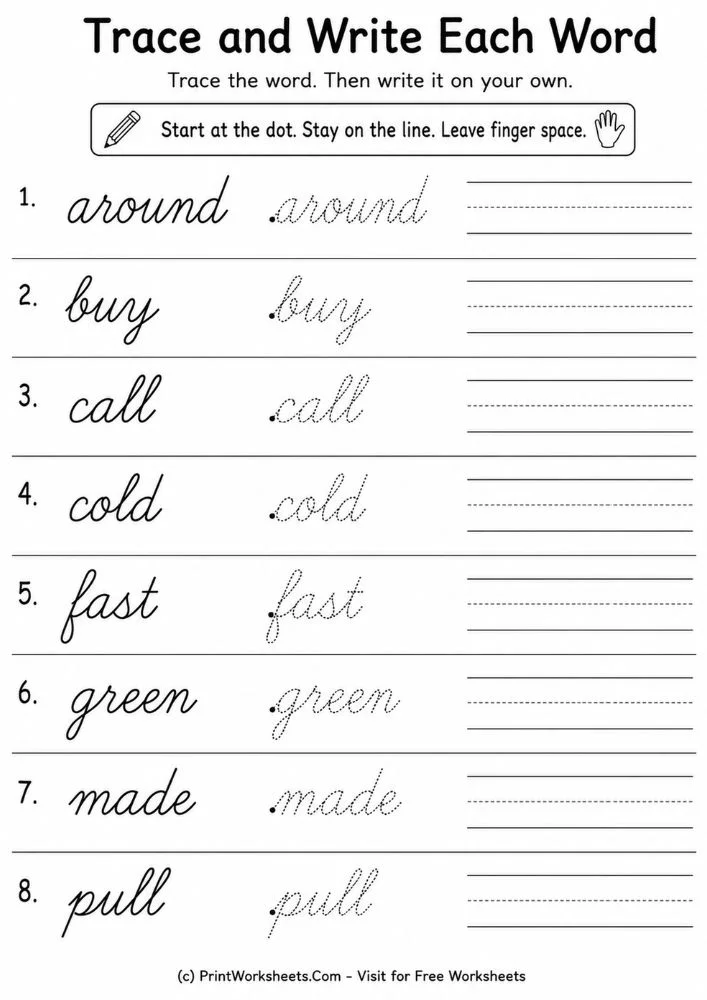
- Trace and Write Each Word A guided independence page. Students start at the directional dot to trace words like “around” and “made.” Afterward, they must leave a finger space and write the cursive word completely on their own.
- Printable Practice Worksheet A blank lined template. This versatile page provides standard primary dashed lines for teachers to dictate their own specific spelling words or for students to practice their most challenging letter connections.
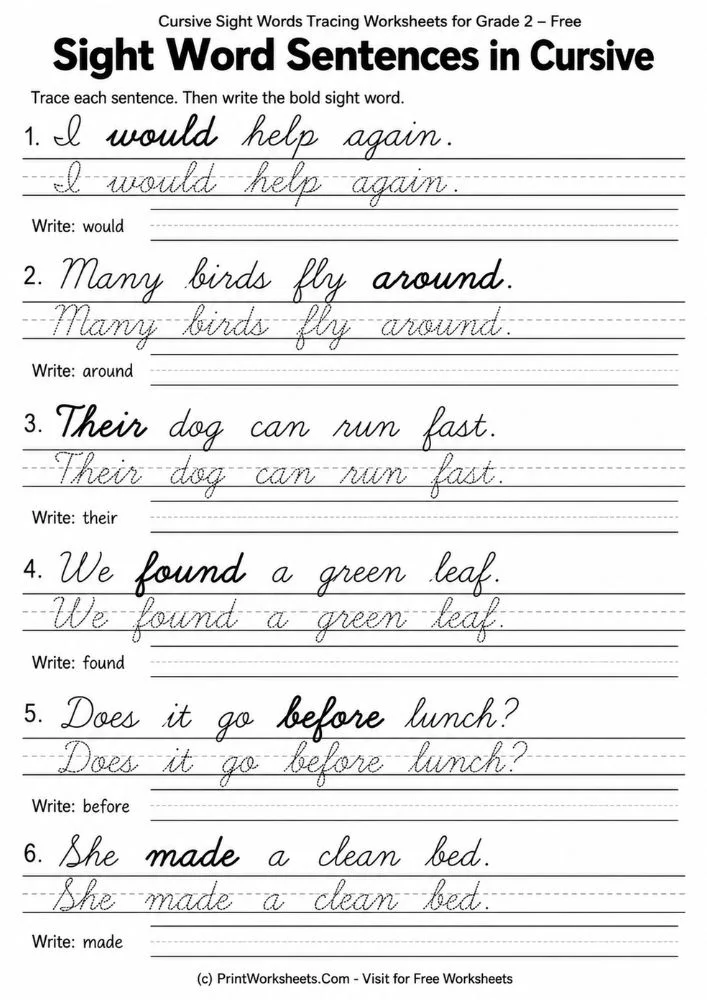
- Sight Word Sentences in Cursive A comprehensive sentence writing worksheet. Students trace complete sentences such as “We found a green leaf.” Then, they isolate and write the bold sight word on the final line, integrating spelling with continuous text flow.
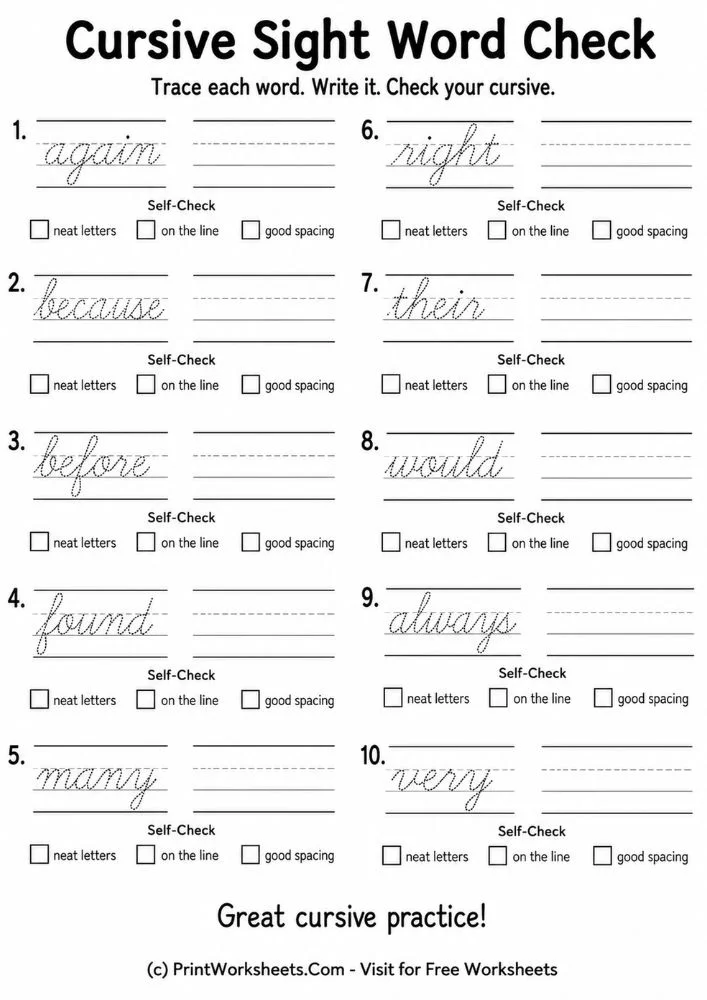
- Cursive Sight Word Check An interactive self-assessment page. Students trace and write ten sight words. Below each word, they use a checklist to self-evaluate their work based on three criteria: neat letters, on the line, and good spacing.
Effective Handwriting Center Implementation
Print these high-resolution handwriting pages directly on standard 8.5″ x 11″ copy paper. Integrating proper pencil grip routines alongside the cursive sight words tracing worksheets guarantees maximum fine motor retention. During the Sight Word Sentences activity, closely monitor students to ensure they are maintaining a consistent slant and not lifting their pencils unnecessarily between letters.
To maximize literacy center efficiency, place the Trace and Write pages and the Sight Word Check page inside heavy-duty dry-erase sleeves. Provide students with fine-tip dry-erase markers. This straightforward preparation allows multiple classroom groups to practice their cursive loops and sight word spelling repeatedly throughout the instructional week without consuming excess printer ink or copy paper.
Frequently Asked Questions
Why is practicing cursive sight words important?
Practicing cursive sight words is important because it combines two crucial literacy skills: spelling memorization and fine motor development. When young students write high-frequency words in cursive, they build the physical muscle memory required for fast, fluid writing in the upper grades.
How does self-checking improve handwriting?
Self-checking improves handwriting by forcing students to actively evaluate their own work rather than rushing through an assignment. Teaching students to look for neat letters, proper line placement, and good spacing makes them conscious of their mistakes and instantly improves their penmanship quality.
What grade levels use these printables?
These printable handwriting activities are designed specifically for standard 2nd grade and 3rd grade English Language Arts expectations. Advanced 1st-grade classrooms can utilize the basic tracing pages during small group teacher-led interventions. Educators print these exact sheets for independent writing centers to build beautiful baseline cursive skills.