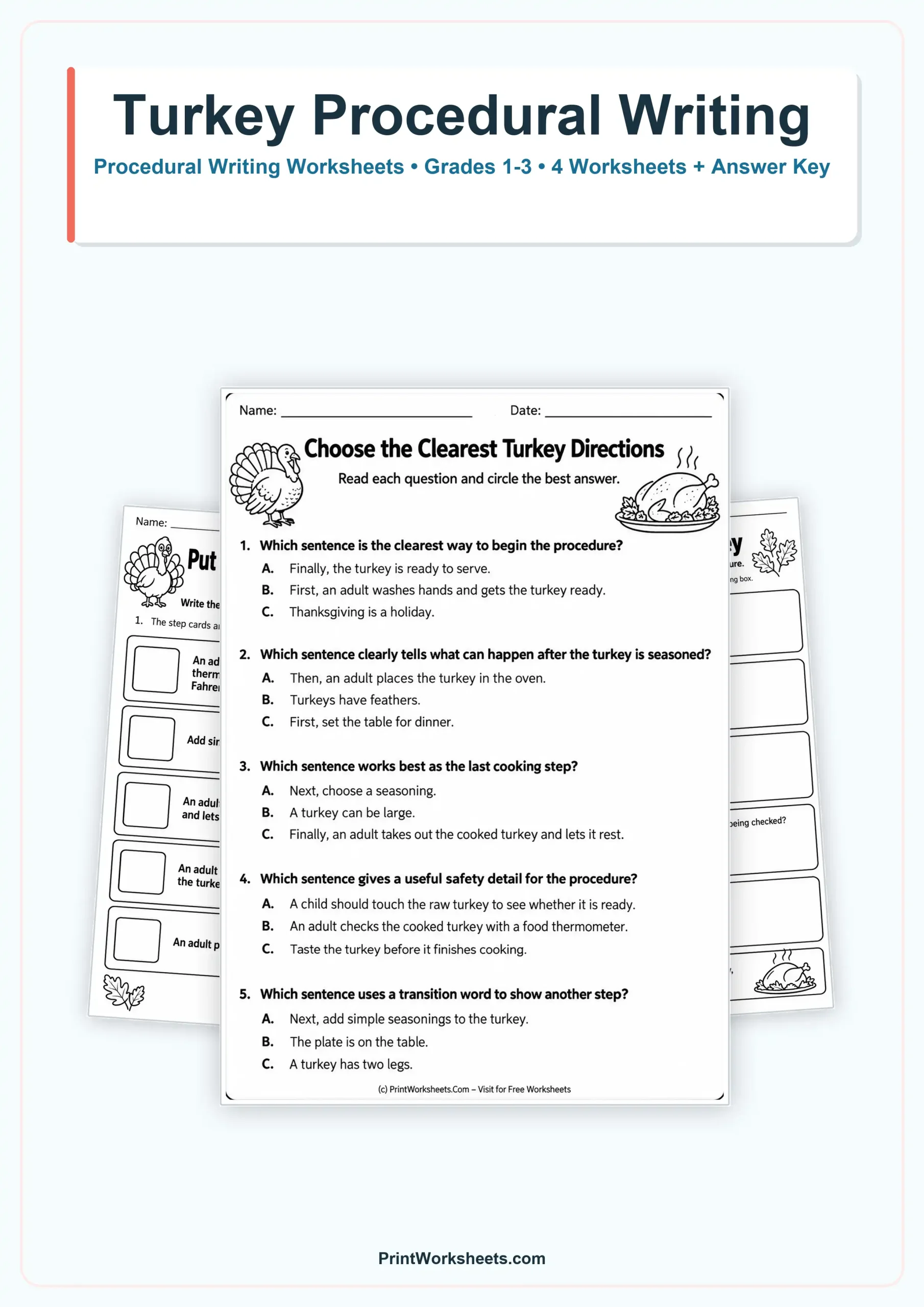
This turkey procedural writing worksheet set helps first through third grade students move from understanding an ordered process to writing one themselves. Instead of asking children to begin with a blank page, the printable pack starts with concrete turkey-cooking steps, then builds toward choosing clear directions, organizing ideas with transition words, and producing a complete how-to response. The Thanksgiving theme keeps the writing task familiar while the activities stay focused on sequence, clarity, and safe adult-led cooking actions.
Turkey Procedural Writing Practice in Four Steps
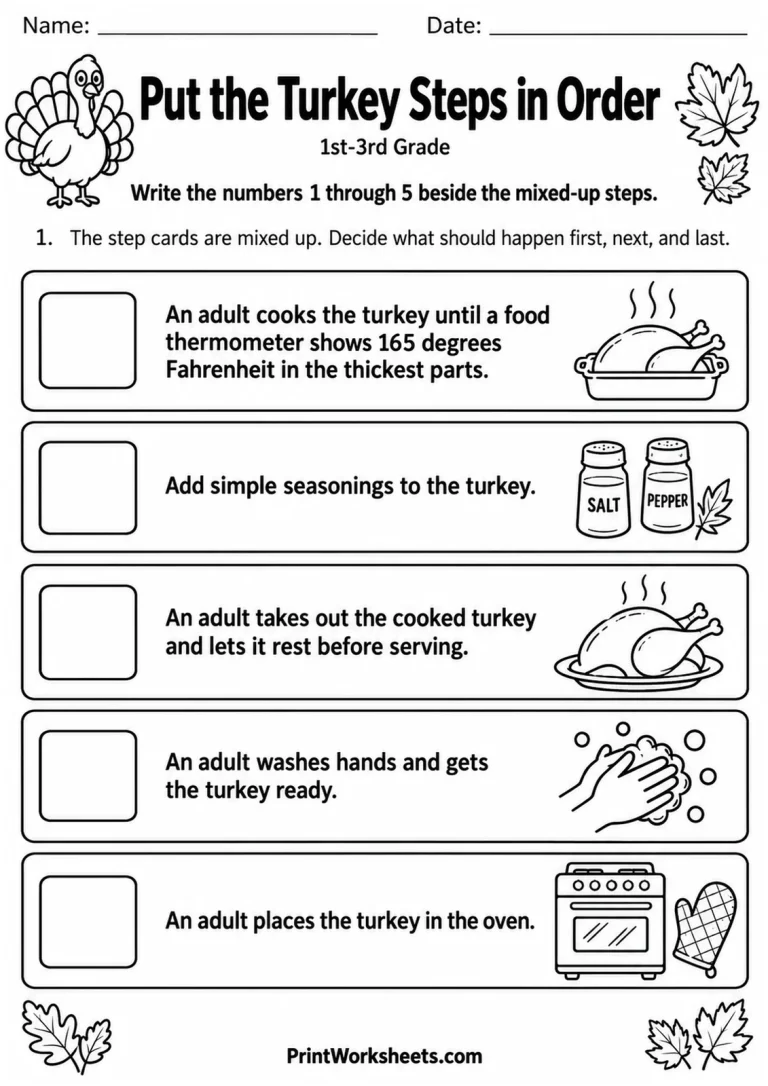
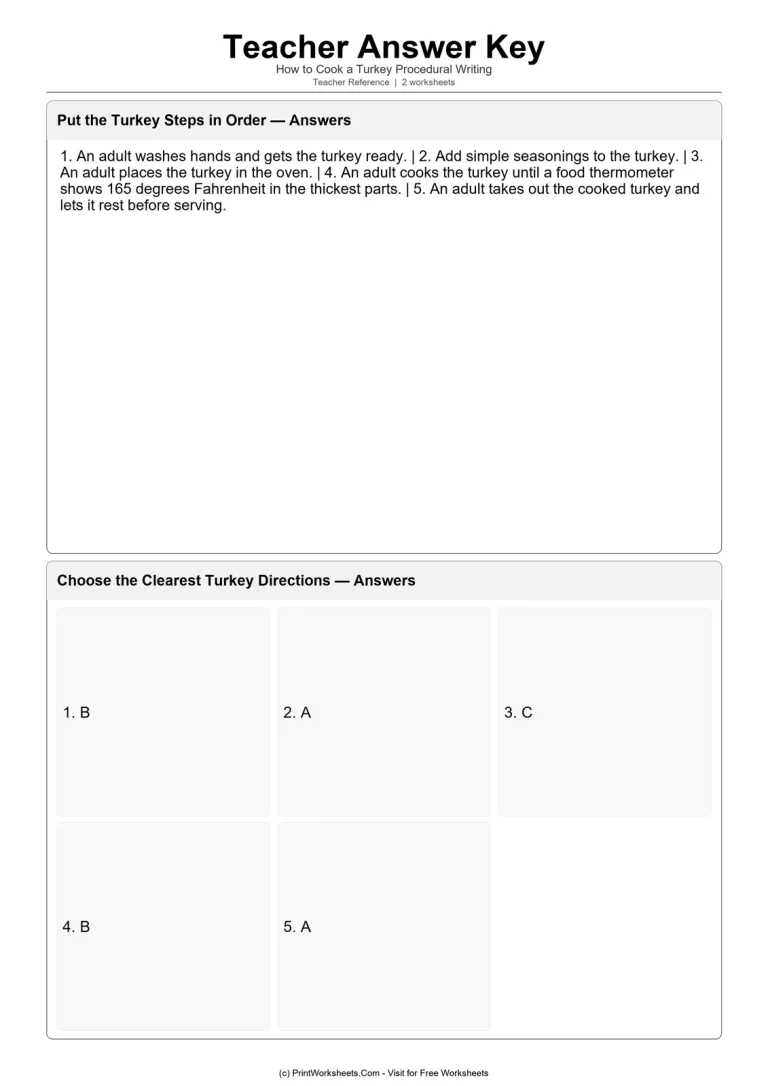
The first worksheet, Put the Turkey Steps in Order, gives students five mixed-up actions and asks them to number the steps from 1 through 5. The sequence begins with an adult washing hands and getting the turkey ready, continues through seasoning and placing the turkey in the oven, and includes cooking until a food thermometer shows 165 degrees Fahrenheit in the thickest parts. The final step has an adult remove the cooked turkey and let it rest before serving. Because every action belongs to the same process, students must think about what logically happens first, next, and last rather than simply matching unrelated statements.
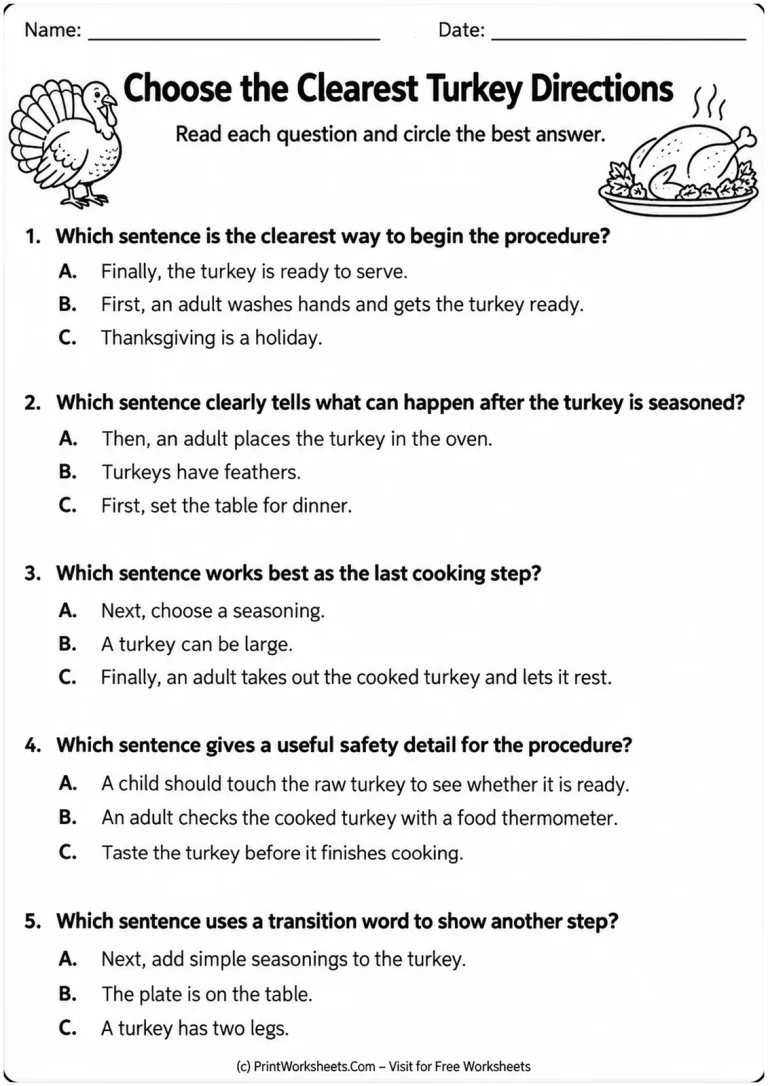
The second page changes the format with five multiple-choice questions. Students decide which sentence best begins the procedure, what can happen after seasoning, which sentence works as the final cooking step, which detail gives useful safety information, and which sentence uses a transition word correctly. Choices such as First, Then, Next, and Finally reinforce language that readers depend on when following directions. This makes the page useful for both reading comprehension and writing instruction because children practice recognizing the features of effective procedural text before they are expected to create their own.
Plan Before Writing the Full Procedure
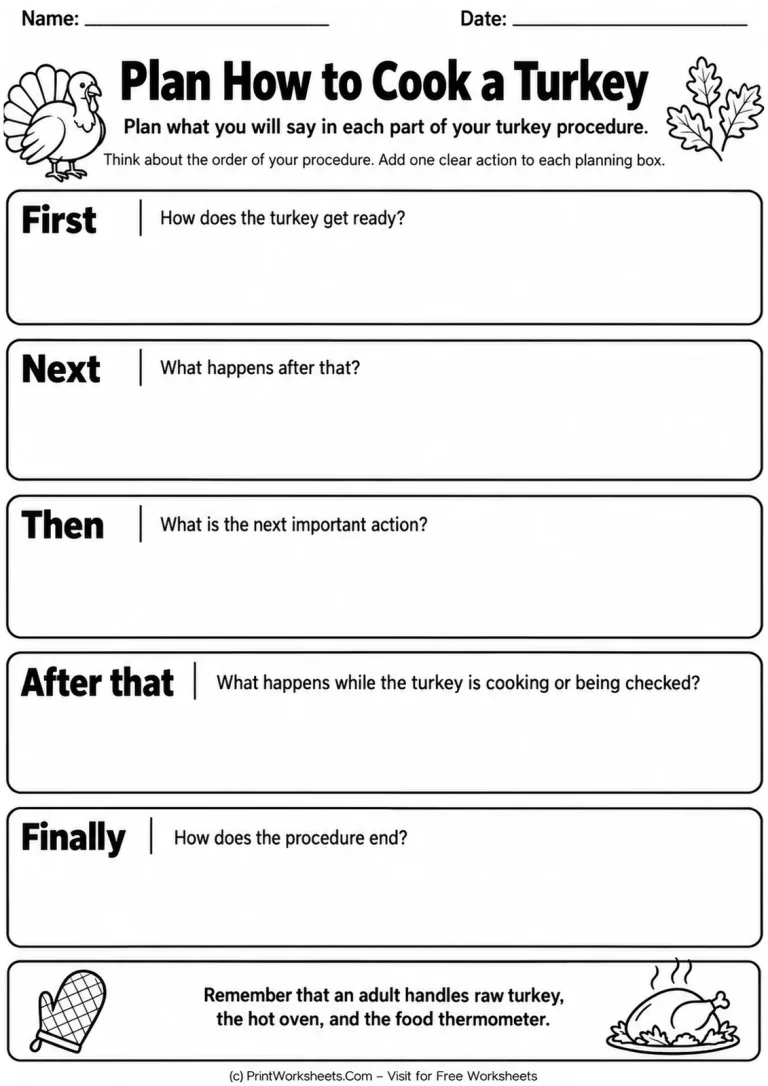
The third worksheet is a five-part planning page titled Plan How to Cook a Turkey. Large writing boxes are labeled First, Next, Then, After that, and Finally. Short prompts guide students to decide how the turkey gets ready, what happens after that, what important action comes next, what happens while the turkey is cooking or being checked, and how the procedure ends. The layout gives young writers a visible structure for organizing ideas and reduces the chance that they will skip an important part of the sequence.
A safety reminder at the bottom of the planner states that an adult handles the raw turkey, the hot oven, and the food thermometer. That detail is especially useful for elementary learners because it allows the worksheet to discuss a real cooking process without suggesting that children should perform unsafe kitchen tasks themselves. Teachers and parents can keep the lesson centered on procedural language while clearly separating student writing practice from adult cooking responsibilities.
From Transition Words to Independent How-To Writing
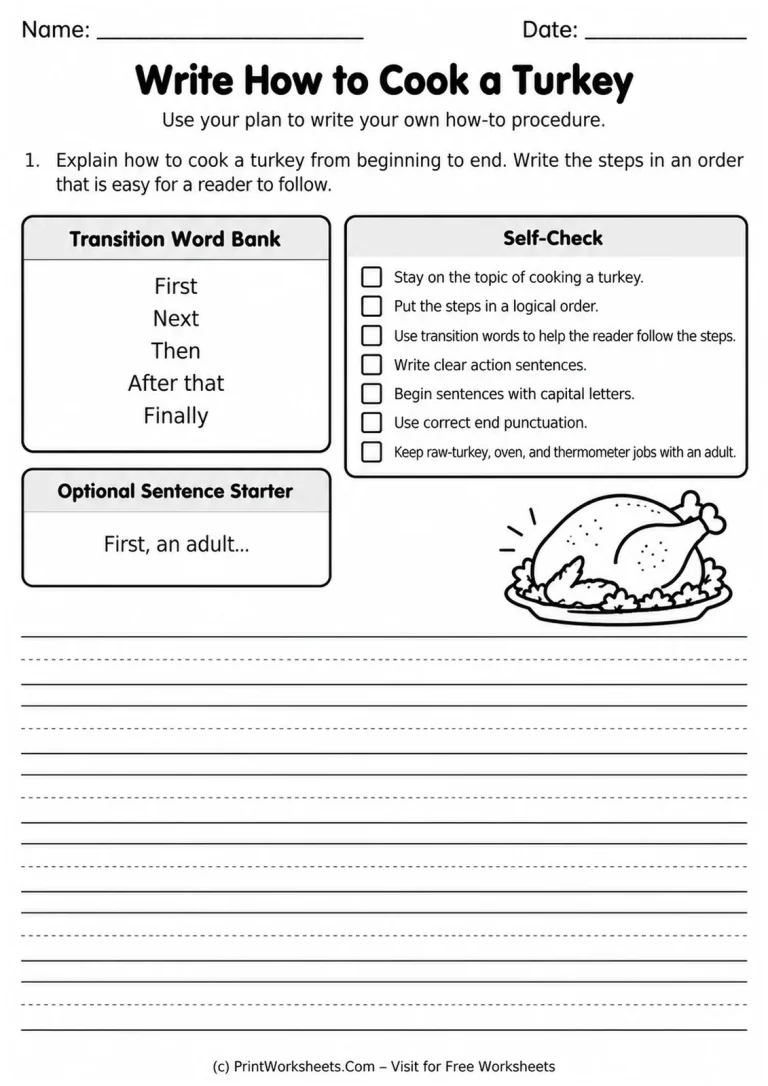
The final student page, Write How to Cook a Turkey, asks learners to explain the procedure from beginning to end in an order that is easy for a reader to follow. A transition word bank provides First, Next, Then, After that, and Finally, and an optional sentence starter gives extra support to students who need help getting started. The page then provides extended lined space for a complete response rather than limiting students to isolated sentences.
A built-in self-check turns the writing page into a simple revision tool. Students can confirm that they stayed on the topic, arranged steps logically, used transition words, wrote clear action sentences, began sentences with capital letters, and used correct end punctuation. The final checklist item reminds writers to keep raw-turkey, oven, and thermometer jobs with an adult. These checks give teachers a practical bridge from drafting to editing without requiring a separate rubric for a short classroom assignment.
Ways to Use These Thanksgiving Writing Worksheets
This set can work as a short Thanksgiving ELA sequence across several days or as a focused writing center. One option is to complete the sequencing page as a whole-class warm-up, use the multiple-choice page for guided discussion about clear directions, and then let students complete the planner independently. The finished plan can be carried directly into the final writing page. Stronger writers can add more detail to each stage, while developing writers can rely on the visible transition words and sentence starter.
The included teacher answer key covers the objective sequencing and multiple-choice activities, making quick checking easy. The planner and final composition remain open-ended so students can show their own understanding while still following the same logical procedure. For Thanksgiving literacy lessons, this combination of ordering, reading, planning, drafting, and self-checking makes the printable more useful than a single one-page prompt. Print the full set when you want a connected mini-unit, or choose individual pages for review, centers, homework, or small-group writing support.