These Thanksgiving writing prompts give students in Grades 1-3 several ways to turn seasonal ideas into complete sentences and short pieces of meaningful writing. Across four printable worksheets, children move from highly supported picture responses to sentence starters, explanation writing, and practical tasks such as a thank-you note and friendly invitation. The changing level of support makes the set useful when students need help generating an idea as well as when they are ready to write more independently.
Thanksgiving Writing Prompts That Build Ideas Step by Step
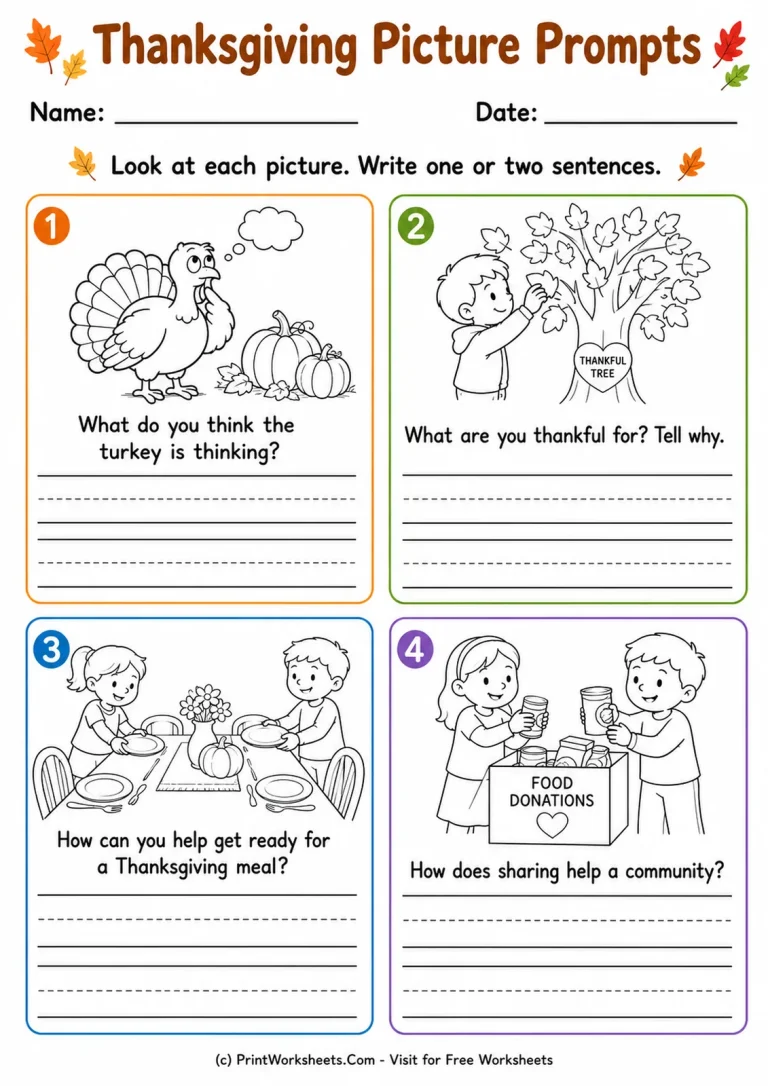
The first worksheet, Thanksgiving Picture Prompts, starts with visual support. Students study four Thanksgiving-themed scenes and write one or two sentences about each. One prompt asks them to imagine what a turkey might be thinking beside pumpkins. Another uses a Thankful Tree to help children name something they appreciate and explain why. Additional scenes focus on helping prepare a Thanksgiving meal and on food donation as a way to help a community. These concrete pictures give young writers a clear starting point without limiting them to a single correct response.
This page works especially well for students who can speak about an idea but hesitate when a blank writing space appears. Teachers can first invite students to describe the picture aloud, identify one important detail, and then turn that thought into a sentence. More confident writers can add a second sentence that explains a feeling, reason, or action.
From Sentence Starters to Complete Explanations
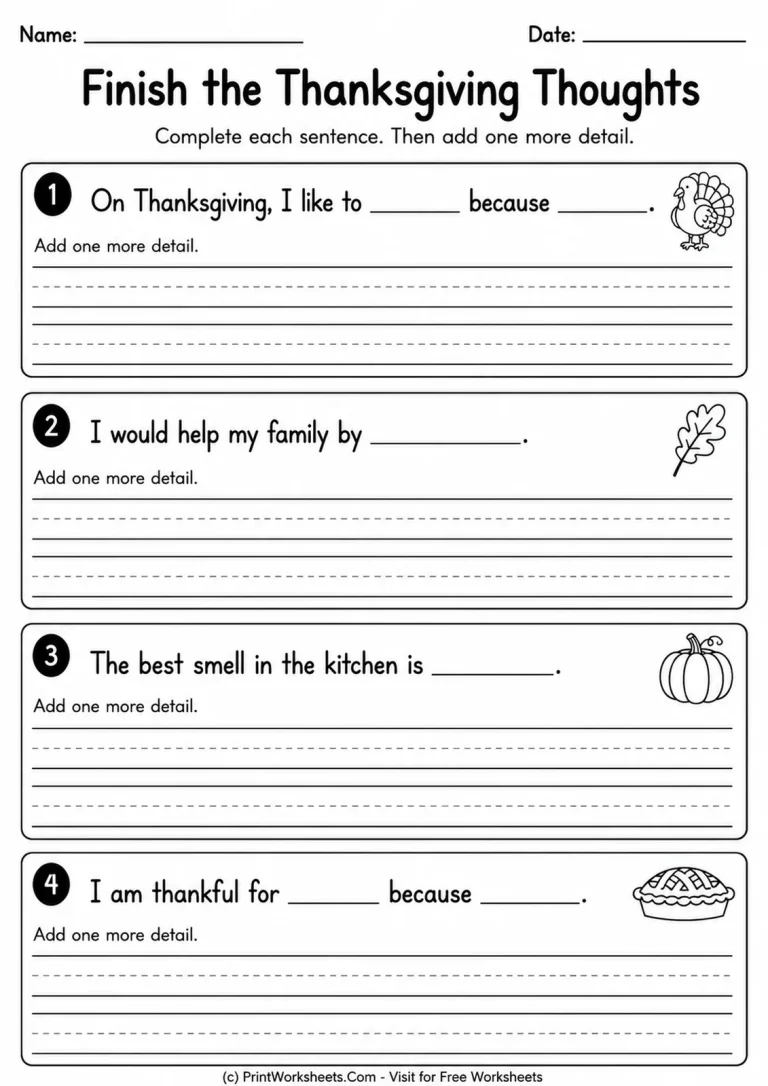
The second worksheet, Finish the Thanksgiving Thoughts, shifts from pictures to sentence completion. Four starters ask students to write about a favorite Thanksgiving activity, a way they help their family, a smell they notice in the kitchen, and something they are thankful for. Each response also requires one additional detail. That small second step is important because students are not simply finishing a phrase; they are practicing how writers expand an idea.
For example, a child may first complete a sentence about helping set the table and then add a detail about placing plates or napkins. Teachers can use this format to model the difference between a basic sentence and a more informative response. It also provides a manageable way to practice capitalization, ending punctuation, and logical detail without turning the activity into a long composition.
Choice-and-Explain Writing for Complete Sentences
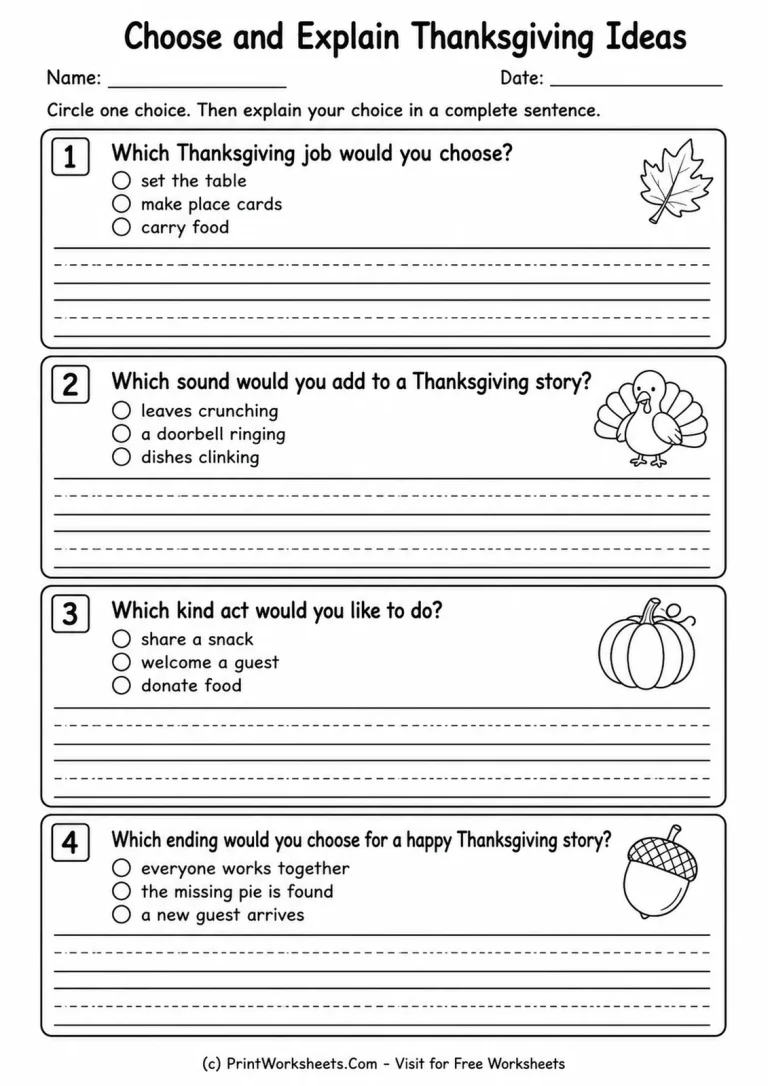
The third worksheet adds decision-making. In Choose and Explain Thanksgiving Ideas, students select one of three options for each question and then explain the choice in a complete sentence. Topics include choosing a Thanksgiving job, imagining a sound for a story, identifying a kind action, and selecting a happy story ending. Because students receive possible ideas before writing, they can concentrate on explaining why they made a choice.
This format is useful for introducing simple opinion and reasoning language. Encourage students to use connectors such as because when appropriate or to add a specific example after their first sentence. For Grade 1, the choice itself can reduce the challenge of idea generation. Students in Grades 2 and 3 can extend the explanation with an additional reason or descriptive detail.
Real-Life Thanksgiving Writing Tasks
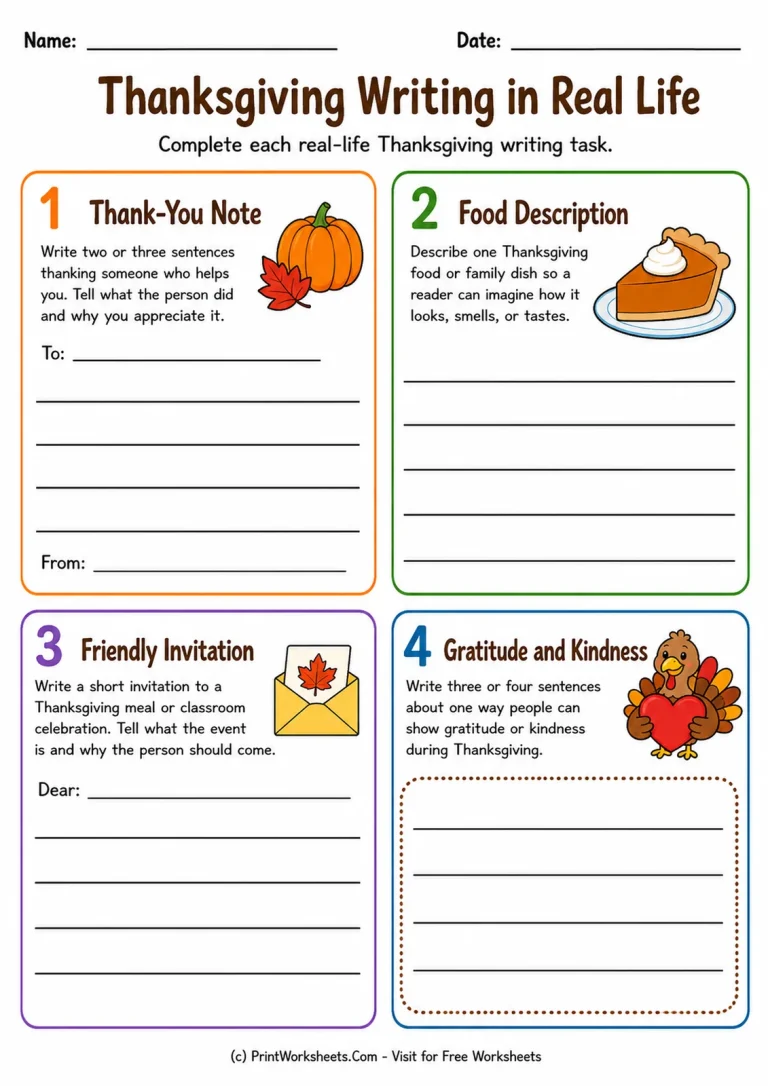
The fourth worksheet, Thanksgiving Writing in Real Life, gives the set a practical finish. Students write a thank-you note, describe a Thanksgiving food, create a friendly invitation, and respond to a prompt about gratitude or kindness. Each section provides a clear purpose and dedicated writing space, helping students see that writing is used to communicate with real people as well as to complete classroom exercises.
The thank-you note can reinforce audience and polite language. The food description invites sensory vocabulary about appearance, smell, taste, or texture. The invitation gives students a reason to include useful details, while the gratitude or kindness response encourages personal reflection. Younger writers may benefit from a shared example before beginning this page, while older students can work more independently and revise for clarity.
Ways to Differentiate the Four Worksheets
Use the pages selectively rather than requiring every student to begin at the same point. A developing writer might start with the picture prompts and orally rehearse each sentence with a partner. A student who needs moderate support can use the sentence starters or choice-and-explain page. Writers ready for more independence can begin with the real-life tasks and add two or three supporting sentences where space permits.
For additional seasonal practice for younger learners, the Canadian Thanksgiving worksheets for 1st Grade provide another Thanksgiving-themed option. Kindergarten students who need an even earlier entry point can also use the Canadian Thanksgiving worksheets for Kindergarten.
Teaching Notes, Extensions, and Exit Tickets
Before students write, spend a minute collecting Thanksgiving vocabulary connected to family, food, gratitude, helping, community, and celebration. Keep the word bank visible so spelling does not become the main barrier to expressing an idea. During writing, ask students to reread each response and check for a capital letter, a complete thought, and ending punctuation.
As an extension, students can choose one response from any worksheet and expand it into a short paragraph with a beginning sentence, two details, and a closing thought. For a quick exit ticket, ask students to write one sentence naming something they are thankful for and a second sentence explaining why. This keeps the final task closely connected to the skills practiced throughout the set: generating an idea, writing a complete sentence, and adding a meaningful detail.