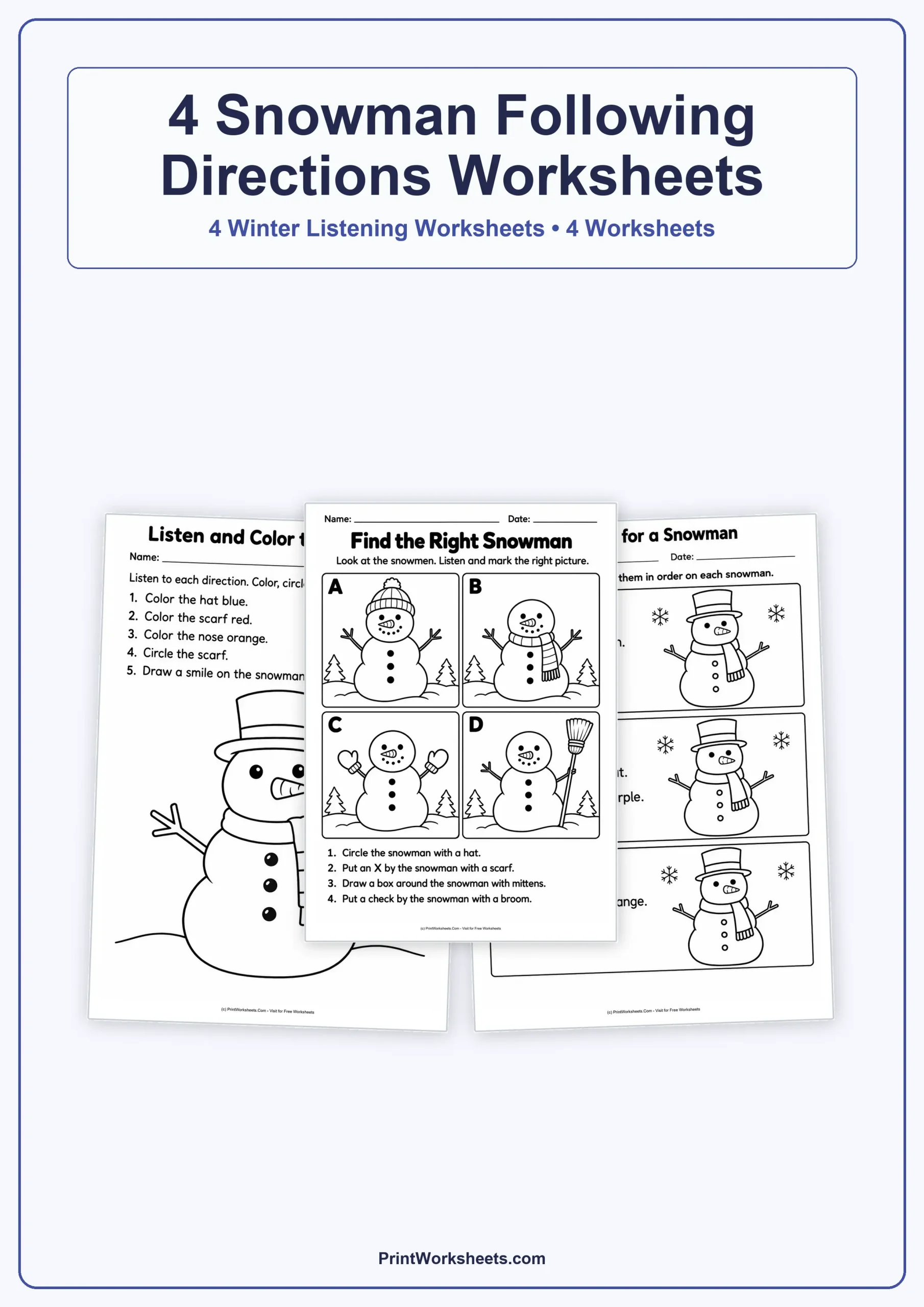
Snowman following directions worksheets give young learners a playful way to practice listening carefully and responding to instructions. This four-page winter printable set moves beyond ordinary coloring activities: children identify details, follow spoken directions, complete two-step tasks, and place marks in specific positions around a snowman. Designed for preschool, kindergarten, and early first grade, the activities work especially well when an adult reads the instructions aloud and children complete each action independently.
What’s Inside These Snowman Following Directions Worksheets?
Each worksheet introduces a different challenge while keeping the familiar snowman theme. The pages use clear black-and-white illustrations, simple actions, and recognizable winter accessories. Children can use crayons, pencils, or markers, depending on the activity.
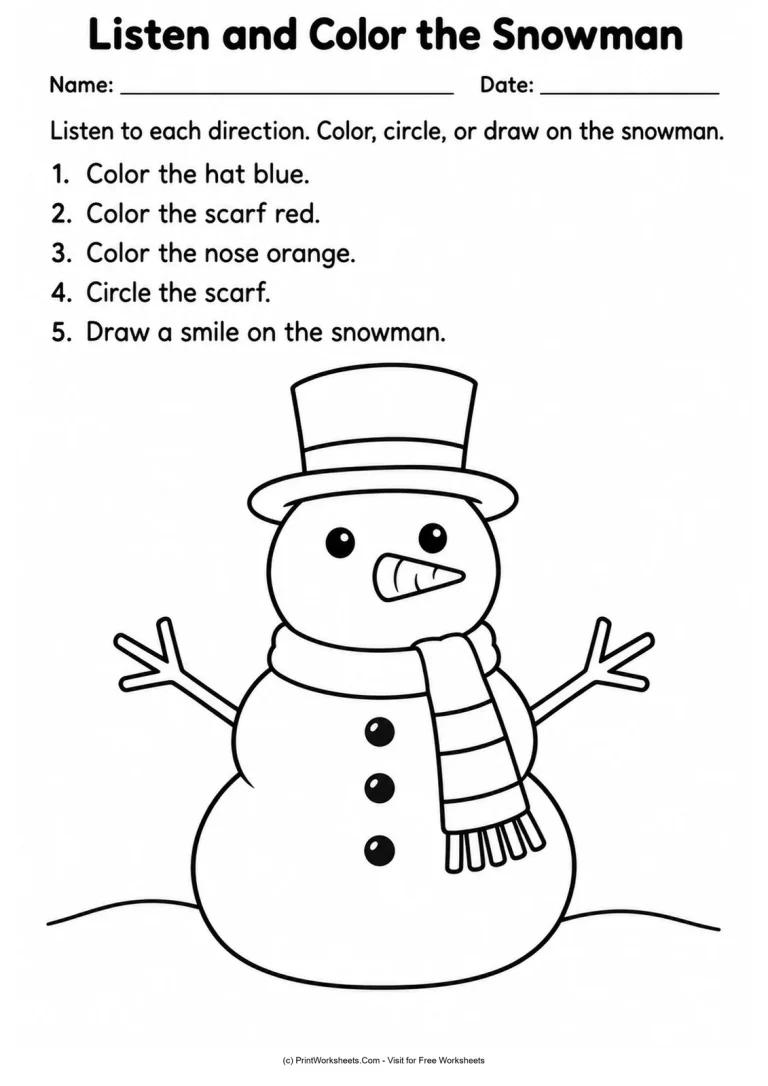
Page 1: Listen and Color the Snowman
The first worksheet features one large snowman wearing a tall hat and scarf, with a carrot nose and buttons. Children listen to five short directions. They color the hat blue, the scarf red, and the nose orange. Next, they circle the scarf and draw a smile on the snowman’s face. This page is a useful introduction because children must distinguish between different actions: coloring, circling, and drawing. The large illustration also provides generous space for young learners who are still developing pencil control.
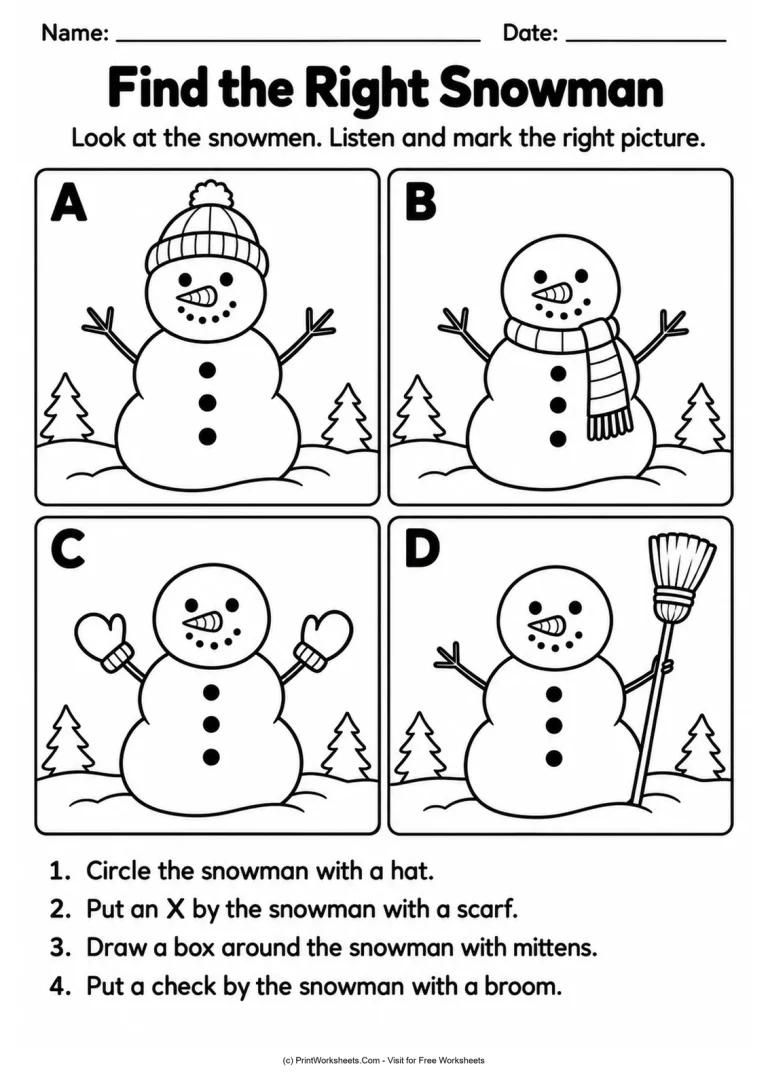
Page 2: Find the Right Snowman
Four snowmen appear in separate boxes labeled A, B, C, and D. Although the characters share similar body shapes, each has a different distinguishing accessory. One wears a winter hat, another has a scarf, one has mittens, and the last holds a broom. Children listen and circle the snowman with a hat, place an X beside the snowman with a scarf, draw a box around the snowman with mittens, and add a check beside the snowman with a broom. This task combines careful observation with choosing the correct marking action.
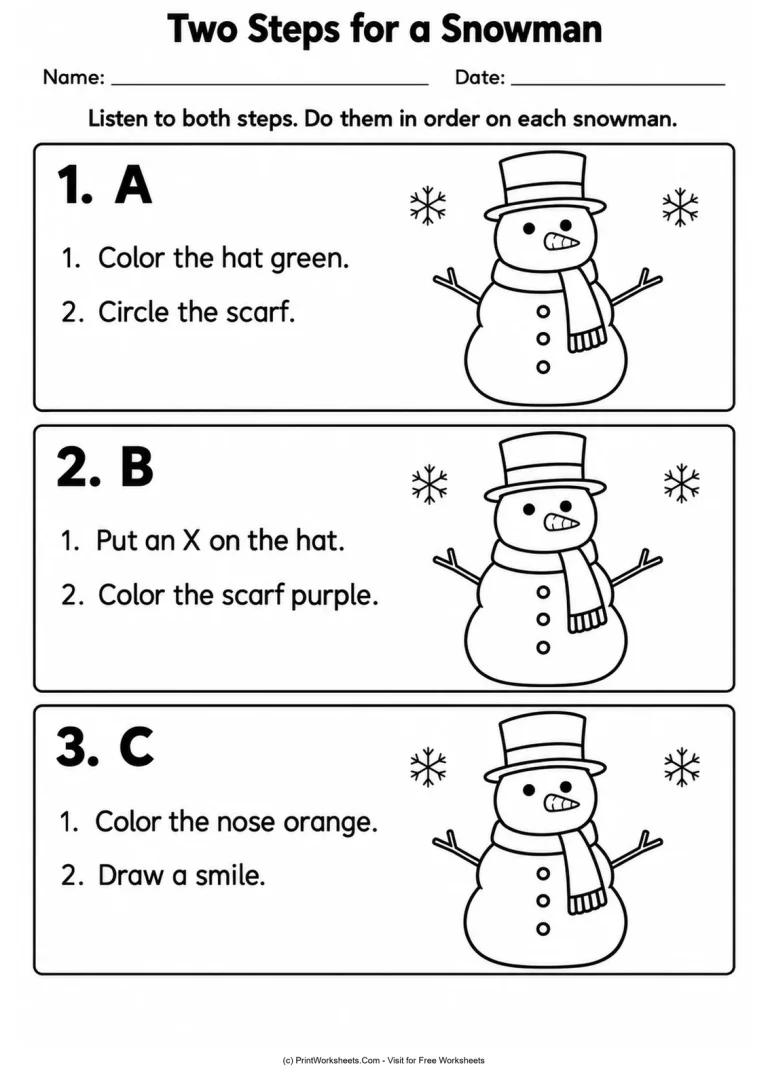
Page 3: Two Steps for a Snowman
The third printable increases the challenge with three separate two-step activities. Each section includes its own snowman illustration and two numbered instructions. In the first section, students color the hat green and circle the scarf. In the second, they mark the hat with an X and color the scarf purple. The last section asks them to color the nose orange before drawing a smile. Students practice remembering two directions, completing them in order, and paying attention to the difference between coloring and marking.
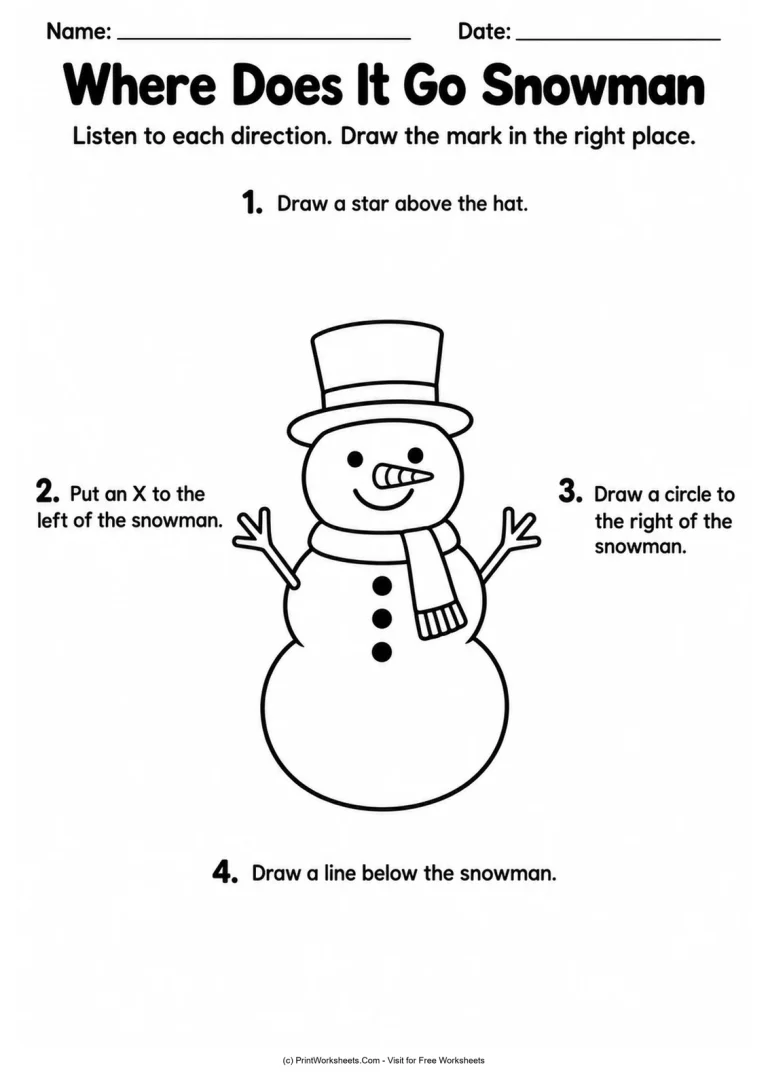
Page 4: Where Does It Go Snowman?
The final worksheet introduces important position words using one central snowman. Children draw a star above the hat, put an X to the left of the snowman, draw a circle to the right, and make a line below the snowman. Instead of choosing an existing picture, students must decide where each new mark belongs. This creates a practical opportunity to check their understanding of above, left, right, and below.
Listening and Following Directions Skills
These winter activities target several connected early learning skills. Children practice recognizing the object mentioned in a direction, understanding the action they need to perform, and checking that they have completed the task correctly. The set also introduces color vocabulary, winter clothing words, visual discrimination, sequential listening, and spatial language.
The sequence offers a natural increase in difficulty. Children begin by responding to individual instructions on one picture, then identify the correct picture among several possibilities. After that, they hold two directions in mind before applying location words to a larger illustration. Teachers can use the pages separately or in order, depending on the students’ confidence and attention span.
How to Use the Worksheets in the Classroom
Start by giving each child the first worksheet and the required coloring supplies. Read the direction line aloud, then repeat the first numbered instruction at a comfortable pace. Give children time to complete the action before moving to the next instruction. For students who are new to listening activities, briefly review the words hat, scarf, and nose before starting.
On the picture-identification page, encourage students to examine all four snowmen before making a mark. Remind them that circling, drawing a box, placing an X, and adding a check are different tasks. This helps children focus on the entire instruction rather than only the accessory being named.
For the two-step page, read both steps before children begin if they are ready for a memory challenge. If they need more support, read one instruction at a time, gradually building toward completing both independently. On the position-word page, use gestures or familiar classroom objects to introduce left and right before beginning the printable.
Ideas for Different Learning Levels
Preschool learners may benefit from having each direction repeated and from completing one action at a time. Kindergarten students can try listening to the full direction before touching their crayons. First graders who are becoming independent readers can read the printed instructions themselves, then check whether their finished pictures match each sentence.
For a small-group activity, ask children to explain what they need to do before completing a direction. You can also invite students to describe the location of their marks using full sentences, such as placing a star above the hat. This connects listening comprehension to speaking practice without requiring extra worksheets.
Free Printable Winter Listening Practice
Use these four snowman pages during a winter literacy center, morning work period, small-group lesson, homeschool session, or listening-skills activity. Print the full set for a gradual progression or select the page that matches your current teaching goal. With coloring, picture identification, two-step directions, and positional drawing tasks, the set offers several distinct ways to help children practice listening and acting on instructions.