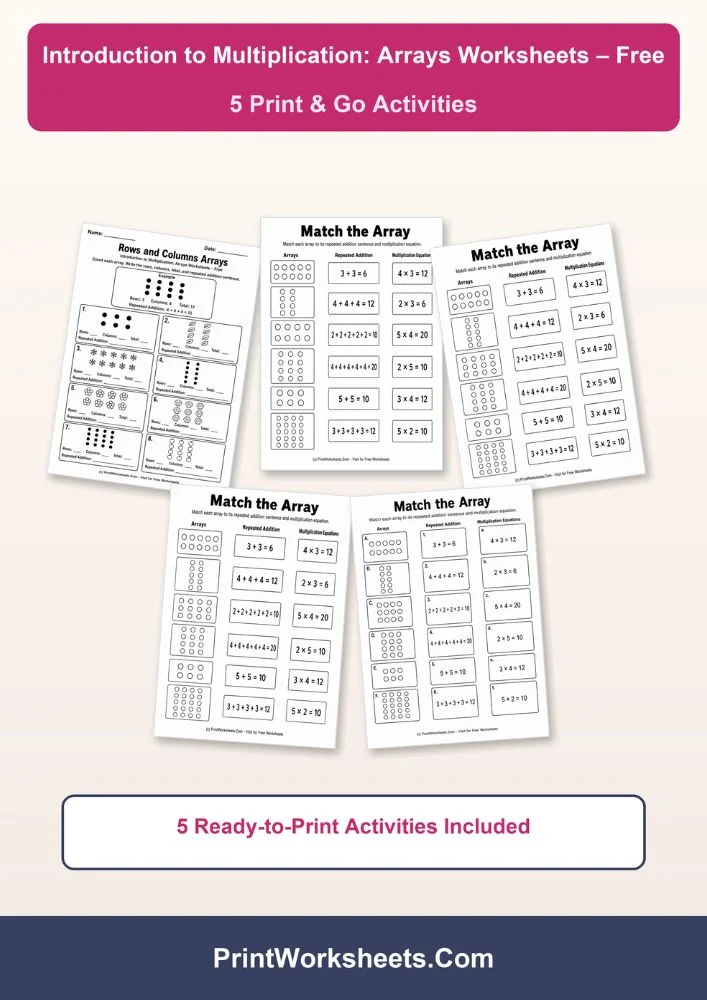
Printable introduction to multiplication arrays worksheets provide the essential visual foundation early elementary students require when transitioning from basic arithmetic to advanced times tables. Moving from standard addition into multiplication is a massive cognitive leap for second and third graders. If educators simply demand rote memorization of multiplication facts without explaining the underlying concept of grouping, students will inevitably struggle with advanced math logic. Providing a targeted, no-prep PDF worksheet pack completely eliminates this abstract confusion by utilizing structured rows and columns. By prompting young learners to interact with highly organized visual groupings, educators ensure that the core concepts of repeated addition and equal groups are deeply understood before introducing standard algorithms.
Educators and parents consistently deploy these visual arithmetic bundles into daily math centers, morning review routines, and focused tutoring interventions. Building a comprehensive curriculum for transitioning learners requires continuous exposure to concrete visual groupings. We highly encourage pairing this specific introductory packet with the rigorous, leveled resources found in our main multiplication worksheets category. Ensuring a rock-solid understanding of spatial arrays is the absolute most important step before requiring students to memorize their times tables.
Inside the Multiplication Arrays PDF Pack
Designing effective introductory math materials requires explicitly connecting what a student already knows (addition) to what they are currently learning (multiplication). Utilizing large, easy-to-read formatting and highly recognizable seasonal graphics ensures the student focuses entirely on the structural concept of grouping. Each activity page within this bundle serves a specific, tiered pedagogical purpose:
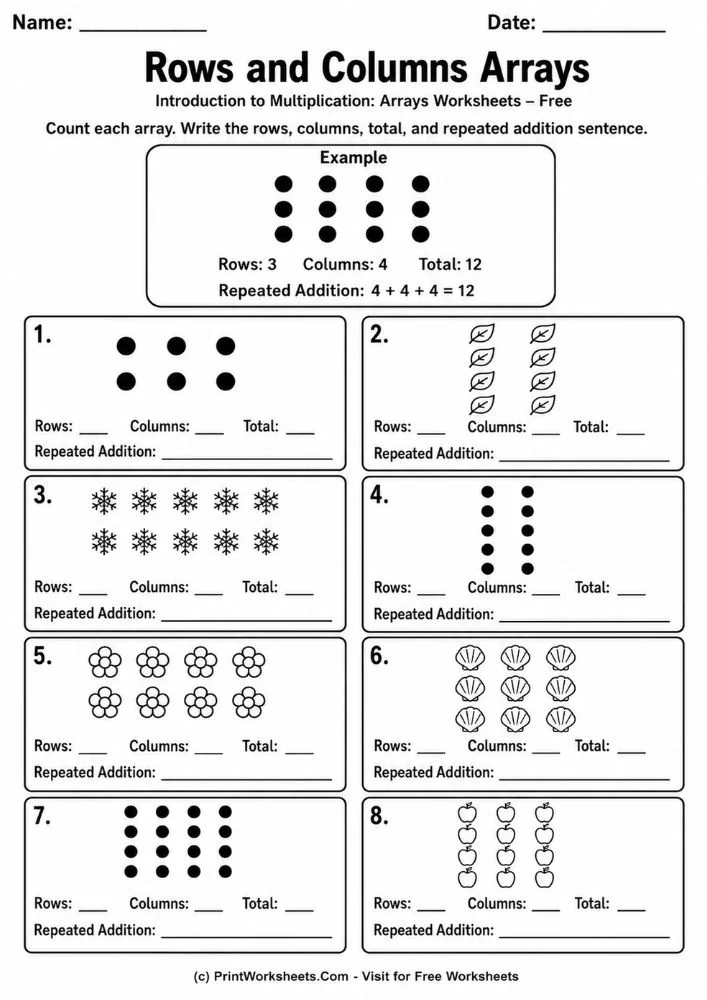
- Rows and Columns Arrays: An incredibly intuitive introduction to spatial mathematics. Children view organized grids of familiar items (dots, leaves, snowflakes, shells). The worksheet provides explicit visual scaffolding, asking the student to count the horizontal rows, count the vertical columns, write the total sum, and then build the repeated addition sentence (e.g., 4 + 4 + 4 = 12). This explicitly proves that multiplication is simply adding the same number multiple times.
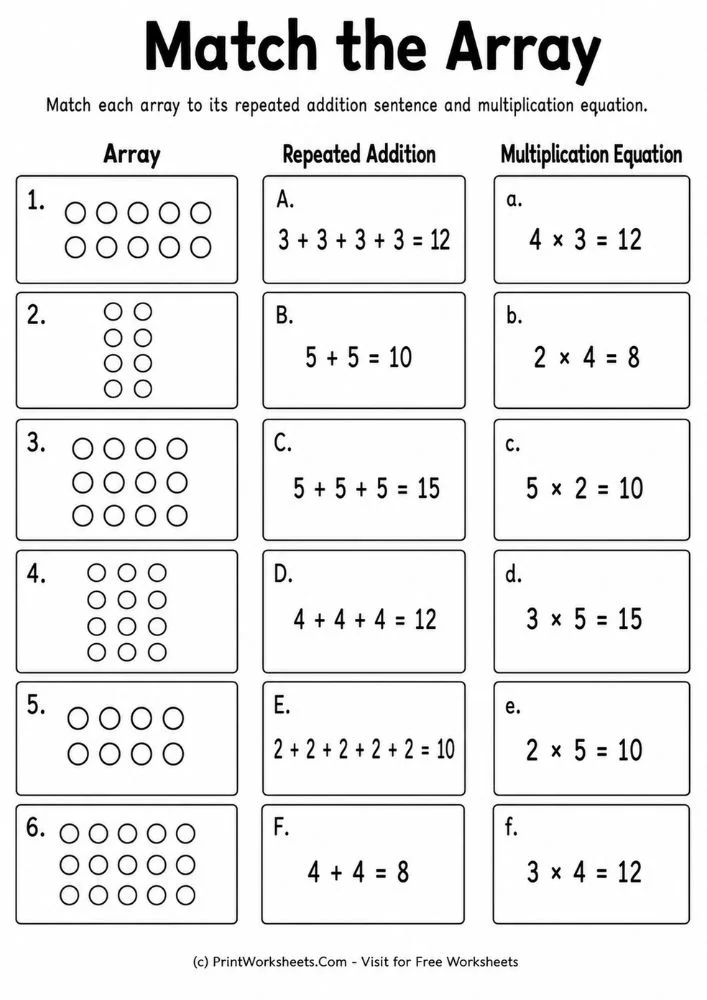
- Match the Array: A crucial cognitive assessment pushing students to connect visual data to abstract equations. Children examine a column of circular arrays. They must draw a line matching the visual array to its corresponding repeated addition sentence in the middle column, and then draw another line connecting it to the formal multiplication equation in the third column (e.g., connecting a 4×3 array to “3 + 3 + 3 + 3 = 12” and then to “4 x 3 = 12”).
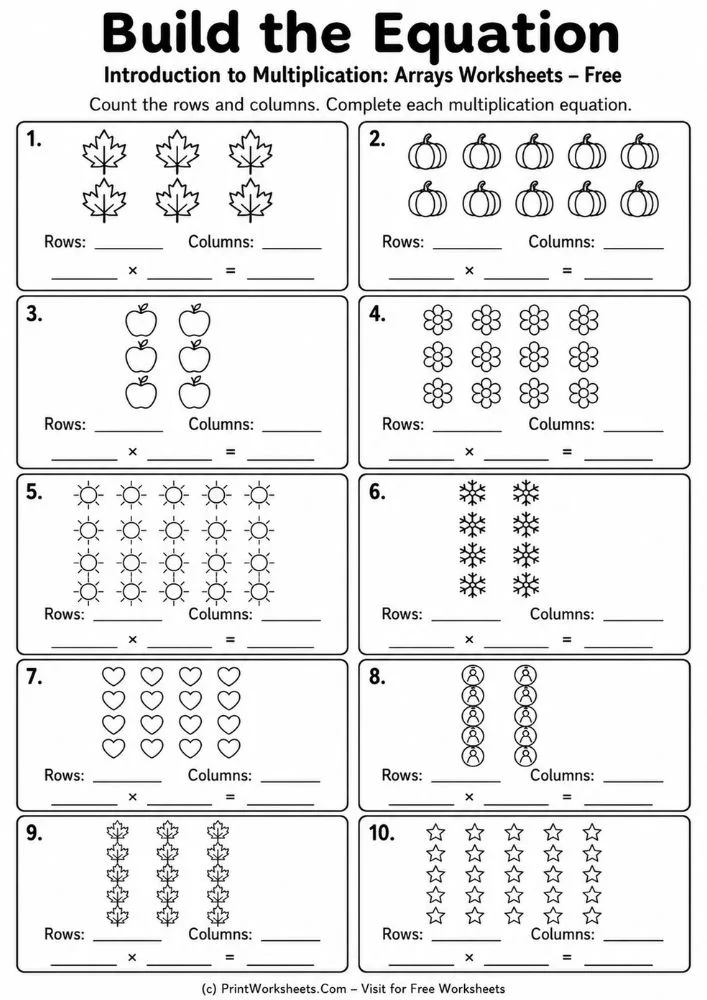
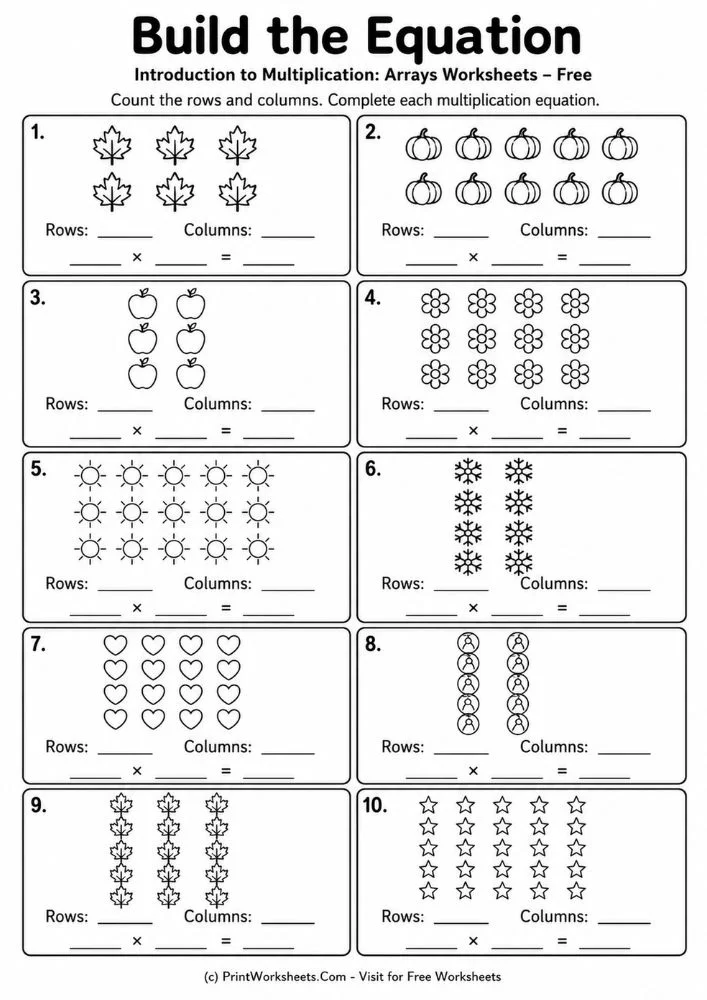
- Build the Equation: An independent practice assessment. After mastering the guided worksheets, students must independently count the rows and columns of various items (pumpkins, suns, apples) and directly translate that visual data into a formal multiplication equation (___ x ___ = ___), bridging the gap between counting and formal multiplication.
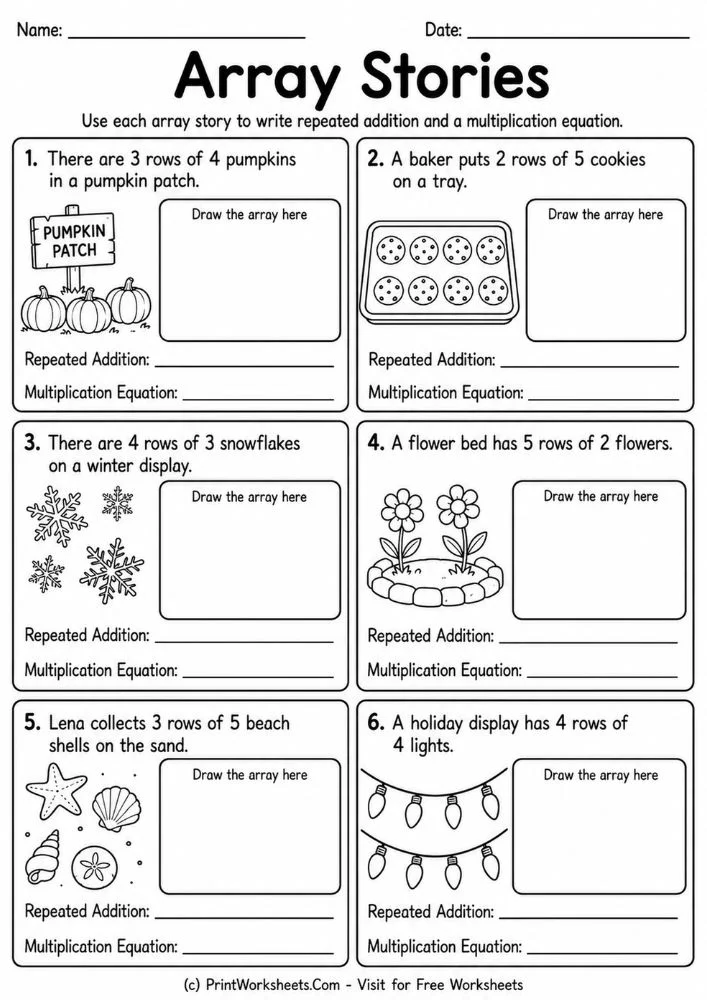
- Array Stories: A highly interactive application of abstract numbers. Instead of just looking at pre-drawn arrays, students read real-world word problems (e.g., “A baker puts 2 rows of 5 cookies on a tray”). They must physically draw the array inside the blank box, write the repeated addition sentence, and write the final multiplication equation. Drawing the math completely eliminates word problem anxiety.
Practical Classroom and Home Implementation
Download the high-resolution file and print the entire PDF directly on standard 8.5″ x 11″ copy paper. Because early learners thrive on tactile, hands-on feedback, utilizing these worksheets alongside actual, physical manipulatives yields incredible classroom results. When introducing the “Rows and Columns Arrays” page, provide the student with a handful of small items like buttons, cereal pieces, or small candies. Have the child physically build the array on their desk before filling out the worksheet. Physically touching “3 rows of 4” cements the concept in their brain permanently.
To maximize the effectiveness of the “Array Stories” worksheet, provide the student with different colored crayons or colored pencils. Instruct them to draw their rows and columns meticulously, ensuring their drawn arrays actually look like organized grids rather than messy piles. This spatial discipline is critical for their mathematical development and prevents counting errors.
Frequently Asked Questions
Why are arrays so important for teaching early multiplication?
Young children operate in a concrete learning stage; they need to see and process physical quantities before they can understand abstract math sentences. If a child simply memorizes “4 x 5 = 20,” they do not actually understand what the numbers mean. However, when they see an array of 4 rows and 5 columns, their brain actively processes that multiplication is simply a fast way of counting equal groups. Arrays provide the visual proof that makes times tables make sense.
What is the easiest way to explain rows versus columns to a child?
Reversing rows and columns is the most common mistake students make. Use physical classroom examples to anchor the vocabulary. Explain that “Rows” go side-to-side, just like rowing a boat across the water or sitting in a row at a movie theater. Explain that “Columns” go up-and-down, just like the tall columns holding up a porch or a famous building. Using hand motions (sweeping left-to-right for rows, and up-and-down for columns) while reciting the definitions creates strong muscle memory.
What grade level is this arithmetic packet best suited for?
This specific PDF worksheet pack is heavily aligned with late 2nd-grade and standard 3rd-grade core math standards. Second graders are formally introduced to the concept of repeated addition and rectangular arrays as a precursor to multiplication. Third graders can utilize the entire packet at the beginning of the school year to solidify their conceptual understanding before moving into rote memorization and timed multiplication drills.