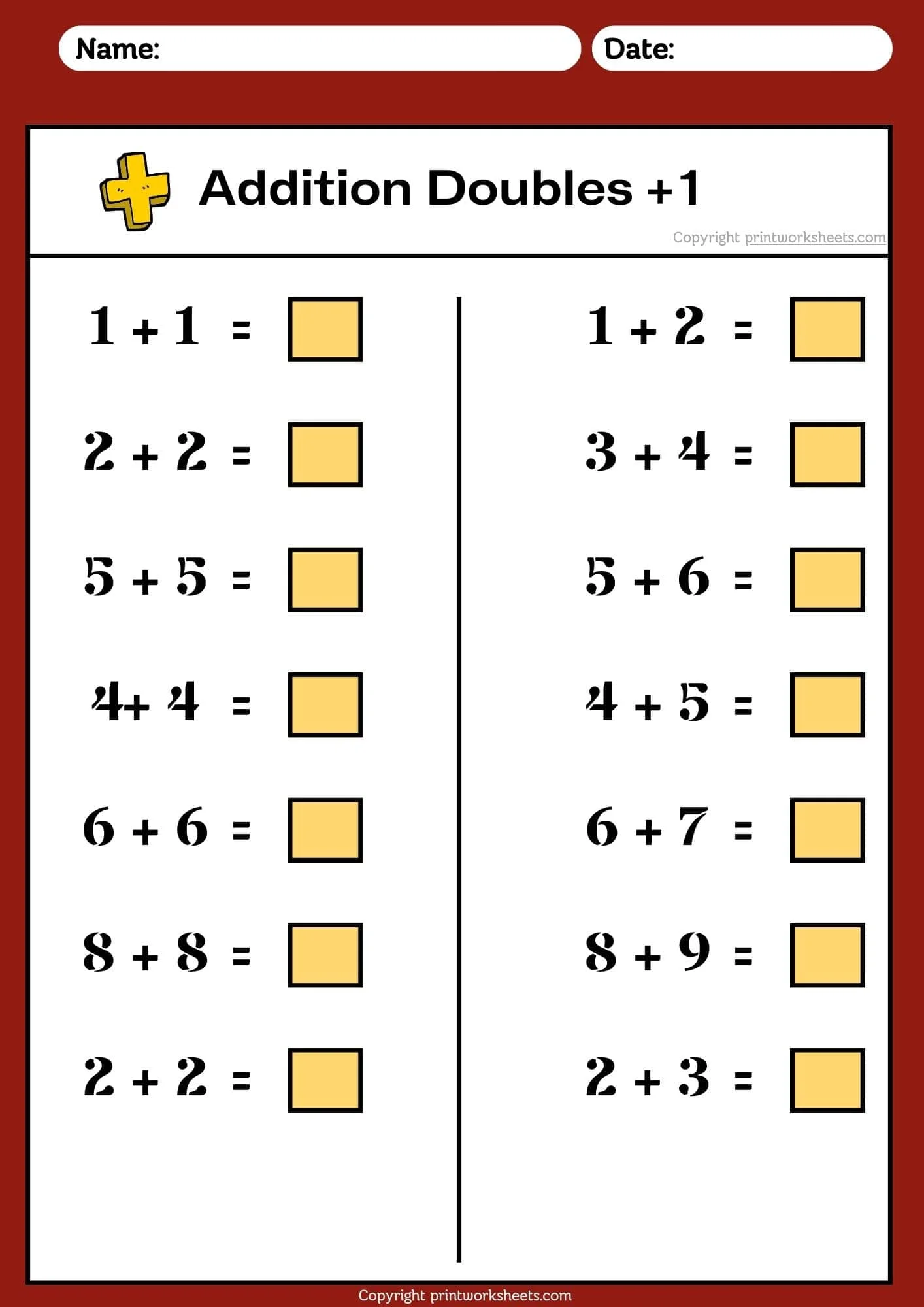


This doubles plus one addition sums to 20 worksheet helps young learners develop strong mental math strategies by introducing the “near doubles” concept. Instead of counting each number individually, students learn to use known doubles facts and adjust by one to find the correct sum.
For example, problems like 6+7 or 8+9 encourage children to recognize patterns in numbers and build quicker calculation strategies. This approach supports fluency by connecting new problems to facts students already know.
Designed for early math development, this doubles plus one addition sums to 20 resource strengthens number sense and helps learners move away from finger counting toward confident mental arithmetic. It is ideal for classroom practice, small group work, or independent review.
What is the “Doubles Plus One” Strategy?
The concept is simple but powerful: if a student knows their doubles facts (e.g., 6 + 6 = 12), they can easily solve a neighboring problem like 6 + 7 by just adding one more to the total. This strategy bridges the gap between basic memorization and active problem-solving.
These worksheets are ideally suited for students in 1st Grade Math, helping them visualize numbers and relationships rather than relying on rote counting.
Why Focus on Sums to 20?
Dealing with sums up to 20 is the core curriculum for First Grade. Mastering equations like 5+6, 7+8, or 8+9 lays the groundwork for multi-digit addition in later grades. By using our printables, children build the confidence and speed needed to tackle complex math problems without hesitation.
Related Practice Resources
To get the most out of the “Doubles Plus One” strategy, ensure your students first have a solid grasp of basic doubles. You can combine these worksheets with our other targeted resources:
- Reinforce base skills with Addition Doubles Worksheet (Sums to 20).
- Provide extra practice with Addition Doubles 10-20 (Set 1).
- Challenge advanced learners who are ready for 2nd Grade Math concepts.
Frequently Asked Questions
How do I explain Doubles Plus One to a child?
Ask the child to find the “hidden double.” For 6 + 7, ask “What double is hiding in 7?” (It’s 6 + 1). So, the problem becomes 6 + 6 + 1.
At what grade level is this strategy taught?
While some advanced Kindergarteners may grasp it, the “Doubles Plus One” strategy is a primary focus in 1st Grade and reviewed extensively in 2nd Grade.