
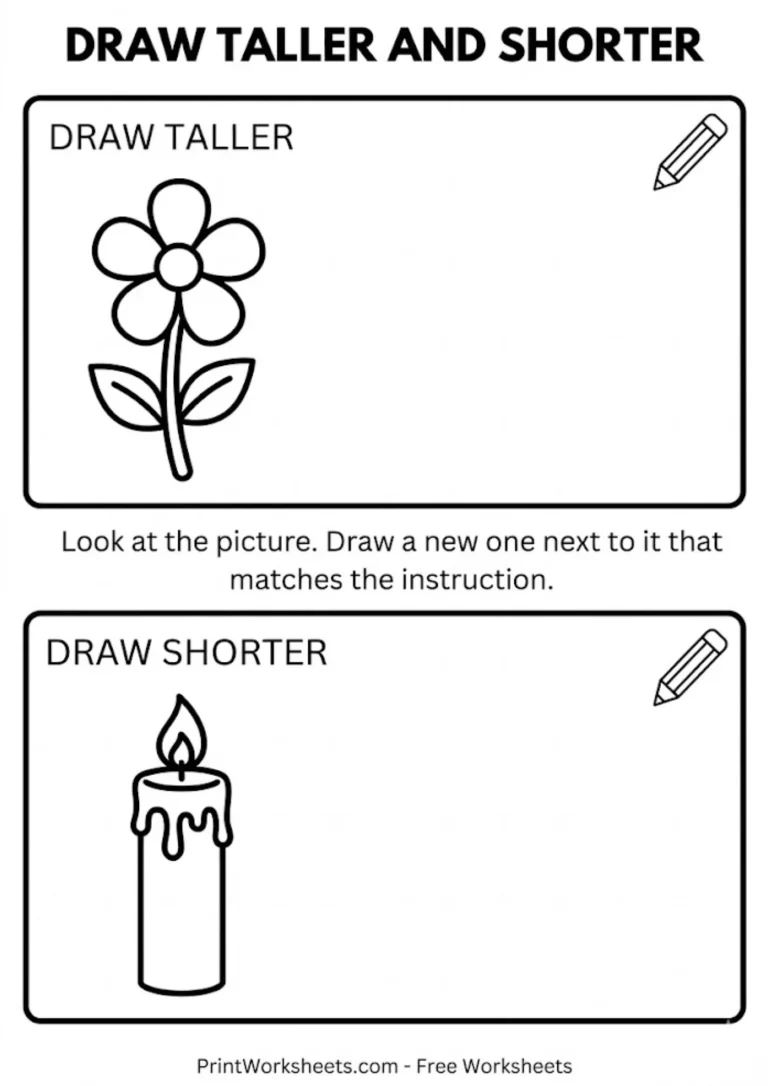
From Observation to Creation: Mastering Height Through Art Identifying height differences is a passive skill, but creating them is an active one. Our Draw Taller and Shorter Worksheet invites young learners to pick up their pencils and construct vertical relationships themselves. Unlike previous activities where students simply circled an answer, this worksheet requires them to visualize a specific height and then execute it manually. This transition from “finding” to “drawing” represents a significant leap in cognitive development and spatial awareness.
Why Drawing is Critical for Math Skills You might wonder, why include drawing in a math lesson? When a child is asked to “draw a flower taller than this one,” they are performing a complex mental calculation.
- Reference Points: They must constantly look back at the original object (the reference) to ensure their new drawing exceeds it.
- Motor Control: They must control their hand to stop the line at exactly the right moment—too short, and the answer is wrong; too long is fine for “taller,” but precision matters for “shorter.”
- Visual Planning: They learn to estimate how much space they have on the paper before they begin.
Activity Walkthrough: A Two-Part Challenge This printable PDF is carefully divided into two distinct sections to test different aspects of height comparison.
Part 1: Reaching for the Sky (Draw Taller) In the first section, students encounter objects that need to “grow.” For example, they might see a small tulip. The instruction challenges them to draw a new tulip next to it that stands taller.
- The Goal: The top of the new drawing must be vertically higher than the top of the reference image.
- Teacher Tip: Encourage students to draw a light imaginary line from the top of the first object across the page. Their new drawing must break through that ceiling!
Part 2: Shrinking Down (Draw Shorter) The second section reverses the logic. Here, students see a tall object, such as a burning candle or a flagpole. The task is to draw a companion object that is shorter.
- The Challenge: This is often harder for kids because they have to “stop” early. The impulse is often to draw big.
- Guidance: Ask the student, “Where should your pencil stop so it stays below the big one?”
Developing Fine Motor Precision Beyond the math concepts, this Draw Taller and Shorter Worksheet is an excellent workout for fine motor skills. Holding a pencil, applying pressure, and controlling the length of a stroke are essential pre-writing skills. By integrating these physical tasks with mathematical vocabulary (up, down, high, low), you are engaging multiple areas of the brain simultaneously.
Ideas for Extension and Play Don’t let the learning stop at the paper’s edge.
- Playdough Towers: Give students a ball of playdough. Make a “reference tower” yourself. Ask them to build a tower that is taller than yours, then smash it down and build one that is shorter.
- Chalk Walk: Go outside with sidewalk chalk. Draw a line on the ground. Ask the student to draw a line that is longer (or in this vertical context, taller if drawn on a wall).
- Body Language: Ask students to make themselves “tall” by stretching up, and then “short” by curling into a ball.
By combining visual estimation with creative drawing, this worksheet solidifies the concepts of vertical measurement in a way that simple multiple-choice questions cannot.