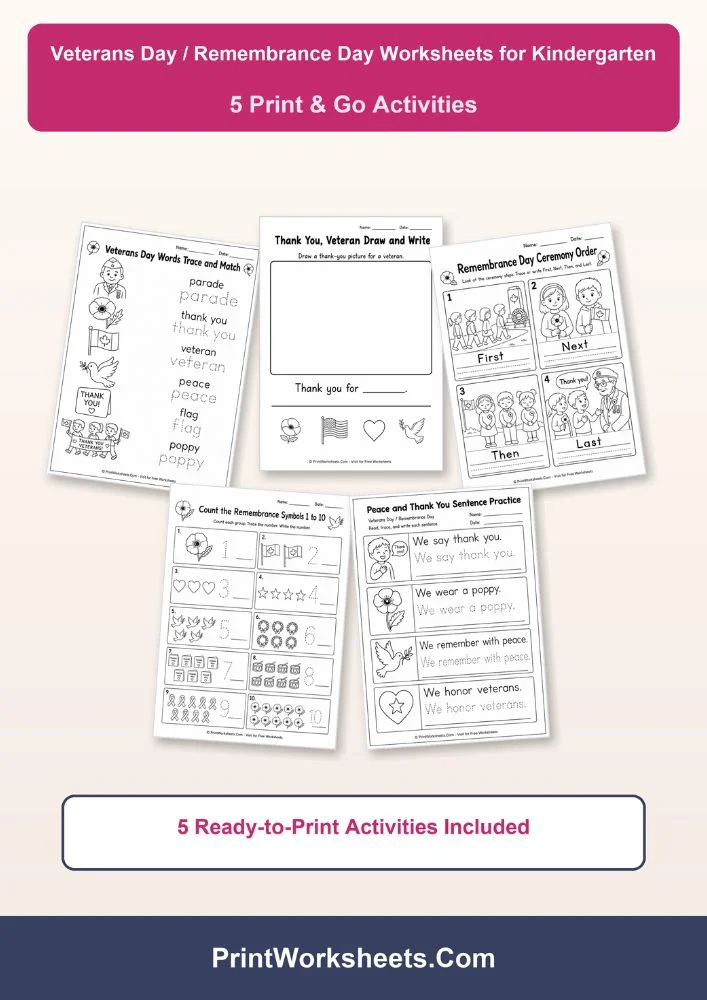

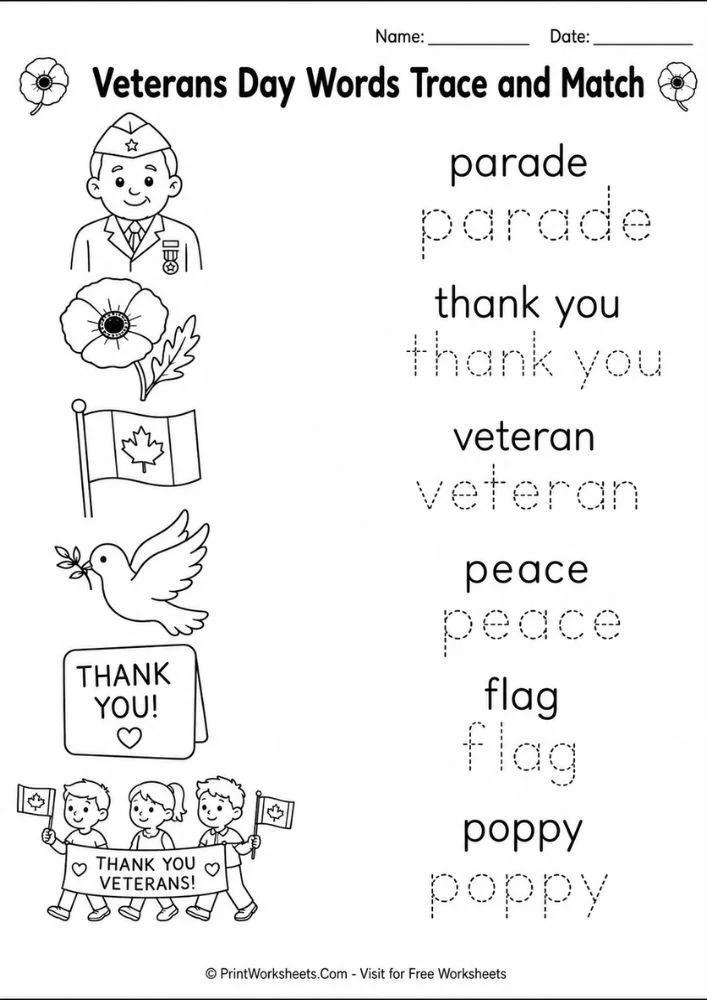
These completely free printable veterans day remembrance day worksheets for kindergarten provide early learners with age-appropriate social studies, foundational math, and fine motor tracing activities designed specifically for the month of November. Introducing civic holidays to five-year-olds requires a careful pedagogical approach that emphasizes peace, honor, and saying “thank you” without overwhelming them with complex historical facts. This robust 5-page PDF packet seamlessly integrates these gentle concepts with core kindergarten academic milestones, ensuring that your seasonal classroom activities remain highly educational.
Educators can instantly build a cohesive autumn learning curriculum by deploying these no-prep resources alongside our other seasonal packets. After utilizing our Canadian Thanksgiving worksheets for kindergarten in October, these remembrance pages perfectly continue the theme of gratitude. Furthermore, if you are teaching a split-grade class or have advanced students who need a greater challenge, you can seamlessly pair this packet with our Veterans Day Remembrance Day worksheets for 1st grade to maintain a unified classroom theme.
Inside the Kindergarten November PDF Packet
This printable bundle deliberately avoids complex, multi-step instructions that often frustrate early learners. Instead, it features intuitive layouts, bold outlines, and large primary tracing baselines perfectly suited for kindergarten developmental milestones. Each activity page targets a distinct academic goal:
- Veterans Day Words Trace and Match: An essential handwriting and visual association builder. Children look at friendly icons (a veteran, a poppy, a flag, a peace dove) and trace the boldly dotted vocabulary words next to them to develop fine motor pencil control and early letter recognition.
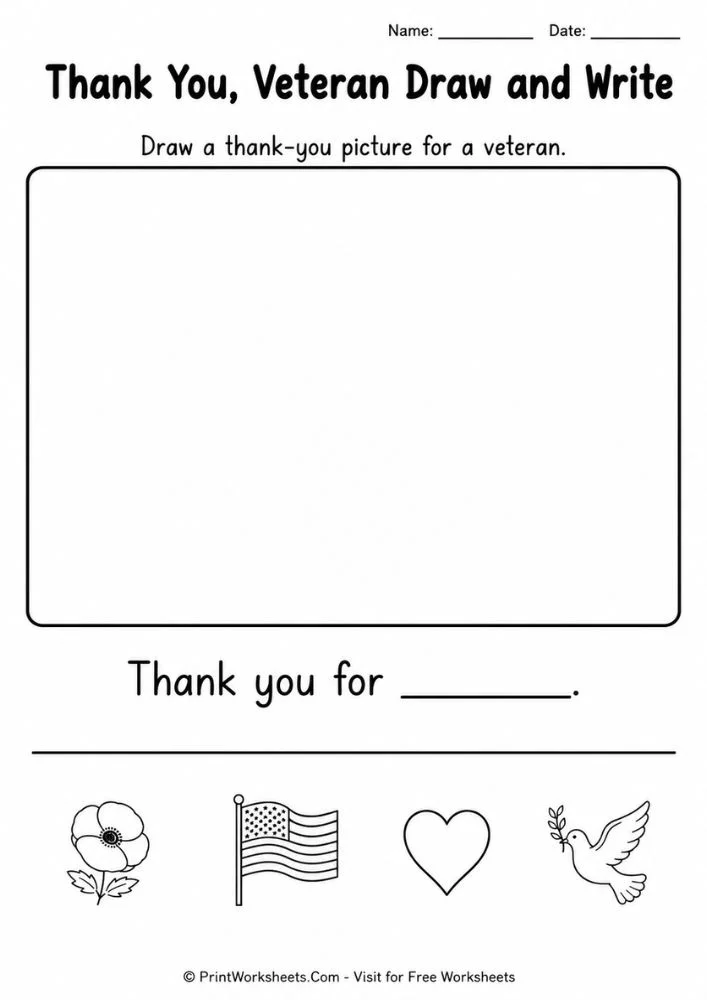
- Thank You, Veteran Draw and Write: An early expressive arts and social-emotional prompt. Children utilize a large blank space to draw a picture expressing their gratitude. At the bottom, they use a primary handwriting line to complete the sentence “Thank you for…” using their own phonetic spelling or teacher dictation.
- Remembrance Day Ceremony Order: A visual chronological sequencing activity. Kindergarteners look at four sequential scenes (arriving at the monument, holding a poppy, standing quietly, thanking a veteran) and trace the transitional words “First, Next, Then, Last” to understand basic chronological ordering.
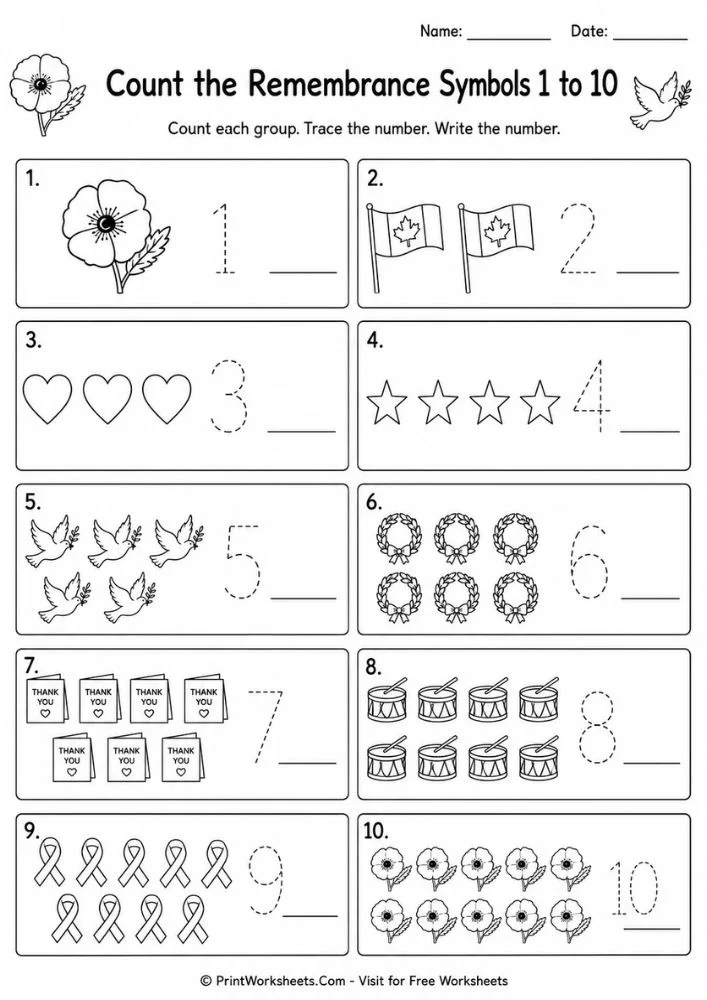
- Count the Remembrance Symbols 1 to 10: A foundational quantitative math assessment. Students practice one-to-one correspondence by counting scattered groups of holiday symbols (poppies, flags, hearts, stars, doves) and then trace the correct numeral from 1 to 10 in the provided boxes.
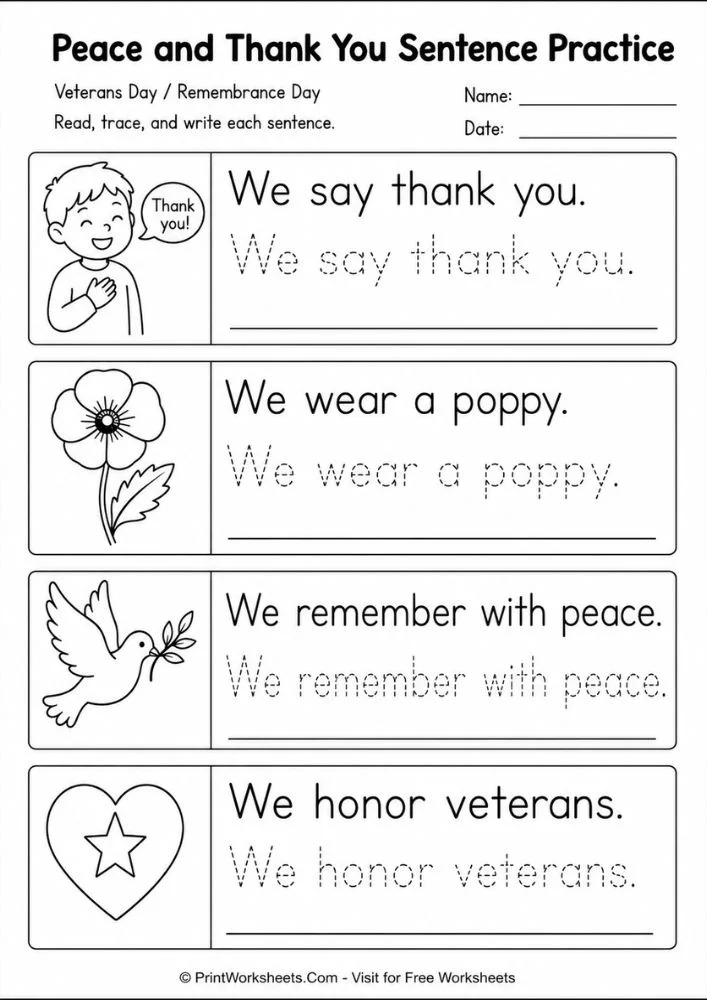
- Peace and Thank You Sentence Practice: An early literacy reading and writing task. Students read short, decodable sentences (“We say thank you.”, “We wear a poppy.”) and then trace the exact sentence below it, reinforcing sight word recognition and proper sentence structure formatting.
Practical October and November Classroom Center Implementation
Download the high-resolution file and print the packet on standard 8.5″ x 11″ copy paper. Ensure your printer dialogue is set to “fit to printable area” so the lower handwriting lines and activity borders remain intact. The “Count the Remembrance Symbols” math worksheet operates brilliantly as an independent morning center. We highly suggest placing this specific page inside a heavy-duty dry-erase sleeve so multiple students can practice counting and number tracing using washable markers throughout the week.
Use the “Thank You, Veteran Draw and Write” prompt during a dedicated social-emotional learning (SEL) block. Gather the children on the classroom carpet, discuss the concept of community helpers and peace, and let them share their drawing ideas verbally before sending them back to their desks to illustrate their personal thoughts.
Frequently Asked Questions
Why combine Veterans Day and Remembrance Day into a single packet?
Because the United States celebrates Veterans Day and Canada (along with other Commonwealth nations) celebrates Remembrance Day on the exact same timeline in November, these worksheets are engineered to be universally applicable across North America. The graphics deliberately feature both American and Canadian flags alongside universal symbols of peace like the poppy and the dove, making it a perfectly inclusive civic resource.
Are the math and literacy activities aligned with kindergarten standards?
Absolutely. The counting worksheet focuses on strict one-to-one correspondence up to the number 10 and proper numeral formation, which are core kindergarten math standards. The tracing and sequencing pages introduce basic transitional logic (First, Next, Last) and fine motor pencil control, which are vital precursors to independent elementary writing.
How should I explain these holidays to five-year-old students?
When teaching kindergarteners about these civic holidays, it is best to avoid complex or scary historical details about conflict. Instead, focus entirely on the concepts of community helpers, peace, and expressing gratitude. Explain that veterans are people who worked hard to keep our country safe, and that this special day is simply our chance to say “thank you” and to think about how we can be peaceful and kind to one another.
How can I adapt the drawing and writing prompt for children who cannot spell yet?
Kindergarten students are typically highly capable illustrators but hesitant phonetic spellers. Instruct the child to complete their detailed thank-you drawing first. Once finished, ask them to verbally describe their drawing to you. You can then write their chosen word (e.g., “Peace,” “Helping,” or “Safety”) lightly in yellow highlighter on the primary baseline, allowing the student to confidently trace over your letters with their pencil.