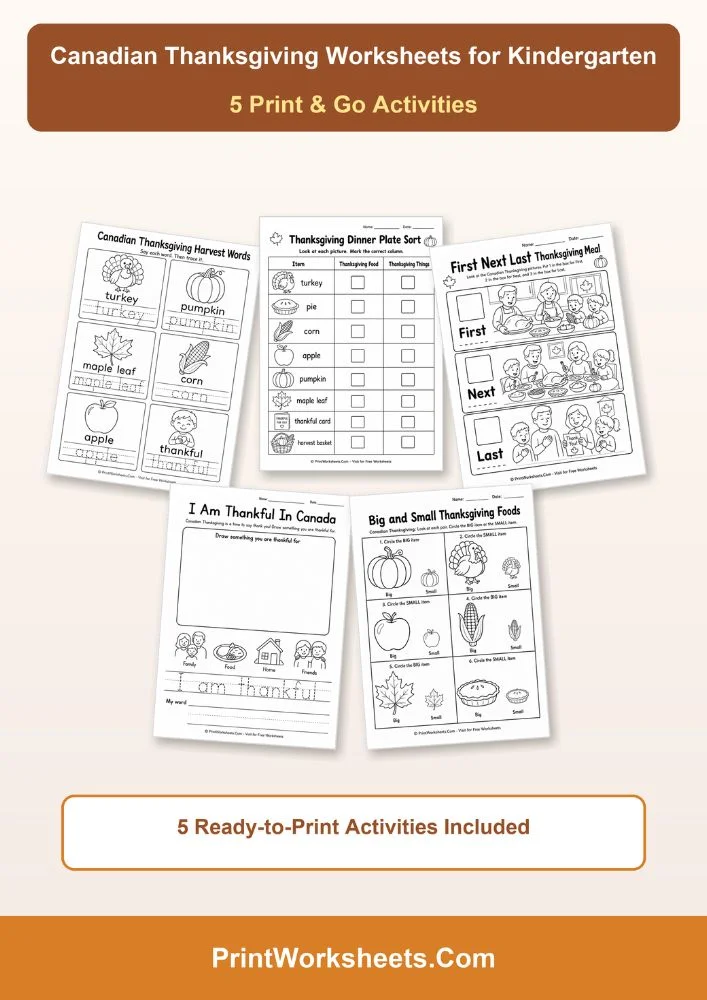
These completely free printable canadian thanksgiving worksheets for kindergarten deliver highly targeted early math, visual discrimination, and foundational literacy activities designed specifically for the October harvest season. By utilizing culturally relevant graphics such as maple leaves, local harvest baskets, and traditional Thanksgiving meals, this PDF packet ensures that Canadian educators and parents have access to historically accurate materials. Kindergarten students will actively develop their pencil control, logical sequencing abilities, and primary categorization skills without relying on November-centric American holiday themes.
Educators can instantly build a comprehensive autumn learning curriculum by deploying these no-prep resources. As you clear away your early fall and Halloween worksheets from morning centers, transition smoothly into harvest themes using these culturally focused pages. If you teach split classes or have advanced students, you can seamlessly pair this kindergarten packet with our Canadian Thanksgiving worksheets for 1st grade to maintain a cohesive, multi-level classroom environment.
Inside the Kindergarten Canadian Thanksgiving PDF Packet
This printable bundle deliberately avoids complex, multi-step instructions that often frustrate early learners. Instead, it features intuitive layouts, bold outlines, and large primary tracing baselines perfectly suited for kindergarten developmental milestones. Each activity page targets a distinct academic goal:
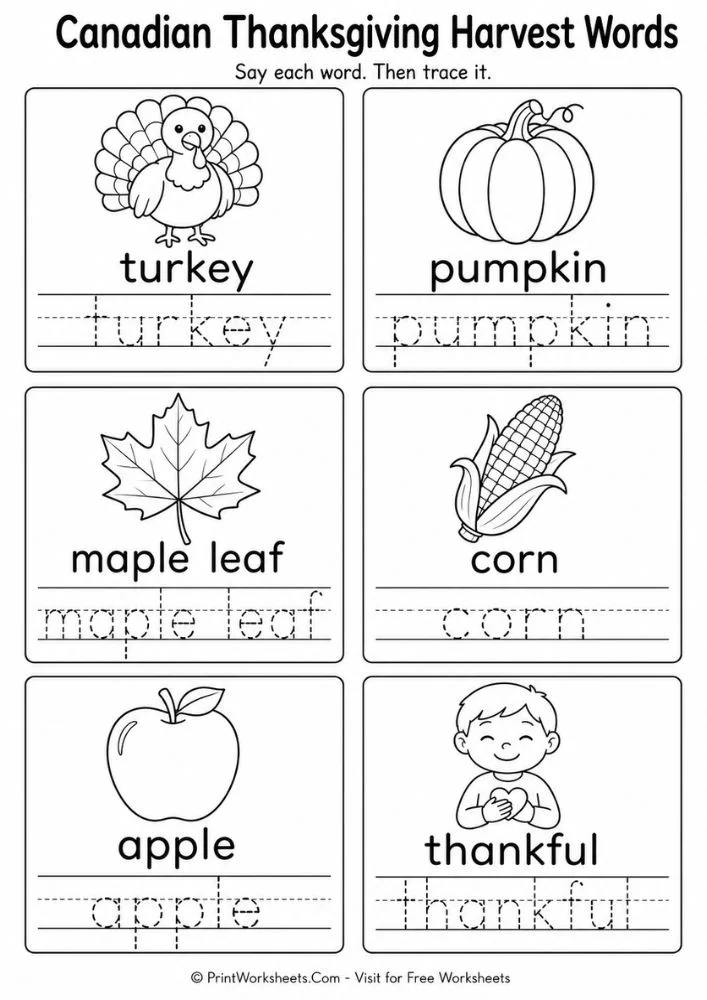
- Canadian Thanksgiving Harvest Words: An essential handwriting and seasonal vocabulary builder. Children identify classic items (turkey, pumpkin, maple leaf, corn, apple, thankful) and trace the boldly dotted text below each image to develop fine motor pencil control and letter recognition.
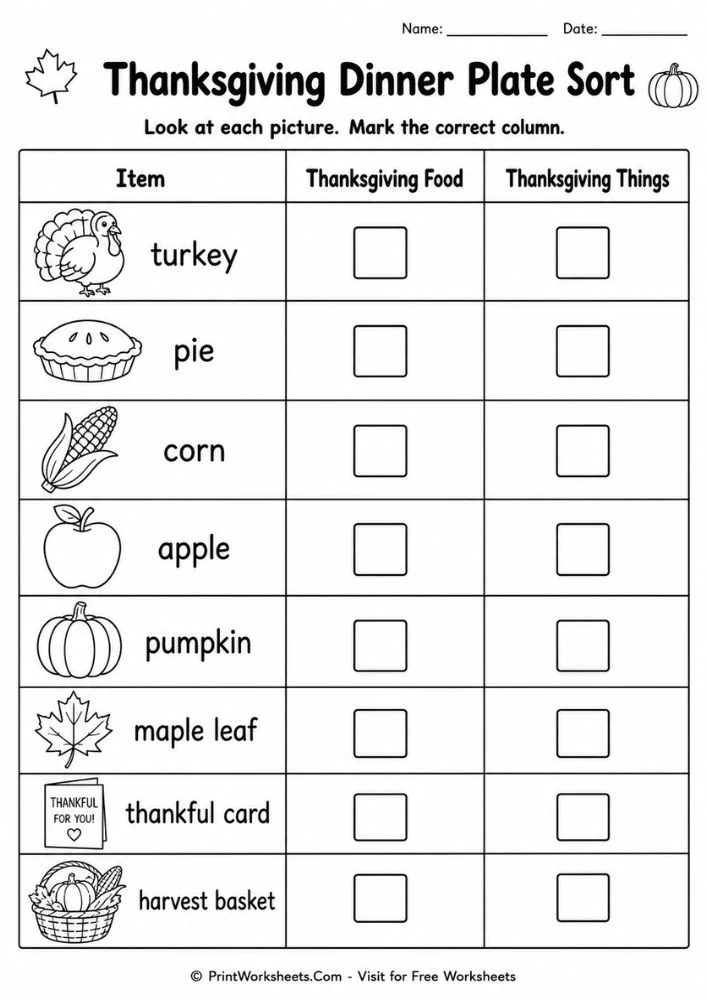
- Thanksgiving Dinner Plate Sort: An introductory logical categorization matrix. Students look at various holiday items and mark a checkbox to classify whether the object is a “Thanksgiving Food” (like pie and corn) or a “Thanksgiving Thing” (like a harvest basket or thankful card).
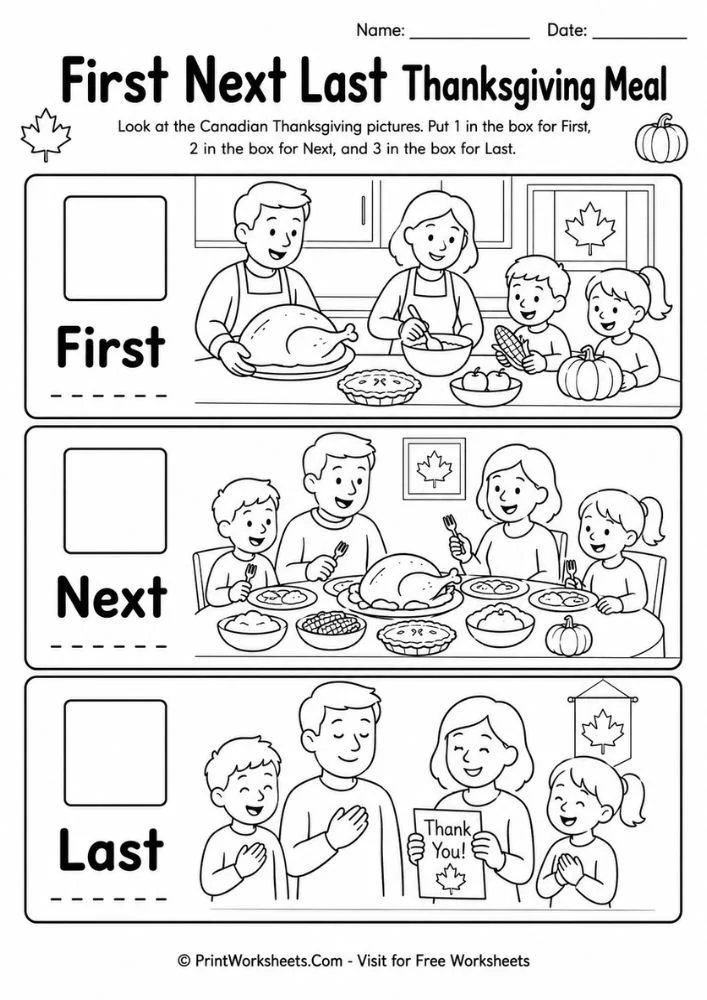
- First Next Last Thanksgiving Meal: A visual chronological sequencing activity. Kindergarteners look at three familiar family scenes (preparing the food, eating the turkey, expressing gratitude) and independently write the numbers 1, 2, and 3 in the correct sequential boxes.
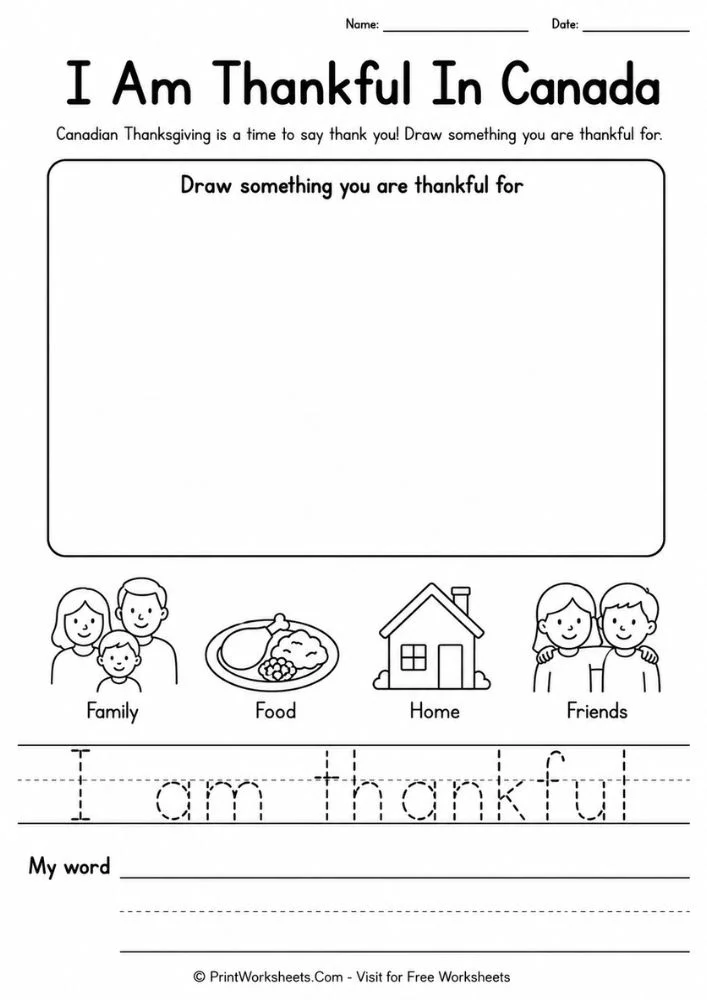
- I Am Thankful In Canada: An early expressive arts and social-emotional prompt. Children utilize the large blank space to draw something they appreciate, trace the sentence “I am thankful,” and attempt to copy their specific focus word at the bottom using the provided primary lines.
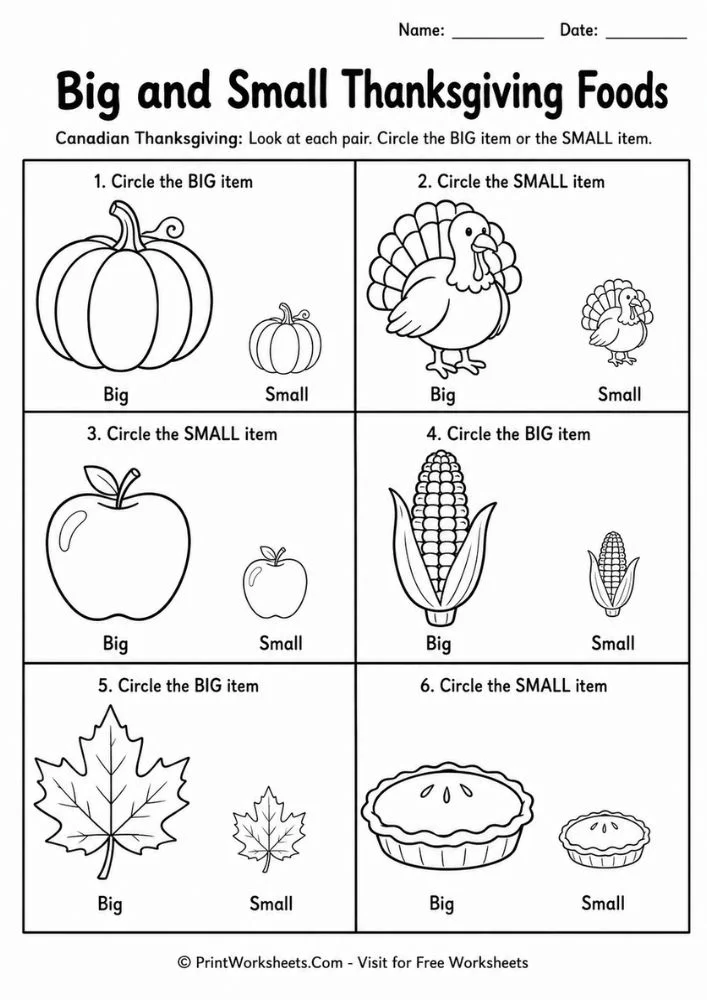
- Big and Small Thanksgiving Foods: A foundational early math and visual discrimination task. Students analyze paired harvest illustrations and follow specific text prompts to circle either the “BIG” item or the “SMALL” item in each separate box.
Practical October Classroom Center Implementation
Download the high-resolution file and print the packet on standard 8.5″ x 11″ copy paper. Ensure your printer dialogue is set to “fit to printable area” so the lower handwriting lines and activity borders remain intact. The “Big and Small Thanksgiving Foods” and “Dinner Plate Sort” worksheets operate brilliantly as independent math and logic centers. We highly suggest placing these specific pages inside heavy-duty dry-erase sleeves so multiple students can complete the sorting and circling activities using washable markers throughout the week.
Use the “I Am Thankful In Canada” drawing prompt during a dedicated social-emotional learning (SEL) block. Gather the children on the carpet, discuss the concept of gratitude, and let them share their ideas verbally before sending them back to their desks to illustrate their personal thoughts.
Frequently Asked Questions
What makes the big and small worksheet effective for early math?
Visual discrimination is a direct precursor to advanced geometric and quantitative skills. By asking kindergarteners to physically identify and circle the larger pumpkin or the smaller maple leaf, they are actively practicing size comparison, spatial awareness, and following specific conditional directions—all of which are critical early mathematics standards for primary education.
How can I adapt the gratitude writing prompt for pre-writers?
Kindergarten students are often highly capable illustrators but hesitant phonetic spellers. Instruct the child to complete their detailed drawing first. Once finished, ask them to verbally describe their drawing to you. You can then write their chosen word (e.g., “Mom,” “Dog,” or “House”) lightly in yellow highlighter on the primary baseline, allowing the student to confidently trace over your letters with their pencil.
Can the dinner plate sort be used to teach early logic skills?
Absolutely. The categorization worksheet forces children to analyze an object’s core function rather than just its appearance. Recognizing that an apple is meant to be eaten (Thanksgiving Food) while a thankful card is meant to be read (Thanksgiving Thing) builds the exact foundational logical sorting skills required in early childhood science and mathematics.
Are these activities suitable for Canadian homeschoolers?
Yes. The highly visual nature of these instructions means parents do not need a specialized education degree to guide their children through the packet. The activities provide a perfect, low-stress method to incorporate Canadian cultural heritage directly into a home-based October curriculum without relying on American holiday traditions.