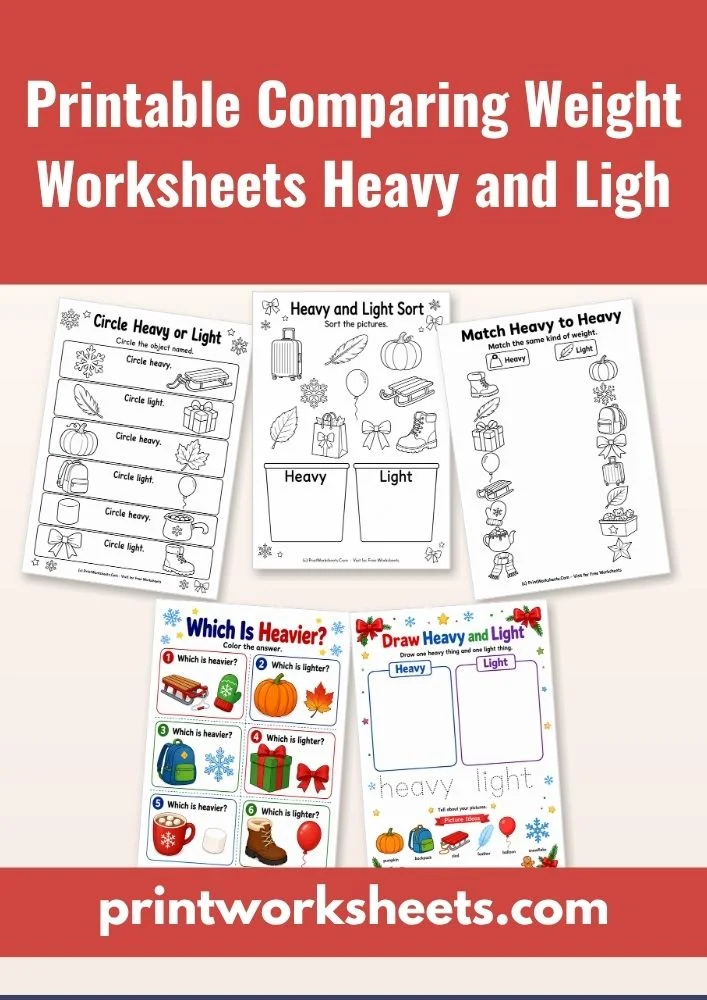
Comparing weight worksheets heavy and light are highly structured printable educational resources developed to help preschool and kindergarten students master foundational measurement and physical science concepts. Early childhood educators utilize these specific analytical printables to transition young learners from simply recognizing objects to actively estimating, comparing, and categorizing their invisible physical properties, such as mass. By completing these visual weight estimation activities, students develop the essential critical thinking skills required to analyze standard environments and use proper mathematical vocabulary. Download this complete comparing weight worksheets heavy and light PDF directly from PrintWorksheets.Com to establish rigorous, developmentally appropriate cognitive learning stations in your early childhood classroom.
To construct a highly effective mathematical and scientific foundation, pair these physical property printables directly with our spatial length worksheets. Ensuring students understand how to compare visible dimensions (such as tall and short) creates the necessary cognitive framework before asking them to evaluate the invisible property of mass.
Inside the Weight Measurement Printables Pack
This targeted cognitive practice pack features meticulously designed early learning worksheets. Each printable page is explicitly structured to meet exact Pre-K and Kindergarten measurement and data standards, bridging the gap between basic observation and scientific deduction.
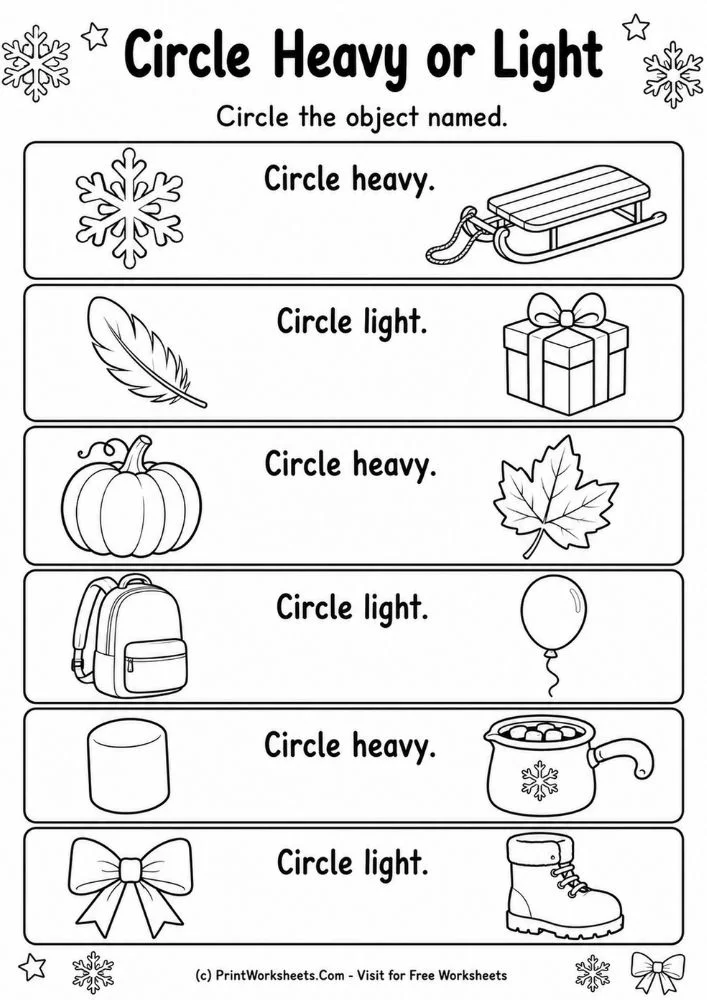
- Circle Heavy or Light: This foundational worksheet combines reading comprehension with visual mass estimation. Students analyze binary pairs of items (e.g., a feather versus a gift box). They must read the specific instruction for that row (“Circle heavy” or “Circle light”) and identify the correct object. This builds targeted measurement vocabulary.
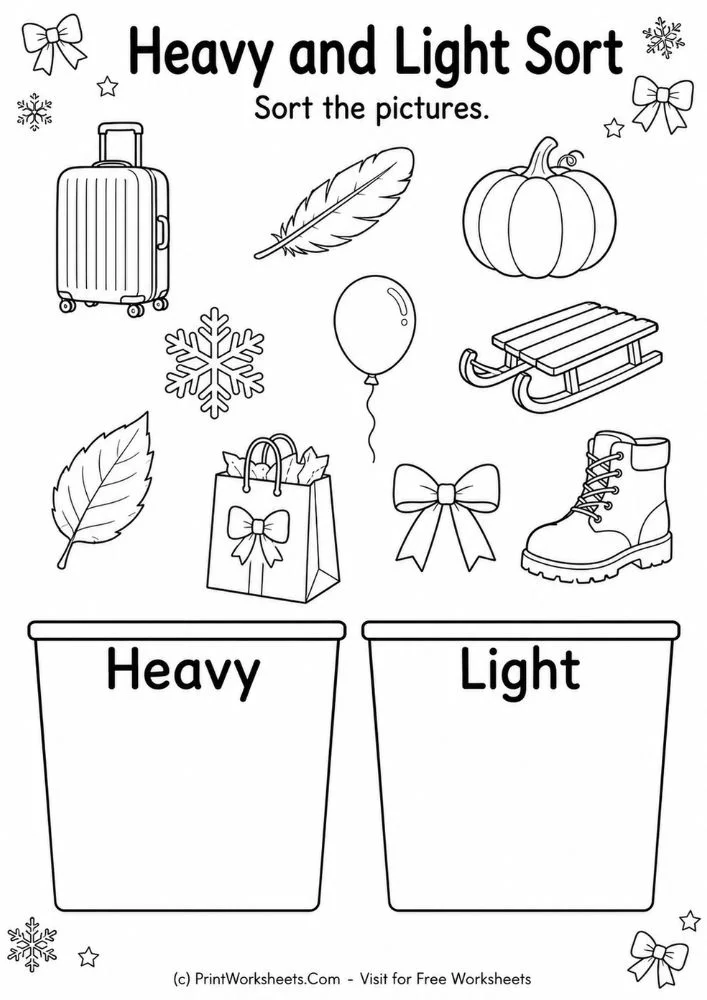
- Heavy and Light Sort: A dedicated cognitive classification page. Students scan a mixed array of daily items, including suitcases, balloons, sleds, and leaves. They must use critical thinking to mentally weigh the objects based on real-world experience and sort them into the correct “Heavy” or “Light” category boxes, strengthening logical reasoning.
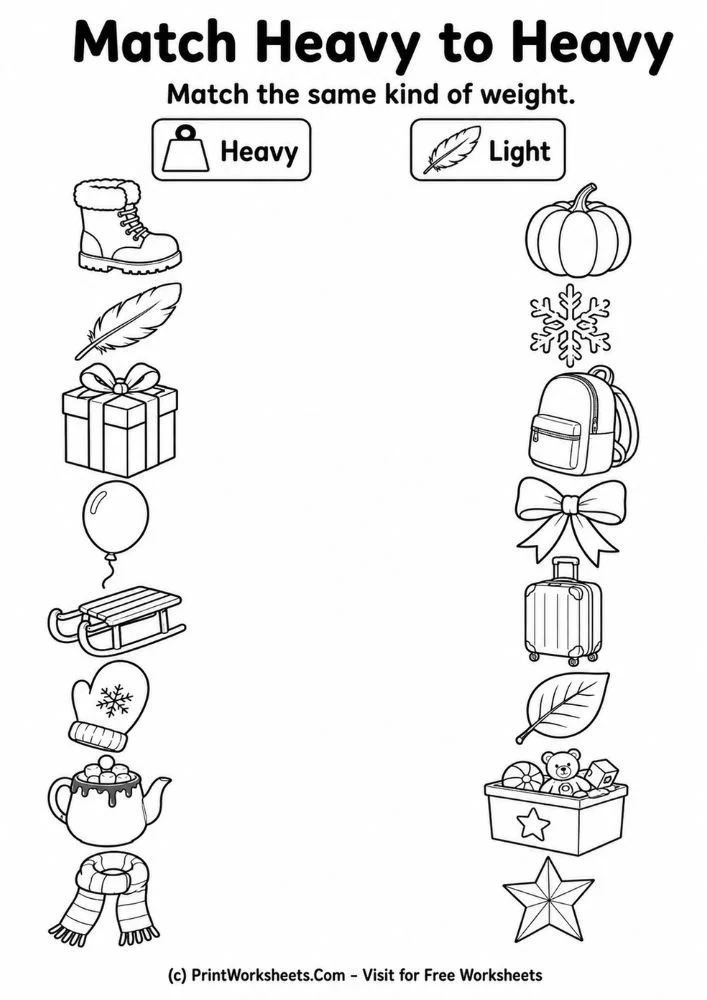
- Match Heavy to Heavy: An advanced targeted identification worksheet. Rather than matching identical pictures, students must match objects based on their shared physical attributes. They draw a line connecting an item in the left column (like a winter boot) to an item in the right column that shares the same weight class (like a pumpkin). This requires high-level abstract thinking.
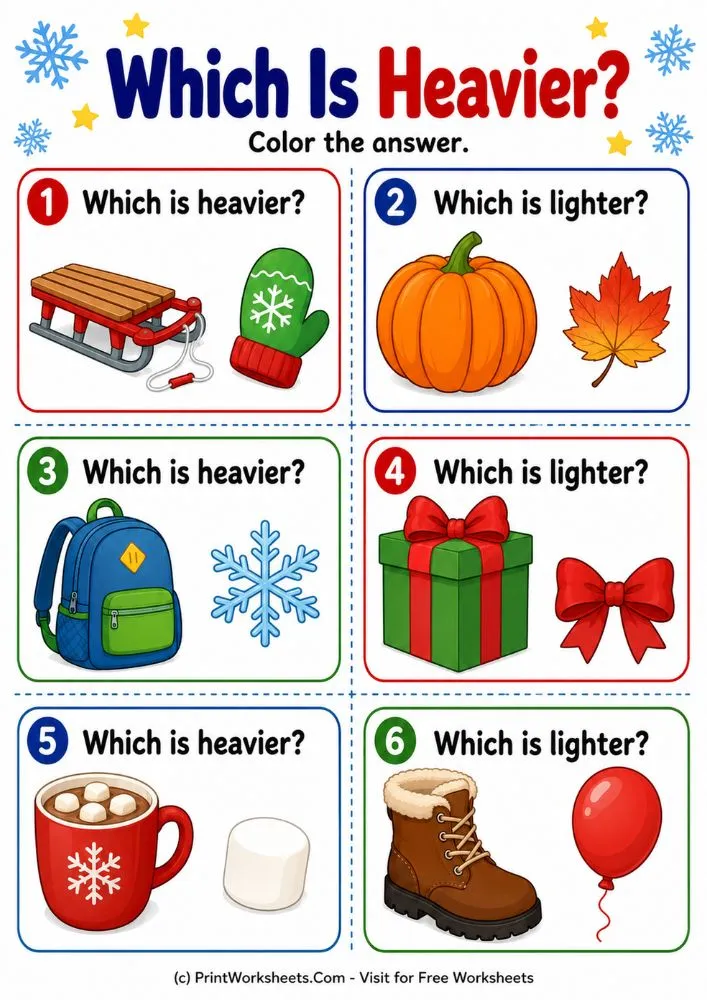
- Which Is Heavier / Lighter (Coloring): This visually engaging worksheet presents students with clear binary choices inside distinct colored boxes. Students must evaluate the prompt (e.g., “Which is lighter?”) and color the correct answer. The integration of coloring promotes fine motor control while simultaneously assessing their understanding of mass.
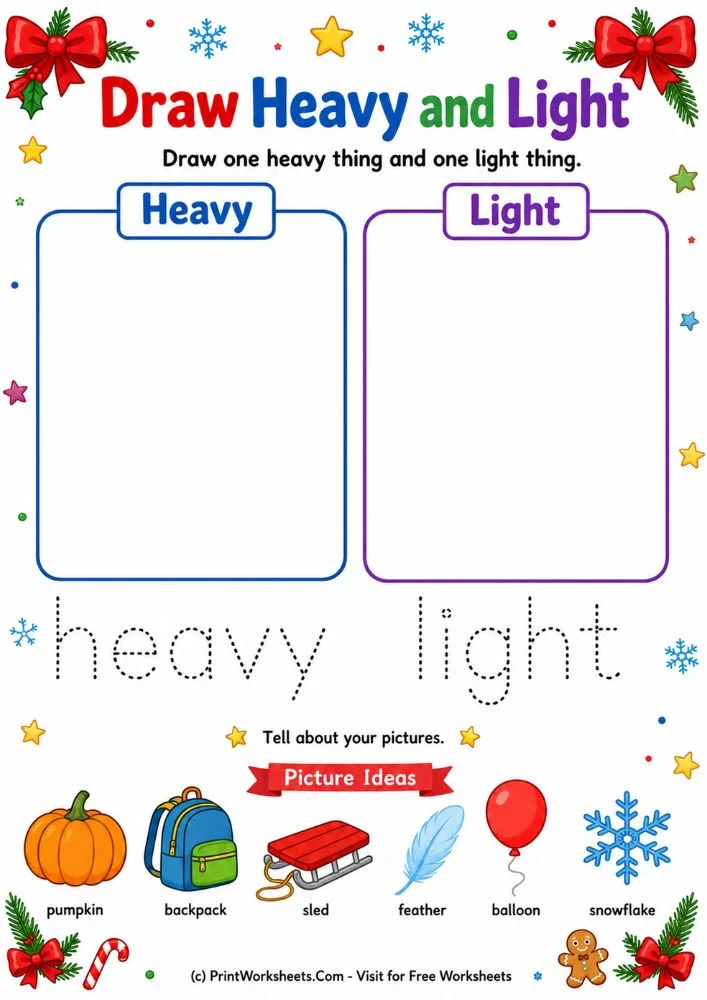
- Draw Heavy and Light: A culminating assessment page blending creativity with handwriting practice. Students must independently conceive of one heavy object and one light object, drawing them in the designated spaces. At the bottom, they trace the foundational measurement vocabulary words, integrating English Language Arts (ELA) with mathematics.
The Pedagogical Benefits of Visual Weight Estimation
Mastering the concepts of mass and weight is one of the most critical cognitive milestones in early childhood education. When kindergarten students complete comparing weight worksheets heavy and light, they are actively building the mental precursor to advanced physics and data analysis. Unlike length or height, weight is generally an invisible property. A child must rely on prior real-world experiences to know that a large balloon is lighter than a small rock. These worksheets force the brain to evaluate volume versus mass, preventing common logical fallacies. Explicitly practicing this visual estimation builds the exact mental framework required for later grades, where students will eventually use standardized balance scales and metric units to quantify these exact same properties.
Setting Up Your Measurement Math Centers
Print these logical reasoning worksheets on standard 8.5 x 11 copy paper for independent morning work, small-group science interventions, or dedicated math blocks. To maximize your educational resources, place the “Match Heavy to Heavy” and sorting worksheets inside heavy-duty plastic dry-erase sleeves. Provide early learners with fine-tip whiteboard markers. To create a highly immersive learning environment, place physical objects (such as a real feather and a real book) next to the worksheet station. This straightforward classroom preparation allows students to physically verify the concepts they are evaluating on paper, creating a permanent, reusable cognitive station.
Early Childhood Measurement FAQs
What grade levels use comparing weight worksheets heavy and light?
Comparing weight worksheets heavy and light are heavily utilized by preschool (Pre-K), kindergarten, and special education (SPED) educators. They provide essential cognitive practice that targets required early learning math standards, focusing strictly on logical reasoning, visual mass estimation, and foundational physical science.
What specific cognitive skills do these printables target?
These measurement printables explicitly target abstract logical deduction, visual discrimination, working memory (recalling the real-world weight of 2D illustrations), and the acquisition of standard mathematical comparison vocabulary.
Why is it important to teach heavy and light before using a scale?
It is important to teach heavy and light before using a scale because young children must conceptually understand what mass is before they can quantify it with numbers. Just as a child must understand the concept of “more” before doing addition, they must conceptually grasp the physical property of “heavy” before reading numerical grams or ounces on a tool.