
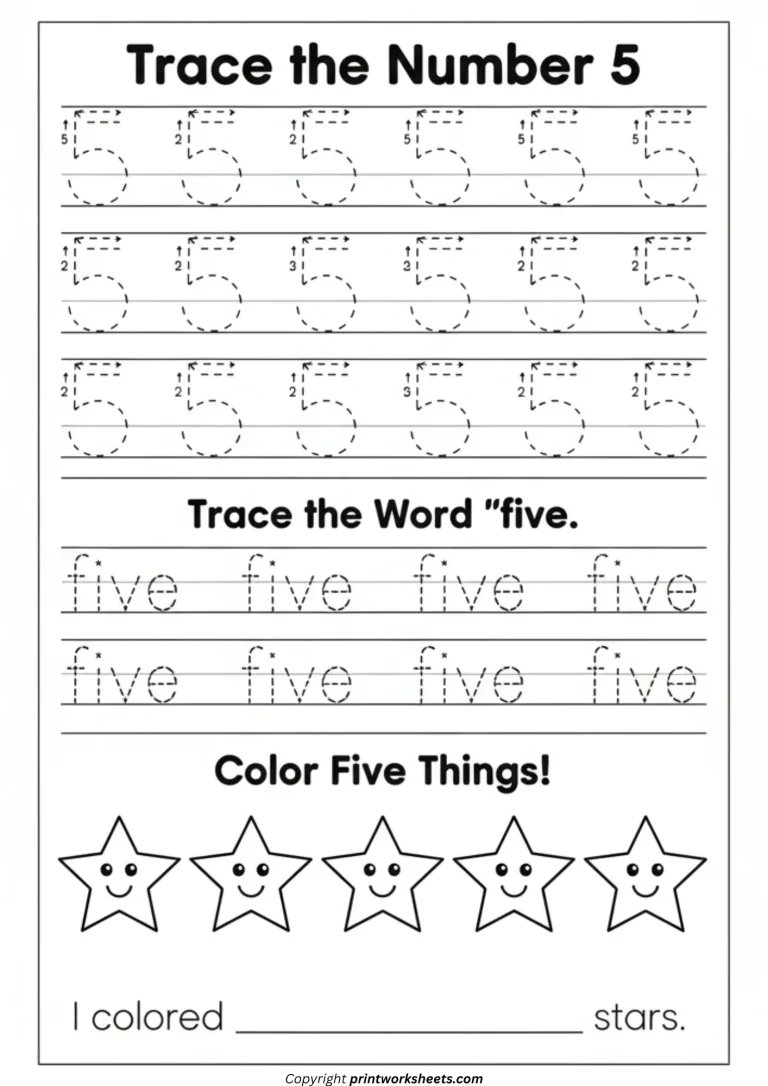
What are number 5 tracing worksheets? Number 5 tracing worksheets are highly structured early numeracy printables engineered to teach preschoolers and kindergarteners the precise kinesthetic strokes required to write the digit five. Developing accurate numeral formation requires repetitive, guided muscle memory practice rather than unguided free-drawing. This printable math PDF delivers a controlled learning environment focusing entirely on mastering the visual symbol, writing the vocabulary word, and proving physical quantity. By utilizing numbered directional arrows, dashed letter tracking, and a bounded object-counting task, educators guarantee that students establish a flawless mathematical foundation. Printing these targeted early math activities ensures young mathematicians avoid developing chronic handwriting reversals and secure a concrete understanding of numerical value.
Early childhood educators and homeschool parents deploy our number 5 tracing worksheets during dedicated math rotations, morning work routines, and intensive fine motor intervention blocks. Establishing strict directional habits for the number five is notoriously difficult due to its mix of straight lines and complex curves. Before introducing this multi-step digit, verify your student has conquered the intersecting linear strokes found in our number 4 tracing worksheets at PrintWorksheets.Com. Securing absolute mastery of the previous digit ensures a logical, frustration-free progression of sequential counting and spatial awareness.
Inside the Number 5 Practice PDF
This specific resource intentionally eliminates visual clutter to provide a highly focused academic space. The printable page is divided into three distinct pedagogical zones, each targeting a different cognitive mechanism of early mathematics:
- Directional Numeral Tracing: The top section features large outlines of the numeral 5. Inside the lines, step-by-step numbered arrows explicitly dictate the sequence of the pencil stroke (pull down, curve around, and finally, draw the hat on top). This mechanical guidance prevents students from inventing incorrect, inefficient writing paths.
- Vocabulary Word Integration: Directly beneath the numerals, students encounter the word “five” written in dashed primary tracing font. This section bridges mathematics and literacy, requiring the student to trace the letters f-i-v-e. Linking the spoken sound directly to the alphabetical symbol reinforces phonetic recognition alongside math.
- Quantity Verification and Coloring: The bottom half of the page shifts from abstract symbols to concrete representation. Students are presented with five smiling stars. They must physically color each star, applying one-to-one correspondence. Finally, they conclude the activity by filling in a declarative sentence blank: “I colored ___ stars,” forcing them to actively own their final count.
Differentiation Options for Teachers
When adapting this material for students with underdeveloped fine motor control, skip the pencil entirely for the first attempt. Provide a small tray filled with colored craft sand or shaving cream. Have the student use their index finger to practice the “down, around, hat on top” motion in the sand while looking at the worksheet’s directional arrows. This gross motor practice reduces pencil anxiety. For your advanced kindergarteners who finish tracing rapidly, flip the paper over. Demand that they draw five completely unique objects of their own choosing, and then attempt to write the word “five” entirely independently without the assistance of dashed tracing lines.
Targeted Academic Skills
This comprehensive tracing printable directly supports Common Core State Standards for Kindergarten Mathematics (specifically CCSS.MATH.CONTENT.K.CC.A.3), which mandates that students must write numbers from 0 to 20 and represent a number of objects with a written numeral. Additionally, the coloring and fill-in-the-blank exercise fulfills standard K.CC.B.4, requiring students to understand the relationship between numbers and quantities, firmly connecting the act of counting to mathematical cardinality.
Frequently Asked Questions
Why are directional arrows necessary for tracing numbers?
Directional arrows prevent chronic handwriting reversals. If a child is simply given a dotted number 5 without instructions, they may start at the bottom and push their pencil upward. This creates inefficient muscle memory that becomes incredibly difficult to break in later grades. Explicit arrows force the brain to learn the correct top-to-bottom, left-to-right mechanics from day one.
How does coloring stars relate to mathematical fluency?
Coloring builds one-to-one correspondence. A child can often recite numbers out loud from one to ten without actually understanding what those numbers mean. By forcing the student to slow down, color one star, say “one”, color the next star, and say “two”, you are bridging the gap between rote memorization and true quantitative understanding.
What age group is best suited for this tracing activity?
This worksheet is optimally designed for ages 4 to 6. Pre-K students (ages 4-5) will utilize this page to initially discover the shape and name of the digit. Kindergarten students (ages 5-6) will use this exact printable as a formal assessment tool to refine their handwriting precision and demonstrate independent sentence completion.