What are punctuation practice worksheets? Punctuation practice worksheets are targeted instructional printables designed to help early elementary students master the mechanics of sentence boundaries. Developing reading fluency requires an immediate, automatic understanding of where a thought ends and how it should be read aloud. This printable grammar PDF delivers rigorous, winter-themed learning centers focusing strictly on periods and question marks. By utilizing tactile sorting, contextual reading scenes, and proofreading exercises, educators guarantee comprehensive English Language Arts development. Printing these punctuation practice worksheets ensures young writers consistently apply correct end marks to statements and questions rather than writing endless run-on sentences.
Educators and homeschool parents rely on these punctuation practice worksheets for grade 1 and grade 2 during morning work, independent literacy stations, and targeted grammar interventions. Consistent exposure to standard punctuation builds the mechanical muscle memory required for confident writing. To construct a highly effective grammar curriculum, pair this specific packet directly with our proper nouns capitalization practice worksheets at PrintWorksheets.Com. Mastering both capital letters at the beginning and proper marks at the end secures the foundational logic needed for advanced primary grade paragraph construction.
Inside the Winter-Themed Punctuation PDF
Unlike generic grammar drills, this specific packet utilizes engaging winter-themed illustrations and contextual vocabulary to maintain student interest. Each printable activity isolates a specific syntactic skill to prevent cognitive overload:
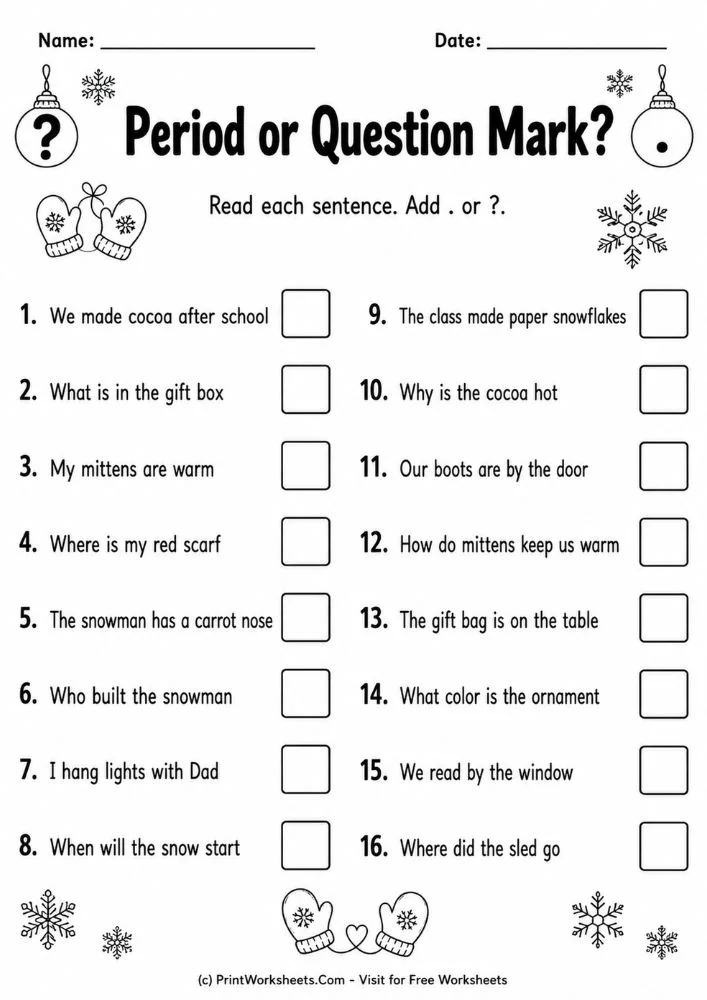
- Period or Question Mark: A foundational recognition worksheet. Students read 16 distinct winter-themed sentences (e.g., “We made cocoa after school” or “Where are my mittens?”). They must evaluate the intent of the text and manually draw either a period or a question mark inside the provided box, testing their basic “telling vs. asking” comprehension.
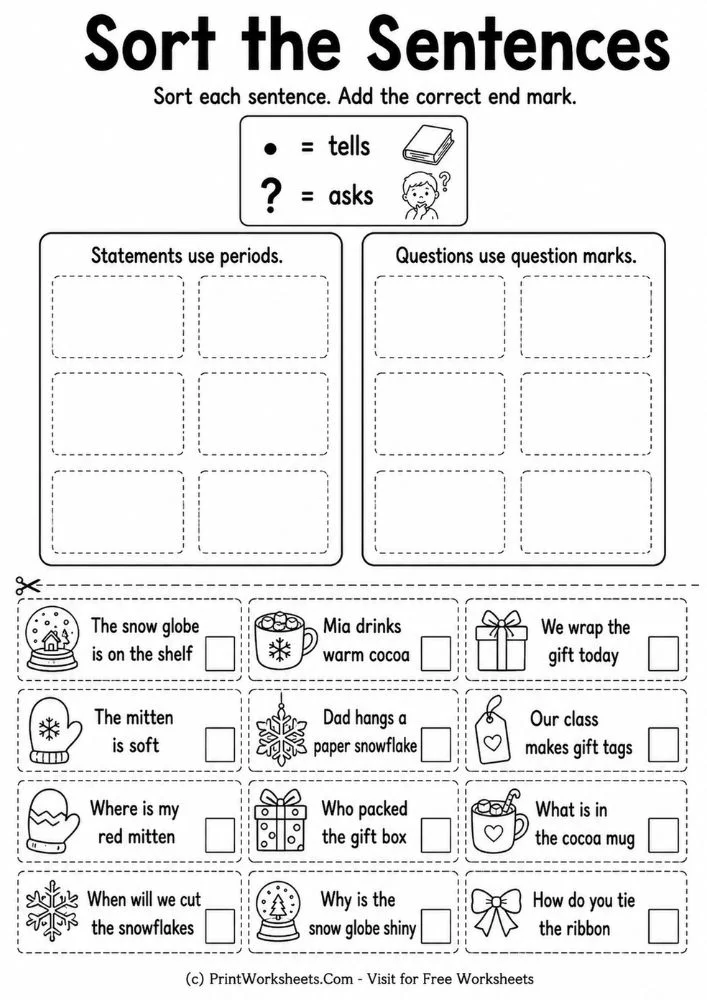
- Sort the Sentences: A kinesthetic cut-and-paste grammar activity. Students cut out 10 dashed sentence boxes. The worksheet requires them to physically sort and glue the sentences into two distinct categories: statements and questions. This tactile sorting proves grammatical comprehension before the student is ever asked to write independently.
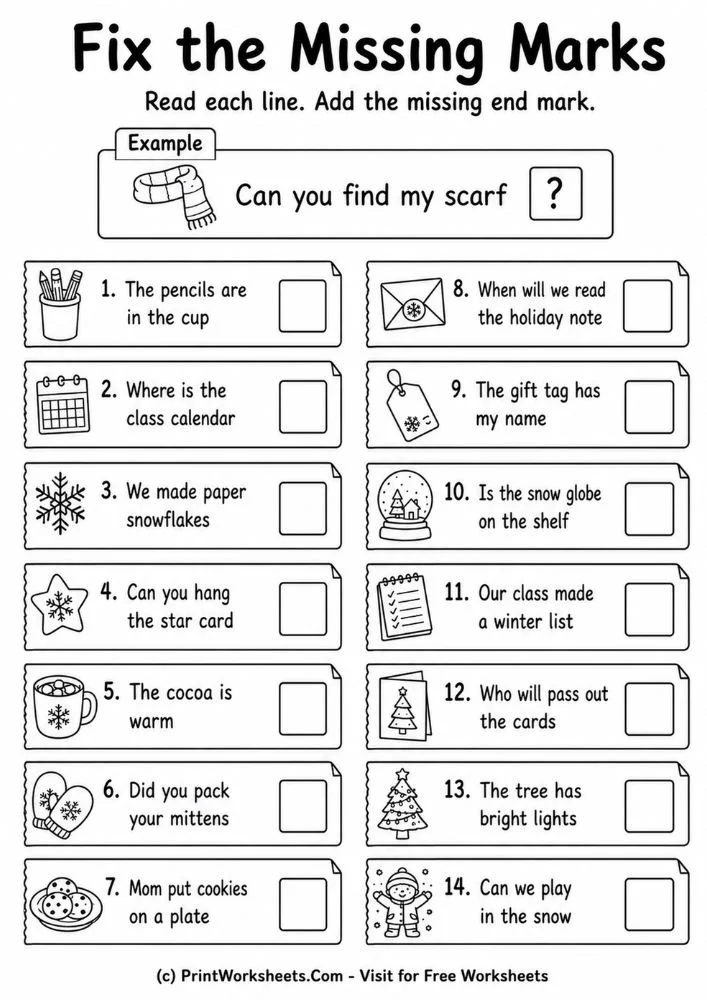
- Fix the Missing Marks: A targeted proofreading and formatting worksheet. Students act as “editors” to evaluate 14 complete sentences that are missing their terminal punctuation. They must read the text and physically draw the missing mark at the end of the line, mimicking the revision process of actual paragraph writing.
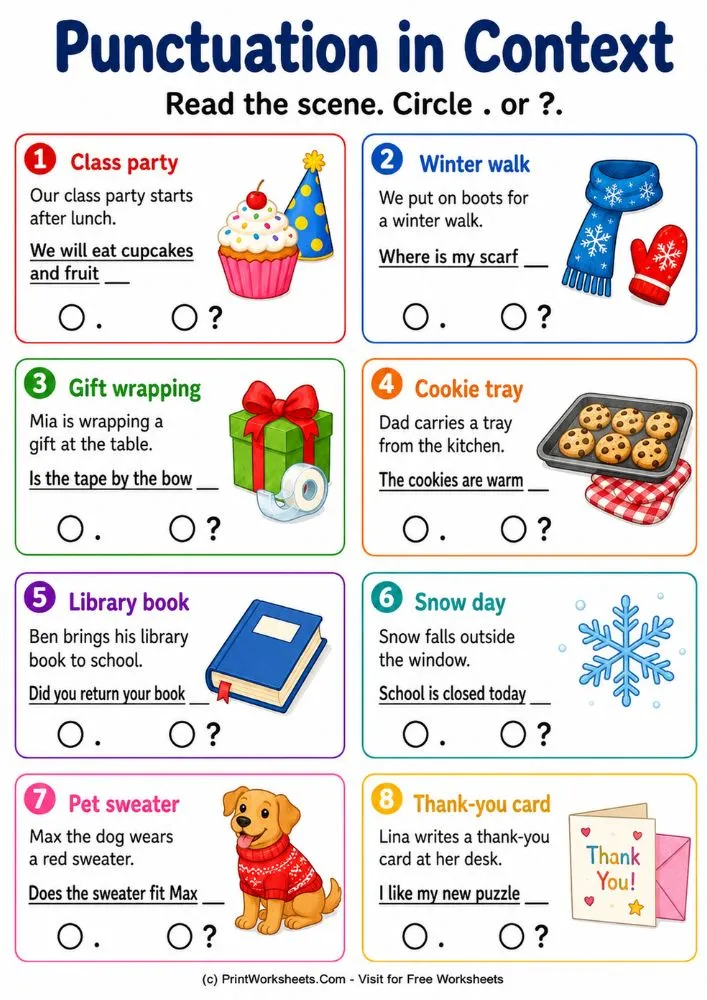
- Punctuation in Context: An advanced reading comprehension and grammar application page. Students read 8 short, distinct winter scenes (such as a class holiday party or a snowy winter walk). Each scene contains two sentences, but the final sentence is missing its end mark. Students must evaluate the context of the entire paragraph to select and circle the correct punctuation.
Differentiation Options for Teachers
To support struggling readers, incorporate Total Physical Response (TPR) into the lesson. Before they complete the worksheets, have students read the sentences out loud. Teach them to raise their hands up high at the end of an “asking” sentence (to represent a pitch going up) and fold their arms flat for a “telling” sentence. For advanced learners, skip the multiple-choice sections. Challenge them to flip the paper over and write their own cohesive winter-themed story that includes exactly three questions and three statements, correctly punctuated.
Targeted Academic Skills
These printables directly support Common Core ELA standards (specifically CCSS.ELA-LITERACY.L.1.2.B), which mandate that students recognize and name end punctuation. Furthermore, practicing punctuation within context heavily influences reading prosody. When students understand that a question mark requires a change in vocal inflection, they transition from robotic “word callers” into fluent, expressive readers.
Frequently Asked Questions
Why isolate only periods and question marks?
Isolating these two specific marks prevents over-excitability in writing. Introducing exclamation points too early often leads young writers to overuse them on every sentence. Mastering the fundamental binary—is this sentence giving information or asking for information?—establishes a solid, predictable base for future syntactic growth.
How does reading in context improve grammar?
Contextual reading forces true comprehension rather than blind guessing. When a student reads a single isolated sentence, they might just guess the end mark. However, when they read a short scene (like the “Winter walk” activity), they must understand the relationship between the first and second sentence to determine if a character is stating a fact or asking a question.
What grade levels benefit most from this PDF?
First and second-grade educators use these pages extensively. While kindergarten teachers might use the sorting pages in small, guided reading groups, 1st and 2nd-grade teachers utilize these specific worksheets for independent practice, morning work, and formal assessments to ensure students are ready for paragraph drafting.