What are identifying nouns and verbs worksheets? Identifying nouns and verbs worksheets are targeted grammar printables designed to teach early elementary students the foundational building blocks of sentence structure. Understanding the mechanics of a sentence requires an immediate, automatic ability to distinguish an action word from a person, place, or thing. This specific printable PDF delivers rigorous ELA center activities focusing entirely on this grammatical binary. By utilizing vocabulary analysis, historical writing comparisons, and paragraph sequencing, educators can guarantee comprehensive syntactic development. Printing these grammar activities ensures young learners transition from speaking in fragmented phrases to writing complete, grammatically sound sentences.
Educators and homeschool parents consistently utilize our identifying nouns and verbs worksheets during morning work, direct grammar instruction, and writing intervention periods. Recognizing how subjects and actions interact directly influences a student’s reading comprehension speed. To build a complete literacy progression, pair this foundational grammar packet directly with our reading comprehension worksheet for beginners at PrintWorksheets.Com. Continuous practice isolating the “who” and the “what they are doing” secures the core logic required for future creative writing.
Inside the Grammar Worksheets PDF
Unlike generic fill-in-the-blank drills, this specialized packet embeds parts of speech practice directly into cross-curricular topics like history and reading comprehension. Each printable activity targets specific primary ELA standards through unique formatting:
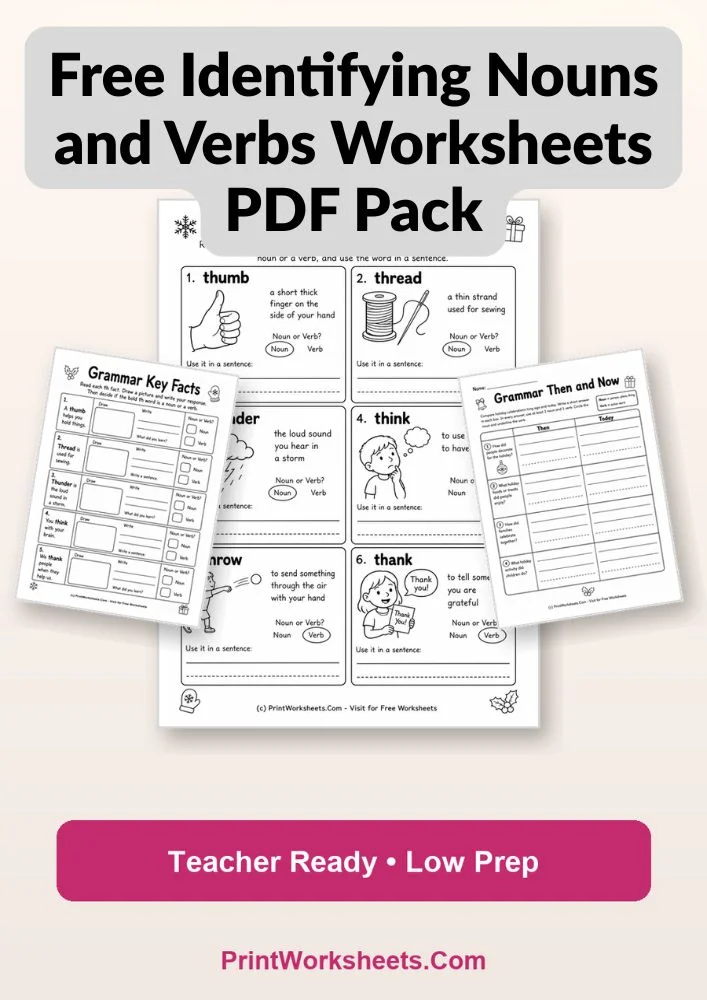
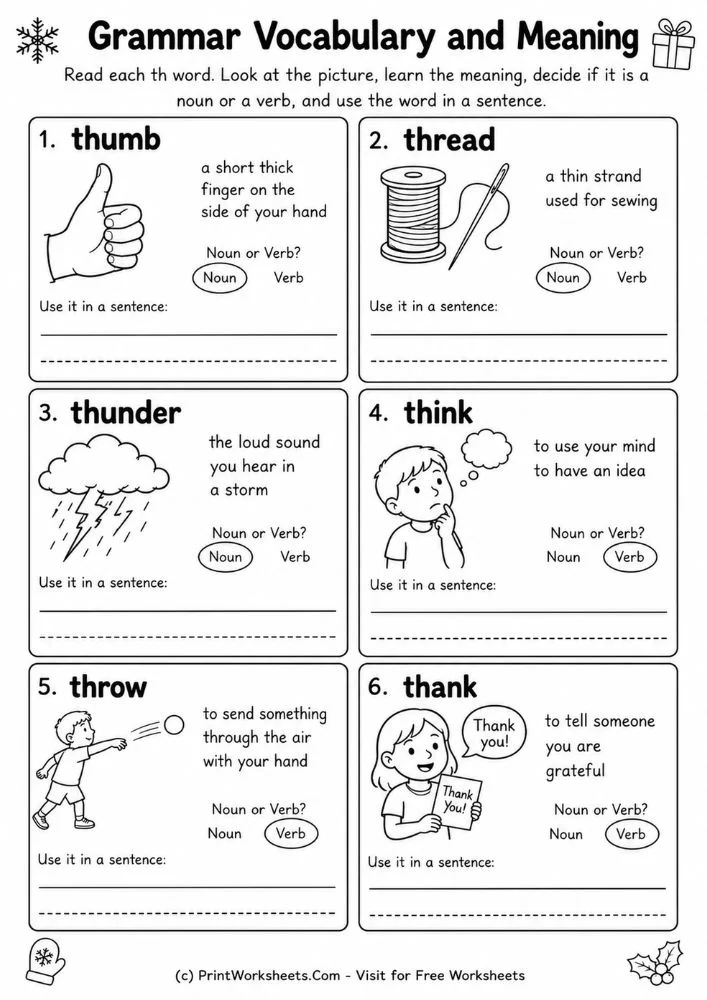
- Vocabulary and Meaning Analysis: A dual-purpose phonics and grammar page. Students read specific “th” digraph words (thumb, thread, thunder, think, throw, thank) alongside explicit dictionary definitions. They must classify the target word by circling either “Noun” or “Verb” and then prove their comprehension by writing a completely original sentence utilizing that word.
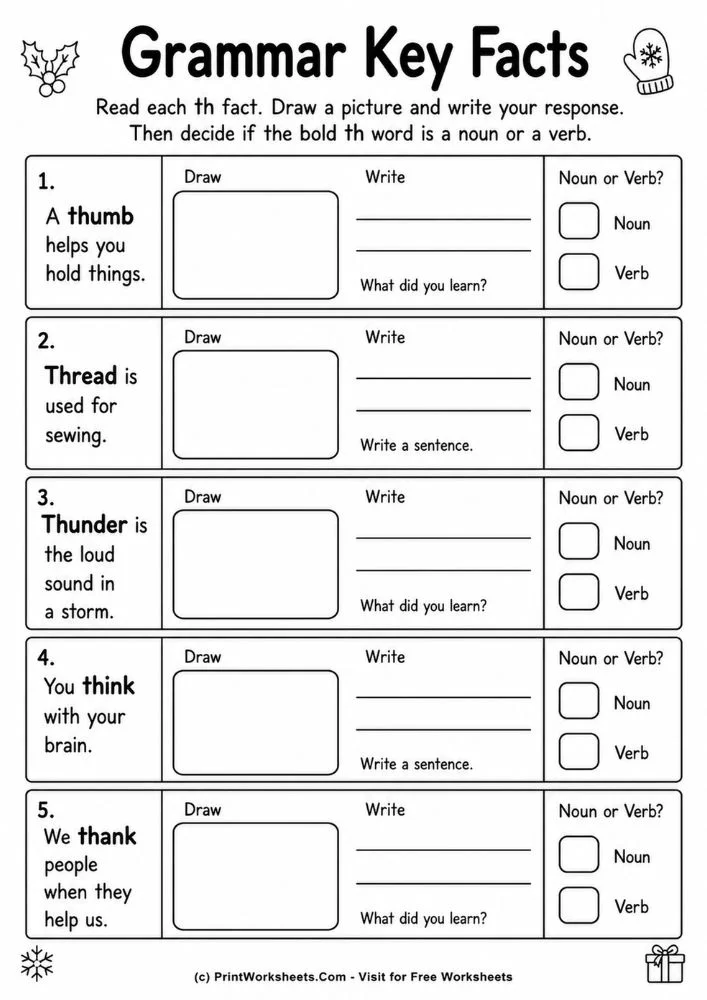
- Grammar Key Facts: A reading comprehension integration. Students read factual statements containing bolded target words. They are required to draw a corresponding picture to demonstrate reading comprehension, write a response sentence explaining the new fact, and formally classify the bolded word using provided checkboxes.
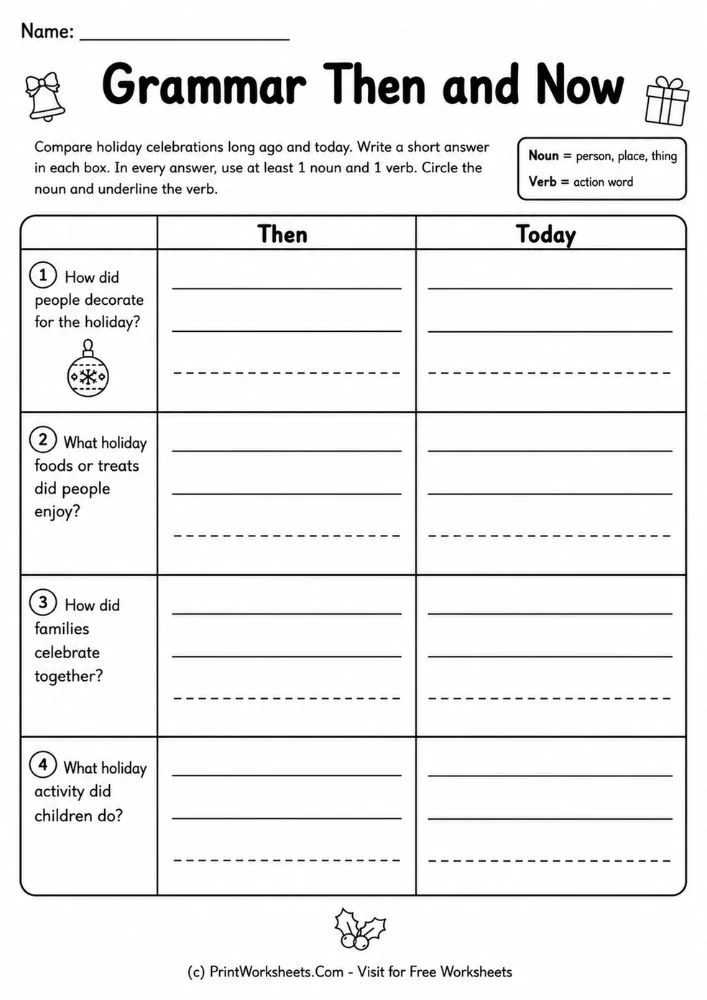
- Grammar Then and Now: A historical comparison writing activity. Students evaluate how holiday celebrations looked long ago versus today using a structured graphic organizer. The critical twist: every written comparative answer must contain at least one noun and one verb. Students must explicitly circle their noun and underline their verb, proving grammatical intent during the drafting process.
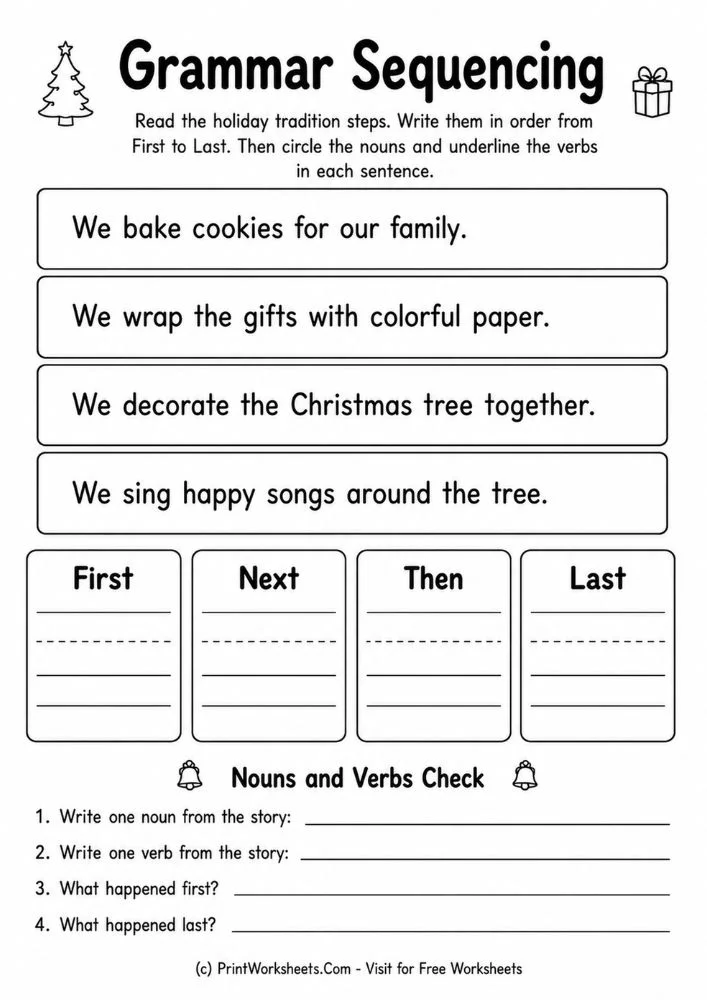
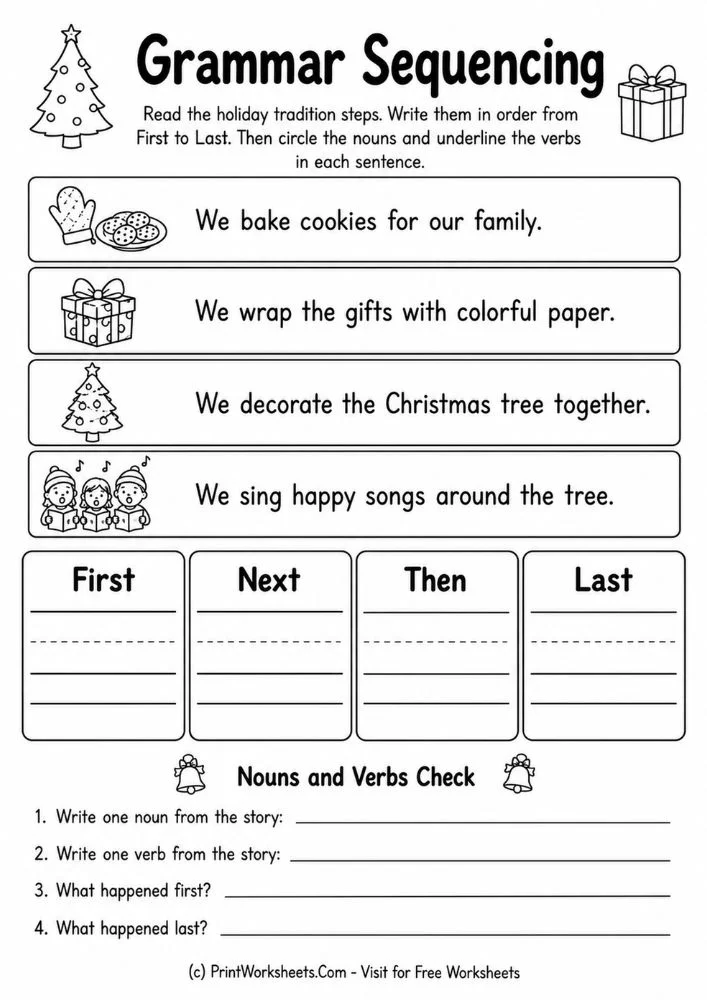
- Grammar Sequencing: A paragraph logic and text analysis worksheet. Students read four scrambled sentences detailing a specific tradition (e.g., baking cookies, wrapping gifts). After rewriting the sentences chronologically into “First, Next, Then, Last” boxes, they must act as editors to circle all nouns and underline all verbs within their newly sequenced narrative.
Differentiation Options for Teachers
To support kinesthetic learners who struggle with abstract grammar concepts, introduce physical movement before handing out the worksheets. Say a word from the list aloud; have students touch their desk if it is a noun (a tangible thing) or jump in place if it is a verb (an action). For advanced writers completing the “Grammar Then and Now” page, restrict their vocabulary choices. Challenge them to use highly specific proper nouns (e.g., “December” instead of “month”) and strong action verbs (e.g., “decorated” instead of “did”) to elevate their writing maturity.
Targeted Academic Skills
These printables are strictly aligned with core primary ELA expectations, specifically CCSS.ELA-LITERACY.L.1.1.B (Use common, proper, and possessive nouns) and L.1.1.C (Use verbs to convey a sense of past, present, and future). By forcing students to identify these words within the context of a paragraph rather than just in isolated lists, educators directly assess a student’s working syntactic awareness.
Frequently Asked Questions
Why teach nouns and verbs simultaneously?
A noun without a verb is just an isolated object; a verb without a noun is an impossible action. By practicing identifying nouns and verbs worksheets together, students immediately understand the interdependent relationship required to form a complete thought. They learn that every subject strictly requires an action to create a grammatical sentence.
How does sentence sequencing improve grammar skills?
Sequencing forces active syntactic dissection. When a student organizes scrambled sentences into a “First, Next, Then, Last” format, they are studying narrative structure. Combining this task with underlining verbs and circling nouns ensures they are actively analyzing the grammar within the text, rather than just passively reading words off a page.
What grade levels use these parts of speech worksheets?
These materials are ideal for late 1st grade and early 2nd grade. First-grade educators utilize the “Vocabulary and Meaning” organizers to introduce basic dictionary definitions. Second-grade educators heavily rely on this exact PDF pack during back-to-school periods to ensure students can construct a basic subject-predicate sentence before introducing complex adjectives and adverbs.