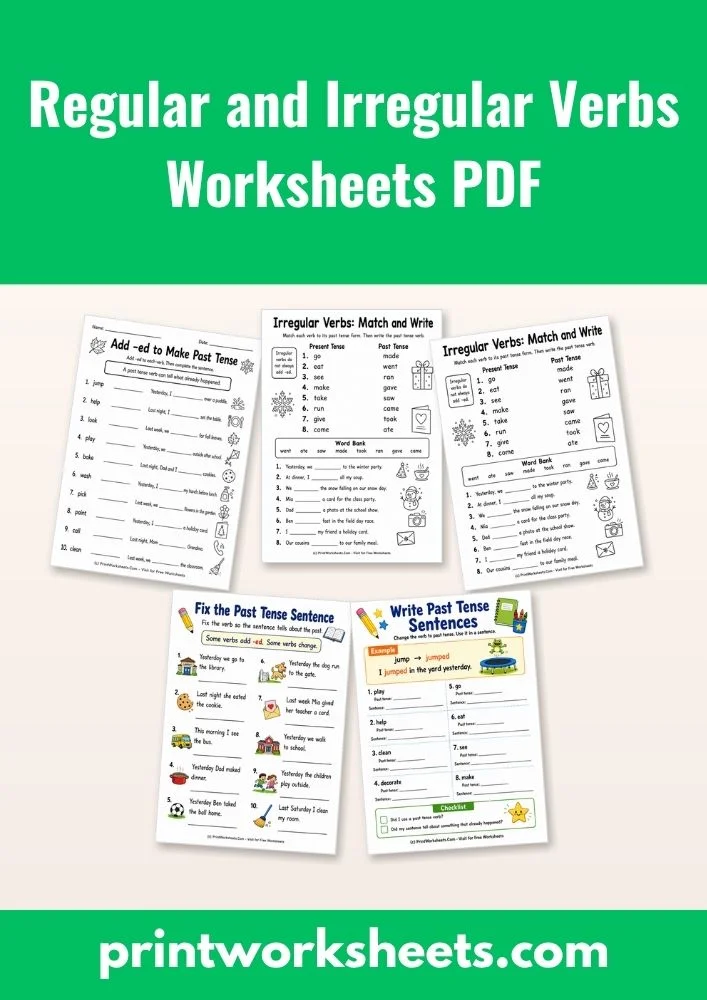
What are regular and irregular verbs worksheets? Regular and irregular verbs worksheets are targeted grammar printables designed to teach early elementary students how action words change when describing the past. Developing strong writing fluency requires an immediate understanding of verb tenses. This printable grammar PDF delivers rigorous, no-prep learning centers focusing strictly on the mechanics of past tense verbs. By utilizing standard suffix addition (-ed), visual matching for irregular forms, sentence correction, and independent writing prompts, educators guarantee foundational English Language Arts development. Printing these verb activities ensures young writers consistently apply correct tenses before progressing to complex paragraph construction.
Educators and homeschool parents utilize our regular and irregular verbs worksheets during morning work, independent grammar centers, and whole-group literacy instruction. Consistent exposure to irregular verb transformations (like “go” changing to “went”) prevents common speech and writing errors (like writing “goed”). To build a complete grammatical progression, pair this specific past tense packet directly with our identifying nouns and verbs worksheets at PrintWorksheets.Com. Securing the ability to identify an action word is the mandatory prerequisite before learning how to alter its timeline.
Inside the Past Tense Grammar PDF
Clear formatting and structured visual cues make these printables highly effective for early readers. The layout isolates specific grammatical concepts to prevent visual distraction. Each printable activity page targets specific primary grade core English standards through varied exercises:
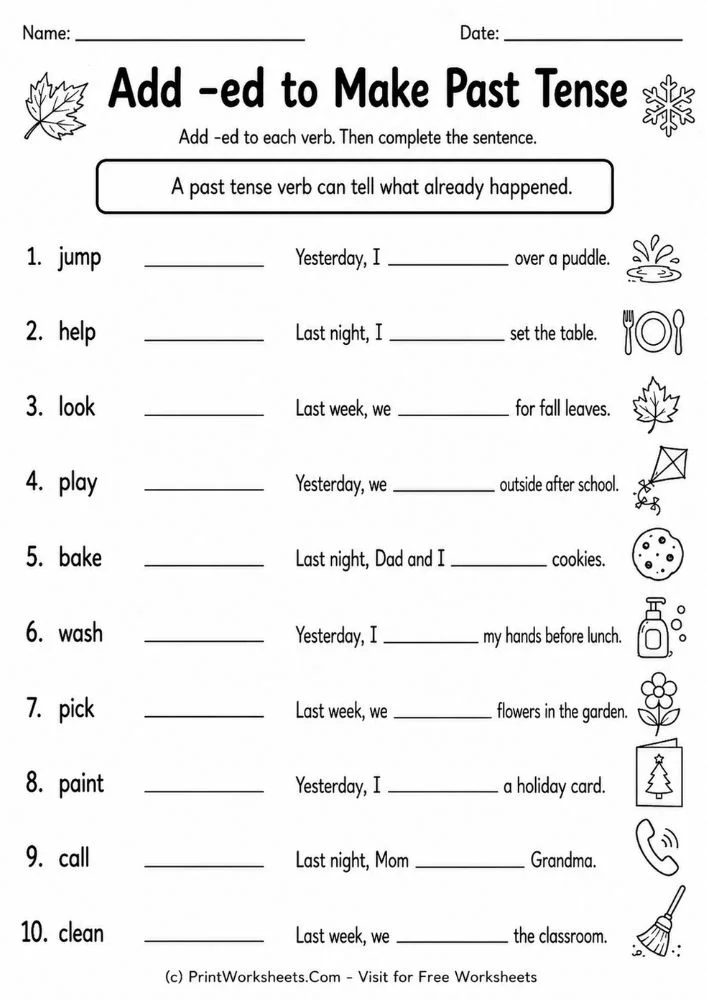
- Add -ed to Make Past Tense: A fundamental regular verb worksheet. Students read 10 base verbs (e.g., jump, help, look). They must rewrite the verb by adding the standard “-ed” suffix on the first line, and then use that newly created past tense verb to complete a contextual sentence on the right side of the page.
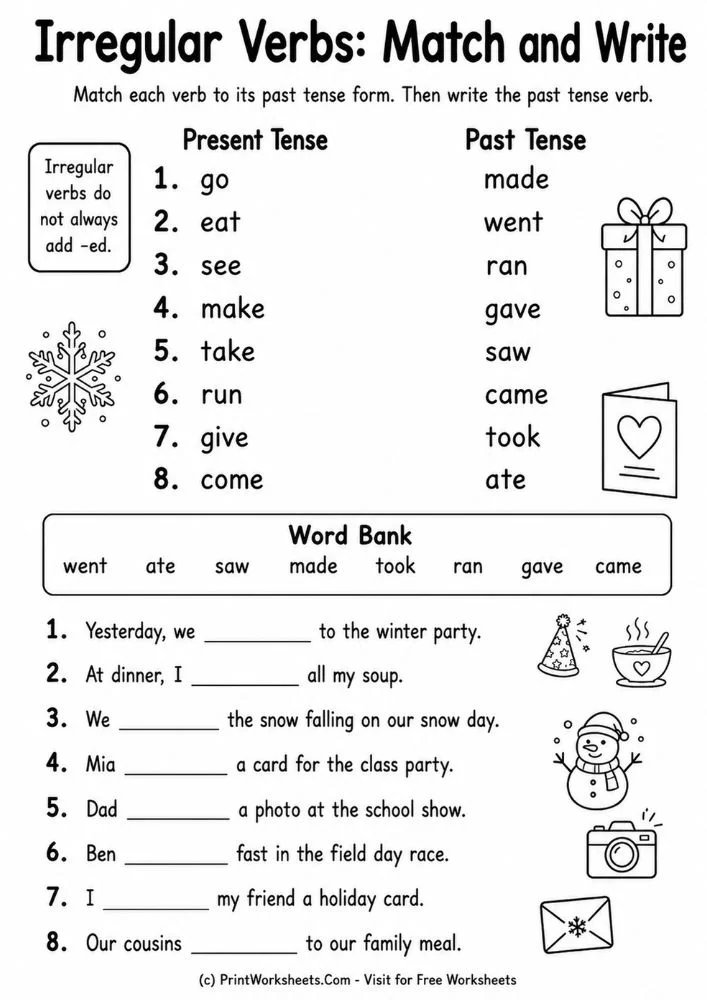
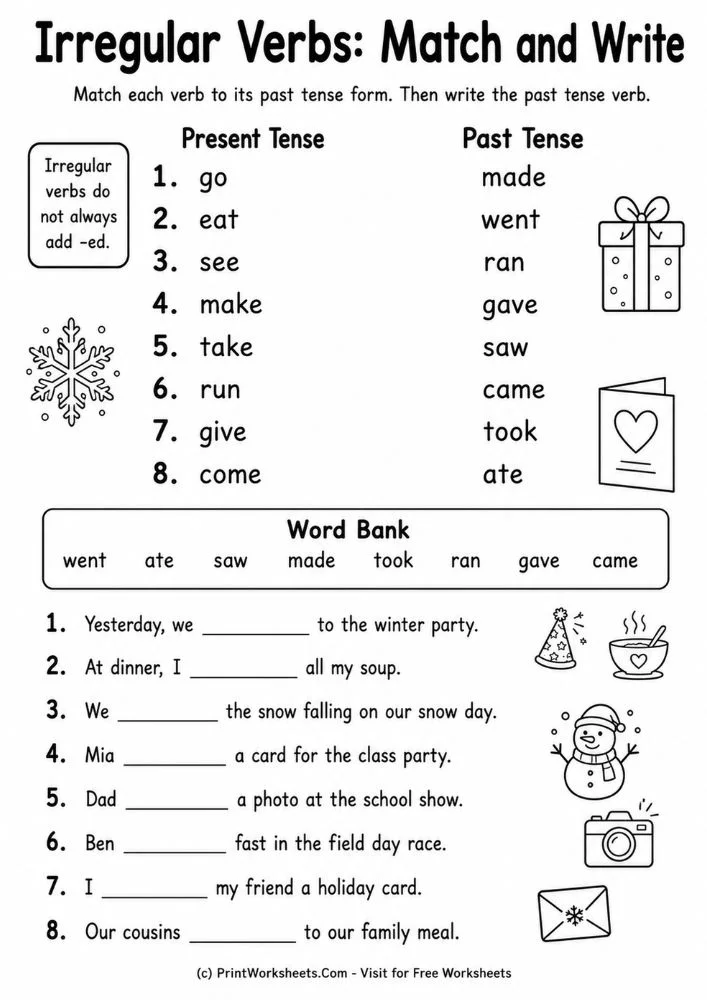
- Irregular Verbs Match and Write: Focused vocabulary and memory worksheets spanning two pages. Because irregular verbs do not follow the “-ed” rule, students view a list of present tense verbs (go, eat, see) next to a scrambled list of their past tense forms (made, went, ran). Students must mentally match the pairs, then use a provided word bank to fill in the correct irregular past tense verbs in eight distinct winter-themed sentences.
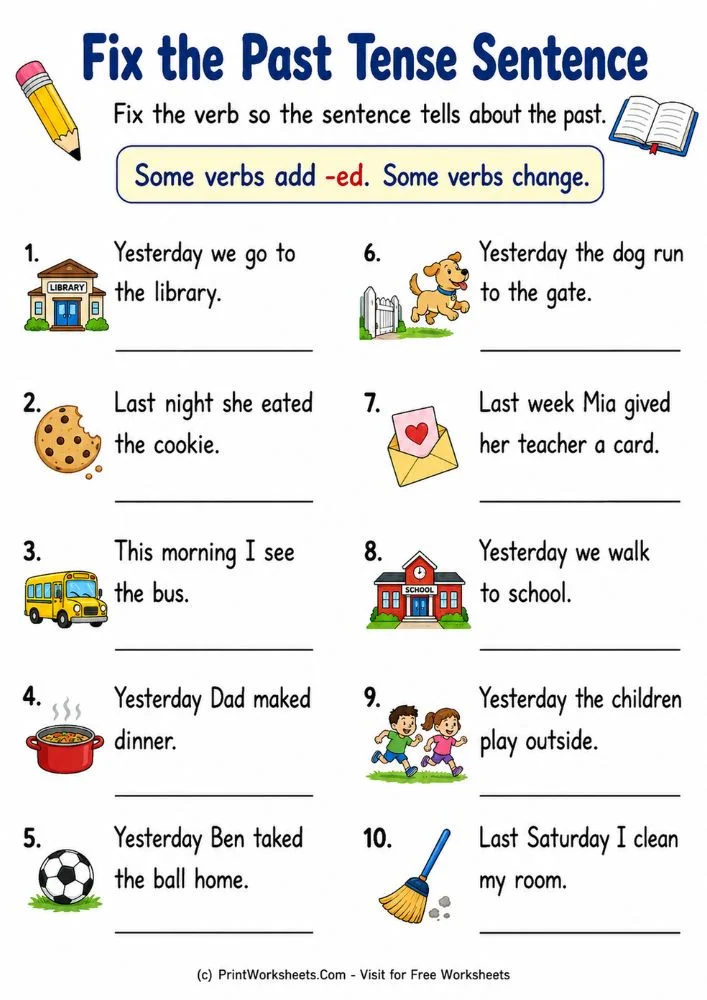
- Fix the Past Tense Sentence: A critical thinking and error analysis worksheet. Students evaluate 10 sentences written with incorrect grammar (e.g., “Last night she eated the cookie”). Students must identify the broken verb, cross it out, and rewrite the correct irregular or regular past tense form on the blank line provided. This mimics the actual editing process required for independent writing.
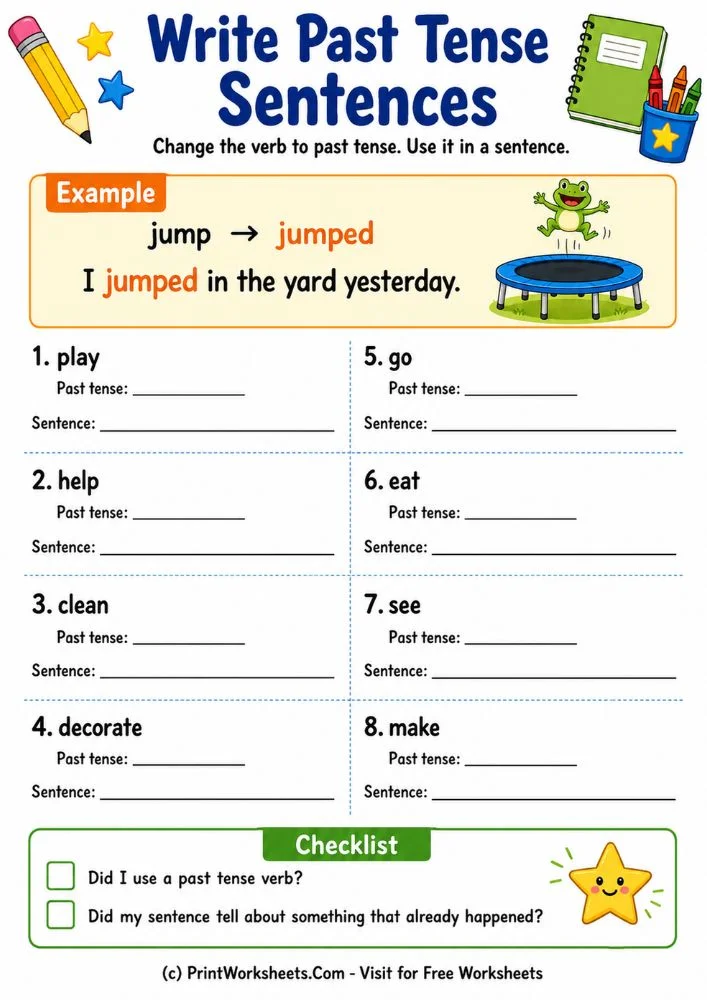
- Write Past Tense Sentences: An independent application worksheet. Students are given 8 base verbs. They must first write the correct past tense form on the short line. Then, they construct an entirely original sentence using that new past tense verb. A built-in checklist at the bottom forces students to self-evaluate if their sentence truly tells about something that already happened.
Differentiation Options for Teachers
To support struggling learners during these activities, provide a visible anchor chart or a “personal verb dictionary” that lists common irregular pairings. Allow them to physically circle the action word in the present tense sentence before attempting to rewrite it. For advanced or gifted writers, remove the word banks entirely. Instead of writing isolated sentences on the final page, challenge them to write a cohesive short story that incorporates at least five different irregular past tense verbs from the lesson.
Targeted Academic Skills
These printables are specifically aligned with core ELA standards (such as CCSS.ELA-LITERACY.L.2.1.D), which require students to form and use the past tense of frequently occurring irregular verbs. Mastery of this skill directly impacts a student’s reading comprehension, as they must accurately understand the timeline of events in a narrative text, and elevates the syntactic maturity of their own written compositions.
Frequently Asked Questions
Why is it so hard for kids to learn irregular verbs?
Young children naturally look for patterns in language. Once they learn that adding “-ed” makes a verb past tense (played, jumped), their brains logically apply that rule to every verb, resulting in “overregularization” (words like “runned” or “eated”). Utilizing regular and irregular verbs worksheets forces students to break this automatic pattern and memorize the linguistic exceptions through targeted repetition and context reading.
What grade levels use these verb printables?
These grammar activities align perfectly with standard 2nd and 3rd-grade core English Language Arts expectations. While 1st-grade students learn the basic “-ed” rule, 2nd-grade educators heavily utilize these exact pages to formally introduce and assess the memorization of irregular verbs, ensuring students can consistently tense their daily independent writing journals.
How can I assess if a student has mastered irregular verbs?
True mastery is demonstrated when a student spontaneously uses the correct irregular past tense verb in their independent, unprompted creative writing without relying on a word bank or an anchor chart. While these worksheets build the foundational knowledge, the ultimate goal is seamless application in everyday communication.