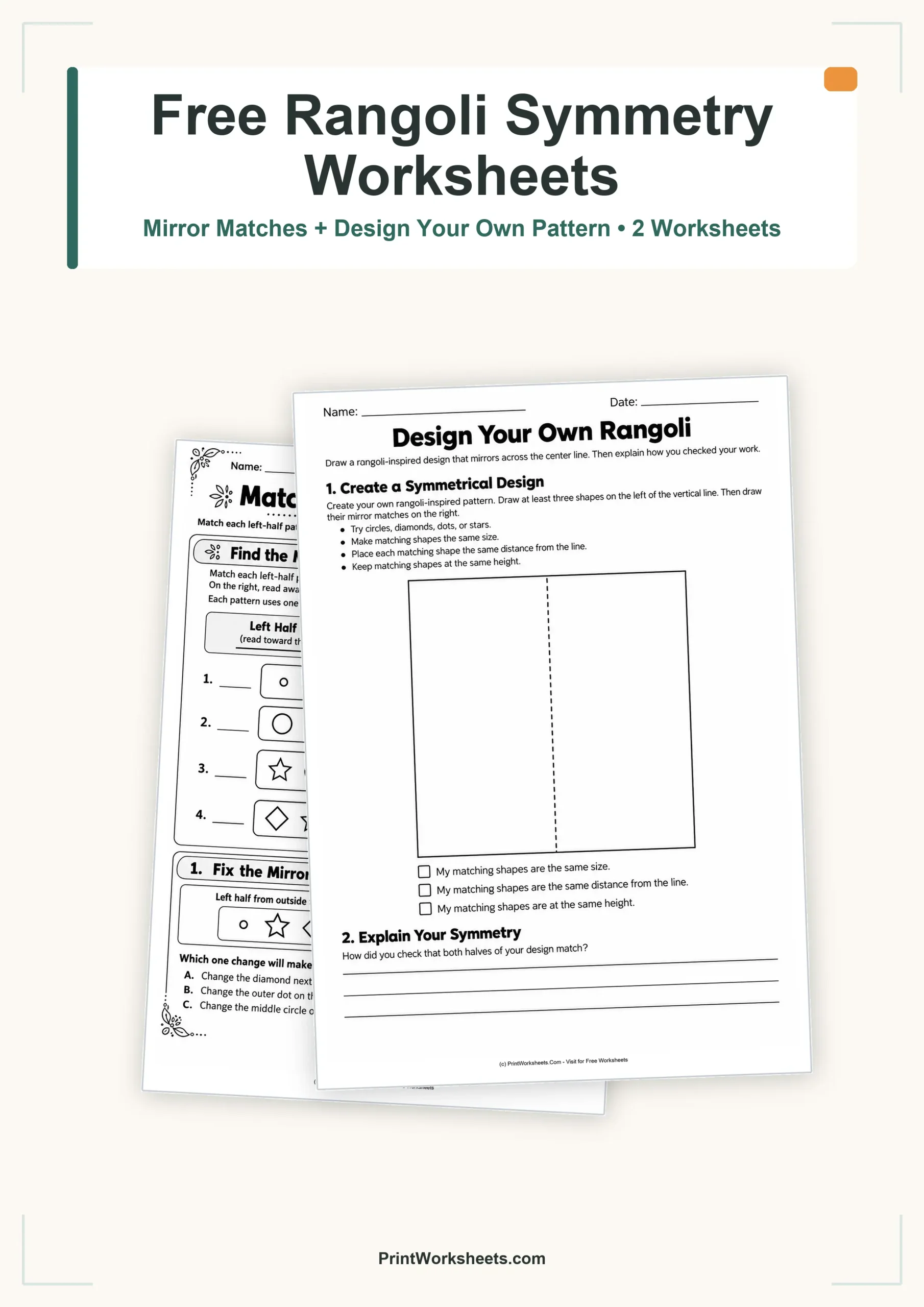
A dot, a diamond, and a star can make a simple pattern, but what happens when that pattern meets a mirror line? These rangoli symmetry worksheets help children discover how shapes change position when reflected across a vertical axis. Inspired by the geometric arrangements found in rangoli art, the two printable activities combine careful observation, pattern matching, creative drawing, and mathematical explanation. They are especially useful for third-grade geometry, with opportunities for supported second-grade practice.
Explore Rangoli Symmetry Worksheets Through Mirror Patterns
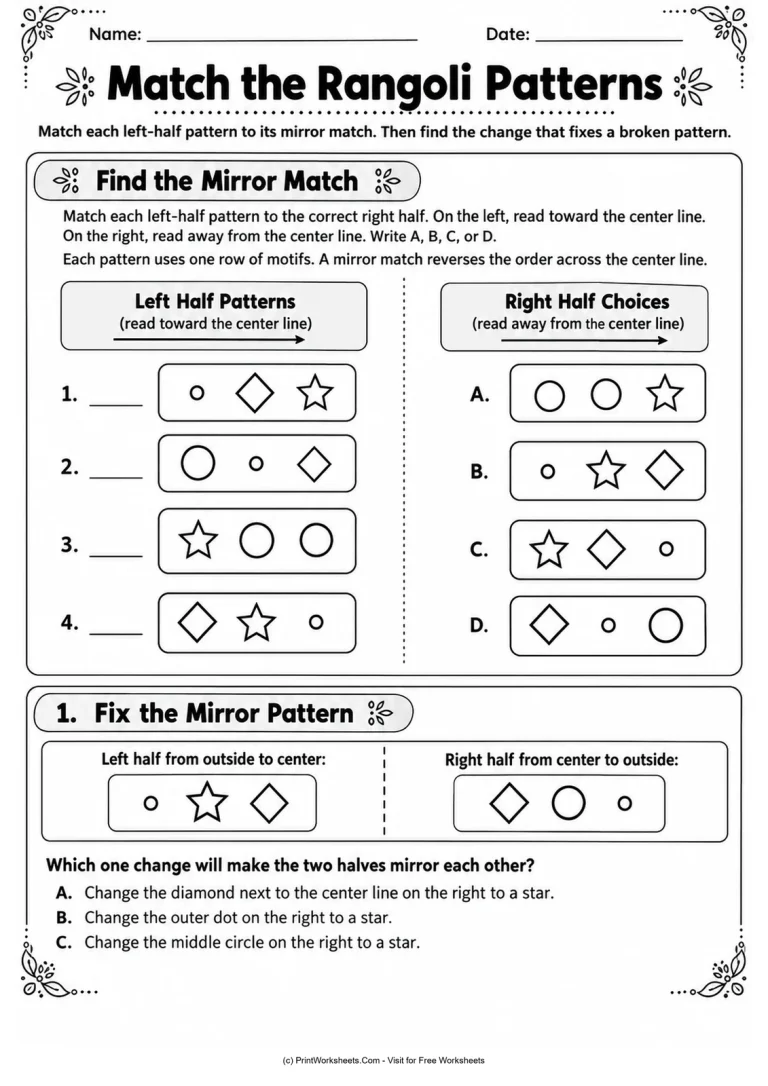
The first activity, Match the Rangoli Patterns, begins with four rows of familiar shapes. Students see dots, diamonds, stars, and circles arranged on the left side of a dotted center line. Their task is to choose the correct right-half pattern from four lettered options.
The important detail is direction. Students read the left-half pattern toward the center, but read the right-half pattern away from the center. That means a correct reflection reverses the order of the shapes. For example, a dot followed by a diamond and a star must be matched with a star followed by a diamond and a dot. A row containing the correct shapes in the wrong order is not a mirror match.
Match Four Shape Sequences
Each numbered question has one matching answer among choices A through D. Some patterns use two different circle sizes, while others combine stars, diamonds, and small dots. Children must notice both the identity of each shape and its position relative to the center line. The repeated format makes the instructions easy to follow while the changing arrangements require close attention.
Before students begin, demonstrate with three simple objects or shapes placed in a row. Point to the shape nearest the imaginary mirror and ask which shape should appear first on the other side. Then have students work through the four printed matches independently or with a partner.
Find the One Change That Repairs the Mirror
The same worksheet includes a second challenge called Fix the Mirror Pattern. On the left, students see a small dot, a star, and a diamond, moving toward the center line. The right side begins correctly with a diamond, but its middle shape is a circle instead of a star. Students choose which of three suggested changes restores the reflection.
This question moves beyond selecting a matching row. It asks children to locate an error and reason about the exact position that needs attention. Changing a shape just because it looks different is not enough; the change must make the two complete sequences correspond.
Design Your Own Rangoli with a Line of Symmetry
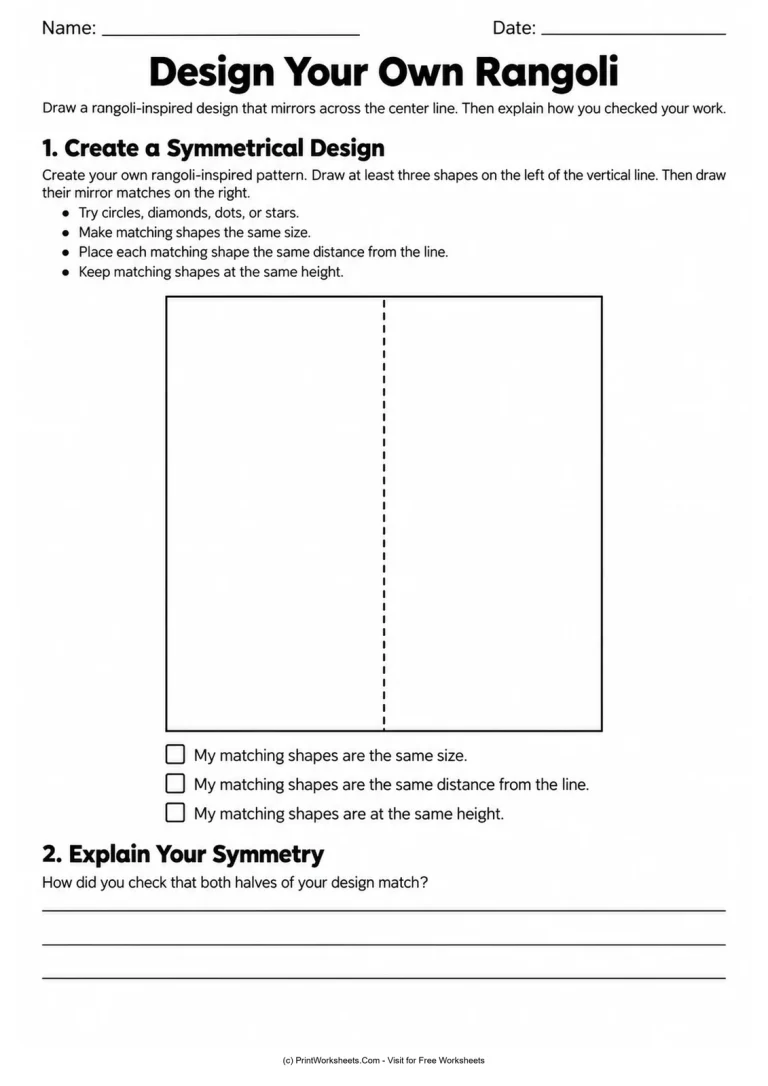
The second printable, Design Your Own Rangoli, gives students responsibility for creating the pattern rather than recognizing one that is already provided. A large rectangular drawing space is divided into two equal sections by a vertical dashed line. Students draw at least three shapes on the left and then create their mirror matches on the right.
Children may use circles, diamonds, dots, or stars, or arrange those shapes into a more elaborate rangoli-inspired design. The goal is not simply to repeat the same collection of shapes on both sides. Each corresponding pair must have the same size, appear at the same height, and sit the same distance from the symmetry line.
The large open drawing area allows students to experiment with different arrangements. One child might use three shapes in a horizontal sequence, while another could place shapes at different heights to form a more complex composition. Both approaches can show accurate reflection when the paired shapes are positioned correctly.
Use the Symmetry Checklist and Explain Your Thinking
After drawing, students review three statements: their matching shapes are the same size, the same distance from the line, and at the same height. A checkbox beside each statement encourages them to inspect their own work rather than assume that a visually balanced design must be correct.
The final question asks how they checked that both halves match. A useful explanation might describe comparing each pair of shapes or measuring the space between each shape and the center line. This writing component helps teachers distinguish students who understand reflection from those who have produced a roughly similar picture.
Teaching and Checking the Two Printable Activities
For a short geometry lesson, begin with the matching page and ask students to describe why an answer is correct. The four matching answers are 1-C, 2-D, 3-A, and 4-B. In the broken-pattern question, choice C is correct because the middle circle on the right must become a star.
Follow with the drawing activity. Encourage children to inspect one corresponding shape pair at a time, starting nearest the mirror line. If a shape is too high, too low, too large, or too far from the center, invite them to correct it before checking the related statement.
For extra challenge, ask students to add another pair of shapes without breaking the symmetry. For students who need support, begin with three clearly separated shapes at the same height before introducing positions above or below one another.
These free printable worksheets bring together recognizing, repairing, constructing, and explaining reflection symmetry. They work well for a focused geometry lesson, an independent math center, or a creative follow-up activity connected to rangoli-inspired pattern art.