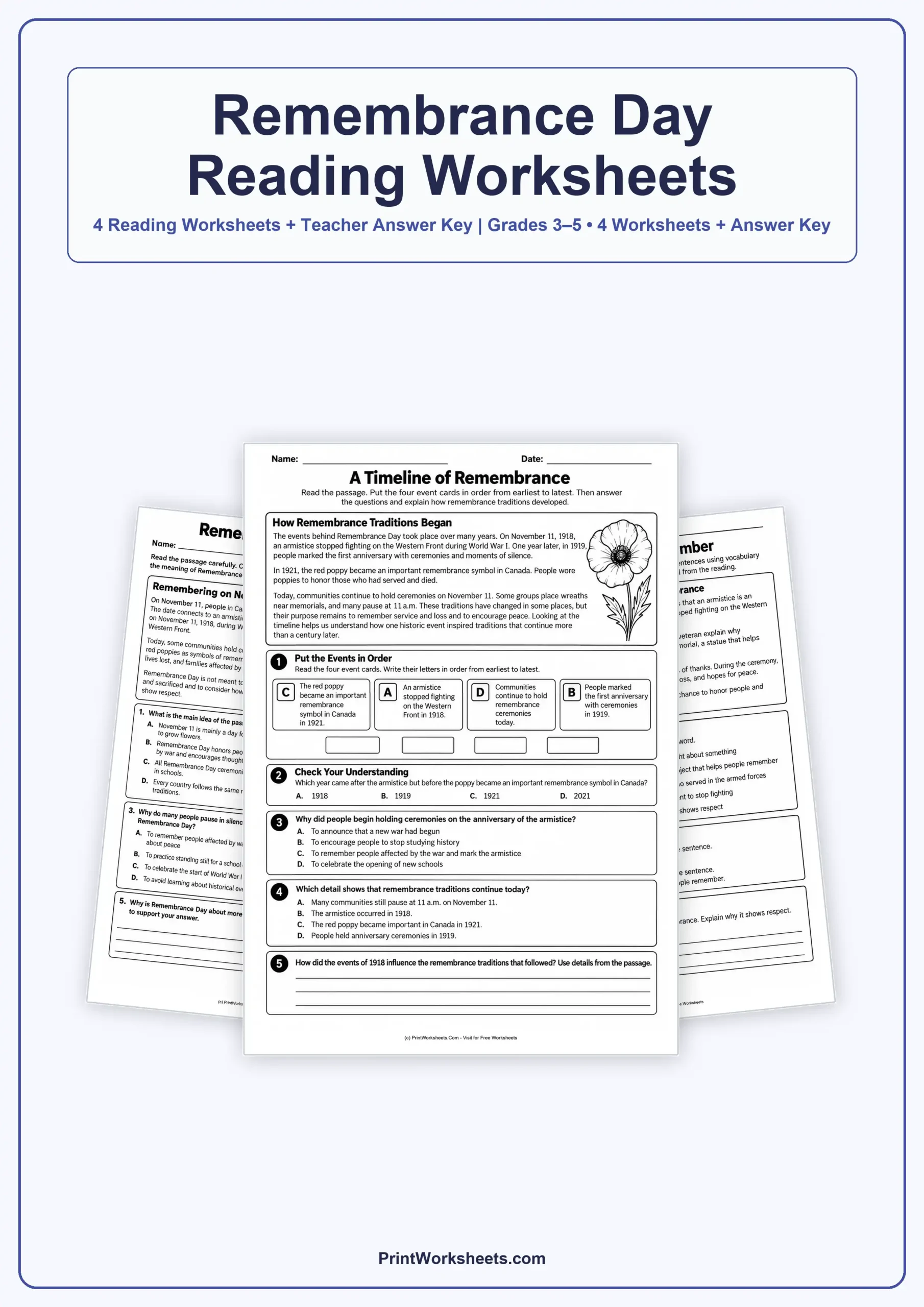
Remembrance Day reading comprehension gives students a way to explore why November 11 matters through history, vocabulary, and thoughtful responses to text. This free printable PDF contains four student worksheets and a teacher answer key. The readings connect the 1918 armistice with remembrance traditions, then invite children to place events in order, learn important words, and compare two community gatherings. Instead of repeating the same question format, each page offers a different way to show understanding.
Remembrance Day Reading Comprehension: November 11 and Its Meaning
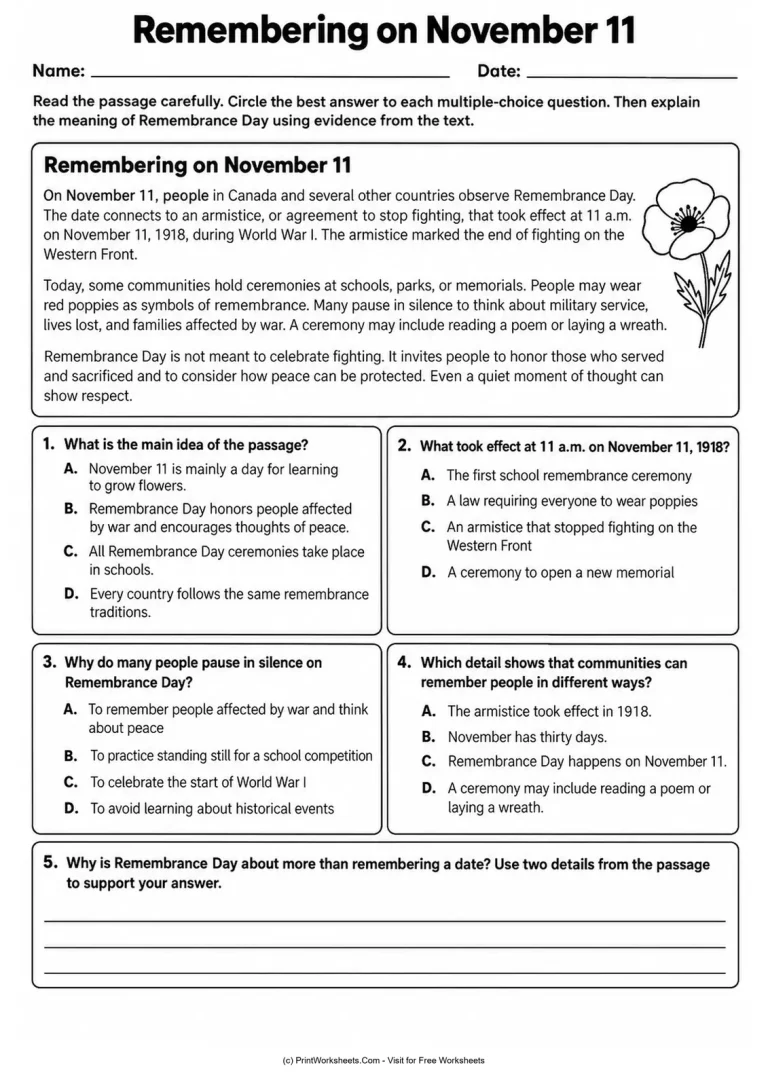
The first worksheet, Remembering on November 11, introduces the armistice that took effect at 11 a.m. on November 11, 1918, ending fighting on the Western Front during World War I. The passage describes how people in Canada and other countries observe Remembrance Day through ceremonies, red poppies, moments of silence, poems, and wreaths. It explains that the day is an opportunity to honor those who served and sacrificed, consider lives affected by war, and think about peace rather than celebrate fighting.
Four multiple-choice questions ask students to identify the main idea, recall the armistice, interpret the purpose of silence, and recognize that communities remember in different ways. The final question asks why the day means more than remembering a date. Students must draw on two details from the passage, moving beyond recalling facts to supporting an explanation with text evidence.
Put Remembrance Traditions on a Timeline
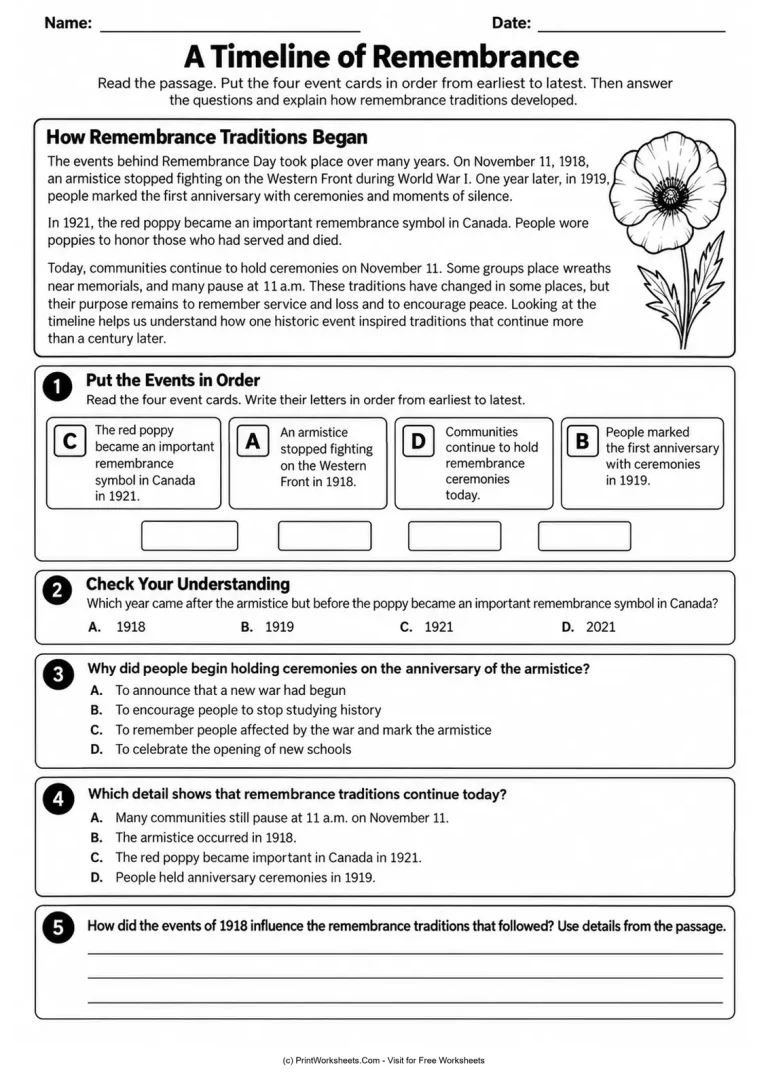
In A Timeline of Remembrance, readers follow four points in time: the 1918 armistice, anniversary ceremonies in 1919, the red poppy becoming an important symbol in Canada in 1921, and remembrance ceremonies today. Four labeled event cards appear in a mixed order. Students write the letters from earliest to latest, then answer questions about the year between the armistice and the poppy tradition, why ceremonies began, and how those traditions continue.
An open-ended prompt asks how events in 1918 influenced what people did afterward. This is a useful place to discuss the difference between simply knowing a date and explaining a historical connection. Students can point to anniversary ceremonies, wreaths, or shared silence as evidence of how remembrance continued over time.
Learn Five Words in Context
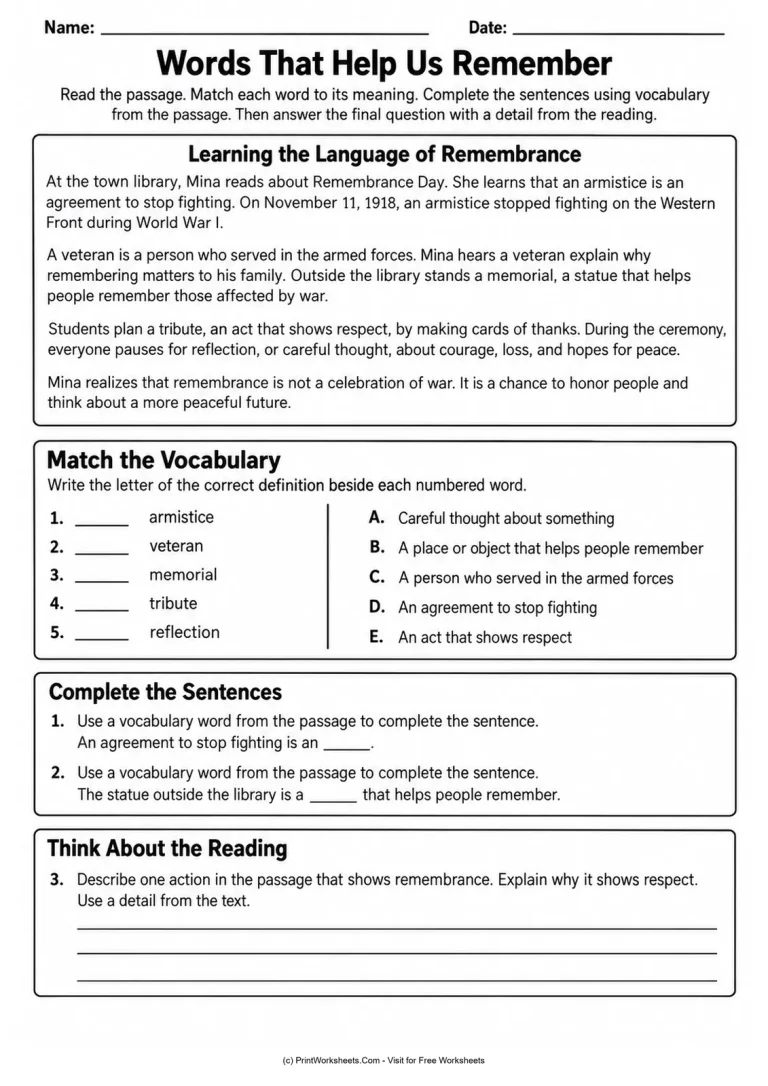
Words That Help Us Remember follows Mina as she reads at a town library and learns language connected with Remembrance Day. The story gives clear context for five terms: armistice, veteran, memorial, tribute, and reflection. Students match each term to its meaning, then complete two sentences with words from the reading. The last question asks them to describe an act of remembrance and explain why it shows respect, using a detail from the story.
This combination lets students recognize definitions before applying a word independently. It also connects vocabulary with actions, including thank-you cards and a quiet moment of thought, rather than treating the terms as an isolated spelling list.
Compare a Library Event and a School Ceremony
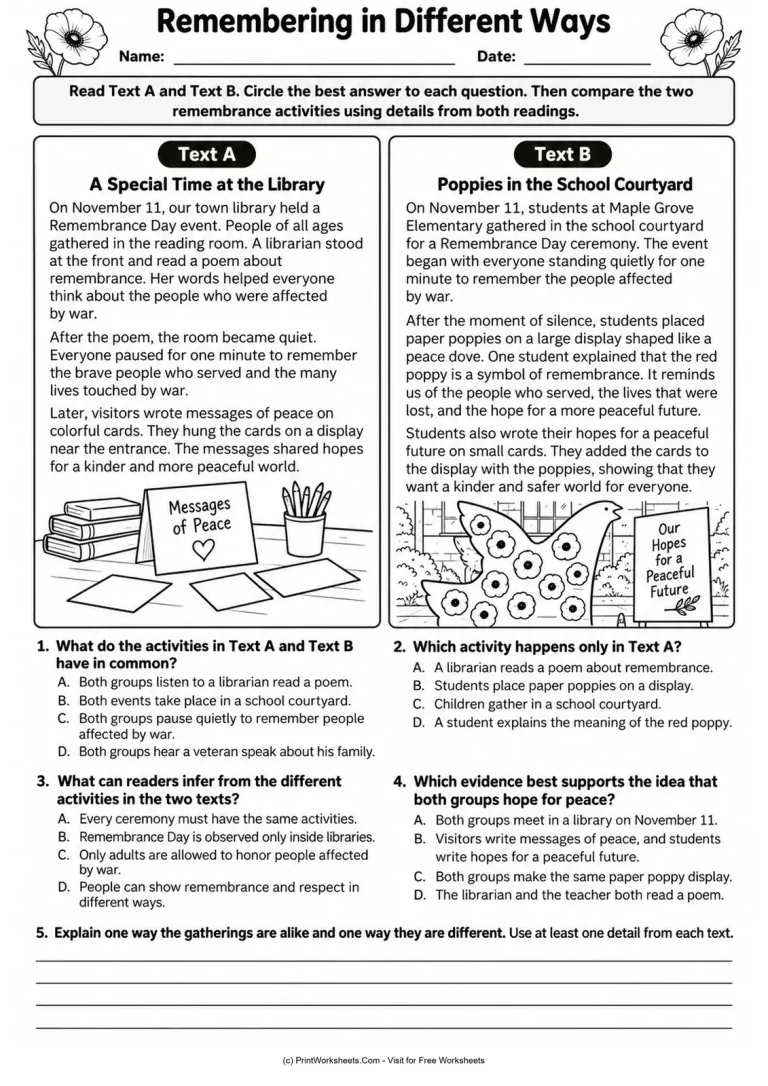
The fourth worksheet, Remembering in Different Ways, contains two short passages. Text A describes visitors at a library listening to a poem, observing silence, and hanging messages of peace. Text B follows students in a school courtyard as they pause quietly, place paper poppies on a dove-shaped display, and add hopes for a peaceful future. These are different settings with a shared purpose.
Questions guide readers to identify an activity the gatherings have in common, select an activity found only in Text A, make an inference about different ways to show respect, and choose evidence that both groups hope for peace. A written comparison then calls for one similarity and one difference supported by details from both texts. Students can practice looking back at each passage before writing, rather than answering from memory alone.
How to Use the Four Printable Worksheets
The set works as a short sequence for approximately Grades 3–5, with extra reading support as needed for younger students. Start with the introductory passage to establish the meaning of Remembrance Day. Use the timeline next to strengthen chronological reasoning, then the vocabulary page to revisit essential terms. Save the paired readings for a lesson on comparing passages and citing evidence. The worksheets can be completed across several sessions or assigned separately according to the skill being taught.
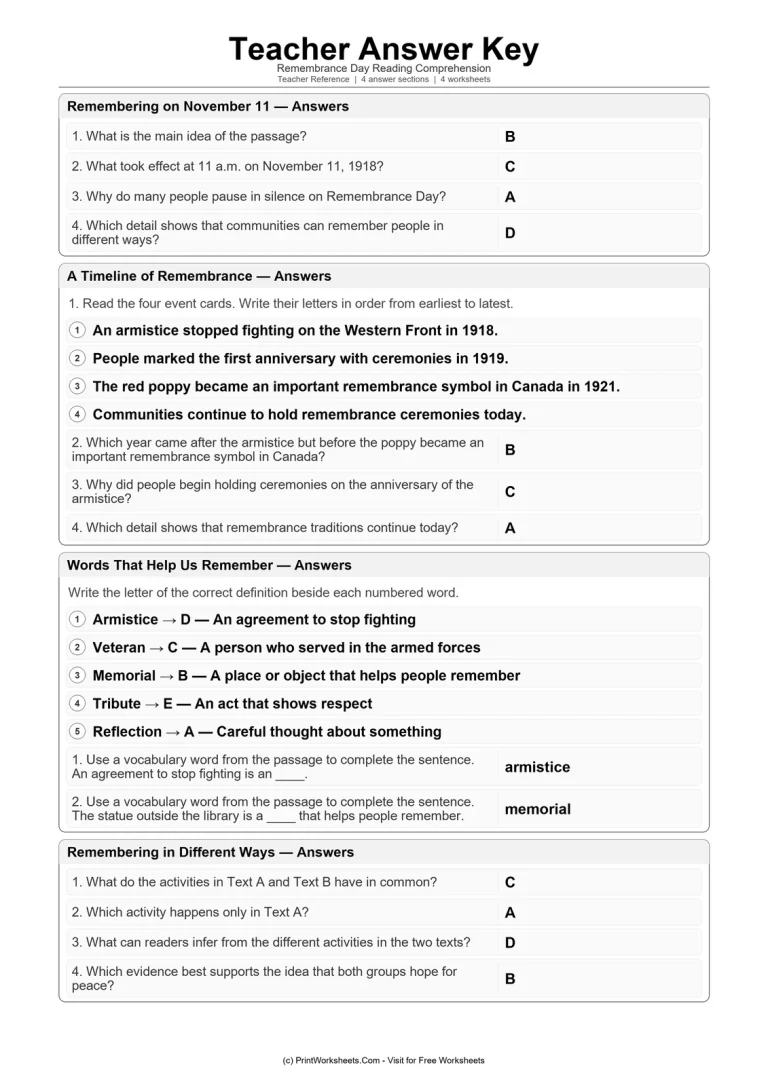
The included teacher answer key covers the multiple-choice items, timeline sequence, vocabulary matching, and sentence completions. For the open-ended questions, look for accurate explanations supported by the passages rather than requiring every student to use identical wording. The black-and-white pages have space for student names and written answers, making them suitable for classroom printing or guided practice at home.
Extend the Discussion With Care
After completing the readings, invite students to discuss why a moment of silence, a poppy, a poem, or a message of peace might be meaningful. Encourage respectful questions and keep the focus on remembrance, service, loss, and hopes for peace. For a separate U.S. observance with related reading practice, see our Memorial Day reading comprehension worksheets. The two holidays have different histories, so they can also provide a thoughtful comparison of how communities honor people affected by war.