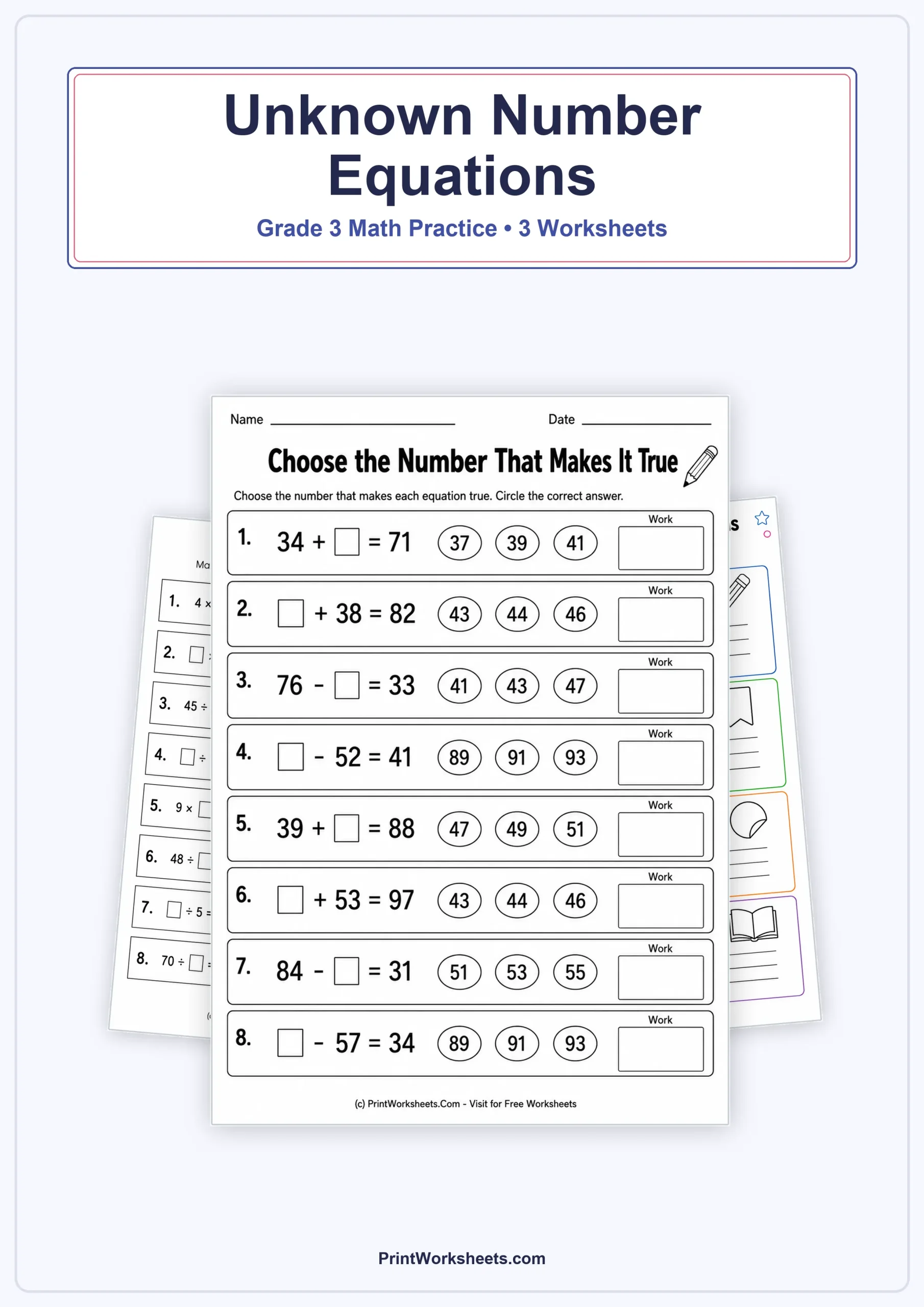
These unknown number equations worksheets give Grade 3 students practice finding missing values in multiplication, division, addition, and subtraction equations. The three-page set moves beyond one repeated format: students first solve and match missing-number facts, then choose values that make two-digit equations true, and finally build and solve equations from short story problems. That variety makes the worksheets useful for independent practice, small-group instruction, math centers, or a focused review of early algebraic thinking.
Practice Unknown Number Equations Across Four Operations
Finding an unknown number requires students to think about the relationship between quantities rather than simply calculate from left to right. In this set, the missing value appears in different types of equations, so students must decide which operation relationship will help them solve. Examples such as 4 × □ = 32 and 45 ÷ □ = 5 reinforce multiplication and division facts while also showing that an unknown can appear in different positions within an equation.
The addition and subtraction work extends that reasoning to two-digit numbers. Students are not only asked to compute an answer; they must identify which number makes the entire equation true. This supports the idea that the equal sign describes a balanced relationship between two expressions.
Match the Missing Numbers
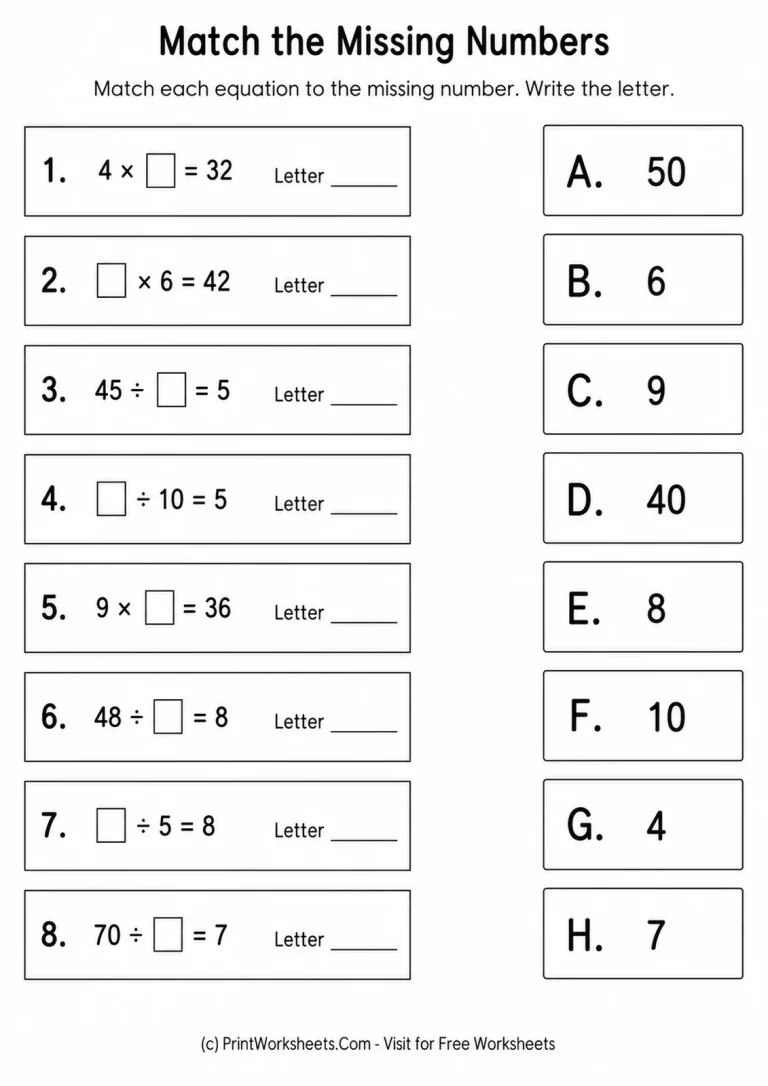
The first approved activity, Match the Missing Numbers, presents eight multiplication and division equations. Students solve each missing value and connect it with one of the lettered A-H answer choices. Because each choice has a unique match, students can use both computation and elimination as they work through the page.
This format is especially useful for practicing basic multiplication and division relationships without turning the exercise into a long column of identical problems. Students encounter unknowns in several equation positions, which encourages flexible reasoning instead of memorizing one fixed procedure.
Choose the Number That Makes It True
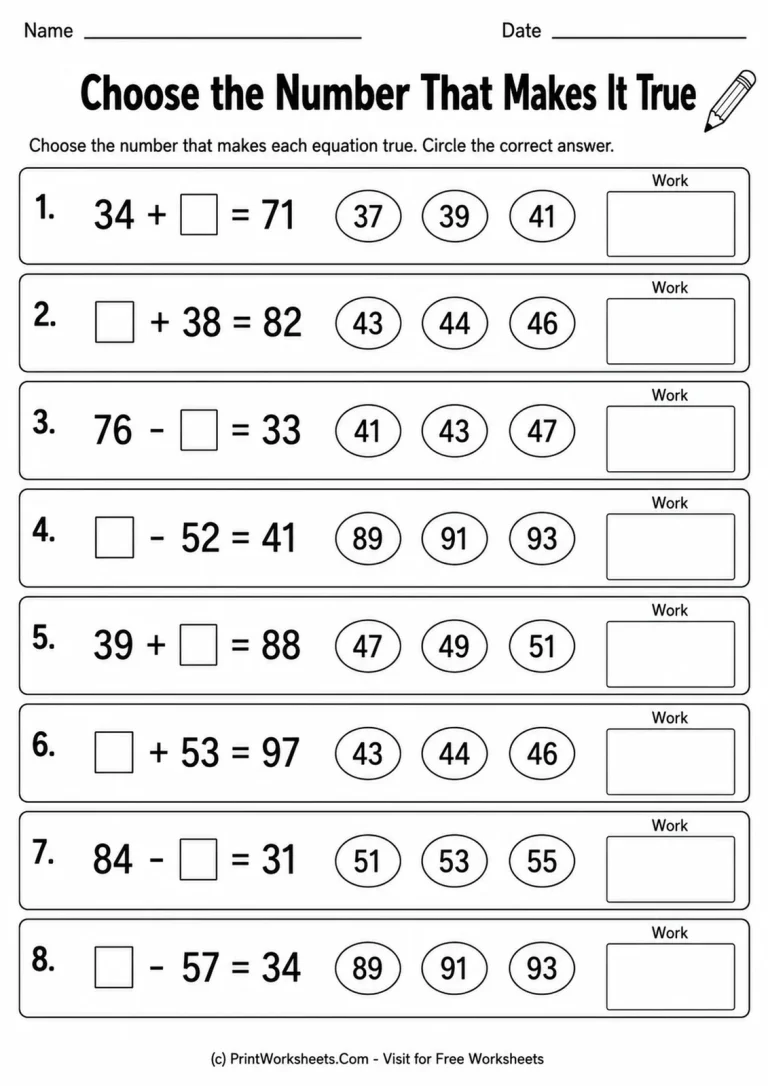
The second worksheet focuses on eight two-digit addition and subtraction equations. Each problem includes three possible missing numbers, and students choose the value that makes the equation true. A separate Work box gives them space to calculate, check an inverse operation, or record another strategy.
The multiple-choice structure can help teachers quickly see whether a student understands the equation or is relying on a calculation error. It also works well for independent practice because students have a clear set of choices while still needing to show mathematical thinking in the work area.
Turn Story Problems Into Unknown-Number Equations
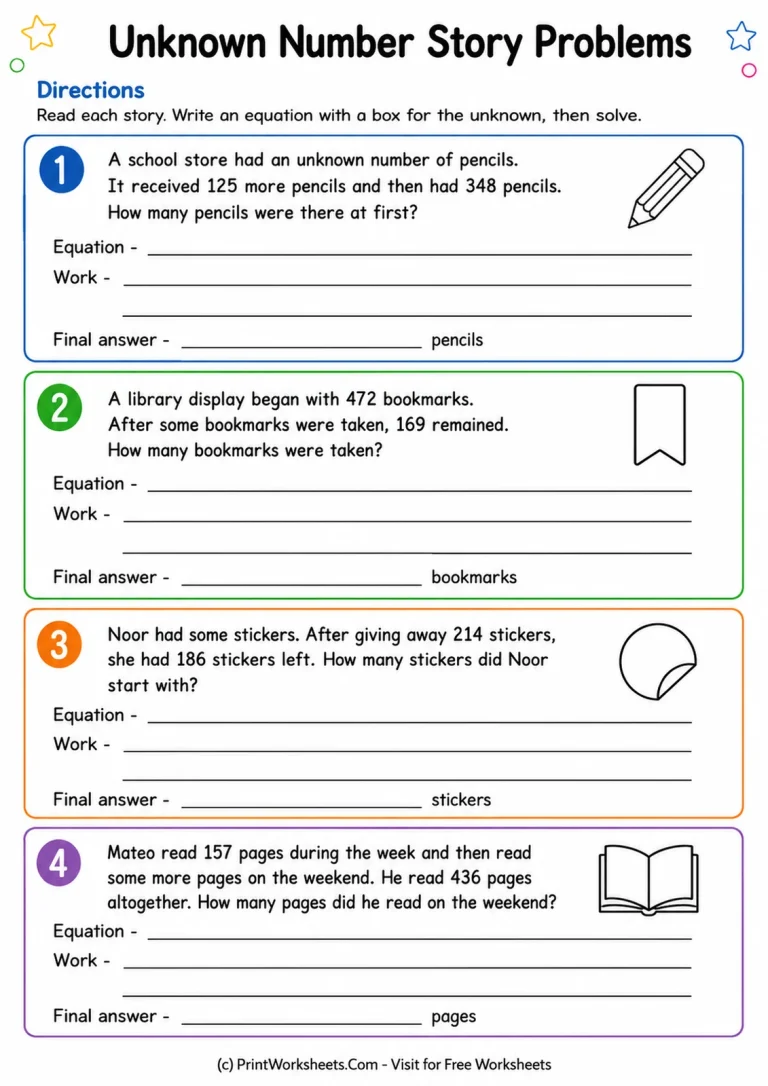
The final worksheet, Unknown Number Story Problems, asks students to move from a real-world situation to a mathematical equation. Four problems use familiar contexts involving pencils, bookmarks, stickers, and pages read. For each situation, students write an equation with a box for the unknown, show their work, and record the final answer with the correct unit.
This step is important because solving an equation and creating an equation are different skills. A student may be able to calculate when the numbers are already arranged but still need practice deciding which quantity is unknown and how the story should be represented mathematically. These problems give students that additional layer of reasoning.
A Useful Progression for Grade 3 Algebraic Thinking
The sequence of the set gradually increases the amount of decision-making required. Matching multiplication and division equations begins with relatively direct fact-based reasoning. The addition and subtraction page adds two-digit computation and distractor choices. The story-problem page then removes the ready-made equation and requires students to represent the situation themselves before solving it.
Teachers can use the pages in order as a short progression, or select one page to target a particular need. A student who needs fact-family practice may benefit most from the multiplication and division matching activity. A student working on equality and two-digit operations can concentrate on the multiple-choice equations. Students who can solve equations confidently but struggle with mathematical modeling can spend additional time on the story problems.
Ways to Use These Worksheets
These printable pages can fit into several Grade 3 routines. Use one as a math-center task, assign a page for independent practice after an unknown-number lesson, or place selected problems in a small-group intervention session. The Work boxes and written equation spaces also make it easier to look at how students arrived at an answer rather than checking only the final number.
For an added challenge, ask students to explain how they know a missing value is correct or to check an addition problem with subtraction and a multiplication problem with division. Students can also create a new story problem that could be represented by one of the equation structures they practiced. With three distinct activity formats, the set provides focused practice while keeping the central skill consistent: understanding and solving equations with an unknown number.