


Sourcing rigorous, standards-aligned math practice for early learners requires resources that balance cognitive accessibility with clear academic outcomes. This Spring Math Worksheets for Kindergarten Printable PDF delivers targeted practice for foundational numeracy skills, focusing on cardinality, basic operations, and non-standard measurement. Designed for independent morning work, math centers, or formative assessment, these printables integrate into early childhood lesson plans without requiring extensive preparation. For additional seasonal integration across other instructional domains, explore our complete category of spring worksheets.
What Skills Are Included in This spring kindergarten math worksheets pdf?
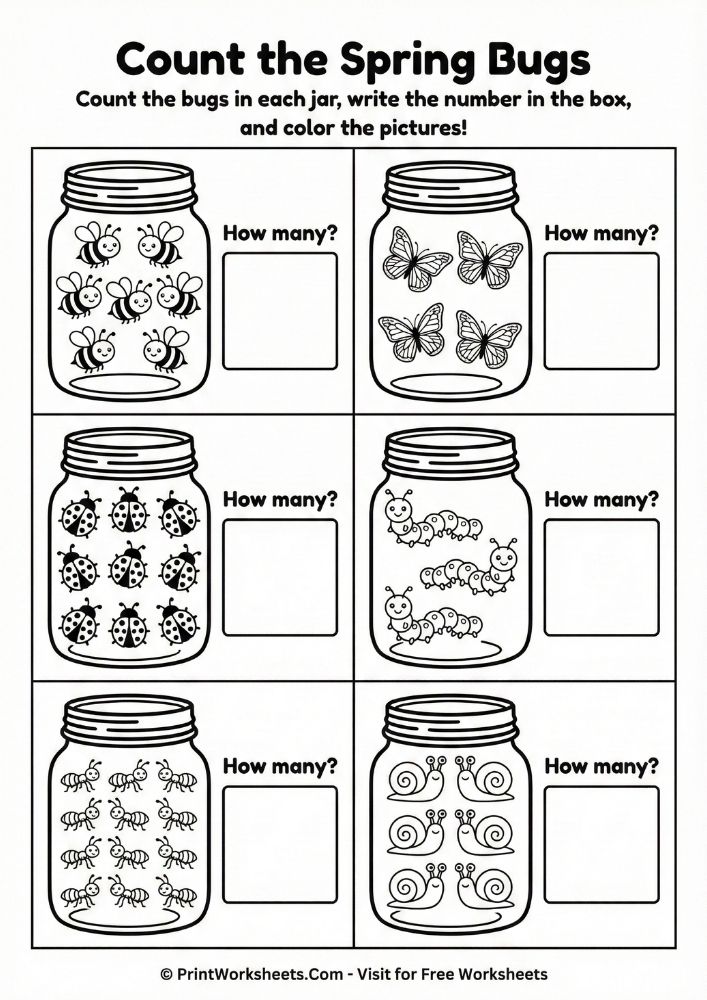
- Counting and Cardinality: The “Count the Spring Bugs” activity requires students to quantify insect illustrations in jars and assign the correct numeral. This aligns with CCSS.Math.Content.K.CC.B.4.
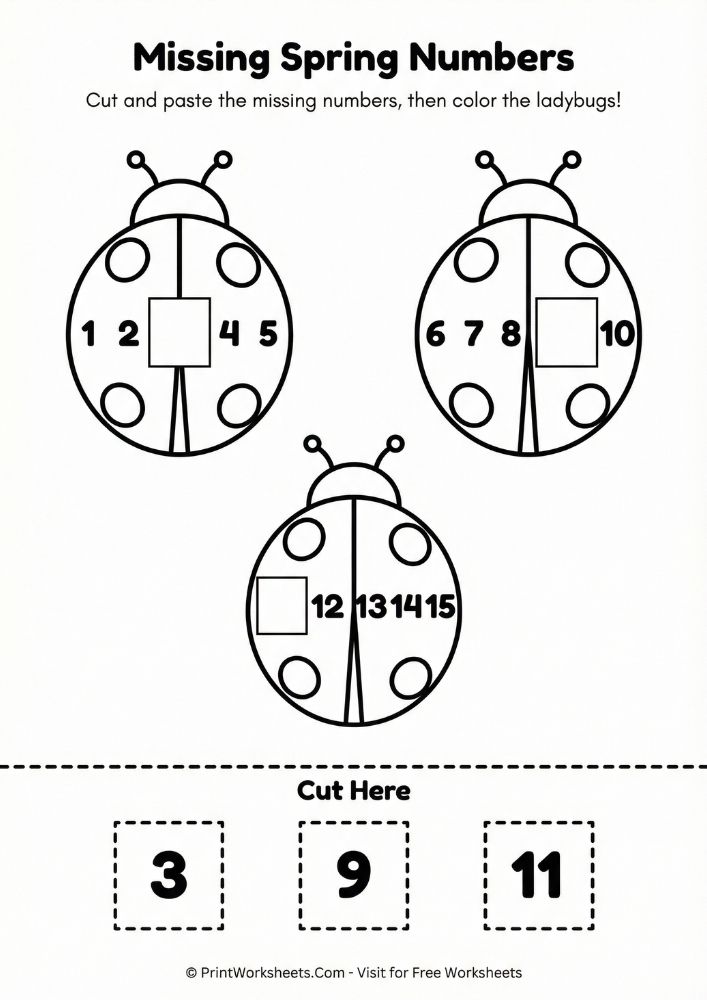
- Number Sequencing: The “Missing Spring Numbers” page tasks students with cutting and pasting the correct missing integers onto ladybugs to complete numerical sequences up to 15.
- Operations and Algebraic Thinking: Students practice visual addition by combining groups of flowers. The “Rainy Subtraction” worksheet provides a visual scaffolding model where students cross out raindrops to solve equations like 5-2 and 6-3.
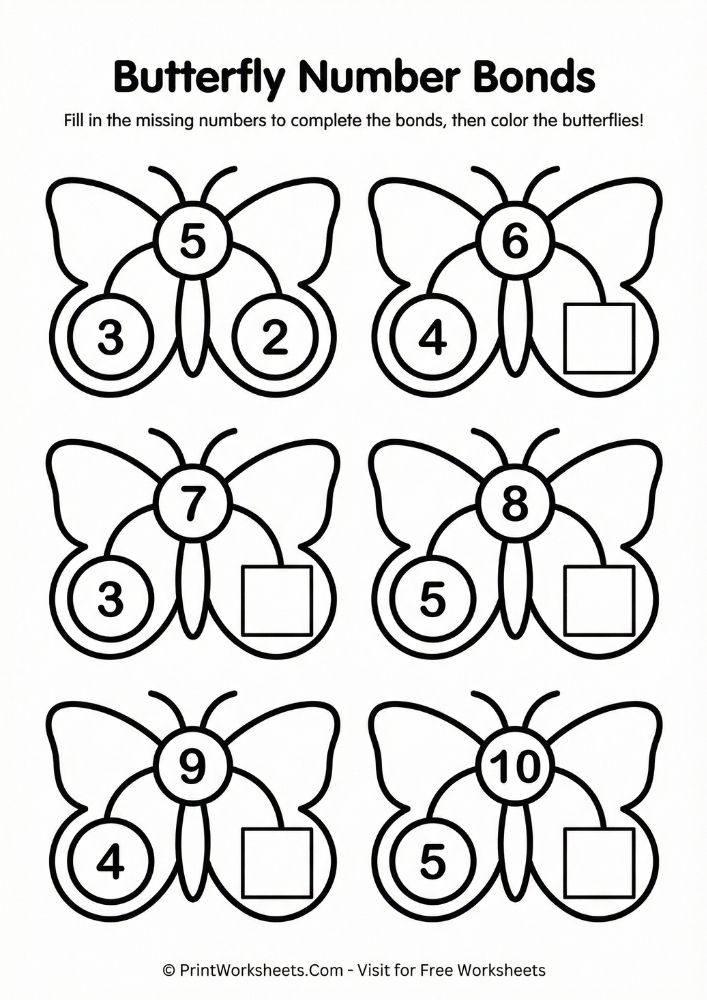
- Decomposing Numbers: The “Butterfly Number Bonds” activity introduces part-part-whole relationships, asking students to supply the missing addend for sums up to 10.
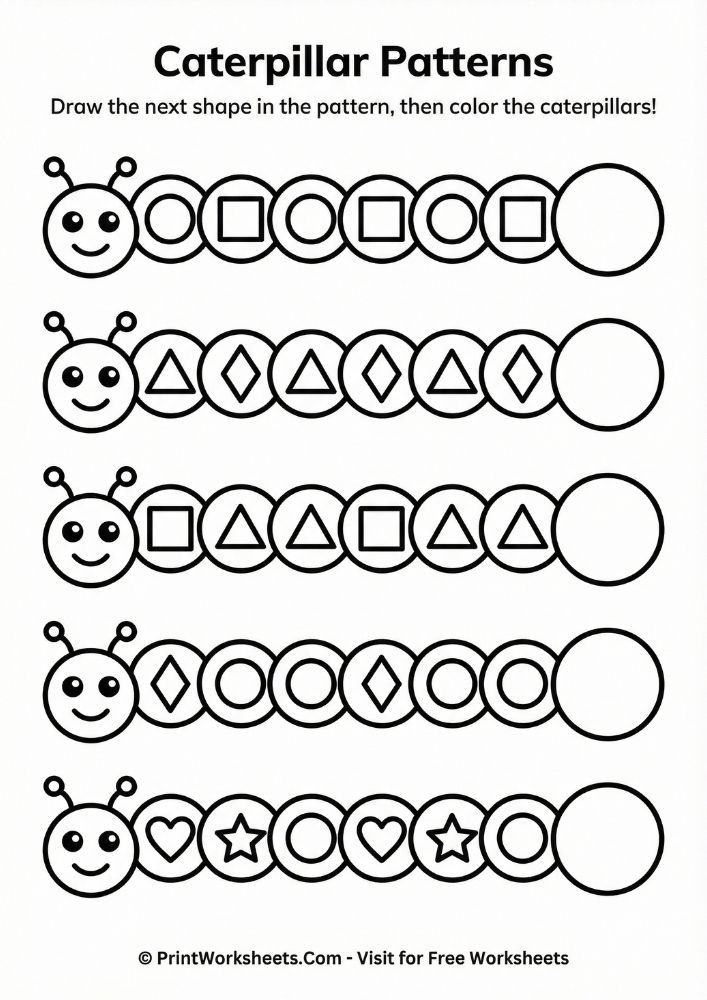
- Geometry and Patterning: The “Caterpillar Patterns” page develops spatial reasoning by prompting students to draw the next shape in repeating 2D geometric sequences.
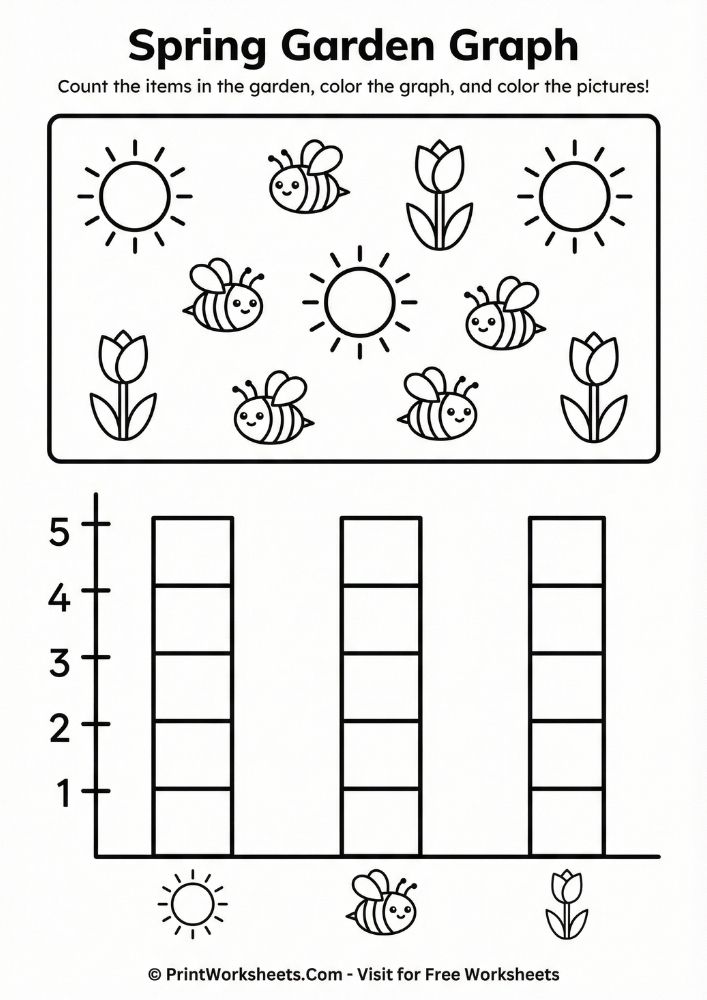
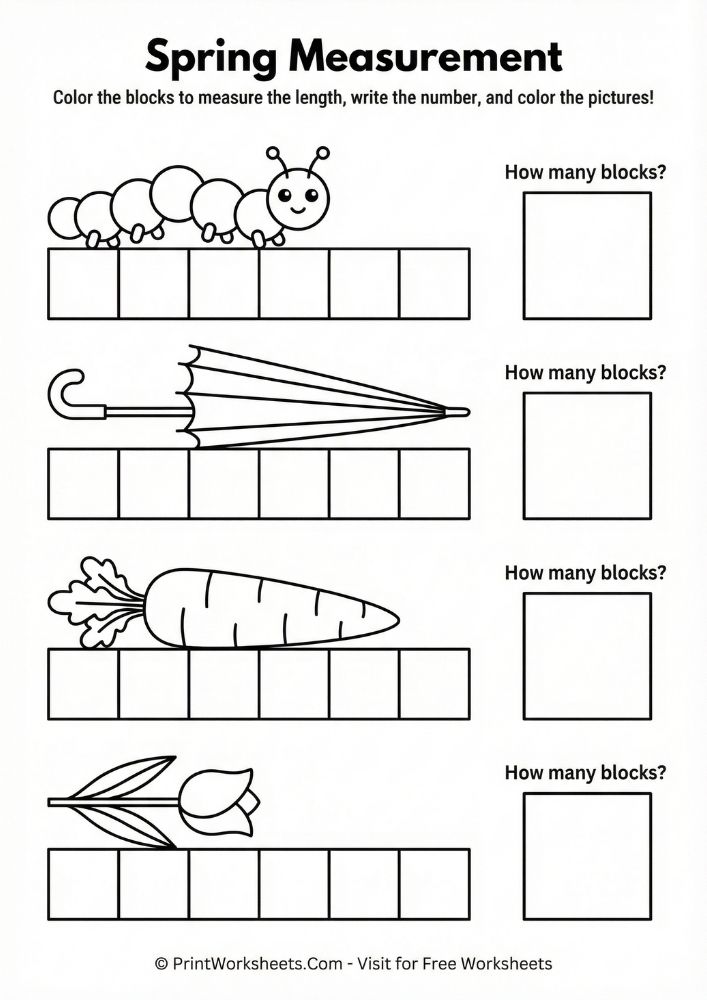
- Measurement and Data: Students are introduced to non-standard measurement by coloring blocks to determine the length of spring objects like umbrellas and carrots. Additionally, the “Spring Garden Graph” requires students to sort, count, and graph visual data points up to 5.
Why This Works for Kindergarten
At the kindergarten developmental stage, learners rely heavily on concrete visual models to transition toward abstract mathematical reasoning. The instructional design of these worksheets prioritizes structured, uncluttered layouts with highly familiar seasonal entities like insects, plants, and weather elements. The “Rainy Subtraction” page effectively reduces cognitive load by explicitly prompting students to cross out the visual representations to find the difference. This targeted approach ensures that early learners can focus directly on the mathematical operations rather than deciphering complex instructions.
Classroom Differentiation
Scaffolding
For students developing fine motor skills or requiring concrete representations, pair the addition and subtraction pages with physical manipulatives such as counting cubes. Providing a desktop number line will also assist students who are still mastering independent numeral writing during the “Missing Spring Numbers” cut-and-paste activity.
Extension
Challenge advanced learners to write corresponding inverse equations on the back of the “Butterfly Number Bonds” page. Alternatively, instruct early finishers to verbally dictate their own comparative story problems using the data collected in the “Spring Garden Graph” activity.
Small Group Strategy
Utilize the “Spring Measurement” page during a teacher-led math center. This facilitates guided mathematical discourse, allowing the educator to prompt vocabulary development as students compare lengths using academic terms like “longer than” or “shorter than.”
FAQ
Is this suitable for struggling readers?
Yes. The worksheets utilize distinct visual cues and consistent formatting to minimize reading barriers. Directions are explicit, brief, and easily modeled by the teacher, such as “Draw the next shape in the pattern” or “Cross out the raindrops to subtract”.
What standards does this align with?
This resource supports Common Core State Standards for Kindergarten Mathematics. It specifically targets counting and cardinality, operations and algebraic thinking through visual addition and subtraction , geometry via shape patterns , and measurement and data through graphing and block measurement.
Can this be used for homework?
The intuitive layout and focus on independent skill review make this packet highly effective for homework. Parents can easily guide students through activities like counting bugs or coloring the correct number of measurement blocks.
How many pages are included?
The PDF download contains 10 total pages. This includes a cover page, 8 distinct student activity pages covering various math domains, and a final terms of use page.