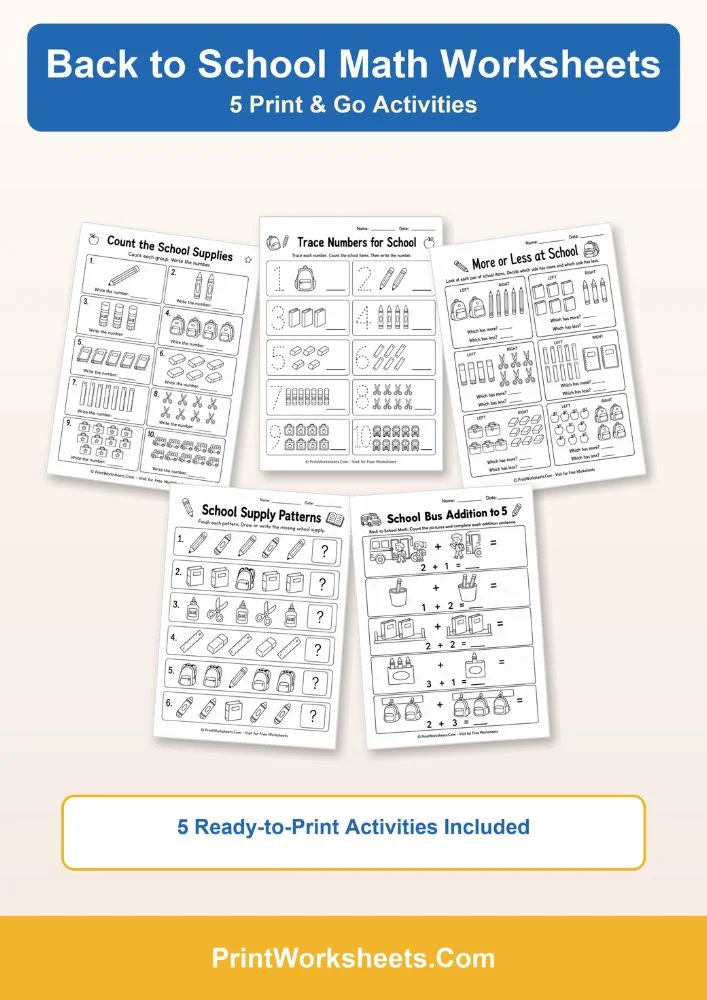
Teachers can smoothly evaluate early arithmetic baseline skills using our free printable back to school math worksheets. Finding high-quality, visual-based review pages that don’t overwhelm students during the chaotic first week is a major challenge for educators. This 5-page PDF bundle provides the perfect academic transition, offering number tracing, logical sequencing, and quantitative comparisons that feel more like engaging puzzles than intimidating formal tests.
Rushing into rigorous curriculum blocks on day one often leads to immediate student burnout. By utilizing familiar seasonal graphics—like school buses, crayons, and backpacks—these math frames keep early learners visually stimulated and confident. To build a completely stress-free orientation block, educators highly recommend pairing this quantitative assessment packet with our back to school icebreaker worksheets to balance academic tracking with healthy peer socialization.
Inside This First-Week Math Assessment Bundle
This comprehensive activity pack is engineered to capture critical diagnostic data across five distinct mathematical domains. Each printable layout removes complex reading instructions, relying instead on clean, bold icons:
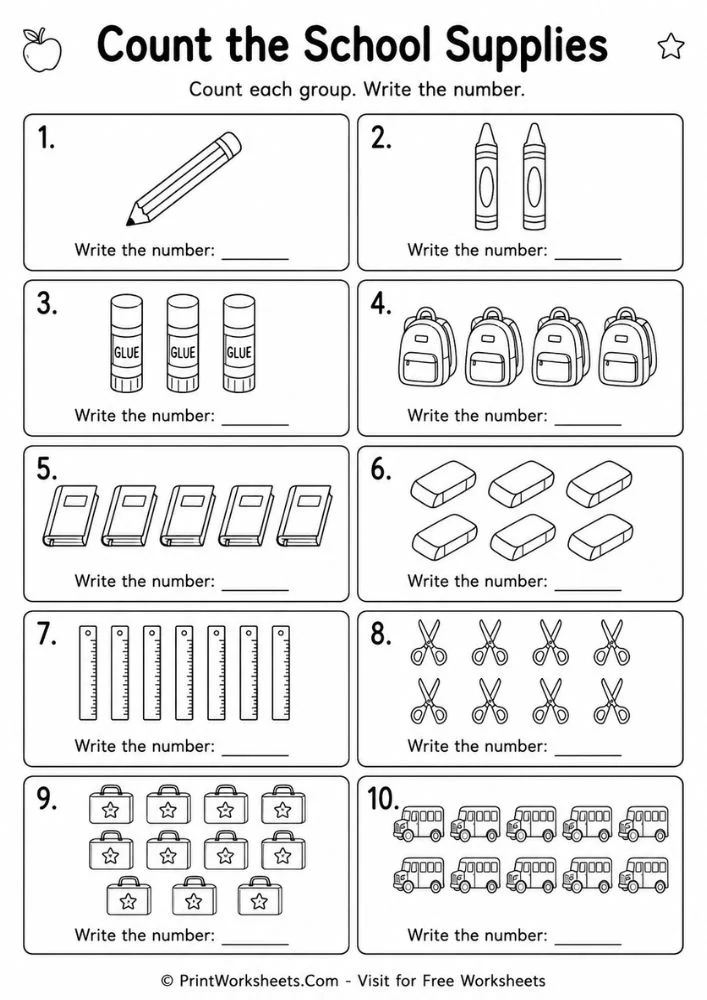
- Count the School Supplies: A 1-to-10 quantitative matching sheet where children count distinct groups of rulers, erasers, and scissors, then independently write the correct integer in the response box.
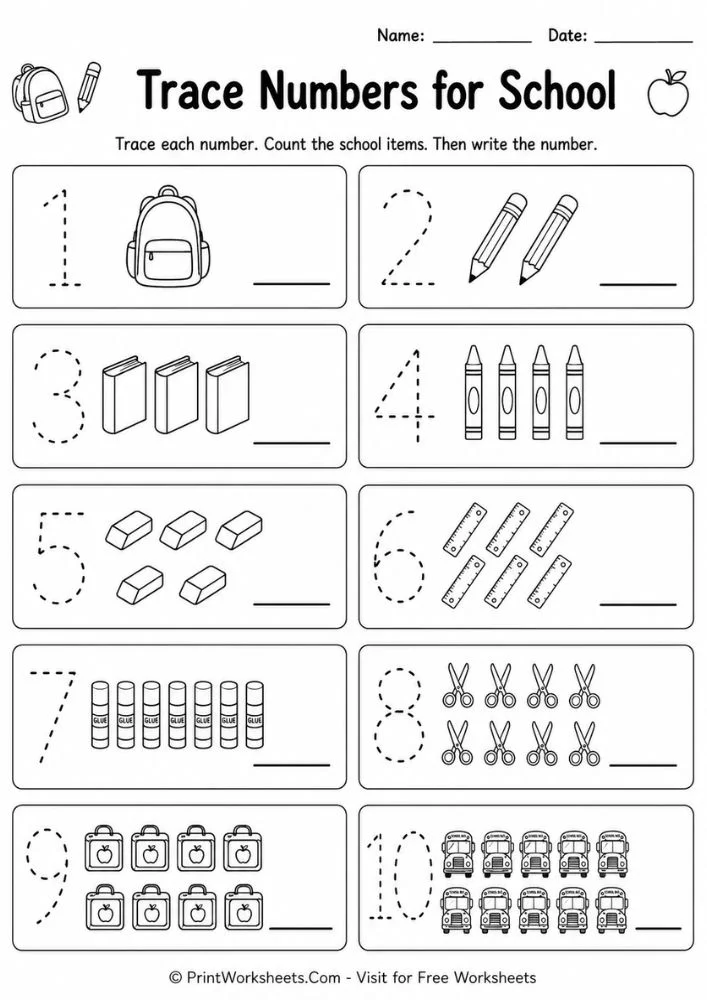
- Trace Numbers for School: A foundational penmanship and digit formation tracker. Students trace large dotted numerals from 1 to 10 and verify the quantity by counting the adjacent backpacks and glue sticks.
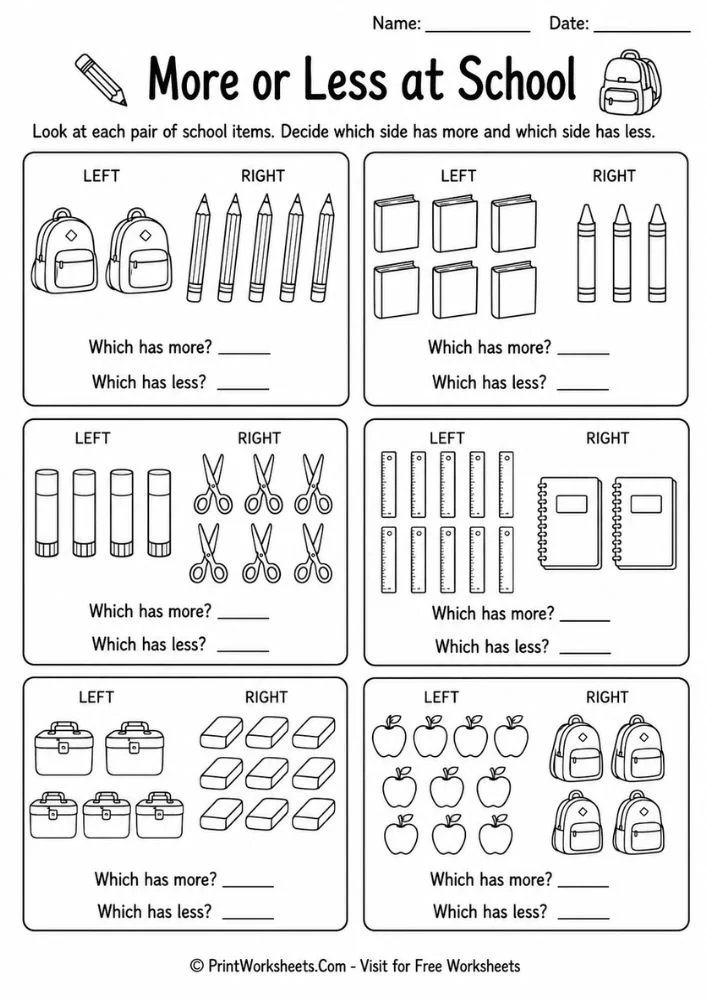
- More or Less at School: An essential visual discrimination layout testing early ratio concepts. Kids analyze two groups of items (left vs. right) and identify which side holds greater or fewer objects.
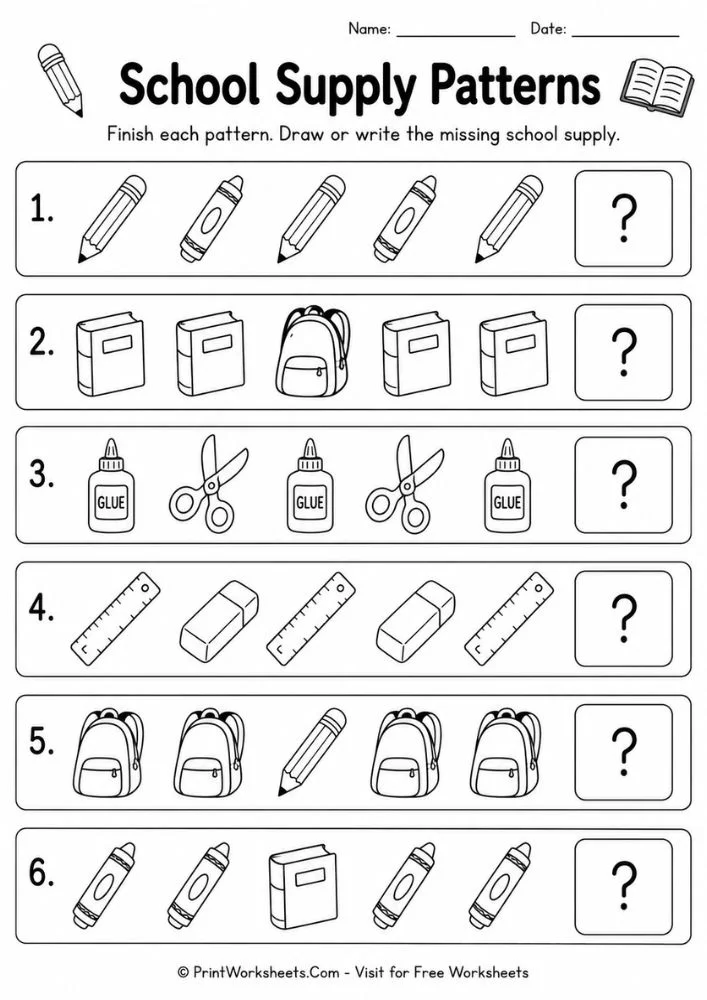
- School Supply Patterns: A logical sequencing matrix featuring standard AB and ABB patterns. Children must deduce the rhythm of the items and draw or write the missing supply in the final square.
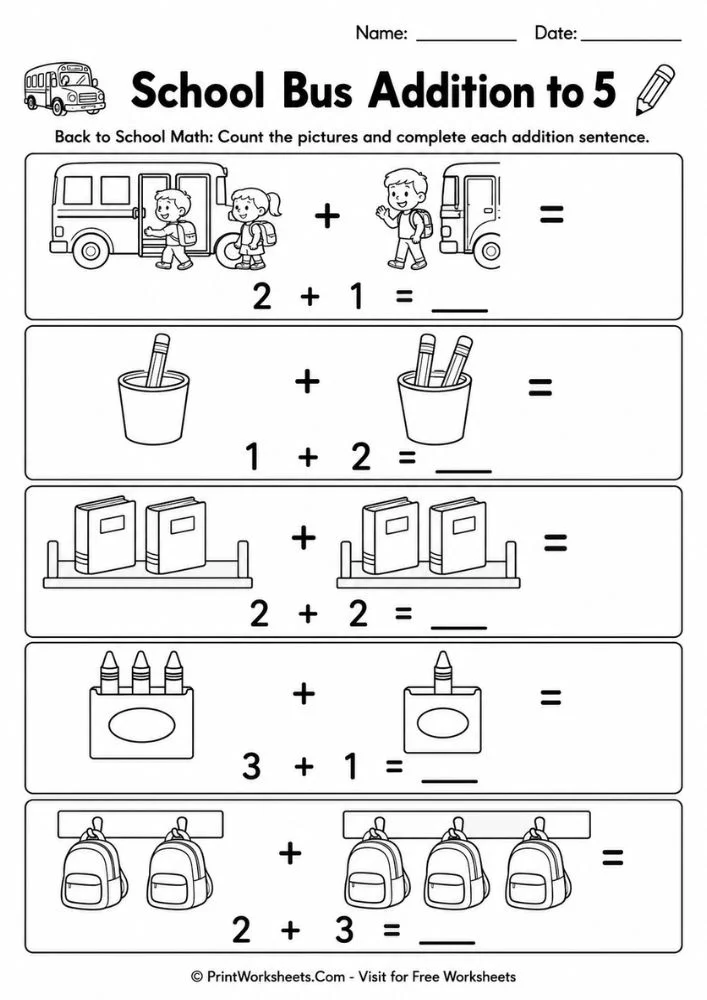
- School Bus Addition to 5: A gentle introduction to operational math. Using clear visual equations (like 2 backpacks + 3 backpacks), students solve foundational addition problems capped at a maximum sum of five.
The primary advantage of this bundle is its ability to disguise essential curriculum benchmarks as fun, low-pressure morning work.
Strategic Implementation for the Classroom
To get the most accurate baseline data, do not present these sheets as a unified test packet. Instead, rotate them through your morning “do-now” bins. Deploying the counting and tracing sheets on Monday gives you immediate insight into pencil grip and number reversal issues. Following up with the “More or Less” and “Pattern” grids on Wednesday allows you to evaluate higher-level logical deduction while the room remains quiet.
Printing these resources is straightforward. Download the high-resolution file and ensure your printer settings are adjusted to “fit to printable area.” This guarantees that the outer boundary boxes, name markers, and lower-level addition equations print crisply on standard 8.5″ x 11″ paper without margin cut-offs.
Expert Teacher FAQs & Recommendations
How can I use these worksheets to assess students without causing test anxiety?
Pro Tip: Avoid calling it a “test” or hovering with a grading pen. Slide the “More or Less” or “Pattern” sheets into dry-erase pockets during free-choice center time. Observe from a distance to see which children intuitively grasp visual quantities and which ones struggle with number sequencing. This gives you raw, authentic data before formal grading begins.
Are these activities suitable for students who cannot read instructions yet?
Absolutely. The layouts are intentionally designed with heavy visual cues. Once you model the first problem (e.g., counting the pencils and writing the number) on the whiteboard, early learners can easily deduce the pattern for the rest of the page without needing phonetic decoding skills.
What should I do if a student struggles with the “Addition to 5” page?
Actionable Advice: If the written equations confuse them, step back into tactile learning. Give the student physical manipulatives like counting cubes or actual crayons. Have them place the physical items directly over the printed backpacks on the worksheet to manually bridge the gap between visual objects and abstract numbers