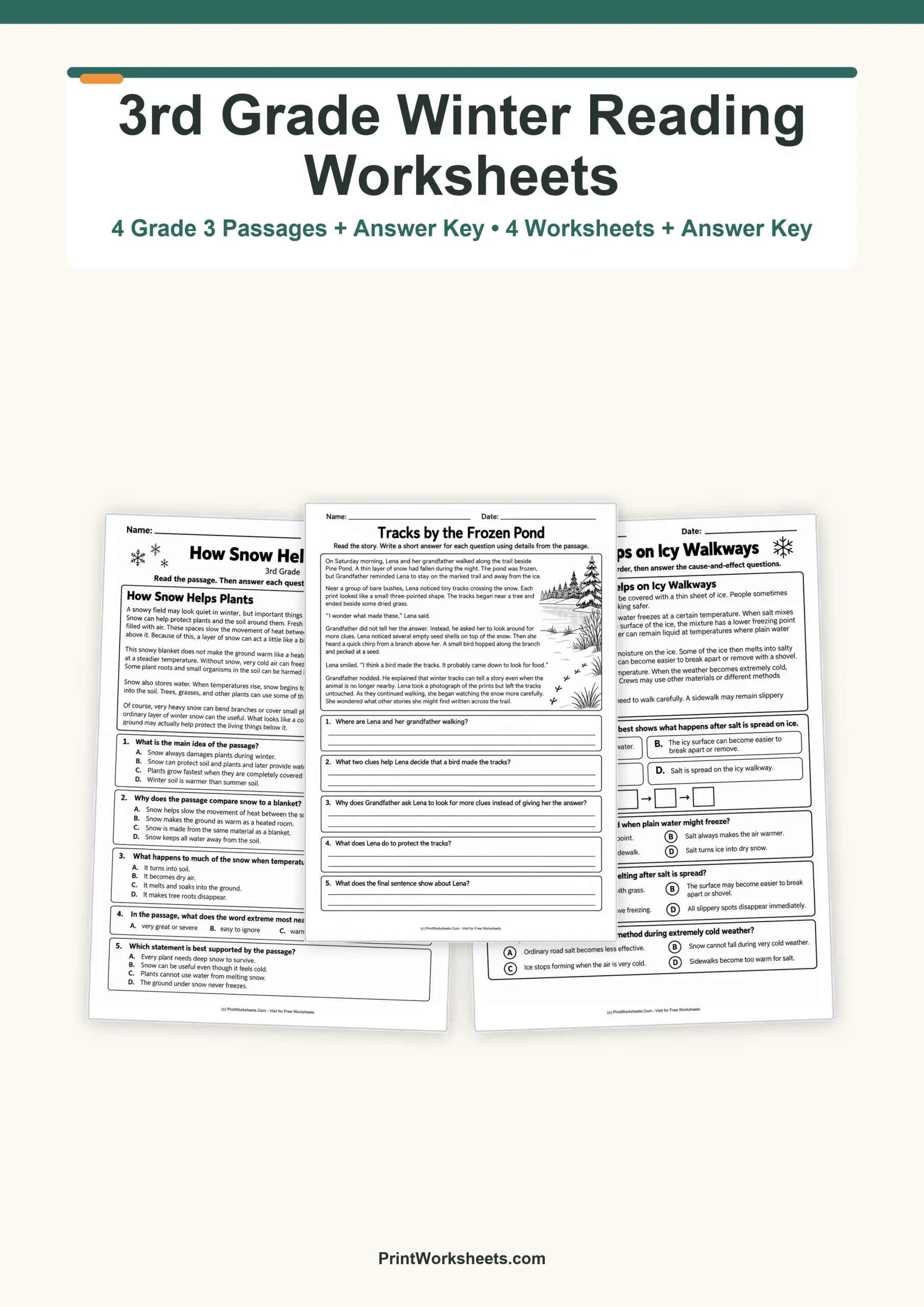
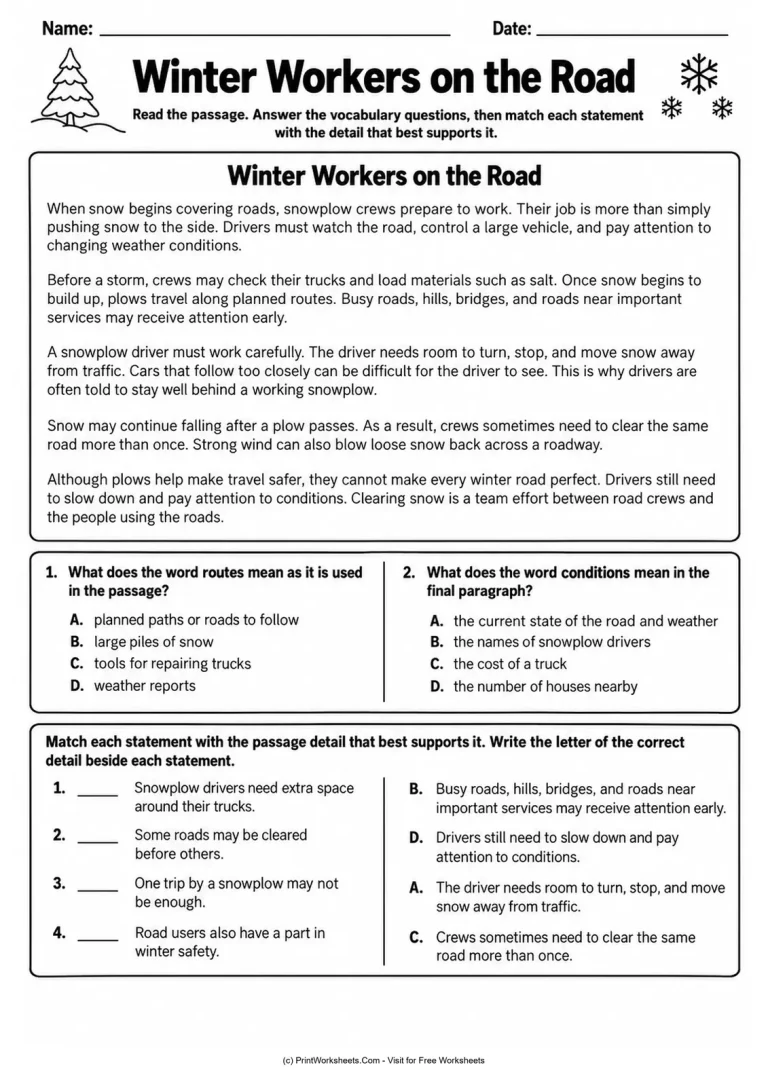
These winter reading comprehension worksheets give third graders four very different reasons to read closely: understanding how snow protects plants, solving a mystery beside a frozen pond, learning why salt helps on icy walkways, and finding evidence about snowplow crews. Across the set, students move beyond simple recall and practice main idea, inference, sequencing, cause and effect, vocabulary in context, and supporting answers with details from a passage.
Winter Reading Comprehension for 3rd Grade
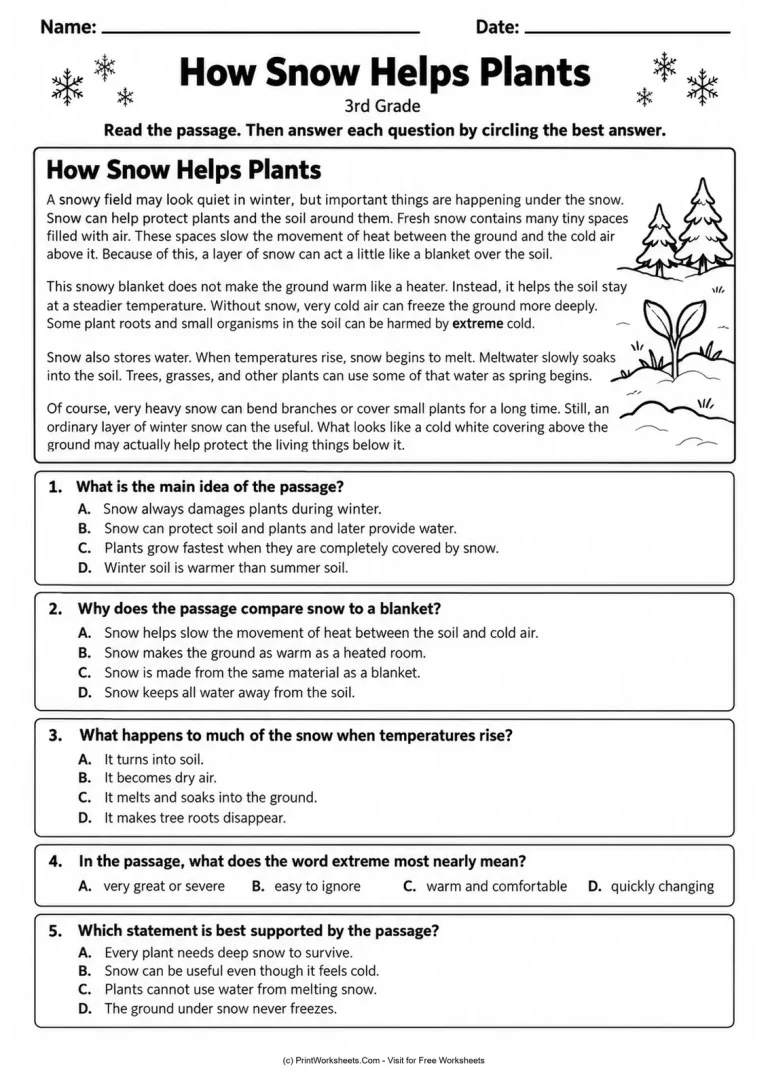
The first worksheet, How Snow Helps Plants, uses an informational passage to explain how snow can act like a blanket over the soil. Students learn that trapped air in snow slows heat movement, helps the soil remain at a steadier temperature, and can protect roots and small organisms from extreme cold. The passage also explains that melting snow can provide water for plants as spring begins. Five multiple-choice questions ask students to identify the main idea, explain the blanket comparison, recall what happens when temperatures rise, determine the meaning of extreme, and choose a statement best supported by the text.
Practice Inference with a Winter Story
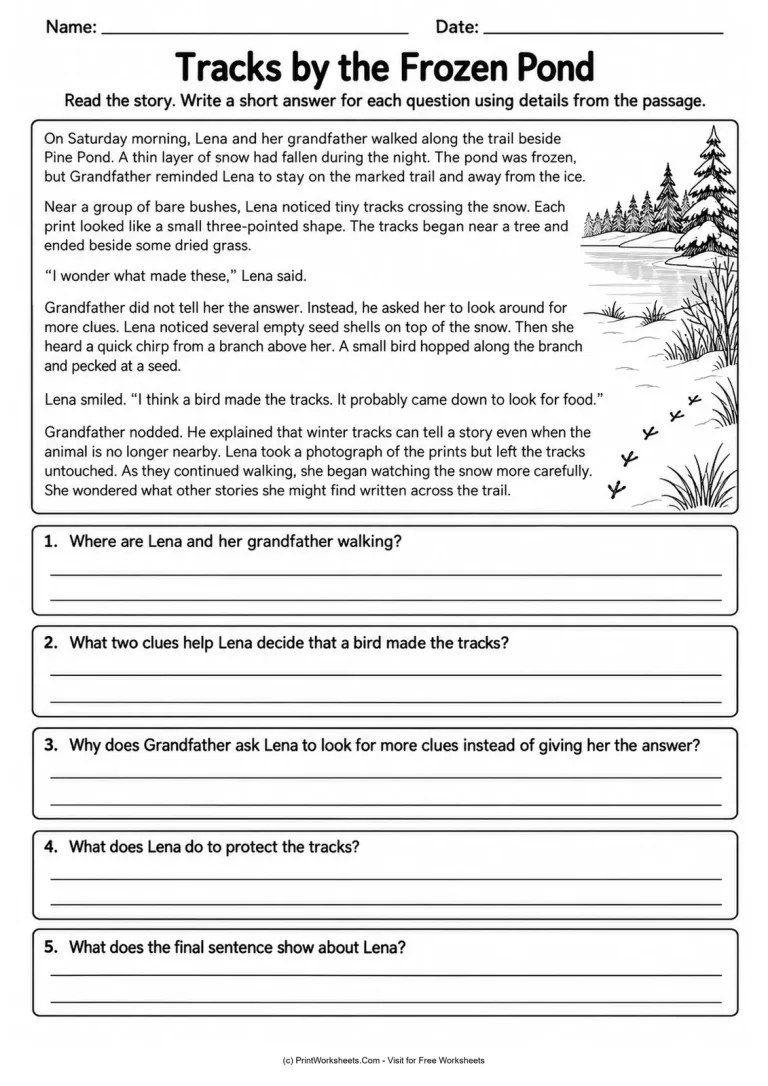
Tracks by the Frozen Pond changes the format from multiple choice to written response. Lena and her grandfather discover tiny three-pointed tracks in fresh snow beside Pine Pond. Instead of giving Lena the answer, her grandfather encourages her to notice evidence. Empty seed shells, a chirp from above, and a small bird pecking at a seed help Lena infer what made the tracks. Students answer five short-response questions about setting, clues, character motivation, protecting the tracks, and what the ending reveals about Lena’s growing curiosity.
Sequence Events and Explore Cause and Effect
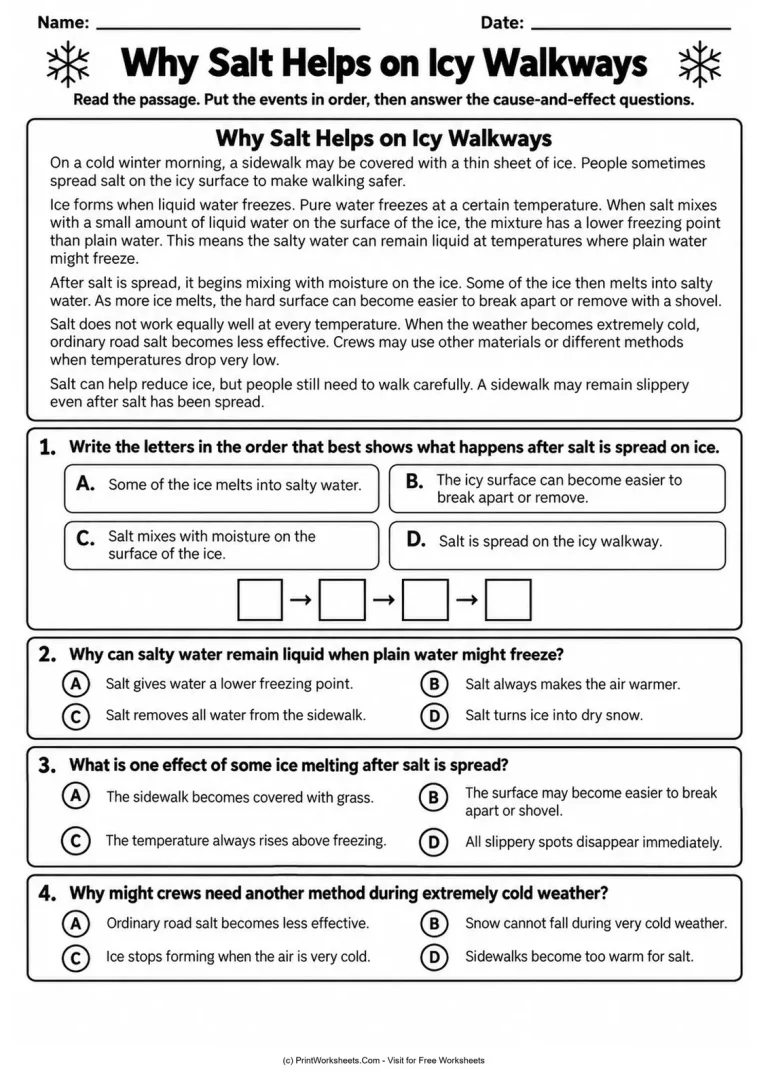
The third worksheet, Why Salt Helps on Icy Walkways, combines reading comprehension with a simple science explanation. The passage describes how salt lowers the freezing point of water, allowing some ice to melt into salty water and making the remaining surface easier to break apart or remove. Students first place four events in logical order, beginning with salt being spread on the icy walkway. They then answer questions about why salty water may remain liquid, what effect melting ice has on the surface, and why ordinary road salt becomes less effective in extremely cold weather.
Match Claims to Supporting Details
Winter Workers on the Road focuses on snowplow crews and winter road safety. Students read about planned routes, preparing trucks, clearing priority roads, giving large snowplows enough room, and sometimes plowing the same road more than once. Two vocabulary questions ask students to determine the meanings of routes and conditions from context. A second task asks them to match statements with the passage detail that best supports each idea, giving useful practice with evidence-based reading.
A Varied Set of Grade 3 Reading Skills
Because each page uses a different task structure, students are not simply repeating the same question format. One worksheet emphasizes multiple-choice comprehension, another requires complete written responses, another combines sequencing with cause and effect, and the final page blends vocabulary with evidence matching. That variety makes the set useful for independent work, reading centers, homework, seasonal review, or a small-group lesson where the teacher wants to compare how students handle different kinds of comprehension questions.
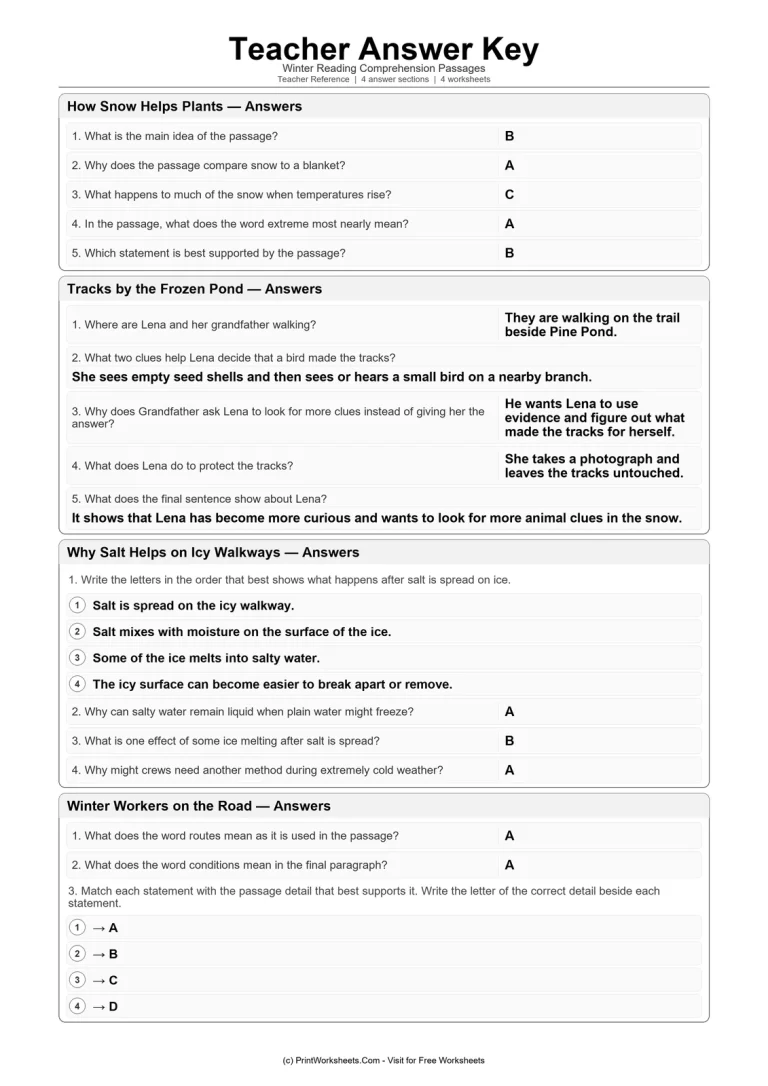
The included teacher answer key covers all four worksheets. It provides the multiple-choice answers, the correct salt-and-ice sequence, the snowplow evidence matches, and sample responses for the open-ended frozen-pond questions. This makes it easier for teachers and parents to check both objective items and reasonable written answers without preparing a separate key.
Use the Set Alongside Easier Winter Passages
Teachers working with mixed reading levels may also want the winter reading comprehension passages for Grades 1-2. The Grade 3 set on this page is better suited to students ready for longer passages, inference, evidence matching, vocabulary in context, and multi-step comprehension tasks.
For a simple classroom routine, assign one passage at a time and ask students to underline or point to the sentence that supports each answer before they respond. By the end of the four worksheets, students have practiced reading winter-themed narrative and informational texts for meaning, evidence, sequence, vocabulary, and deeper understanding.