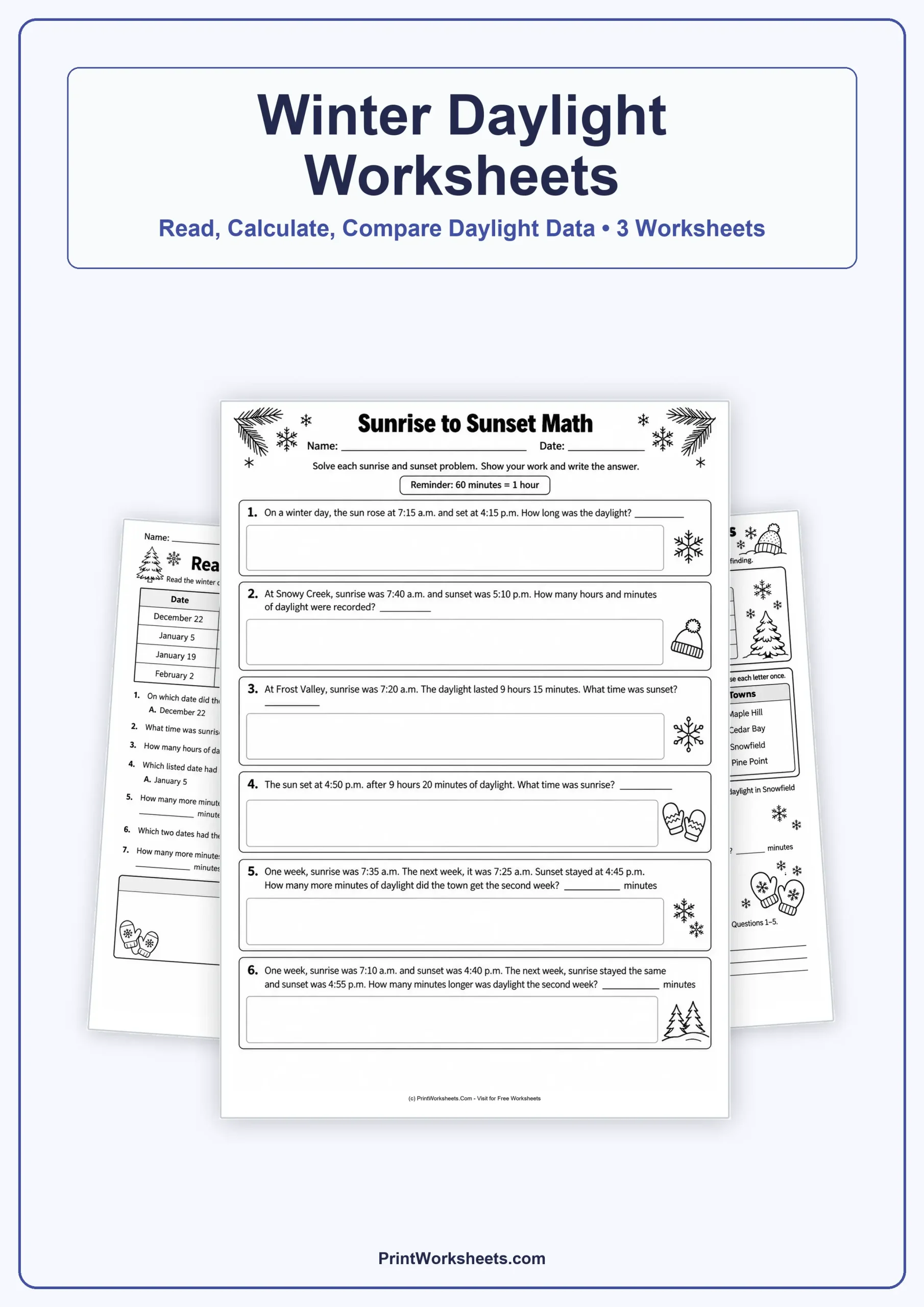
These winter daylight worksheets turn sunrise and sunset information into meaningful math and data practice. Students work with dates, clock times, hours of daylight, and differences measured in minutes while learning to read information carefully and explain what the numbers show. The activities move beyond simple seasonal decoration by using winter daylight as the actual mathematical context, making the set useful for lessons on elapsed time, data interpretation, comparison, and multi-step reasoning.
What Students Practice in These Winter Daylight Worksheets
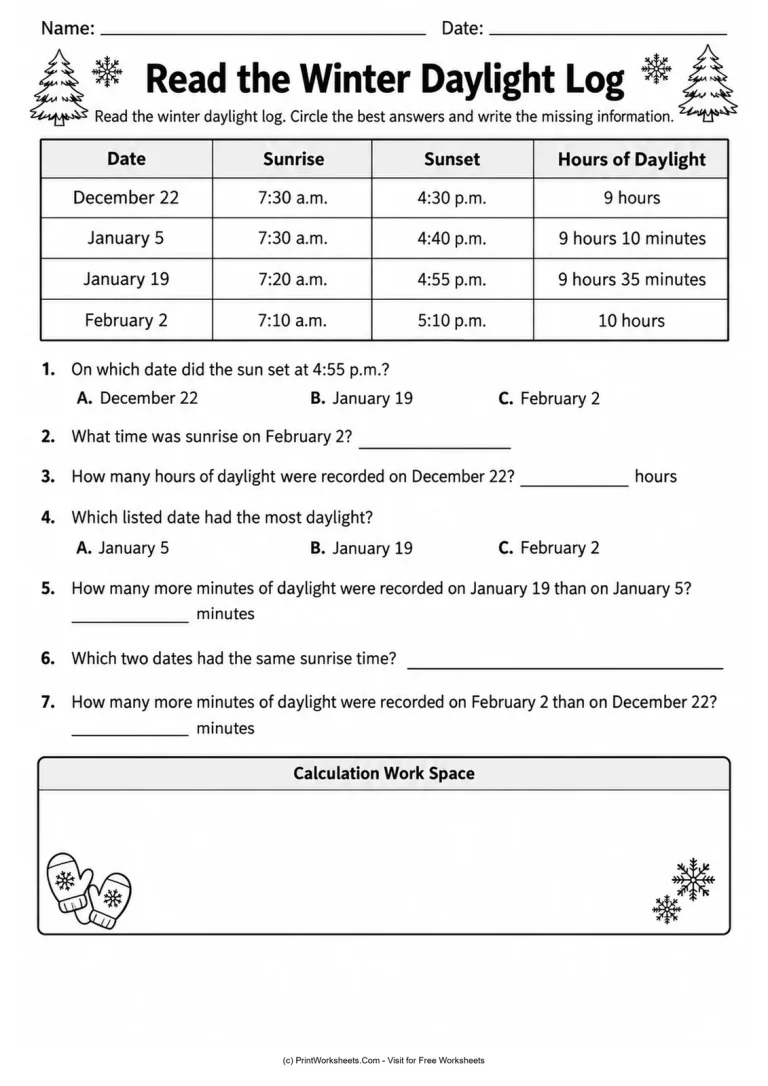
The first activity centers on a winter daylight log. Students read a table containing dates, sunrise times, sunset times, and total hours of daylight. Questions ask them to locate exact information, identify the date connected to a particular sunset time, find a sunrise time, determine which date had the most daylight, and compare daylight totals in minutes. The table also includes two dates with the same sunrise time, giving students practice noticing repeated values instead of only scanning for the largest or smallest number.
This type of table-reading work helps students connect time measurement with organized data. A learner may need to recognize that 9 hours 35 minutes is 25 minutes longer than 9 hours 10 minutes, or that 10 hours of daylight is 60 minutes longer than 9 hours. Those comparisons reinforce the relationship between hours and minutes while keeping the calculations connected to a real-world seasonal pattern.
Sunrise and Sunset Elapsed-Time Math
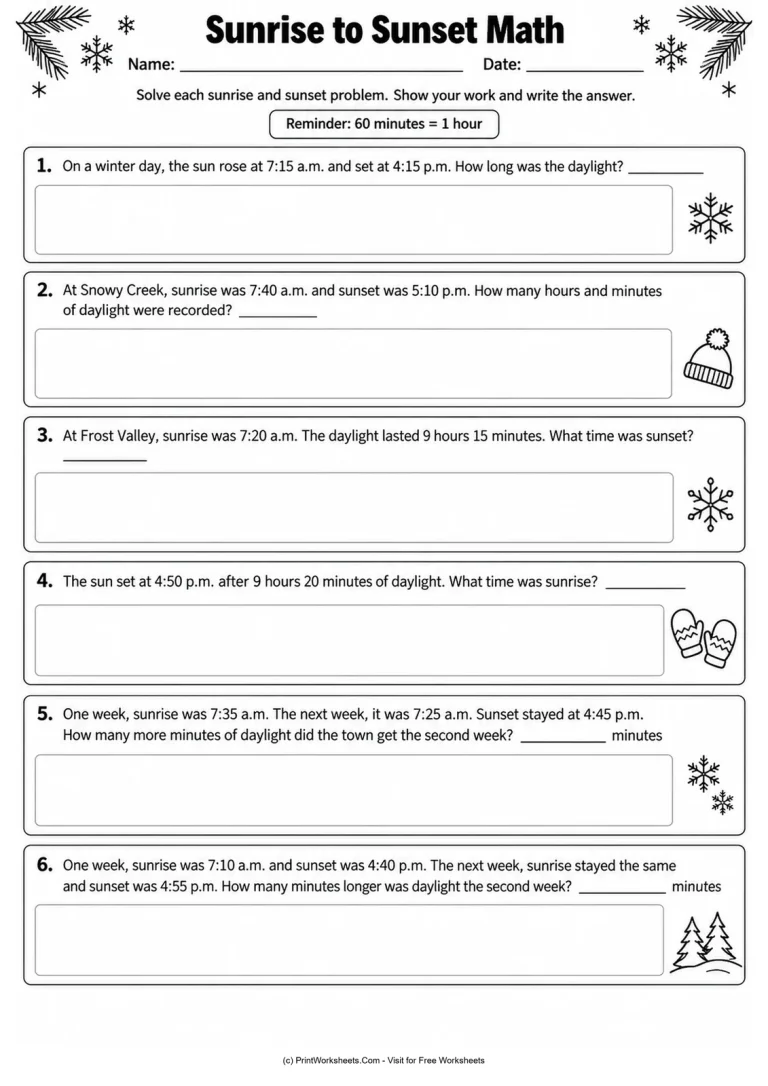
The second activity shifts from reading prepared totals to calculating them. Students solve sunrise and sunset word problems and show their work in large calculation spaces. Some questions provide both the sunrise and sunset and ask for the total daylight duration. Others provide a sunrise plus the length of daylight and require students to find the sunset, or give the sunset and daylight duration so students must work backward to determine sunrise.
The problems include whole-hour and mixed hour-and-minute intervals, so students practice more than one method of elapsed-time reasoning. For example, they may calculate the time from 7:40 a.m. to 5:10 p.m., add 9 hours 15 minutes to a morning sunrise, or subtract a daylight duration from an afternoon sunset. A visible reminder that 60 minutes equals 1 hour supports students who are still developing confidence with time conversions.
Comparing Changes in Daylight
The word problems also introduce week-to-week changes. Students compare two sunrise times while the sunset stays the same, or compare two sunset times while sunrise remains unchanged. This structure encourages them to focus on what changed and then determine how that change affects the total amount of daylight. Instead of calculating every value from the beginning, students can reason that an earlier sunrise adds daylight or a later sunset extends the day by the same number of minutes.
Daylight Data Detective Challenge
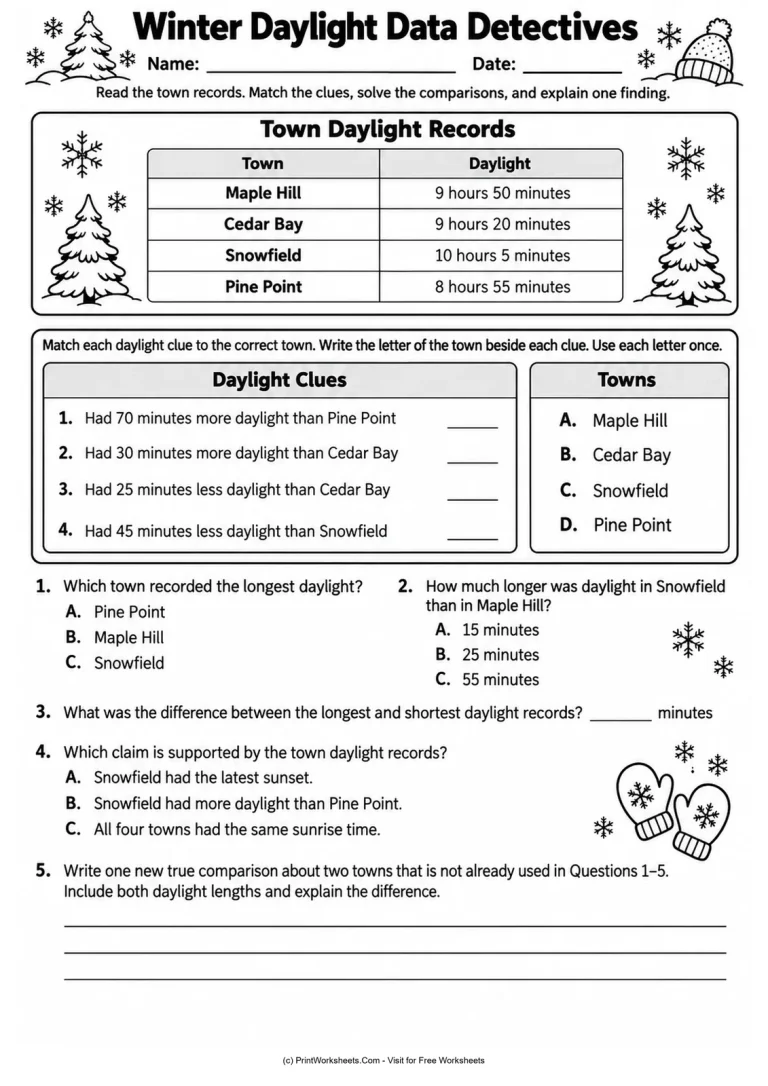
The final activity increases the reasoning demand by presenting daylight records for four fictional towns: Maple Hill, Cedar Bay, Snowfield, and Pine Point. Students compare durations such as 9 hours 50 minutes, 9 hours 20 minutes, 10 hours 5 minutes, and 8 hours 55 minutes. They then match clues to the correct towns, including statements about having a certain number of minutes more or less daylight than another town.
After the matching section, students identify which town had the longest daylight, calculate differences between town records, and choose a claim that is actually supported by the available data. This is an important distinction because the table gives total daylight lengths but does not give individual sunrise or sunset times. Students therefore have to recognize what can and cannot be concluded from the evidence.
The final written-response prompt asks students to create a new true comparison using two towns, include both daylight lengths, and explain the difference. That open-ended task adds a communication component to the math work and gives teachers or parents a quick way to see whether students truly understand the data rather than simply selecting answers.
Useful for Grade 3 and Grade 4 Time Practice
The combination of table reading, elapsed-time calculations, minute conversions, comparisons, and short written reasoning makes this set especially suitable for Grade 3 and Grade 4 learners. It can be used during a winter math unit, as independent practice after teaching elapsed time, for morning work, homework, small-group review, or a seasonal data lesson. Students encounter the same central idea in several formats, helping them build accuracy first and then apply the skill with greater independence.
Use the printable set when you want winter-themed math that still has a clear academic purpose. Students will read daylight records, calculate missing information, compare time intervals, and explain conclusions using evidence from the data.