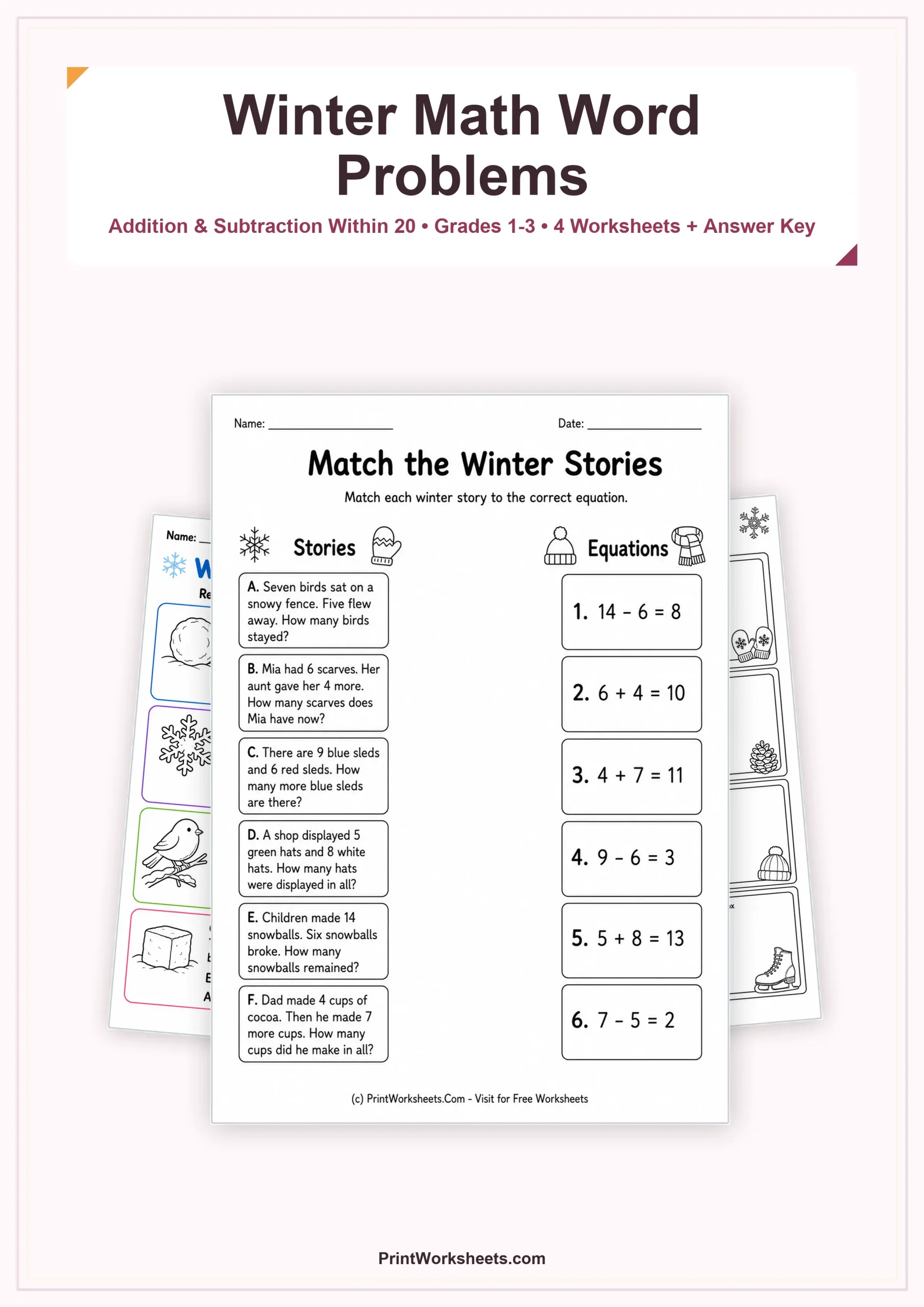
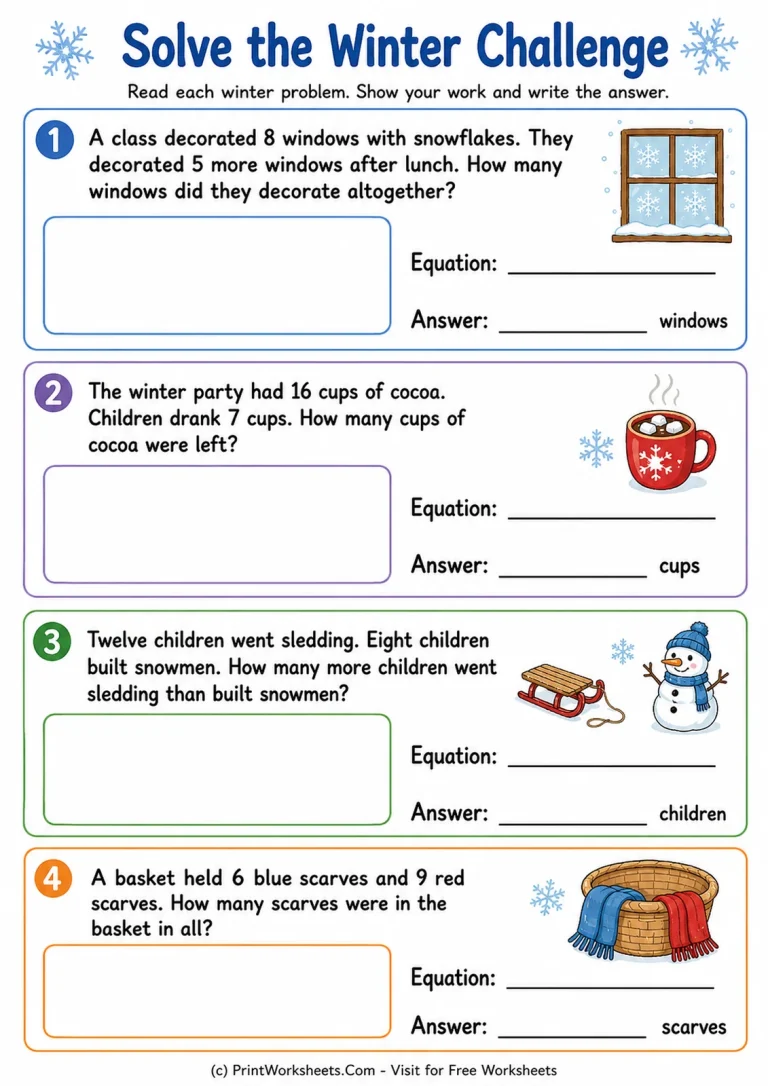
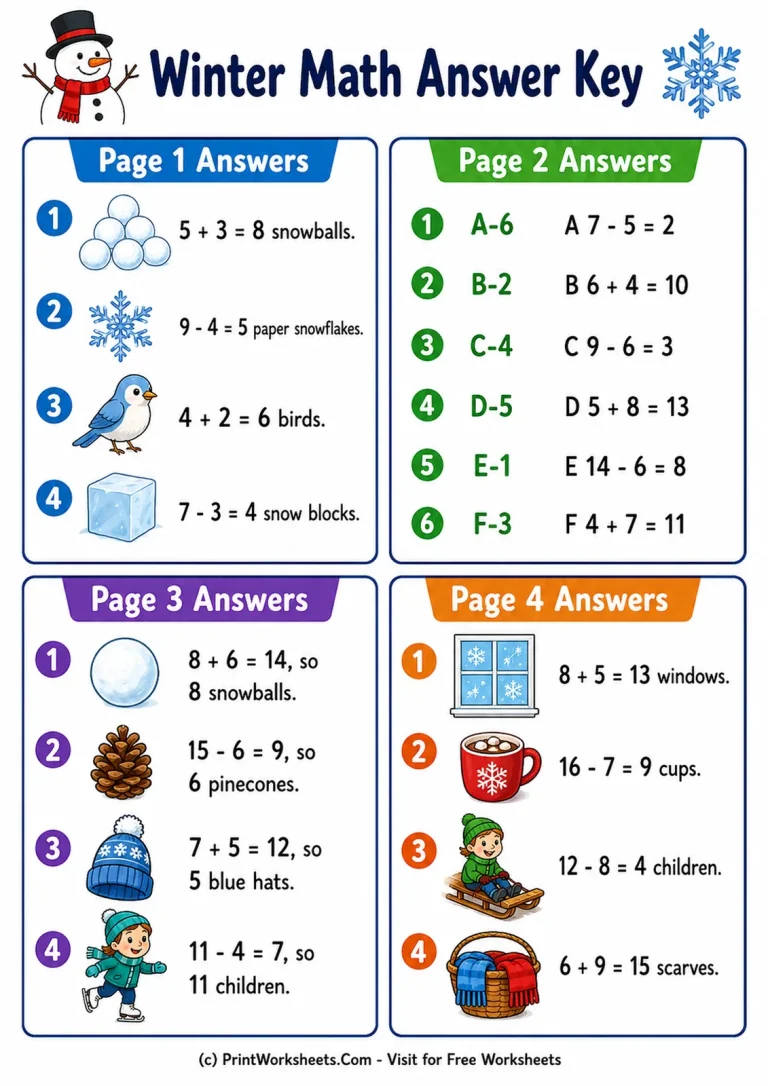
Winter math word problems give young learners a practical way to connect addition and subtraction within 20 to familiar seasonal situations. This four-page set moves beyond simple calculation by asking students to read, choose an operation, write or match an equation, find missing values, compare quantities, and label final answers. Snowballs, paper snowflakes, winter birds, scarves, sleds, hats, cocoa, decorated windows, and snow blocks keep the practice concrete while the math stays focused on early problem-solving skills for Grades 1-3.
Winter math word problems with a clear skill progression
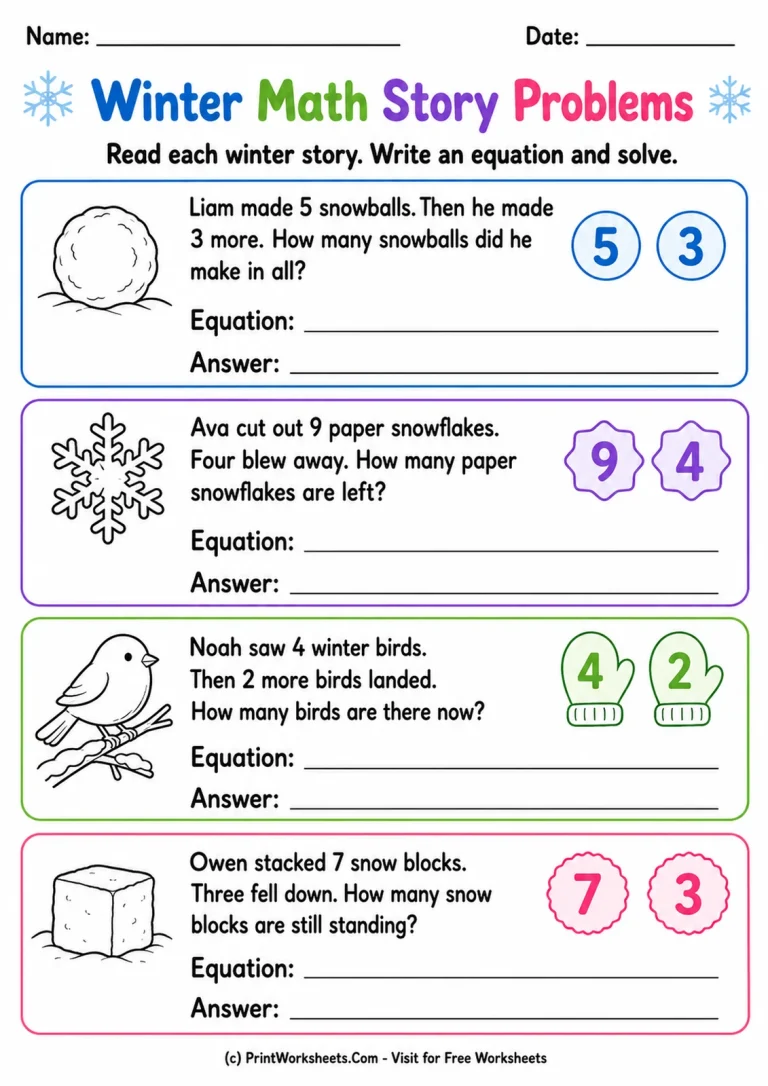
The first worksheet, Winter Math Story Problems, starts with four short stories that ask students to write an equation and solve. The numbers are intentionally accessible, including a snowball story built around 5 + 3 and a paper-snowflake story using 9 – 4. Students also solve stories about winter birds and snow blocks. Because each problem has space for an equation and an answer, teachers can quickly see whether a student selected the correct operation rather than only checking the final number.
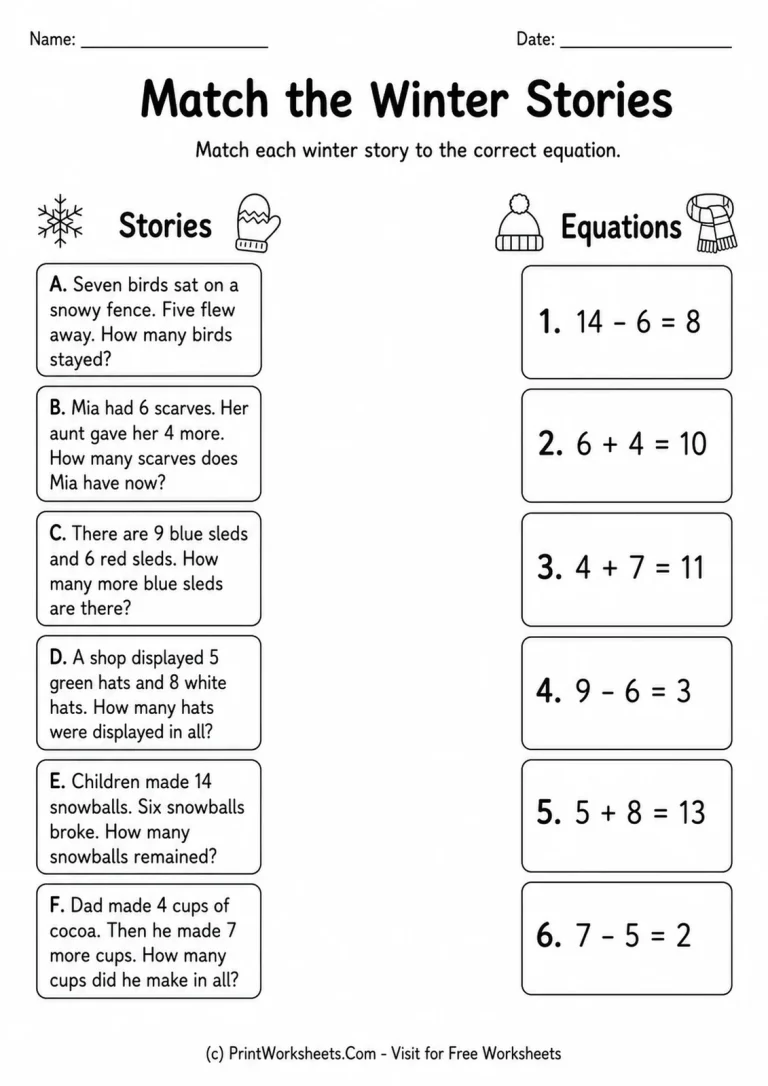
The second page changes the task format. In Match the Winter Stories, students read six scenarios labeled A-F and connect each story to one of six addition or subtraction equations. The contexts include birds, scarves, sleds, hats, snowballs, and cocoa. This matching activity is useful for students who can calculate accurately but still need practice translating words into mathematical structure. It also supports discussion about clues in a story without relying on a single keyword rule.
Missing-number equations strengthen relational thinking
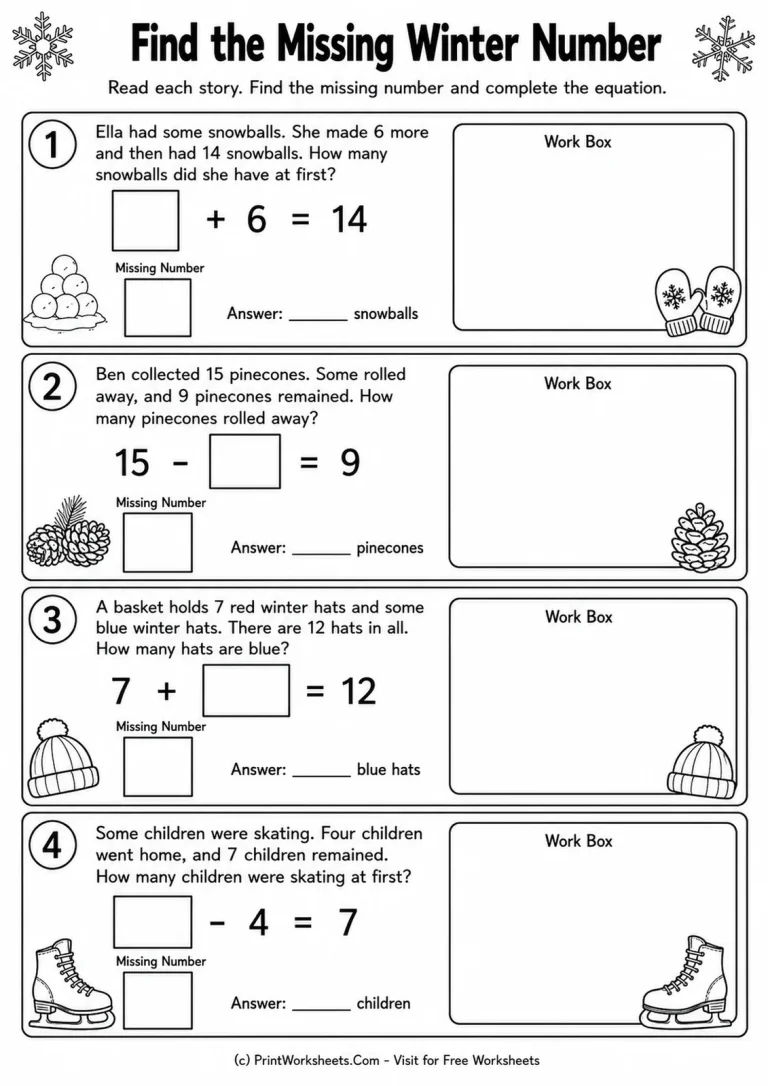
Find the Missing Winter Number asks students to solve four stories in which one part of the equation is unknown. The worksheet includes examples such as □ + 6 = 14 and □ – 4 = 7, so learners work with an unknown addend and an unknown minuend instead of seeing the answer blank only at the end. Each item includes a work box, giving students room to draw, count on, use inverse operations, or record another strategy. This makes the page especially useful for Grade 2 students who are beginning to reason about how addition and subtraction are related.
Mixed winter problem solving for Grades 1-3
The final student page, Solve the Winter Challenge, combines addition, subtraction, comparison, equation writing, shown work, and answers with units. One comparison problem asks how many more children are sledding than building snowmen, represented by 9 – 6. Other stories use decorated windows, cocoa, and scarves. Requiring units helps students answer the actual question in the story instead of stopping after a calculation.
For Grade 1, the set works well after students have practiced addition and subtraction facts and are ready to connect those facts to short story problems. Teachers may read the text aloud, solve one example together, or let students circle the numbers and underline the question before writing an equation. Grade 2 learners can complete the full sequence more independently, with particular attention to the matching and missing-number pages. In Grade 3, the set is best used as a quick review, warm-up, intervention resource, or fluency check before moving to larger-number word problems.
Teaching ideas, differentiation, and quick checks
Use the pages in order when you want a gradual increase in reasoning demand, or select one page to target a specific need. For extra support, provide counters, linking cubes, a number line, or ten-frames. Ask students to explain why an equation matches a story and to name what each number represents. For students who need a challenge, have them rewrite a problem with a different unknown position, create a second equation that checks the answer, or write a new winter story using the same numbers.
A simple exit ticket can extend the lesson: give students an equation such as 8 + 5 = 13 and ask them to write a one-sentence winter story that matches it. Another option is to present 12 – □ = 7 and ask students to identify the missing number and explain how they know. These short checks reveal whether students understand the relationship between the story, equation, and answer.
The included answer key covers all four student pages, including equations, matching pairs, missing-number solutions, and answers with units. That makes the set practical for independent work, math centers, homework, small-group intervention, or a seasonal review packet.
For another seasonal set using the same broad word-problem skill family, use the Fall math word problems worksheets for Grades 2-3. It provides an additional seasonal context for addition and subtraction problem solving.
For another holiday-themed option, try the Halloween math word problems worksheets for Grades 2-3. It can extend themed practice with a closely related math focus.
Whether the goal is direct equation writing, matching stories to equations, finding a missing number, or solving a comparison problem, these winter worksheets keep the arithmetic manageable while making students show how they interpret each situation. The varied formats provide more evidence of understanding than a page of repeated computation alone.