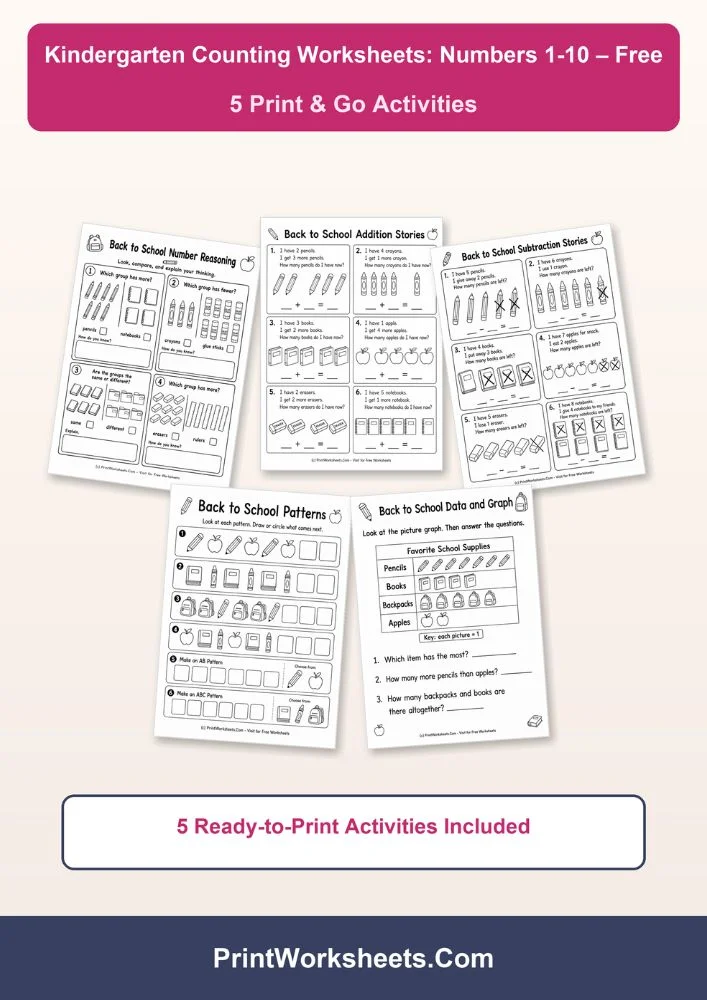
Download free printable kindergarten counting worksheets 1-10 to provide targeted early math practice for your students. Building strong number sense requires explicit practice linking physical objects to written numerals. This specific printable PDF pack delivers rigorous math center activities focusing strictly on single-digit numbers up to ten. By utilizing visual addition stories, subtraction cross-outs, algebraic pattern recognition, picture graphs, and number reasoning, educators can guarantee comprehensive early arithmetic development. Printing these no-prep math activities ensures young learners transition smoothly from rote verbal counting to written mathematical equations.
Educators and homeschool parents utilize kindergarten counting worksheets 1-10 during morning work, independent math centers, and early intervention assessments. Consistent exposure to visual math problems prevents calculation frustration when students enter first grade. To build a complete foundational mathematics curriculum, combine this specific early arithmetic PDF pack with the extensive printable resources available in our main counting worksheets category. Continuous practice isolating numbers one through ten secures the core logic required for future base-ten number operations.
Inside the Kindergarten Counting Worksheets 1-10 PDF
Clear formatting and highly recognizable school supply illustrations make this PDF pack perfect for early learners. The black-and-white line art prevents visual distraction, forcing students to focus entirely on math execution. Each printable activity page targets specific kindergarten core math standards:
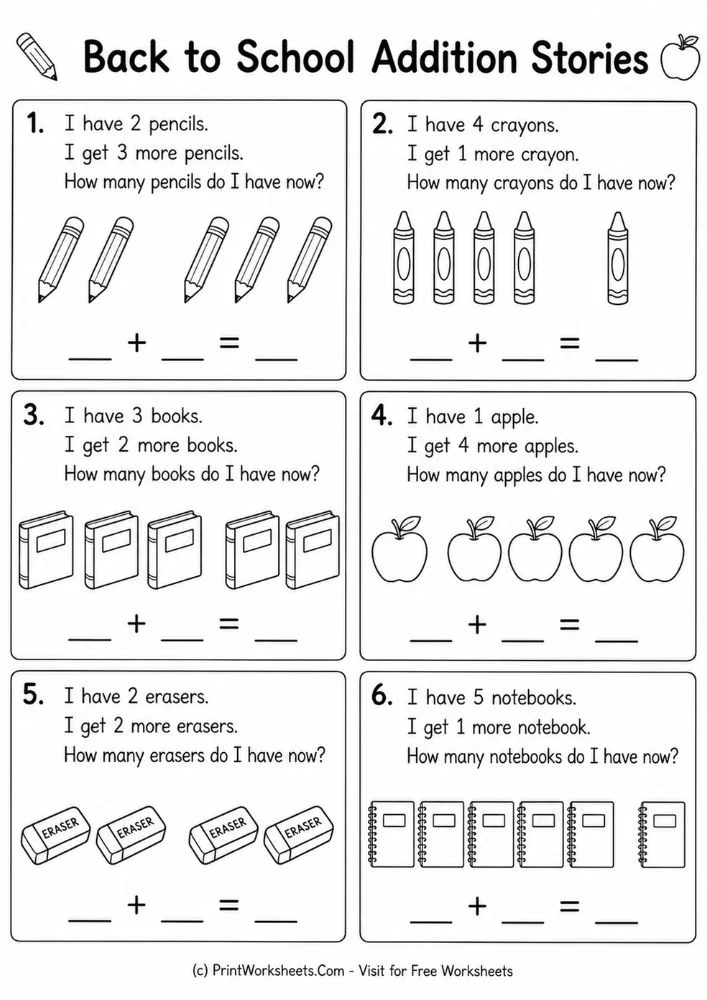
- Back to School Addition Stories: A highly visual early addition worksheet. Students read short, decodable text about collecting school supplies like pencils, crayons, books, apples, erasers, and notebooks. Students count the illustrated items to find the sum. Finally, students trace and write the formal addition equation (e.g., 2 + 3 = 5) on the blank lines, linking early reading comprehension to math operations.
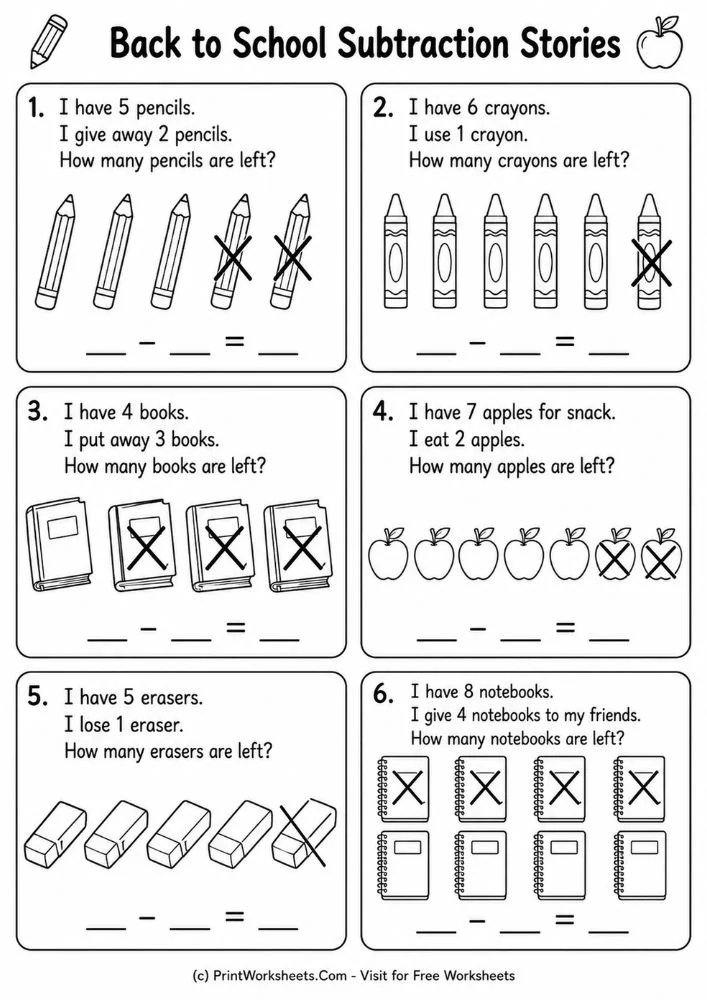
- Back to School Subtraction Stories: A direct visual subtraction practice worksheet. Students read math scenarios detailing giving away or utilizing specific school items. The printed illustrations explicitly display physical “X” marks over the subtracted objects. Students count the remaining unmarked items and write the formal subtraction equation, internalizing the visual proof of taking away numbers.
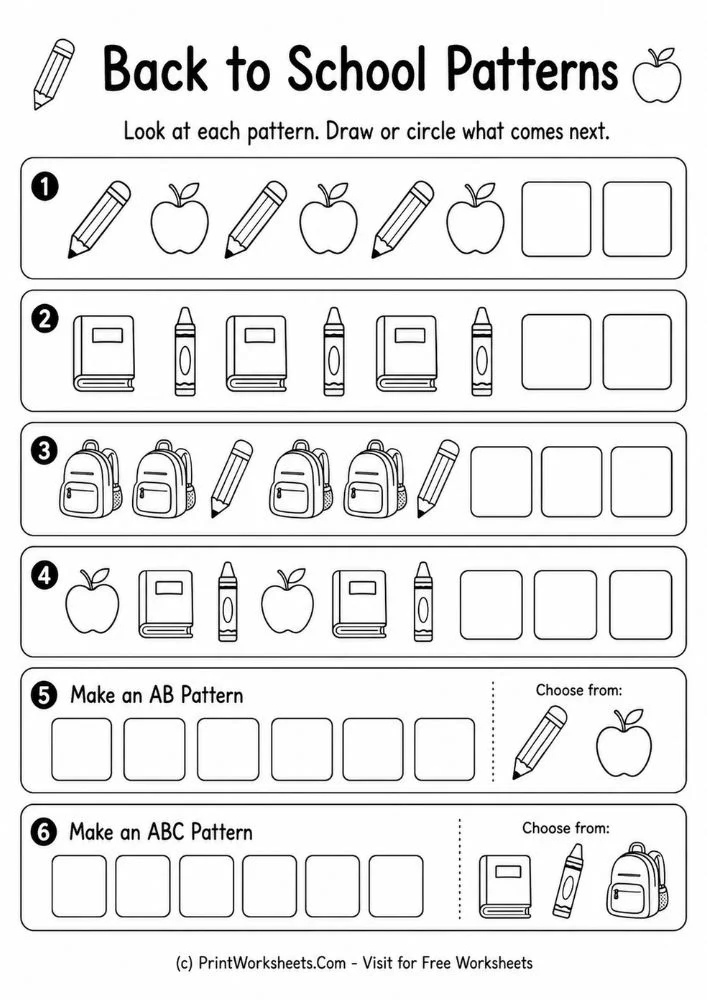
- Back to School Patterns: An early algebra and logic sequence worksheet. Students evaluate sequential groupings of school items. The activity features AB patterns (pencil, apple, pencil, apple) and complex ABC patterns. Students analyze the repeating sequence and physically draw the correct continuing objects inside the blank boxes, securing foundational algebraic logic.
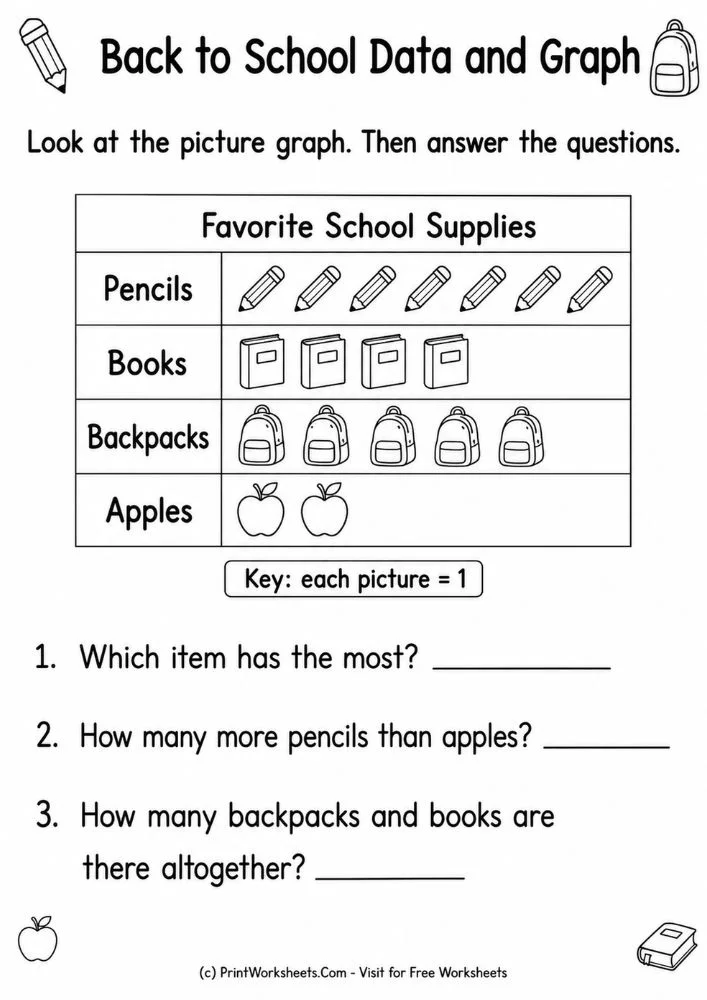
- Back to School Data and Graph: A picture graph and data analysis worksheet. Students observe a completed horizontal picture graph categorizing favorite classroom supplies. Using the provided key (each picture = 1), students count the items in each row. Students write numerical answers to specific data questions, comparing maximum quantities and calculating differences between categories.
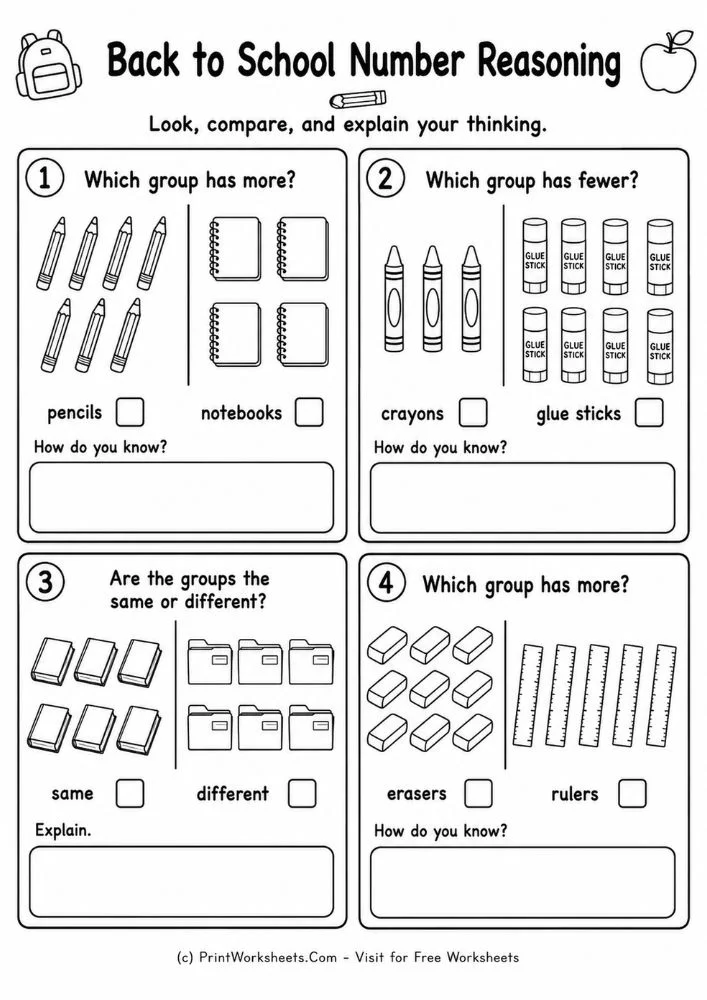
- Back to School Number Reasoning: A group comparison and math logic worksheet. Students examine paired groups of visual objects. The activity requires students to identify which group has “more,” “fewer,” or the “same” amount. A dedicated blank box requires students to explicitly explain their reasoning in writing, transitioning them from simple counting into formal mathematical proof.
How to Use Kindergarten Math Printables
Print this high-resolution PDF directly on standard 8.5″ x 11″ copy paper. Integrating physical math manipulatives directly alongside the kindergarten counting worksheets 1-10 guarantees maximum skill retention. During the addition and subtraction story activities, provide students with physical counting cubes. Instruct students to replicate the word problems physically on their desk before writing the formal equation on the paper.
To maximize math center efficiency, place the pattern sequence and picture graphing pages inside heavy-duty dry-erase sleeves. Provide students with fine-tip washable markers. This simple preparation allows multiple classroom groups to practice early number logic and data analysis repeatedly throughout the instructional week without wasting printer ink or copy paper.
Frequently Asked Questions
Why use visual addition and subtraction worksheets?
Visual addition and subtraction worksheets bridge the gap between concrete objects and abstract mathematical equations. Young learners struggle to process isolated numerical symbols like “5 – 2 = 3”. However, reading a word problem about five pencils and seeing an illustration where two pencils are physically crossed out provides instant context. The brain processes the real-world action, allowing the student to comprehend the exact purpose of the written equation.
How do math patterns support early counting?
Math patterns establish the cognitive foundation for skip counting, multiplication, and algebraic sequencing. When a kindergarten student identifies a simple AB pattern, they recognize predictable numerical intervals. Predicting what comes next forces the child to apply logical rules rather than guessing, which directly translates to understanding the strict sequential rules governing the standard base-ten number line.
What grade levels use these counting worksheets?
These counting worksheets directly align with kindergarten core math expectations focusing on numbers 1 through 10. Advanced preschool students can utilize the visual addition and pattern pages with teacher guidance. First-grade educators frequently print this exact PDF pack at the beginning of the academic year for back-to-school math review, specifically targeting data graphing and written number reasoning before introducing double-digit algorithms.