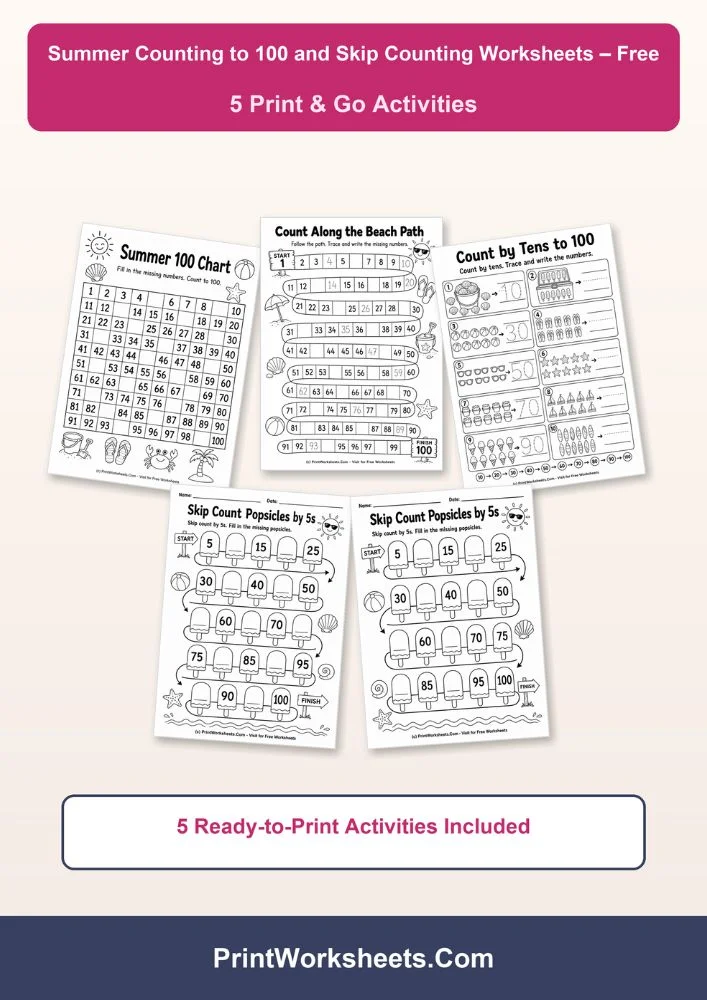
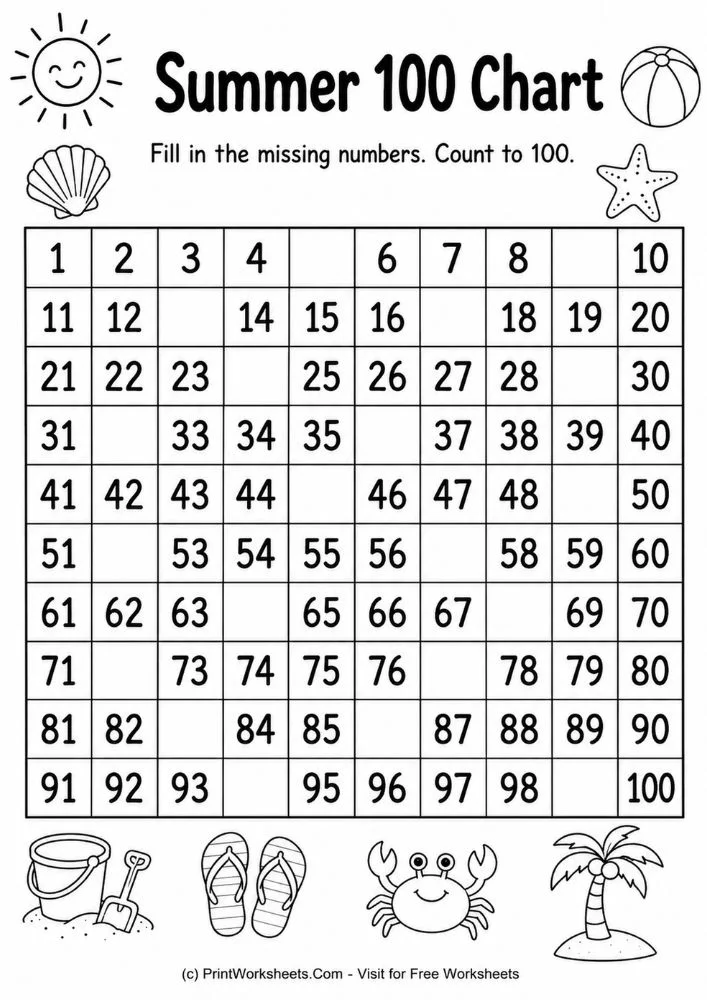
Download free printable summer counting to 100 and skip counting worksheets to provide targeted numerical sequence practice for kindergarten and first-grade students. Developing strong number sense requires extensive practice identifying numerical patterns, writing double-digit numerals, and comprehending the standard base-ten system. This specific printable PDF pack delivers rigorous math center activities focusing strictly on sequential counting up to one hundred. By utilizing structured 100 charts, sequential number paths, and visual grouping exercises, educators guarantee comprehensive numerical development. Printing these no-prep math activities ensures young learners transition smoothly from rote verbal counting to recognizing complex numerical relationships.
Educators and homeschool parents utilize summer counting to 100 and skip counting worksheets during morning work, independent math centers, and end-of-year academic reviews. Consistent exposure to missing number grids prevents calculation frustration and prevents the dreaded “summer slide” learning loss. To build a complete foundational mathematics curriculum, combine this specific seasonal PDF pack with our targeted skip counting by 5s worksheets. Continuous practice isolating numerical patterns secures the core logic required for future addition and multiplication operations.
Inside the Summer Counting Worksheets PDF
Clear formatting and highly recognizable beach-themed illustrations make this PDF pack perfect for early learners. The black-and-white line art prevents visual distraction, forcing students to focus entirely on sequential math execution. Each printable activity page targets specific primary grade core math standards:
- Summer 100 Chart: A traditional number grid assessment. Students view a standard 10 by 10 grid partially filled with sequential numbers. Students must identify the numerical patterns and independently write the missing double-digit numbers to complete the chart up to 100. This activity solidifies base-ten row and column relationships.
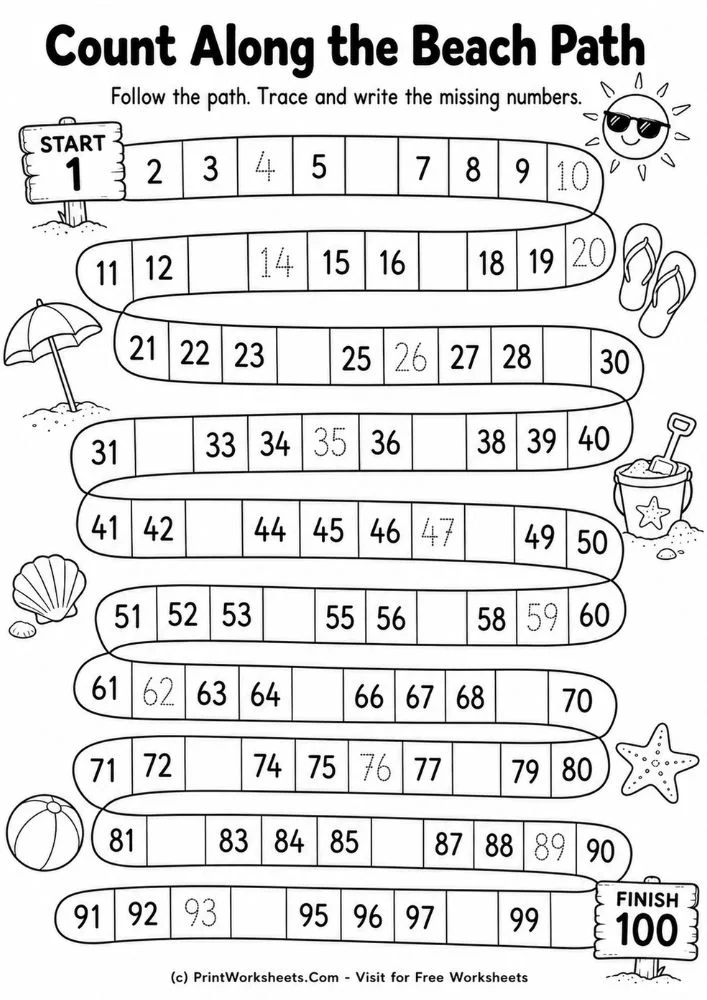
- Count Along the Beach Path: A sequential tracing and writing worksheet. Designed as a continuous winding snake path, this activity requires students to follow the numerical trail from 1 to 100. Students trace dotted numbers for handwriting practice and fill in the blank boxes, reinforcing linear number order without the strict column structure of a traditional grid.
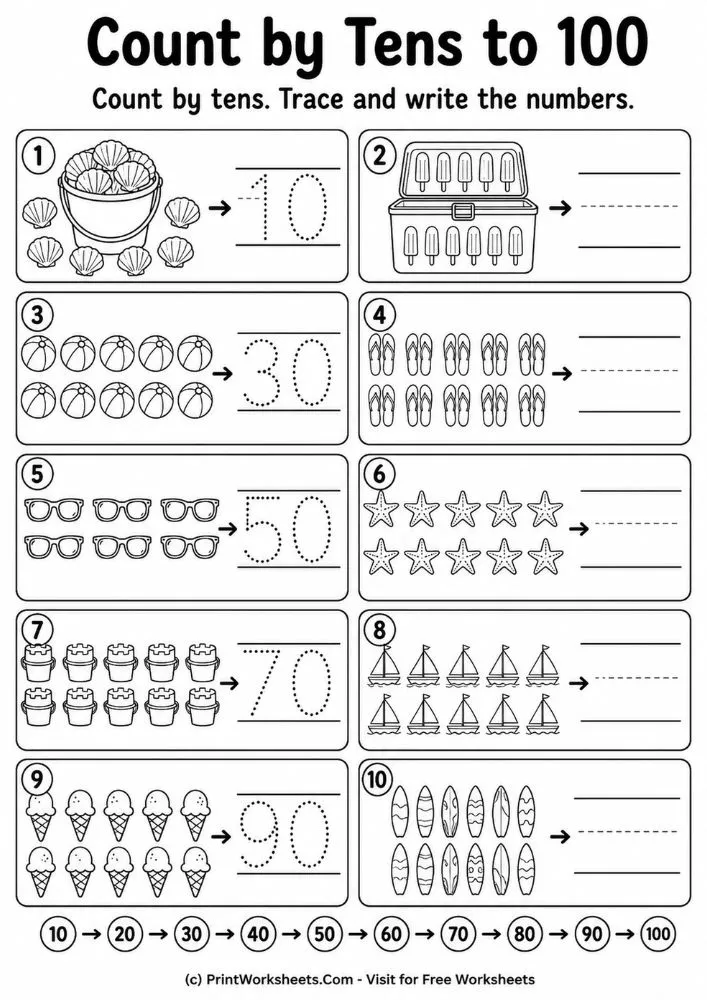
- Count by Tens to 100: A visual grouping and skip counting worksheet. Students observe sets of summer objects organized into distinct groups of ten (seashells, popsicles, beach balls, sunglasses). Students count the physical groups and trace the corresponding multiples of ten (10, 20, 30… up to 100) on the provided handwriting lines, connecting concrete quantities to abstract numerical symbols.
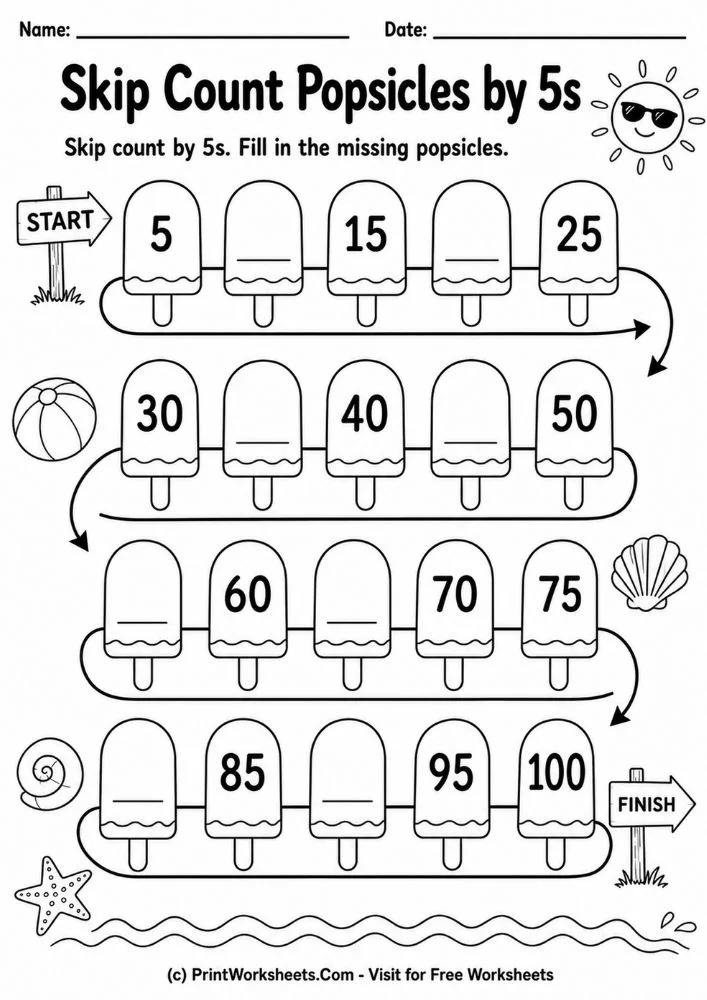
- Skip Count Popsicles by 5s: An early multiplication and number sequence worksheet. Students evaluate a winding path of popsicle illustrations. The activity features a skip counting pattern advancing by fives (5, 15, 25). Students analyze the sequence interval and physically write the missing multiples of five inside the blank popsicles to reach the finish line at 100.
How to Use Sequential Math Printables
Print this high-resolution PDF directly on standard 8.5″ x 11″ copy paper. Integrating physical math manipulatives directly alongside the summer counting to 100 and skip counting worksheets guarantees maximum skill retention. During the “Count by Tens” activity, provide students with physical base-ten blocks. Instruct students to stack ten single cubes for every group of ten illustrated on the worksheet, physically proving the quantity before writing the double-digit number.
To maximize math center efficiency, place the 100 chart and the beach path pages inside heavy-duty dry-erase sleeves. Provide students with fine-tip washable markers. This simple preparation allows multiple classroom groups to practice numerical sequencing and skip counting repeatedly throughout the instructional week without wasting printer ink or copy paper.
Frequently Asked Questions
Why use a missing numbers 100 chart?
A missing numbers 100 chart forces students to analyze base-ten relationships rather than just reciting numbers from memory. When a student needs to find the missing number between 43 and 45, or directly below 34, they actively process how the ones column increases horizontally and the tens column increases vertically. This spatial numerical awareness is mandatory for performing mental math in later grades.
How does skip counting build future math skills?
Skip counting establishes the cognitive foundation for multiplication and division. When a student completes the “Skip Count Popsicles by 5s” worksheet, they are actively memorizing the five times table. Predicting the next sequential interval forces the child to apply logical algebraic rules, translating directly to understanding proportional relationships and fraction sequencing.
What grade levels use these counting to 100 worksheets?
These counting to 100 worksheets directly align with late kindergarten and standard first-grade core math expectations. Kindergarten educators utilize the visual skip counting by tens pages during the second semester. First-grade educators frequently print this exact PDF pack for continuous number sense review, specifically targeting the missing number 100 chart and counting by fives before introducing formal double-digit addition algorithms.