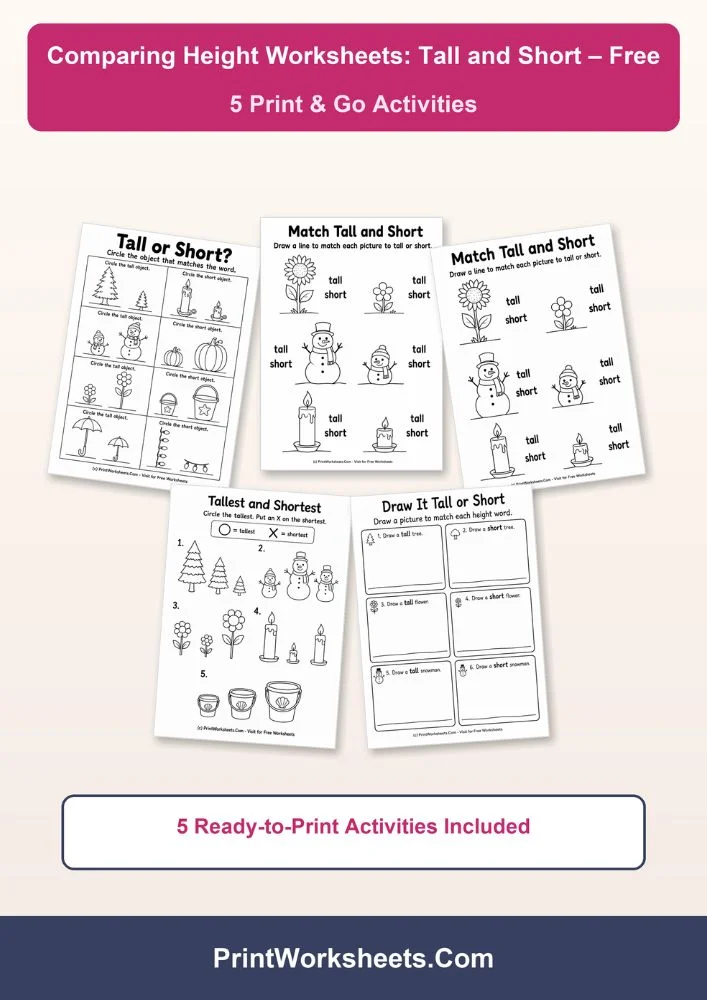
Free printable comparing height worksheets tall and short provide essential early measurement math practice for preschool and kindergarten students. Understanding spatial dimensions and recognizing physical size differences establishes a mandatory foundation for future geometry and standard measurement units. This printable PDF worksheet pack specifically targets vertical size comparison. Students analyze paired objects, utilizing formal mathematical vocabulary such as tall, short, tallest, and shortest to categorize and sort visual data accurately.
Educators deploy comparing height worksheets tall and short into morning math centers, early intervention assessments, and independent desk work routines. Building a comprehensive early math curriculum requires continuous exposure to size and dimension analysis. Combine this vertical measurement packet with the foundational sorting resources found in our main measurement worksheets category. Mastering basic visual comparison prevents spatial reasoning errors before students transition to using standard tools like rulers and measuring tapes.
Inside the Height Measurement PDF Pack
Effective early math materials require clear visual distinction and uncluttered formatting. This PDF utilizes heavy black-and-white line art, ensuring students focus entirely on object height rather than distracting colors or background details. Each activity page targets a specific visual measurement objective:
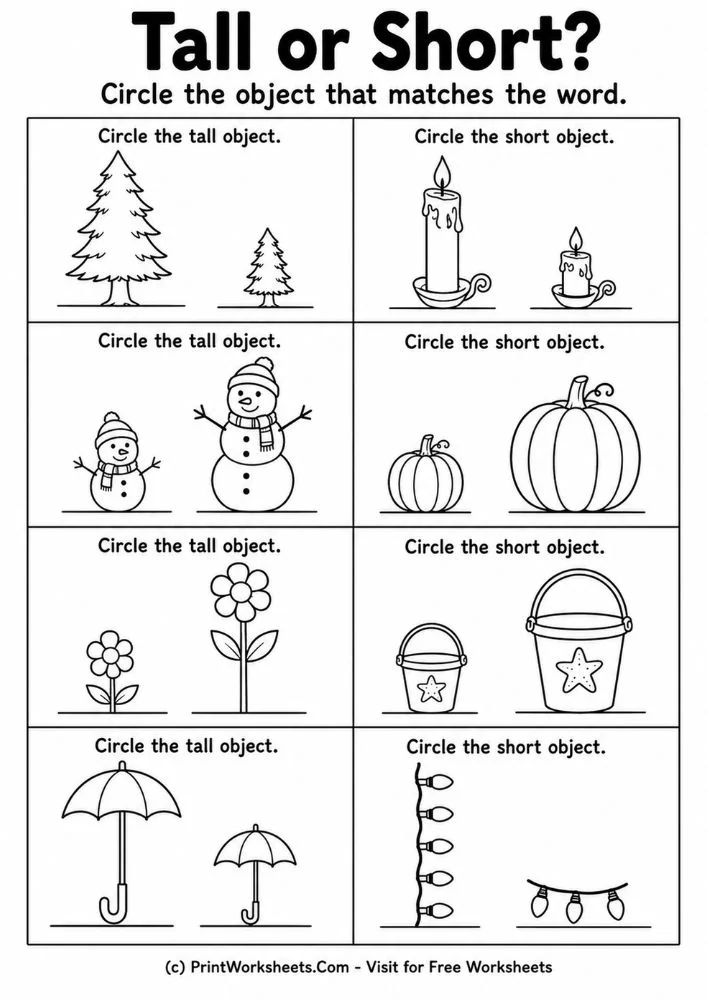
- Tall or Short Circle the Object: A direct visual discrimination assessment. Students view distinct pairs of familiar objects (trees, candles, snowmen, pumpkins, flowers, buckets, umbrellas). The worksheet provides explicit instructions above each paired box, dictating whether the student must circle the “tall” object or the “short” object. This activity solidifies basic vocabulary recognition and immediate visual processing.
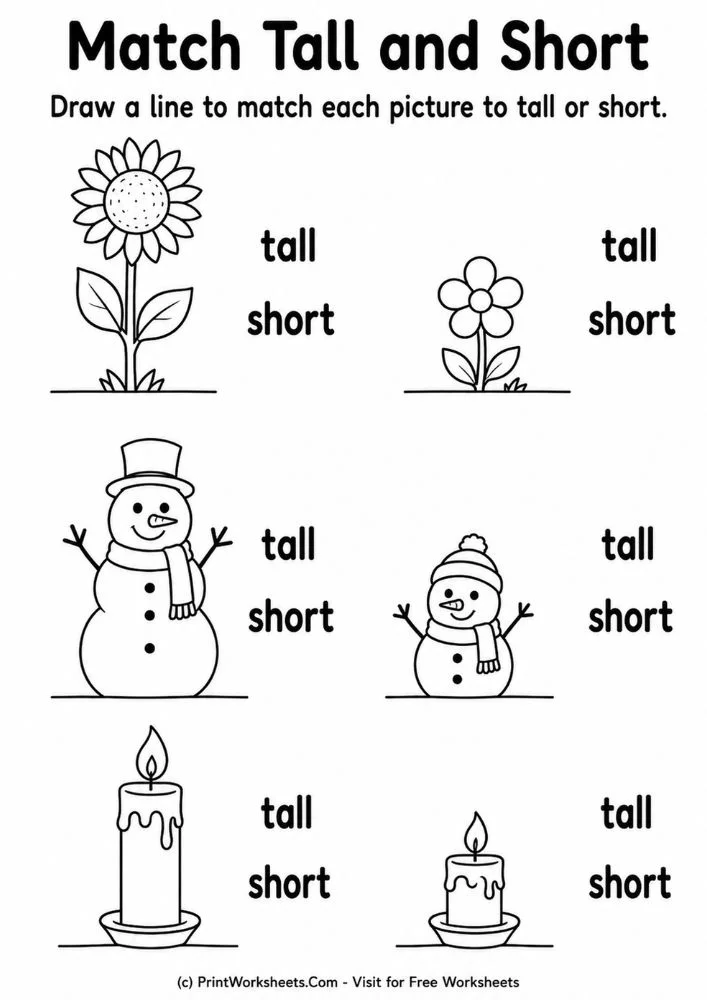
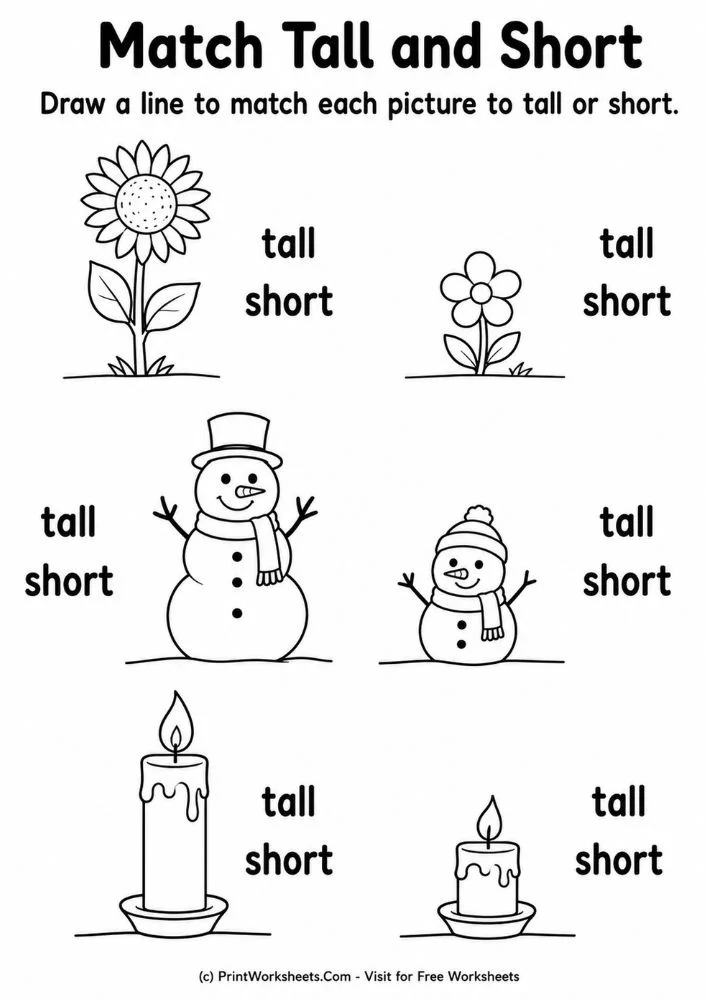
- Match Tall and Short: A targeted vocabulary and line-drawing exercise. Students examine isolated illustrations of varying heights. Beside each illustration are the printed words “tall” and “short.” Students must draw a connecting line from the object to its correct descriptive text. This enforces early reading comprehension alongside mathematical size categorization.
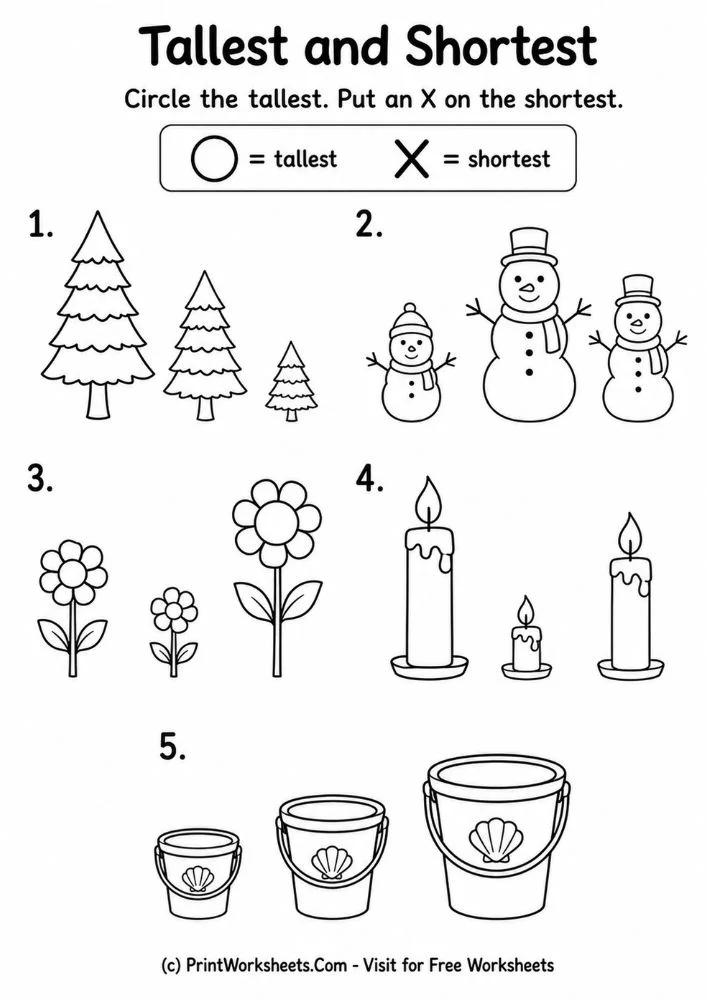
- Tallest and Shortest: An advanced measurement activity requiring the evaluation of three or more objects simultaneously. Students look at a group of items (e.g., three trees of varying heights). Following the explicit instructions at the top of the page, they must draw a circle around the single tallest item in the group and draw a formal “X” directly over the shortest item, demonstrating an understanding of superlative measurement adjectives.
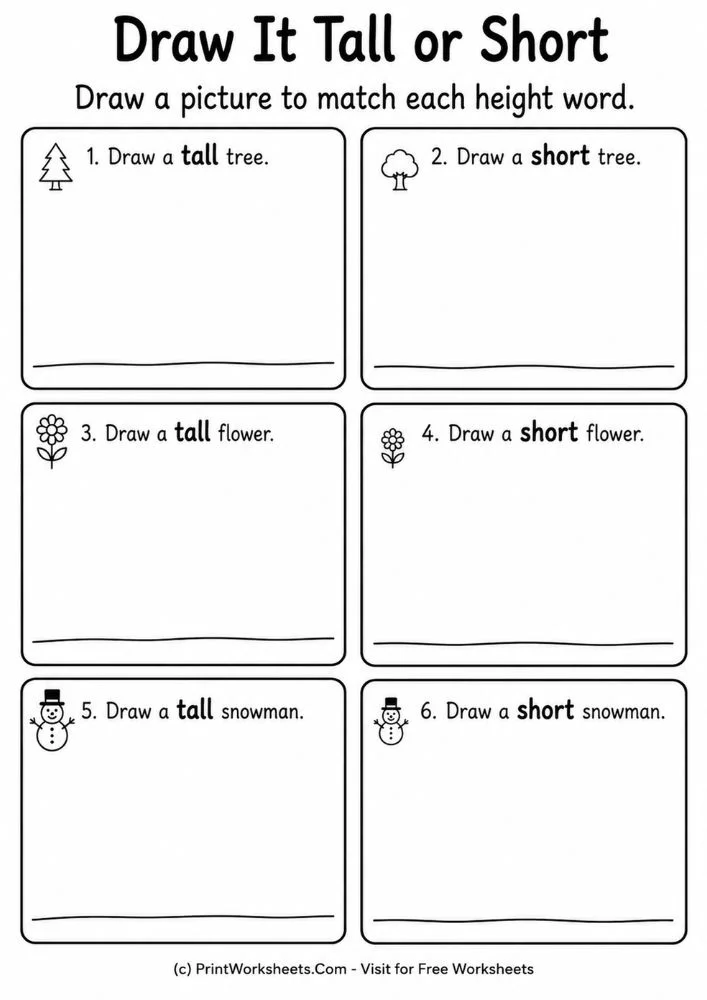
- Draw It Tall or Short: An independent spatial reasoning and fine motor application. Instead of evaluating pre-drawn images, students read specific instructions inside blank boxes (e.g., “Draw a tall tree” or “Draw a short flower”). The student must physically sketch the requested object, controlling their pencil to deliberately reflect the requested vertical proportion.
Practical Classroom and Math Center Implementation
Print this high-resolution PDF directly on standard 8.5″ x 11″ copy paper. Integrating physical manipulatives prior to assigning the worksheets maximizes conceptual retention. Before students complete the “Tallest and Shortest” page, provide them with interlocking math cubes. Instruct students to build one tall tower and one short tower. Physically handling vertical objects grounds the abstract worksheet exercises in reality.
Utilize the “Draw It Tall or Short” page as a formal assessment of spatial awareness. Require students to use a standard pencil rather than thick markers to ensure precision when demonstrating height differences. For repeated center use, place the matching and circling pages inside heavy-duty dry-erase sleeves. Students use washable markers to circle and cross out objects, allowing multiple groups to practice vertical measurement comparisons throughout the instructional week without consuming excess printer paper.
Frequently Asked Questions
Why is visual height comparison important for early math development?
Visual height comparison forces the brain to evaluate vertical spatial relationships without relying on numerical data. Before a child can comprehend that the number 10 is mathematically larger than 2, they must visually understand that a 10-inch block is physically taller than a 2-inch block. Mastering the concepts of tall and short provides the concrete mental framework necessary for understanding abstract numerical values, fractions, and standard ruler measurement in later elementary grades.
How do drawing activities improve height measurement skills?
Evaluating a pre-drawn tall object requires passive visual recognition. Conversely, drawing a tall object requires active spatial planning and deliberate fine motor control. When a student sketches a “short” snowman next to a “tall” snowman, they must actively monitor their pencil strokes to ensure the vertical proportions differ significantly. This physical execution proves the student fully comprehends the dimensional vocabulary.
What grade level aligns with tall and short measurement worksheets?
This measurement PDF pack directly aligns with preschool and kindergarten core math standards. Preschoolers primarily focus on recognizing basic tall and short attributes using the circling and matching pages. Kindergarten students utilize the entire packet to master superlative vocabulary (tallest/shortest) and apply their knowledge independently through the guided drawing assessments.