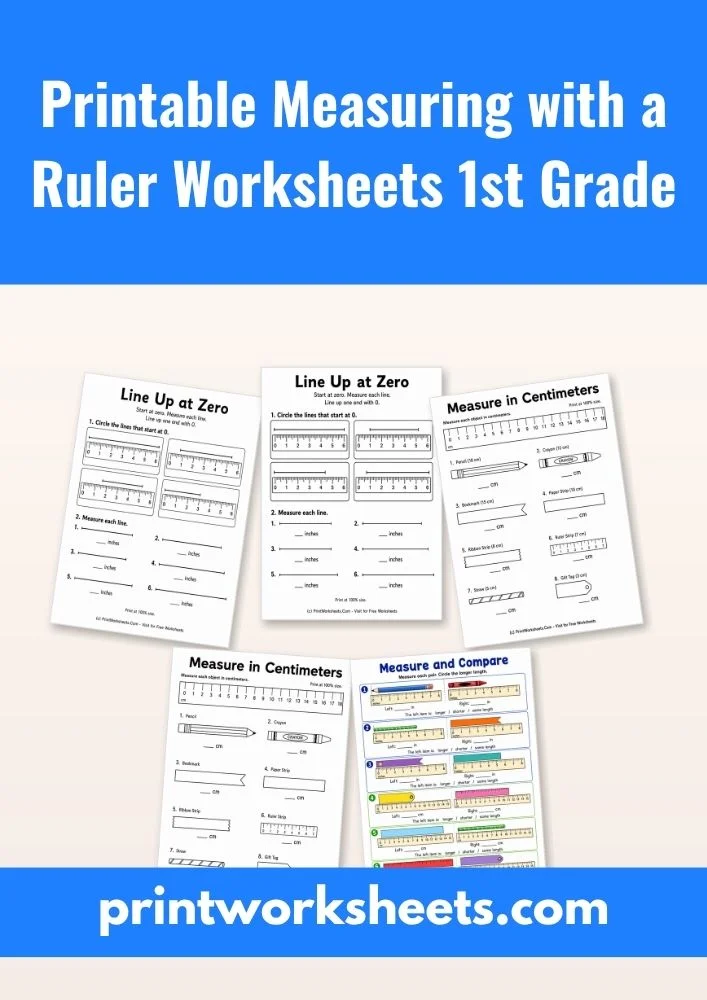
Measuring with a ruler worksheets are highly structured printable mathematical resources developed to help 1st grade and 2nd grade students accurately quantify the length of physical objects using standard units. Elementary educators utilize these specific math printables to transition young learners from visually estimating sizes to utilizing precise, standardized measurement tools. By completing these spatial activities, students master the physical mechanics of using a standard ruler, including identifying the true zero mark, reading continuous number lines, and recording accurate measurements in both inches and centimeters. Download this complete measuring with a ruler worksheets PDF directly from PrintWorksheets.Com to establish rigorous, common core-aligned length assessment stations in your elementary classroom.
To construct a highly effective early childhood measurement curriculum, pair these standard unit printables directly with our foundational non-standard measurement worksheets. Ensuring students first understand the general concept of length using physical blocks creates the necessary cognitive foundation before introducing the complex numerical scale of a standard ruler.
Inside the Standard Measurement Printables Pack
This targeted math practice pack features meticulously designed spatial worksheets. Each printable page is explicitly structured to meet exact 1st Grade and 2nd Grade Measurement and Data standards. Note: It is critical that educators select “Print at 100% size” or “Actual Size” in their printer settings so the visual rulers on the paper accurately match real-world standard units.
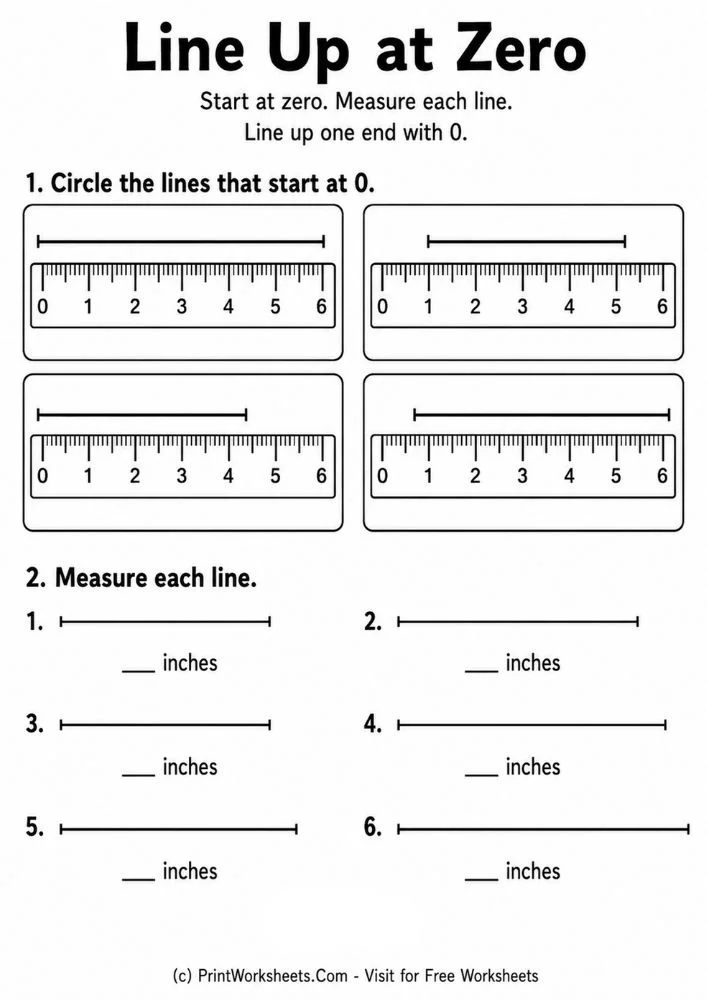
- Line Up at Zero (Inches): This foundational worksheet targets the most common physical error in elementary measurement: starting at the plastic edge of the ruler instead of the printed zero mark. Students first analyze illustrations to identify which lines are correctly lined up at zero. The second section requires them to read a provided visual ruler to measure straight horizontal lines accurately in standard inches.
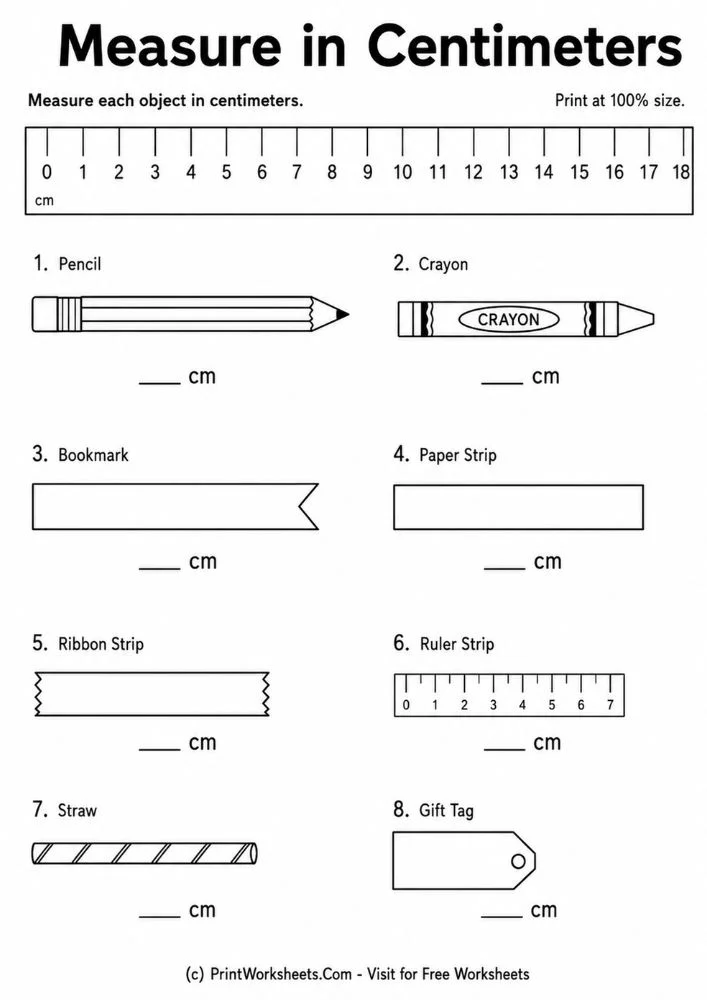
- Measure in Centimeters: A dedicated metric system practice page. Students measure illustrations of real-world classroom objects, such as pencils, crayons, and ribbons, using a visual centimeter ruler provided at the top of the worksheet. This reinforces analytical spatial reasoning and the ability to project a numerical metric scale onto physical items.
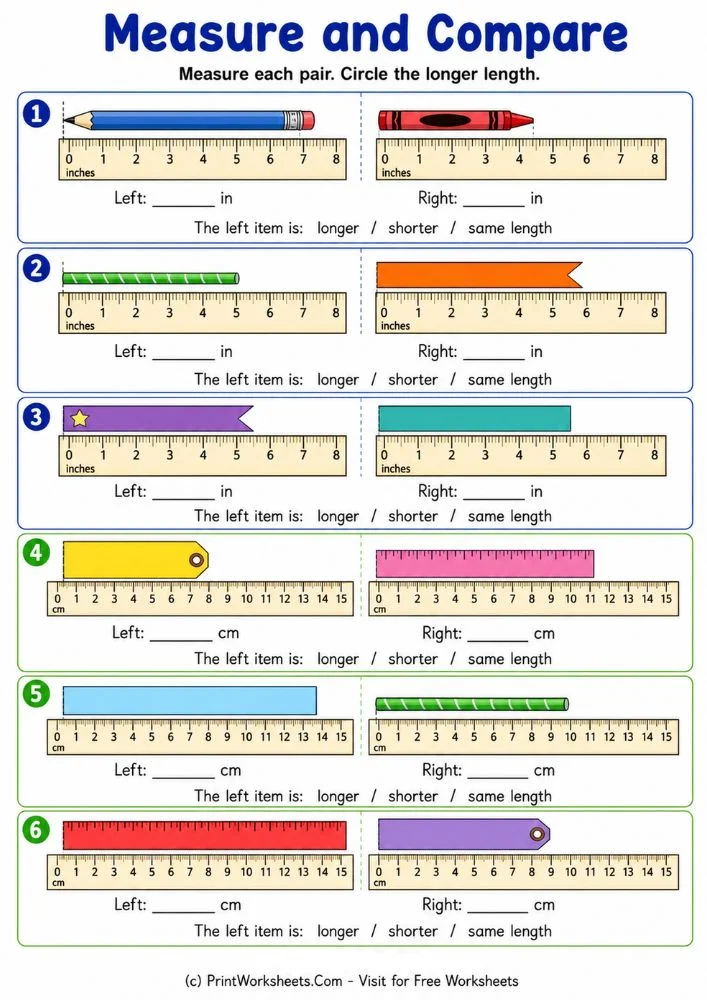
- Measure and Compare Lengths: An advanced analytical math worksheet. Students are presented with pairs of objects placed above visual rulers. They must measure both the left item and the right item, record the standard units (alternating between inches and cm), and then circle the correct mathematical comparative vocabulary: “longer,” “shorter,” or “same length.” This seamlessly integrates spatial measurement with comparative algebraic thinking.
Why Teaching Spatial Alignment Matters
Mastering standard measurement is a critical cognitive milestone in early childhood mathematics. When 1st grade students complete measuring with a ruler worksheets, they are doing much more than simply identifying numbers on a piece of plastic. They are developing advanced spatial reasoning and understanding the concept of continuous mathematical quantities. Unlike counting individual blocks (which provides discrete data), measuring length requires students to understand that a ruler represents a continuous number line where space itself is divided into equal, standardized intervals. Explicitly practicing the “line up at zero” methodology prevents a lifetime of offset measurement errors and builds the exact mental framework required for reading fractions and decimals on a number line in upper elementary grades.
Setting Up Your Ruler Math Centers
Print these spatial math worksheets on standard 8.5 x 11 copy paper for independent morning work, small-group STEM interventions, or dedicated measurement blocks. To maximize your educational resources and drastically minimize copy machine usage, place the comparative measurement worksheets inside heavy-duty plastic dry-erase sleeves. Provide early learners with fine-tip whiteboard markers and real physical wooden rulers to lay directly over the paper as a secondary physical check. This straightforward classroom preparation creates a permanent, reusable math station where students can practice accurate alignment and numerical comparison repeatedly throughout the semester.
Measurement Instruction FAQs
What grade levels use measuring with a ruler worksheets?
Measuring with a ruler worksheets are heavily utilized by 1st grade and 2nd grade math educators. They provide essential spatial practice that targets required common core standards, focusing strictly on standard units, proper tool alignment, and comparative length analysis.
What specific mathematical skills do these measurement printables target?
These measurement math printables explicitly target standard units of measurement (imperial inches and metric centimeters), accurate physical tool alignment (locating the zero point), continuous number line reading, and mathematical comparison vocabulary.
Why is finding the zero mark so difficult for young students?
Finding the zero mark is difficult for young students because standard physical rulers often have a small gap between the physical edge of the material and the actual printed zero line. If students learn to merely measure from the physical edge, every measurement they take will be mathematically inaccurate. Explicit visual practice corrects this spatial misconception immediately.