
Bridging the gap between simply reciting numbers out loud and actually measuring physical space is one of the biggest hurdles in early childhood mathematics. When educators hand a standard ruler to a preschooler, the abstract fractional lines and tiny hash marks usually cause immediate cognitive overload. This targeted preschool measurement activity eliminates metric confusion by utilizing a tool children already understand: interlocking building blocks. By counting colorful bricks to determine the length of familiar toys, early learners effortlessly transition from basic counting to foundational geometry. This printable PDF transforms a complex academic standard into an intuitive, visually supported data collection game, ensuring students grasp the mechanics of non-standard measurement long before they enter formal grade school.
Daycare providers and kindergarten teachers consistently integrate this specific worksheet into their morning table work and hands-on math rotations due to its brilliant use of visual scaffolding. By utilizing recognizable illustrations alongside clearly segmented block units, the activity drastically reduces math anxiety. Before asking a young student to evaluate the length of these toys and record their data, you must verify that they can confidently execute numeral formation. We highly recommend utilizing our number tracing 1-10 worksheet printable activity from PrintWorksheets.Com to ensure their handwriting mechanics are solid. Once they know how to write their numbers, counting the printed blocks and logging the answers becomes a seamless, independent task.
Inside the Measure The Toys PDF
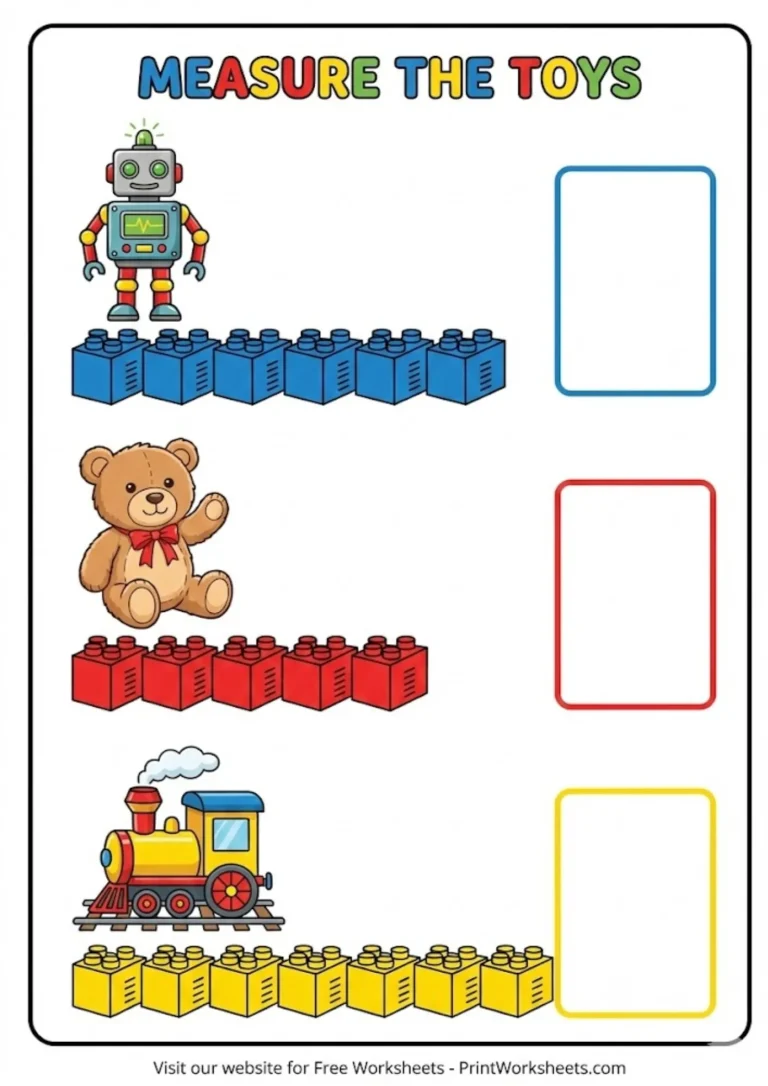
This single-page resource is meticulously formatted to isolate the counting process and prevent visual tracking errors. Titled “MEASURE THE TOYS,” the worksheet presents three distinct non-standard measurement challenges, completely avoiding generic shapes in favor of highly engaging illustrations:
- The Robot Measurement: The top row features a grey mechanical robot with a green antenna. Students must count the row of blue interlocking blocks beneath it to determine its length.
- The Teddy Bear Measurement: The middle section displays a classic brown teddy bear wearing a red bow tie. The measuring units transition into a row of distinct red blocks, forcing the student to restart their counting process.
- The Toy Train Measurement: The final row presents a colorful locomotive resting on a train track. Students evaluate its total length by counting the long row of yellow blocks positioned directly underneath.
- Color-Coded Recording Boxes: The most powerful pedagogical feature of this page is the data entry column. The empty rectangular boxes on the right side are explicitly color-coded to match the blocks (a blue box for the robot, a red box for the bear, and a yellow box for the train). This subtle visual cue ensures the child’s eyes track horizontally across the correct row without writing their answer in the wrong space.
Differentiation Options for Teachers
For kinesthetic learners who frequently lose their place while counting printed images, introduce a tactile marking strategy. Provide the student with a dry-erase marker (if the sheet is in a plastic sleeve) or a crayon. Instruct them to physically place a dot or an “X” on each printed brick as they count it aloud. This forces a physical action for every spoken number, locking in one-to-one correspondence. To challenge advanced early finishers, introduce an estimation component before they are allowed to count. Ask them to look at the page and predict which toy is the longest and which is the shortest, writing their guesses on the back of the paper. Then, have them complete the worksheet to prove or disprove their initial hypothesis.
Targeted Academic Skills
This printable directly supports foundational kindergarten measurement expectations, specifically aligning with early interpretations of CCSS.MATH.CONTENT.K.MD.A.1, which states that students must describe measurable attributes of objects, such as length. Furthermore, by requiring the child to evaluate segmented units (the individual blocks) rather than a solid continuous line, it deeply reinforces standard K.CC.B.4.A, cementing the principle that the last number name said tells the number of objects counted.
Frequently Asked Questions
Why are non-standard units important in early education?
Non-standard units isolate the logic of measurement. Before a child can comprehend what an “inch” is, they must first understand the fundamental concept that physical space can be quantified by laying smaller, equal-sized objects end-to-end. Using familiar items like interlocking blocks strips away the confusing metric terminology and focuses purely on the mathematical concept of length.
How does visual scaffolding help in this worksheet?
It prevents spatial and organizational errors. Young children often struggle with visual tracking—moving their eyes from the left side of a page to the right without skipping a line. By coloring the answer box blue to match the blue blocks under the robot, the worksheet provides an invisible cognitive bridge, ensuring the child records their counted data in the correct location.
What should a student do if they miscount the blocks?
Encourage immediate recounting using physical touch. If a student writes “9” for the blue blocks instead of the correct number, do not simply give them the answer. Ask them to place their index finger on the first block and recount slowly, touching each individual block. Physical touch is the most effective way to recalibrate a misaligned counting sequence.