Preschool math worksheets
Free Printable Preschool Math Worksheets
Free printable preschool math worksheets for counting, number recognition, tracing, shapes, sorting, comparing, measurement, and early addition. Print-ready PDF activities for classroom or home.
Free printable PDFs
Preschool math practice
Skill-based activities
Classroom & home
Practice by skill
All Math topicsBrowse Preschool Math Worksheets by Skill
Counting & Numbers
Free printable counting worksheets for preschool and kindergarten to practice…
Number Tracing
Free printable number tracing worksheets for preschool and kindergarten to…
Measurement
Free printable measurement worksheets for kids to practice length, height,…
Addition
Free printable addition worksheets for kids to practice math facts,…
Subtraction
Master subtraction with our free printable worksheets. From single-digit practice…


Preschool Math Skills for Early Learners
Preschool math introduces young learners to numbers, counting, comparing, sorting, shapes, patterns, measurement, and simple operations through visual and hands-on practice. These free printable preschool math worksheets are designed for short, focused activities that can be used in preschool classrooms, homeschool lessons, learning centers, morning work, or extra practice at home.
Counting and Number Recognition
Counting and number recognition are some of the first math skills preschoolers develop. Children can practice counting objects, matching numbers to quantities, recognizing numerals, comparing groups, and understanding that numbers represent amounts.
Explore our counting worksheets for more early number sense practice.
Number Tracing and Number Formation
Number tracing helps children connect number recognition with early writing skills. Preschoolers can trace numerals, practice correct number formation, and reinforce counting while developing pencil control and hand-eye coordination.
Browse our number tracing worksheets for printable number-writing practice.
Sorting, Matching, and Comparing
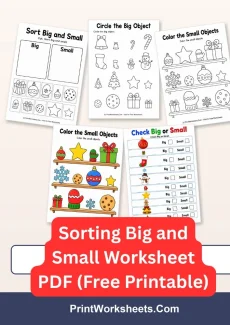
Sorting and matching activities help preschoolers notice similarities, differences, size, color, shape, and other attributes. Comparing objects and organizing them into groups also builds early logical thinking and prepares children for later work with patterns, data, and number relationships.
Explore our sorting and matching worksheets for classification and visual discrimination practice.
Shapes, Patterns, and Early Geometry
Preschool math also includes recognizing basic shapes, identifying visual patterns, matching similar objects, and describing how objects are alike or different. These activities build observation skills and introduce children to early geometric thinking.
Early Measurement and Comparing Sizes
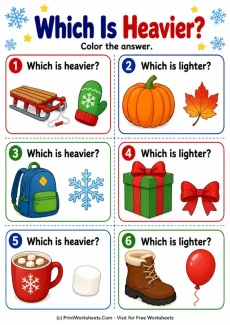
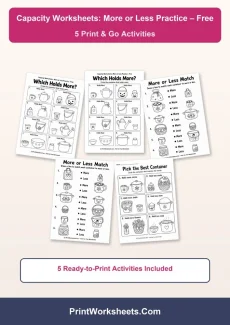
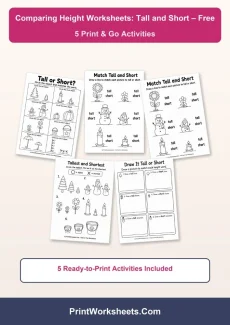
Before using rulers and standard units, preschoolers can explore measurement by comparing objects. Activities involving big and small, tall and short, long and short, heavy and light, full and empty, and more or less help children understand important measurement relationships.
Browse our measurement worksheets for printable size, length, weight, capacity, and comparison activities.
Beginning Addition and Subtraction
Some preschool learners are ready to explore simple addition and subtraction using pictures, fingers, objects, five frames, and small quantities. Visual activities can help children understand the ideas of putting groups together and taking objects away before moving to formal equations.
Explore our addition worksheets for picture-based and early addition practice.
How to Use Preschool Math Worksheets
Choose activities that match the child’s current developmental level and keep practice short and visual. A counting page, number tracing activity, sorting worksheet, or size-comparison exercise can be more useful than completing a large set of worksheets at once.
For stronger early math learning, combine printable practice with everyday activities such as counting toys, sorting objects by color or size, identifying shapes around the room, building simple patterns, comparing household items, or adding small groups of objects together.