Free printable summer subtraction worksheets within 20 provide the exact concrete mathematical foundation required for early elementary students. Transitioning a child from counting single-digit physical objects to mentally calculating double-digit differences represents a major developmental leap. Providing a targeted, no-prep PDF worksheet pack eliminates abstract confusion by heavily utilizing supportive imagery. By prompting young learners to interact with engaging pictures and structured number lines, educators ensure the core concepts of “taking away” are deeply understood before introducing complex algorithms.
Educators and parents consistently deploy early arithmetic bundles into daily math centers, morning review routines, and focused summer vacation interventions. Building a comprehensive curriculum for early learners requires continuous exposure to visual math scenarios. We highly encourage pairing the seasonal transition packet with the rigorous resources found in our main subtraction worksheets category. Ensuring a rock-solid understanding of basic arithmetic is the most important step before introducing advanced double-digit operations or regrouping algorithms.
Inside the Summer Subtraction PDF Pack
Designing effective math materials for small hands and developing minds requires removing distracting visual clutter. Utilizing large, easy-to-read fonts and highly recognizable seasonal graphics ensures the student focuses entirely on the learning objective. Each activity page within the bundle serves a specific pedagogical purpose to build true numerical fluency:
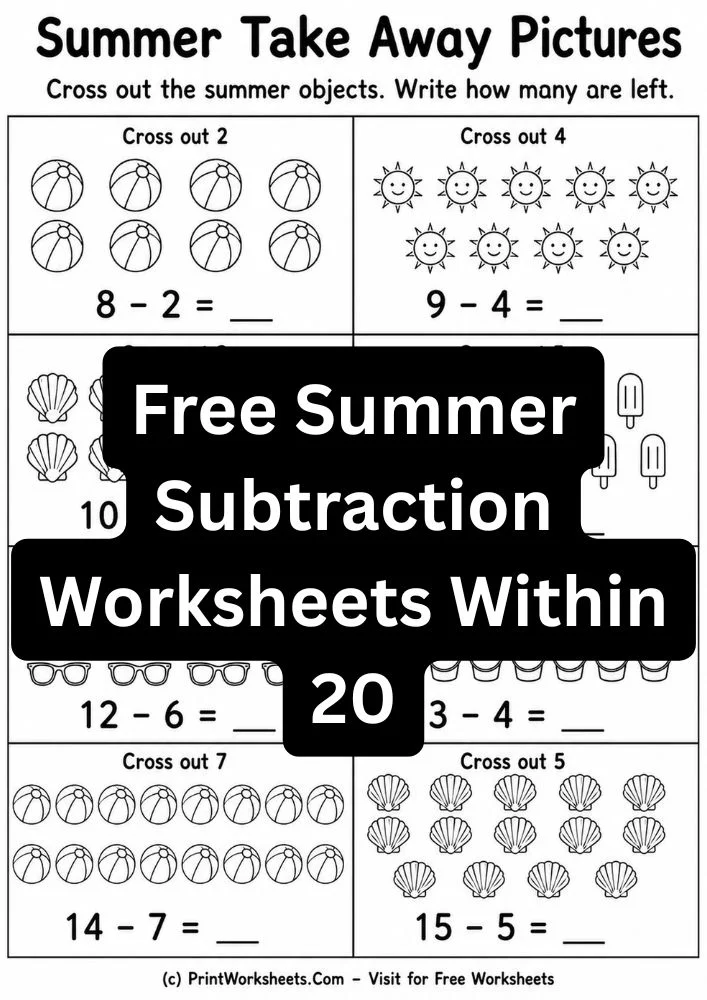
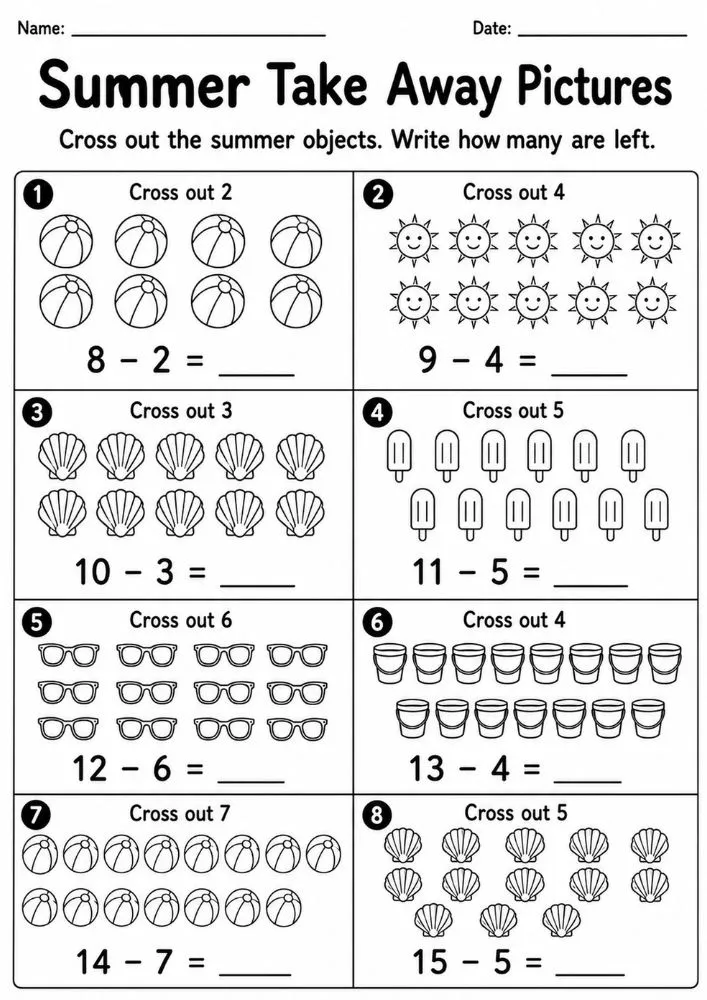
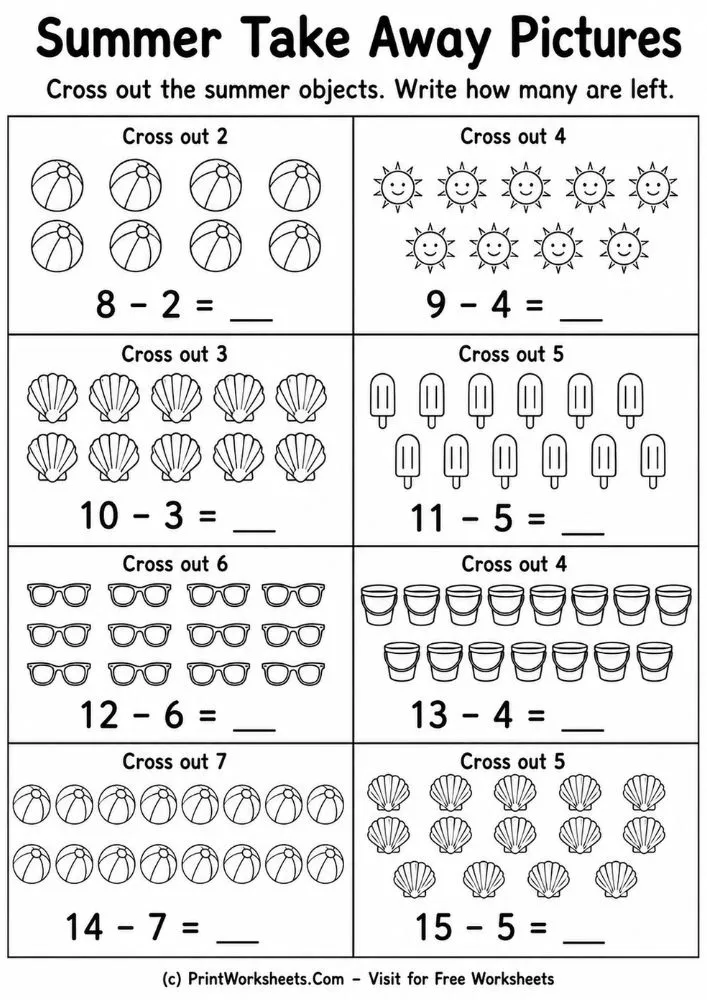
- Summer Take Away Pictures: An incredibly intuitive introduction to subtracting quantities through visual cross-outs. Children view organized groups of familiar seasonal items, including beach balls, smiling suns, seashells, popsicles, sunglasses, and sand buckets. The worksheet provides explicit instructions right above the images, dictating exactly how many objects to cross out. After physically drawing an X through the correct number of items, the student counts the remaining objects and writes the final difference in the formal equation space below.
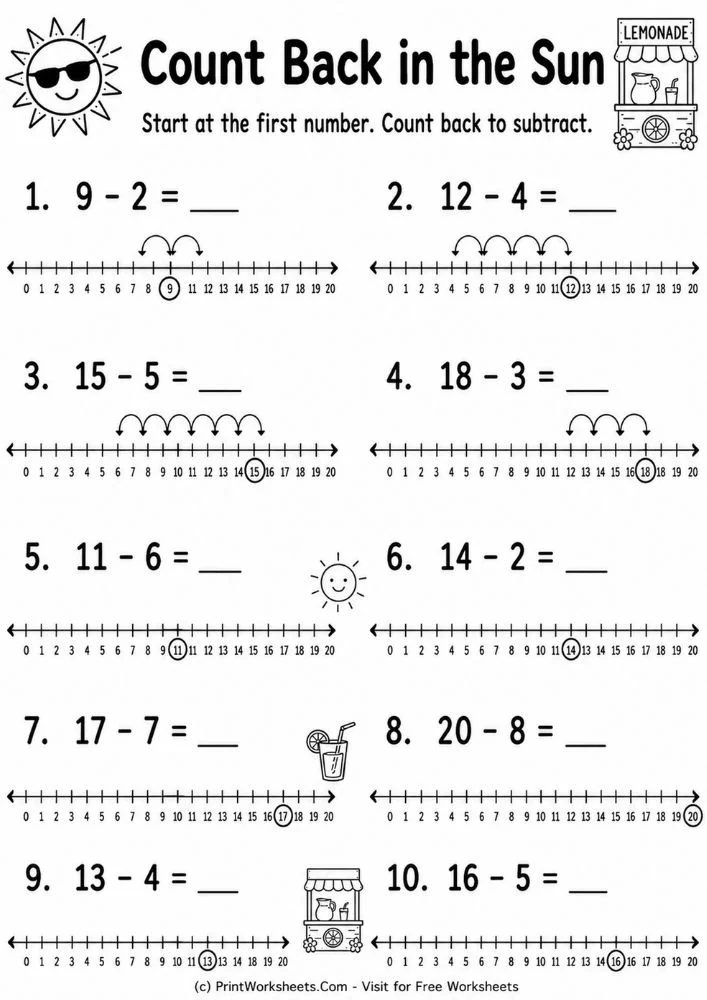
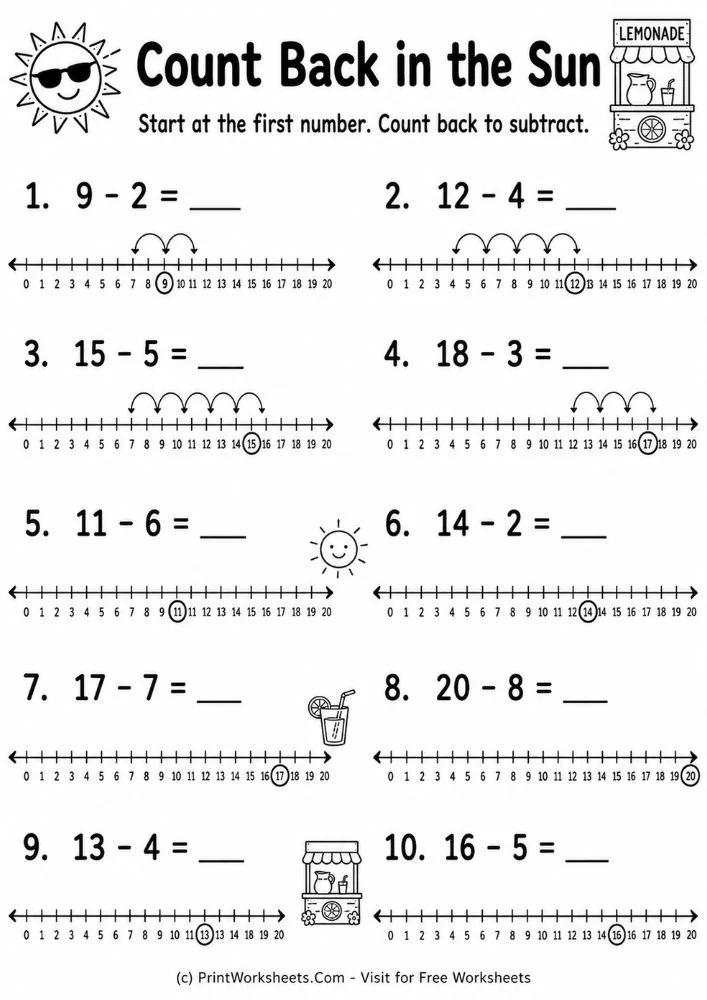
- Count Back in the Sun: A crucial number sense assessment pushing students to explore subtraction logic utilizing a horizontal number line. Children examine standard equations up to 20. Directly beneath each equation is a clearly marked number line spanning from 0 to 20. Students must locate the starting number, circle it, and then physically draw jumping arcs backward to represent the subtracted amount. Writing the final landing number inside the blank equation space solidifies their understanding of descending numerical order and spatial mathematics.
Practical Classroom and Home Implementation
Download the high-resolution file and print the entire PDF directly on standard 8.5″ x 11″ copy paper. Because early learners thrive on repetition and tactile feedback, utilizing the worksheets alongside actual, physical manipulatives yields incredible results. When completing the picture pages, place a pile of physical counting cubes or real seashells on the desk. Have the child physically act out the subtraction process by sliding the correct number of shells away before writing the formal equation on the paper.
To maximize the effectiveness of the number line activity, provide the student with different colored crayons. Instruct them to circle the starting number with a blue crayon and draw the backward jumps with a red crayon. Such a simple color-coding strategy prevents visual tracking errors and makes the final calculation beautifully clear and easy to analyze for both the student and the reviewing teacher.
Frequently Asked Questions
Why is visual support necessary for early subtraction problems?
Young children operate in a concrete learning stage; they need to see and process visual quantities before they can understand abstract math sentences. If a child simply reads an equation on a blank white page, it is just a symbolic string. However, when they read an instruction to cross out five popsicles and physically draw an X over the illustrations, the brain actively processes the real-world application of subtraction. Visuals bridge the gap between abstract numbers and mathematical execution.
How does the number line worksheet build mathematical fluency?
Spatial recognition is the absolute foundation of mental arithmetic. When a student uses a number line to jump backward from 18 to 15, they are rapidly performing mental subtraction while visualizing the distance between the two integers. The mental gymnastics forces the brain to practice subtraction dynamically, dramatically increasing overall computation speed and number sense without relying strictly on finger-counting.
What grade level is the arithmetic packet best suited for?
The specific PDF worksheet pack is heavily aligned with late 1st-grade and early 2nd-grade core math standards. First graders are formally introduced to subtracting from 20 using visual aids, making the cross-out activities perfect for their development. Second graders can utilize the entire packet to solidify number line logic and spatial awareness early in the school year, acting as a perfect review tool to combat learning loss over the long vacation break.