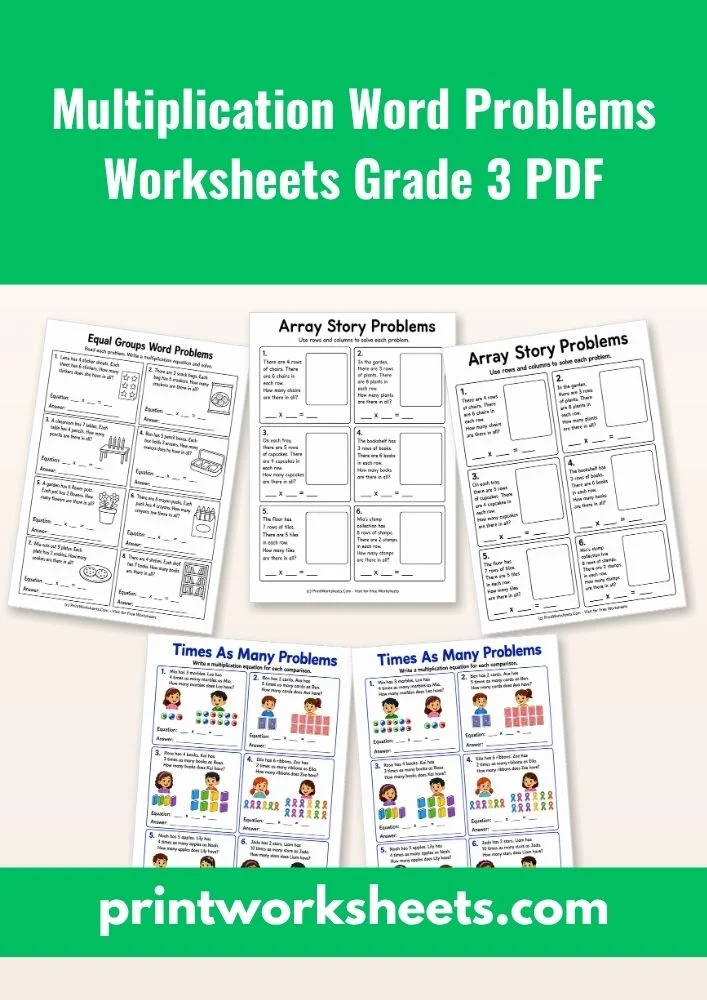
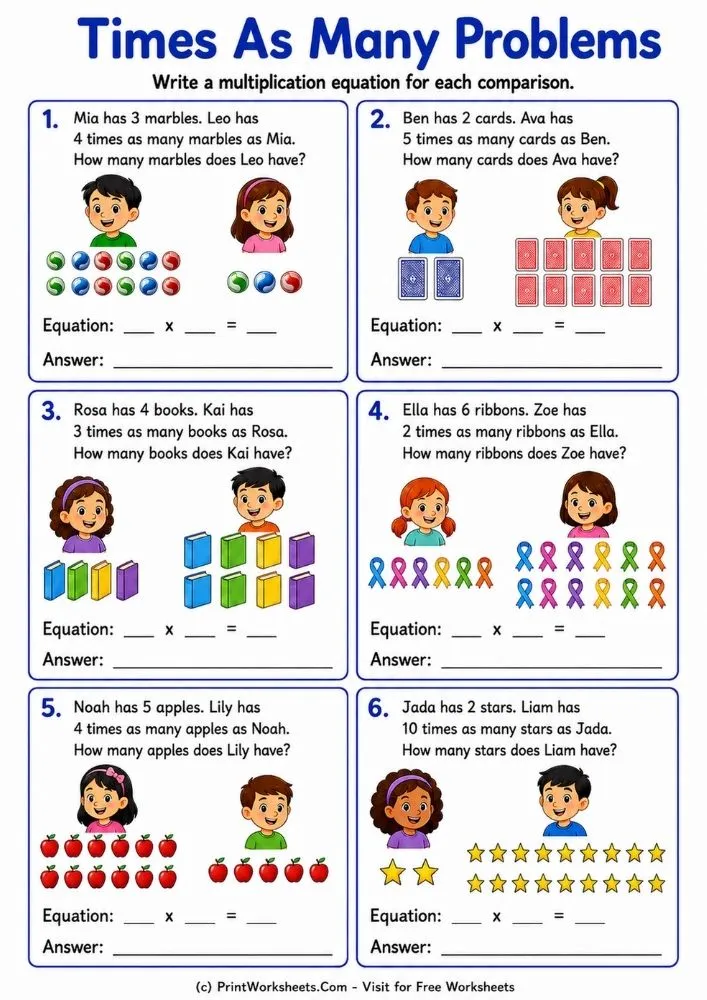
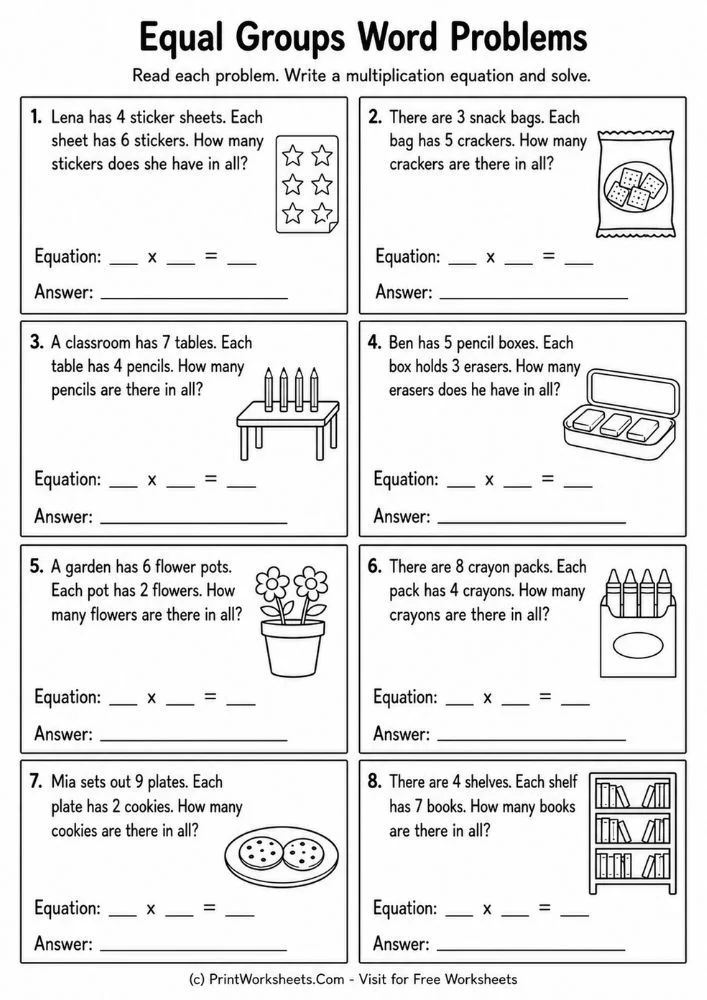
What are multiplication word problems worksheets grade 3? Multiplication word problems worksheets grade 3 are printable math pages that help third-grade students turn short real-life situations into multiplication equations. This PrintWorksheets.Com PDF focuses on array story problems, so students read a situation, identify the number of rows, identify how many objects are in each row, write a multiplication equation, and solve for the total. The worksheet is useful for students who are ready to move from counting pictures one by one into using factors, products, rows, columns, and repeated equal groups.
This page is built around one clean black-and-white worksheet titled Array Story Problems. Each problem gives a compact classroom or everyday context, a large empty drawing box, and an equation line. That structure makes the page practical for math centers, small-group reteaching, morning work, homework, or a quick formative check after a lesson on arrays. Students are not just filling in facts; they are translating words such as “rows,” “in each row,” and “in all” into multiplication thinking.
For a nearby skill bridge, teachers can pair this page with grade 3 multiplication word problems practice so students see the same operation in more than one story format. The array page narrows attention to rows and columns, while the linked practice extends multiplication into broader one-step word problem situations.
Inside the multiplication word problems worksheets grade 3 PDF
- Page title and directions: The worksheet is titled “Array Story Problems” and tells students to “Use rows and columns to solve each problem.” The design uses six large boxes arranged in two columns, with a blank sketch space on the right side of each task and a multiplication equation line at the bottom.
- Problem 1: Students read about 4 rows of chairs with 6 chairs in each row. They can draw four horizontal rows, place six chairs in each row, and write 4 × 6 = 24. This problem introduces the page with a familiar classroom object.
- Problem 2: The garden problem gives 3 rows of plants and 8 plants in each row. Students must connect the plant rows to the equation 3 × 8 = 24. The context supports visual learners because a garden naturally fits the idea of organized rows.
- Problem 3: The cupcake tray problem states that there are 5 rows of cupcakes with 4 cupcakes in each row. Students can draw a 5-by-4 array and solve 5 × 4 = 20. This item gives practice with the same product students may also recognize as 4 × 5.
- Problem 4: The bookshelf story has 3 rows of books with 6 books in each row. The expected multiplication equation is 3 × 6 = 18. This problem keeps the row language clear and connects multiplication to an object students may see in a classroom library.
- Problem 5: Students solve a floor tile problem with 7 rows and 5 tiles in each row. The equation 7 × 5 = 35 asks students to apply a larger factor while still staying within grade-level multiplication facts.
- Problem 6: Mia’s stamp collection has 8 rows of stamps with 2 stamps in each row. Students write 8 × 2 = 16 and can see that arrays also work when each row contains a small number of objects.
Differentiation Options for Teachers
For students who hesitate when reading word problems, use a “row tap” routine before they write anything. Have students underline the number of rows, circle the number in each row, tap the empty drawing box, and say the sentence aloud: “Rows times objects in each row equals total.” Then let them build the first two arrays with counters, square tiles, mini erasers, or drawn dots before transferring the numbers to the equation blanks. This turns the worksheet into a language-to-math translation activity instead of a silent guessing task.
For students who already solve quickly, require a second representation for each item. After writing the original equation, they can write the related commutative equation, such as 4 × 6 = 24 and 6 × 4 = 24, then explain whether the new equation changes the story or only changes the way the array is viewed. Advanced students can also write a matching division sentence for each product, such as 24 ÷ 4 = 6, to connect multiplication word problems with future division reasoning.
Targeted Academic Skills
This worksheet supports the Common Core multiplication expectations commonly taught in grade 3. It directly aligns with CCSS 3.OA.A.1 because students interpret products of whole numbers as groups, rows, and objects in each row. It also fits CCSS 3.OA.A.3 because every task is a one-step multiplication word problem using equal groups or arrays. The equation blanks strengthen the habit of representing a situation with a mathematical sentence rather than writing only the final answer.
The page also reinforces CCSS 3.OA.B.5 when teachers discuss the commutative property through arrays. A 5-by-4 cupcake tray and a 4-by-5 view can have the same product, but the row description in the story still matters. Because the facts stay within 100, the worksheet also gives useful practice toward CCSS 3.OA.C.7, which expects fluency with multiplication and division within 100 by the end of grade 3.
Frequently Asked Questions
Is this worksheet best for early or later grade 3 multiplication?
It works best after students have been introduced to arrays and equal groups. The page is not a pure fact drill. Students need to read row-based language, identify two factors, and write a multiplication equation before solving.
Can students draw the arrays in the blank boxes?
Yes. Each problem includes a large empty box so students can sketch rows and columns. This is especially helpful for students who still need a visual model before they trust the multiplication equation.
Does this worksheet include an answer key?
The visible student page does not show answers. The expected products are 24, 24, 20, 18, 35, and 16. Teachers can use those answers for quick checking or ask students to justify each product with a drawing.
How can I use this for a small group lesson?
Start with one problem as a shared model. Read the story aloud, mark the number of rows, mark the number in each row, draw the array together, and then have students complete the remaining problems independently or with partners.