Print place value blocks worksheets to provide mandatory visual math practice for first and second-grade students. Transitioning from single-digit counting to 3-digit numbers requires a concrete understanding of base-ten concepts. This printable math PDF delivers rigorous, no-prep learning centers focusing strictly on physical representations of hundreds, tens, and ones. By utilizing block counting, active drawing, matching, and error analysis, educators guarantee comprehensive arithmetic development. Printing these math activities ensures young learners internalize the actual physical value of a digit before transitioning to abstract equations.
Educators and homeschool parents utilize place value blocks worksheets during morning work, independent math rotations, and base-ten assessments. Consistent exposure to visual block models prevents critical misalignment errors during multi-digit operations. To build a continuous mathematical progression, pair this visual base-ten packet directly with our expanded form worksheets. Converting physical block models into expanded form equations secures the core logic required for advanced primary grade mathematics.
Inside the Base Ten Blocks PDF
Clear formatting and structured visual models make these printables mandatory for early base-ten fluency. The clean black-and-white design prevents visual distraction, forcing students to focus entirely on block categorization and mathematical accuracy. Each printable activity page targets specific primary grade core math standards.
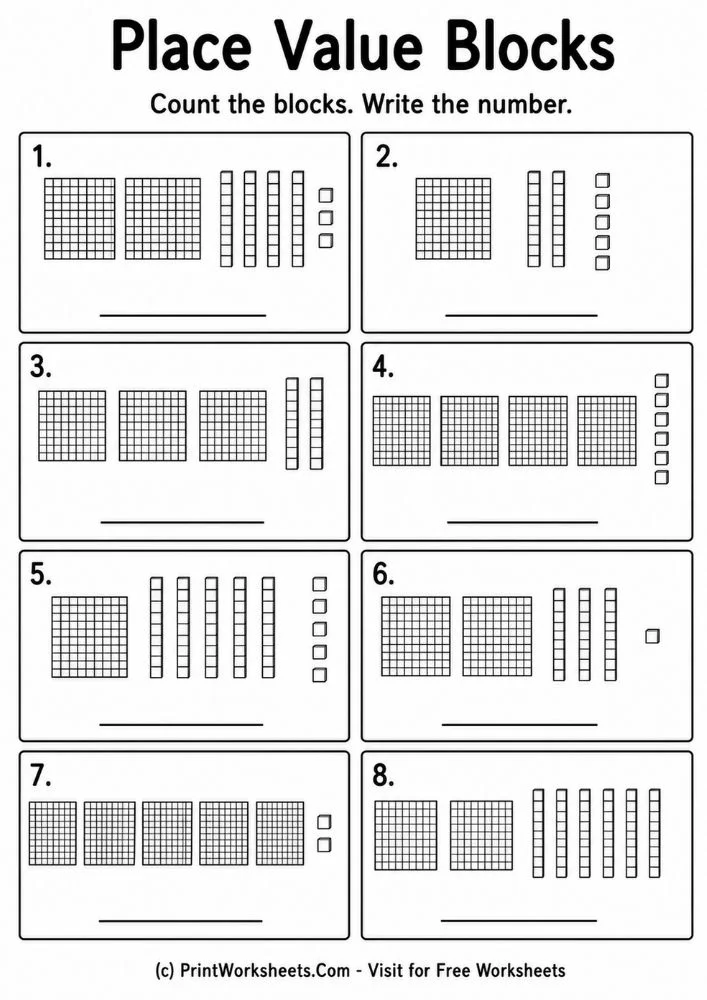
- Place Value Blocks Count A direct visual counting worksheet. Students evaluate 8 distinct groupings of base-ten blocks. They must systematically count the hundred flats, ten rods, and one cubes, and write the final standard 3-digit number on the provided line.
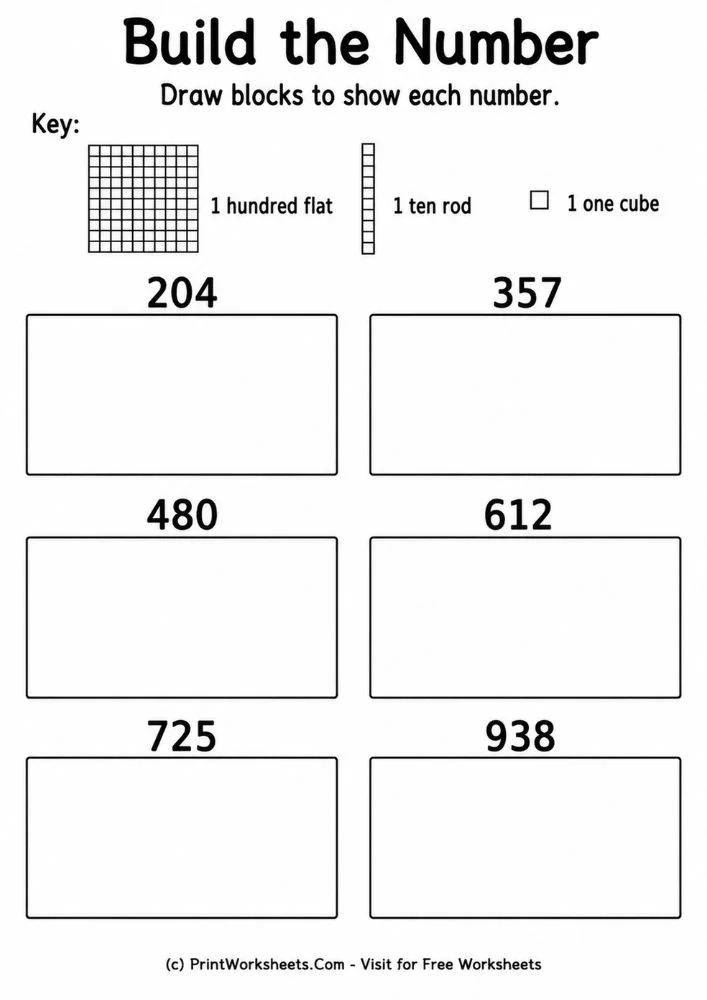
- Build the Number An active spatial reasoning worksheet. Students read six standard 3-digit numbers (e.g., 204, 357). Utilizing the provided block key, students must physically draw the correct amount of flats, rods, and cubes inside the blank box to accurately represent the printed number.
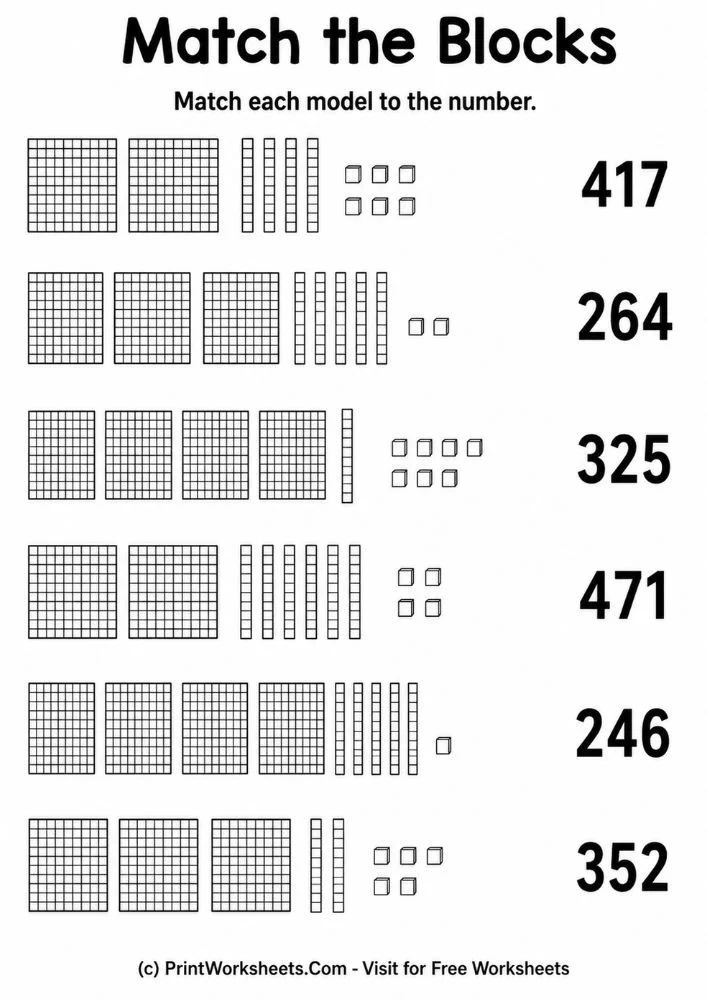
- Match the Blocks A visual tracking and fact retention worksheet. Students evaluate five distinct block models listed on the left margin. They must calculate the total value mentally and draw a connecting line to the correct 3-digit number printed on the right margin.
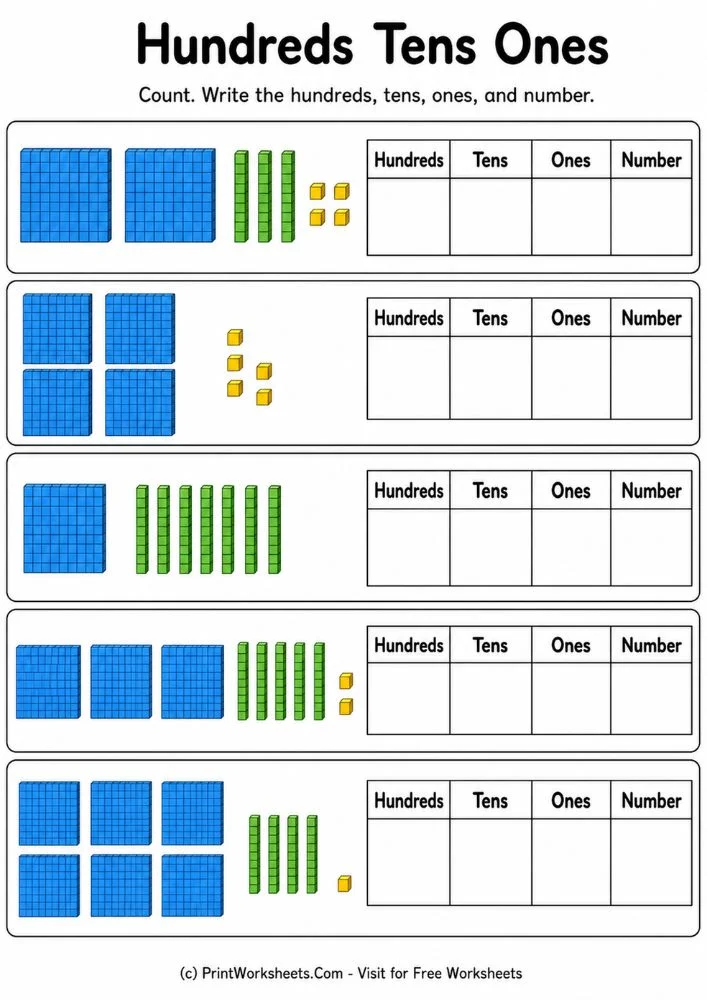
- Hundreds Tens Ones Chart A structured graphic organizer worksheet. Students view colored block models alongside a blank place value chart. They must separate the visual data by writing the exact number of hundreds, tens, and ones into the specific columns before writing the final combined number.
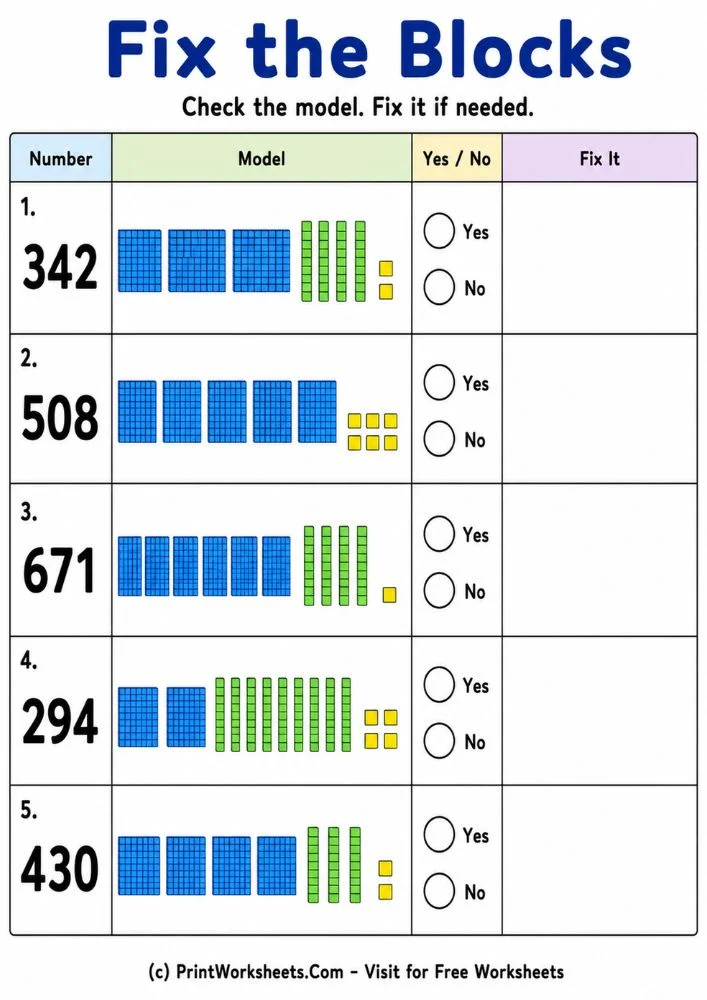
- Fix the Blocks A critical thinking and error analysis worksheet. Students view a target number alongside a pre-drawn block model. They must evaluate the model to determine if it accurately represents the number. If correct, they mark “Yes”. If incorrect, they mark “No” and must draw the missing blocks or cross out the extra blocks in the “Fix It” column.
Effective Math Center Implementation
Print these high-resolution base ten pages directly on standard 8.5″ x 11″ copy paper. Integrating physical math manipulatives alongside the place value blocks worksheets guarantees maximum conceptual retention. For students working on the “Build the Number” page, provide them with physical plastic base-ten blocks. Instruct them to physically build the target number on their desk before drawing the squares and lines on the paper. This concrete tactile method isolates the base-ten rule physically.
To maximize math center efficiency, place the error analysis and matching pages inside heavy-duty dry-erase sleeves. Provide students with fine-tip washable markers. This straightforward preparation allows multiple classroom groups to practice visual counting and algebraic thinking repeatedly throughout the instructional week without consuming excess printer ink or copy paper.
Frequently Asked Questions
Why use place value block models?
Place value block models provide physical proof of abstract numbers. A 2nd-grade student might read the number “471”, but they must visually understand that the “4” represents four massive hundred flats, not just four tiny cubes. Drawing and counting base ten blocks proves this concept spatially, preventing common place value inversion errors.
What grade levels use these base ten worksheets?
These math activities align directly with 1st-grade and 2nd-grade core math expectations. 1st-grade educators utilize the basic counting and matching pages to introduce the concept of tens and ones. 2nd-grade educators frequently print the entire PDF pack for weekly math centers, specifically utilizing the drawing and error analysis pages to assess deep base-ten comprehension up to 1000.