These completely free printable place value worksheets tens and ones practice provide the exact highly visual, concrete mathematical foundation that early elementary students desperately need. When children first encounter double-digit numbers, distinguishing between the value of a “3” in the tens place versus a “3” in the ones place can be incredibly abstract and confusing. This targeted, no-prep PDF worksheet pack eliminates that confusion by heavily utilizing base-ten block imagery. By forcing students to physically draw “ten rods” and count individual “one cubes,” they build a profound understanding of how standard numbers are actually constructed.
Educators and parents can seamlessly deploy this targeted early arithmetic bundle into daily math centers, morning review routines, or focused homework interventions. If you are building a comprehensive curriculum for your early learners, we highly encourage you to pair this specific transition packet with the other fantastic, rigorous resources found in our main place value worksheets category. Ensuring a rock-solid understanding of place value is the absolute most important step before introducing your students to double-digit addition and subtraction.
Inside the Tens and Ones PDF Pack
This printable PDF worksheet pack is engineered specifically to bridge the gap between counting raw objects and understanding numerical place value. We have completely removed distracting visual clutter, utilizing large, easy-to-read fonts and highly recognizable, uniform base-ten blocks. Each activity page serves a specific pedagogical purpose to build true numerical fluency:
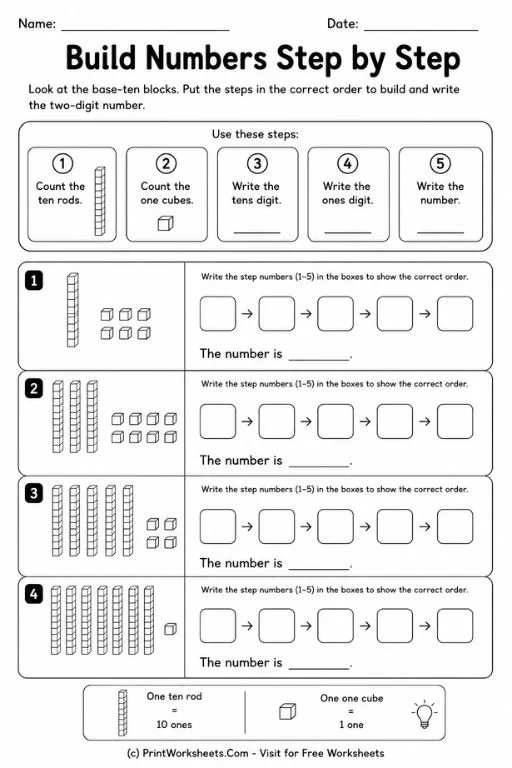
- Build Numbers Step by Step: A brilliant sequential logic and counting assessment. Children look at a provided set of base-ten blocks (e.g., three ten-rods and six one-cubes). At the top of the page, they are given a rigid 5-step mathematical process: Count the ten rods, count the one cubes, write the tens digit, write the ones digit, and write the final number. Students must order these steps logically into blank sequencing boxes before officially writing out the final double-digit answer at the bottom of each problem block.
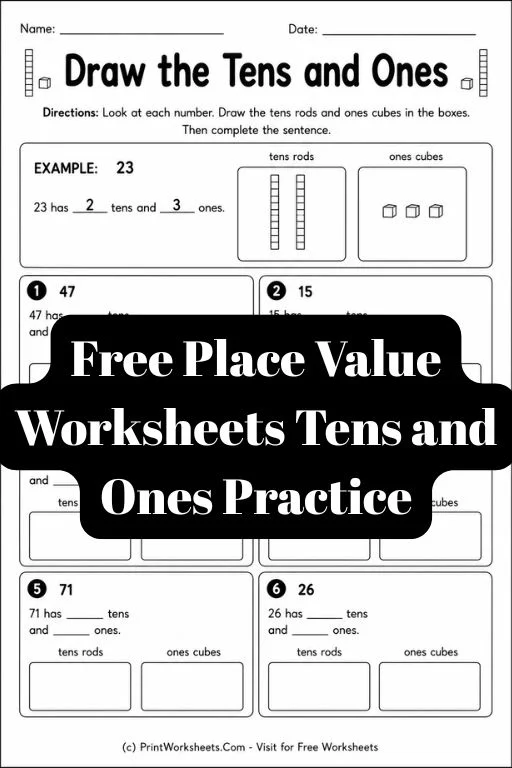
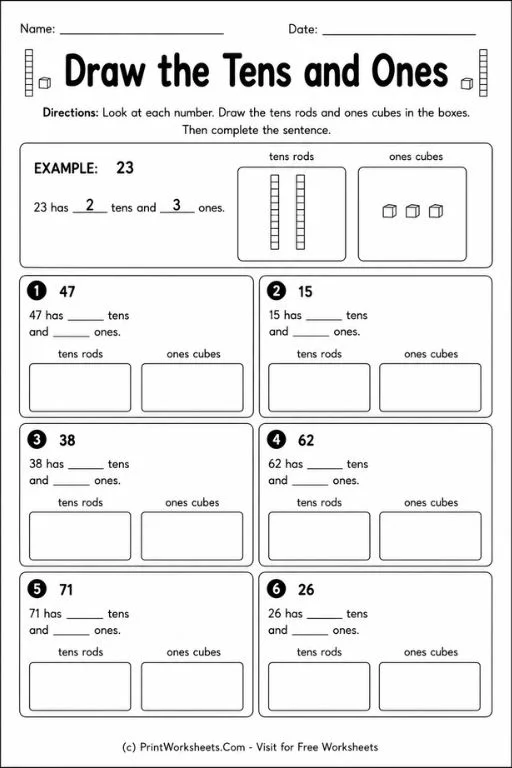
- Draw the Tens and Ones: A highly interactive, concrete application of abstract numbers. Instead of just looking at blocks, students are given a standard double-digit number (like 47 or 15). First, they must complete the guided sentence (e.g., “47 has ___ tens and ___ ones”). Then, they move to the blank drawing boxes where they must physically draw out the tall “tens rods” and the small “ones cubes” that make up that specific number. This physical drawing process solidifies spatial reasoning and numerical grouping.
Practical Classroom and Home Implementation
Download the high-resolution file and print this no-prep PDF directly on standard 8.5″ x 11″ copy paper. Because early learners thrive on tactile feedback, we highly recommend utilizing these worksheets alongside actual, physical manipulatives. When completing the “Draw the Tens and Ones” worksheet, have a pile of physical base-ten blocks (or even Legos stacked in towers of ten) on the desk. Have the child physically build the number “38” with the plastic blocks first, count them out loud, and then transition to drawing those exact blocks on their worksheet.
To make the “Build Numbers Step by Step” page even more effective, consider turning it into an interactive dry-erase center. Place the printed page inside a heavy-duty plastic sleeve and provide the student with two different colored dry-erase markers—perhaps a blue marker for tracking the tens column, and a red marker for tracking the ones column. This simple color-coding strategy works wonders for students who struggle with number reversals.
Frequently Asked Questions
Why is drawing base-ten blocks so important for young learners?
Young children operate in a “concrete” learning stage; they need to touch and see math before they can understand it abstractly. When a child just writes the number “42,” it is just a symbol on a page. However, when they are forced to physically draw four tall rods and two small cubes, their brain actively processes that the “4” represents forty distinct items grouped together, not just four single items. This visual breakdown is mandatory for future success in regrouping and borrowing.
How can I help a child who constantly reverses their tens and ones?
Reversing numbers (writing 27 instead of 72) is a very common developmental hurdle in first grade. The best intervention is strict color-coding. Use a red highlighter to underline the “Tens” word and all the tall rods on the worksheet, and a blue highlighter for the “Ones.” Have the child trace the first digit in red and the second digit in blue. This visual separation trains their brain to respect the strict left-to-right hierarchy of place value columns.
What grade level is this base-ten packet best suited for?
This specific PDF worksheet pack is heavily aligned with 1st-grade and early 2nd-grade core math standards. First graders are formally introduced to grouping objects into bundles of ten to understand numbers up to 100. Second graders can also utilize these exact pages at the beginning of the school year to shake off the summer slide and refresh their foundational grouping skills before moving on to three-digit numbers and the hundreds column.