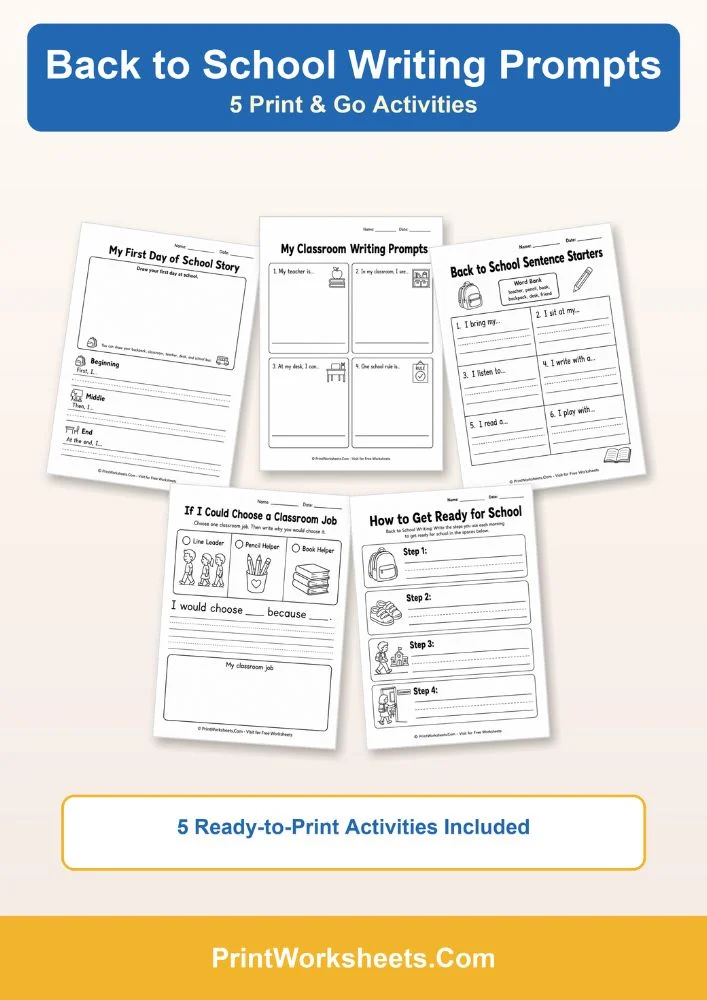
Building early literacy during the first week is highly effective with these free back to school writing prompts. This 5-page PDF bundle provides structured baseline activities that help emerging writers transition into the new academic year. By utilizing guided sentence starters, sequential story mapping, and opinion writing templates, students can confidently practice their penmanship and vocabulary without experiencing first-week writer’s block.
Integrating structured writing tasks alongside interactive morning activities ensures a well-rounded orientation block. You can pair these literacy pages directly with our back to school icebreaker worksheets to balance solo desk work with peer socialization, or combine them with our free printable back to school math worksheets for a complete daily review folder.
Inside the Back to School Writing Bundle
This packet removes the intimidation of a blank page by providing clear visual cues, word banks, and primary dotted baselines. Each page targets a distinct foundational writing skill:
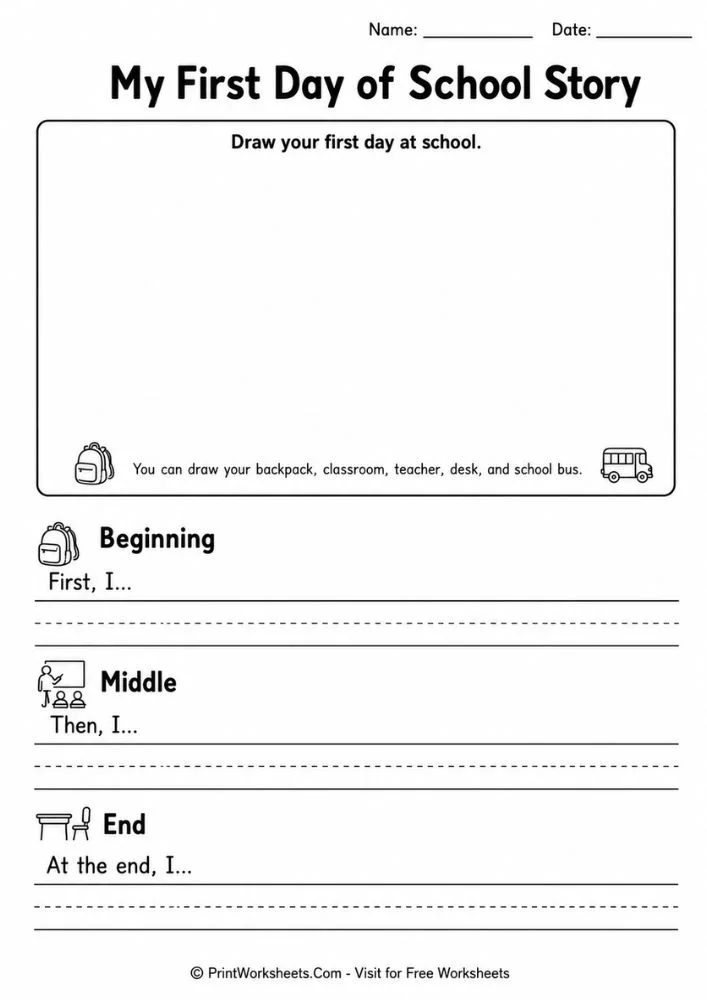
- My First Day of School Story: A narrative sequencing layout where students sketch their first day and use transitional keywords (First, Then, At the end) to write a chronological story.
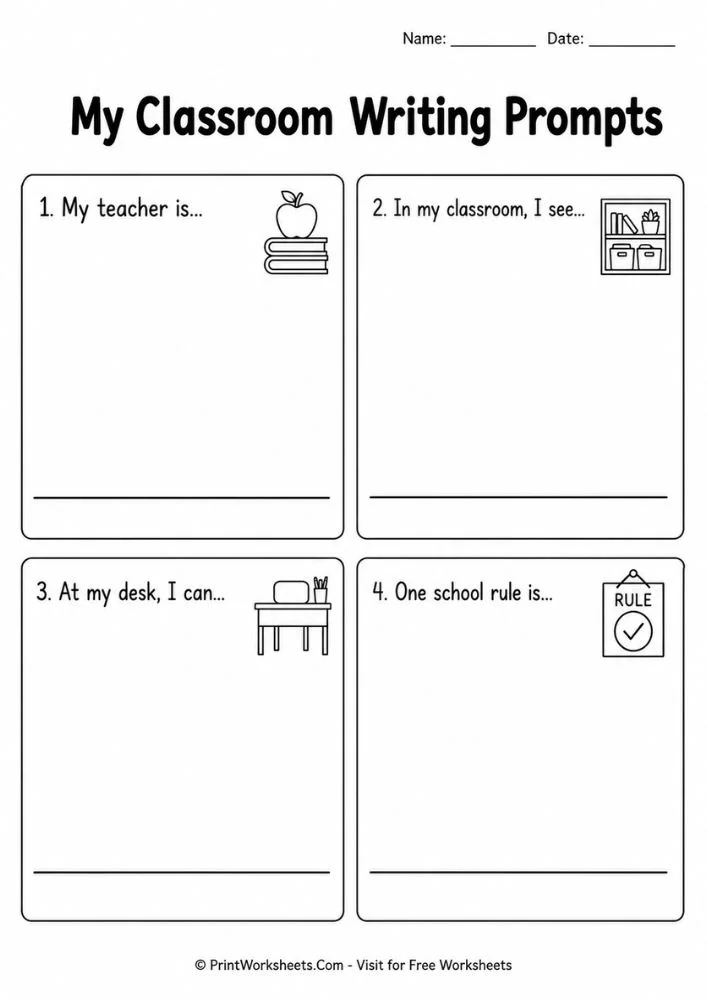
- My Classroom Writing Prompts: An observational exercise featuring four distinct blocks. Students complete short thoughts about their teacher, classroom environment, desk activities, and school rules.
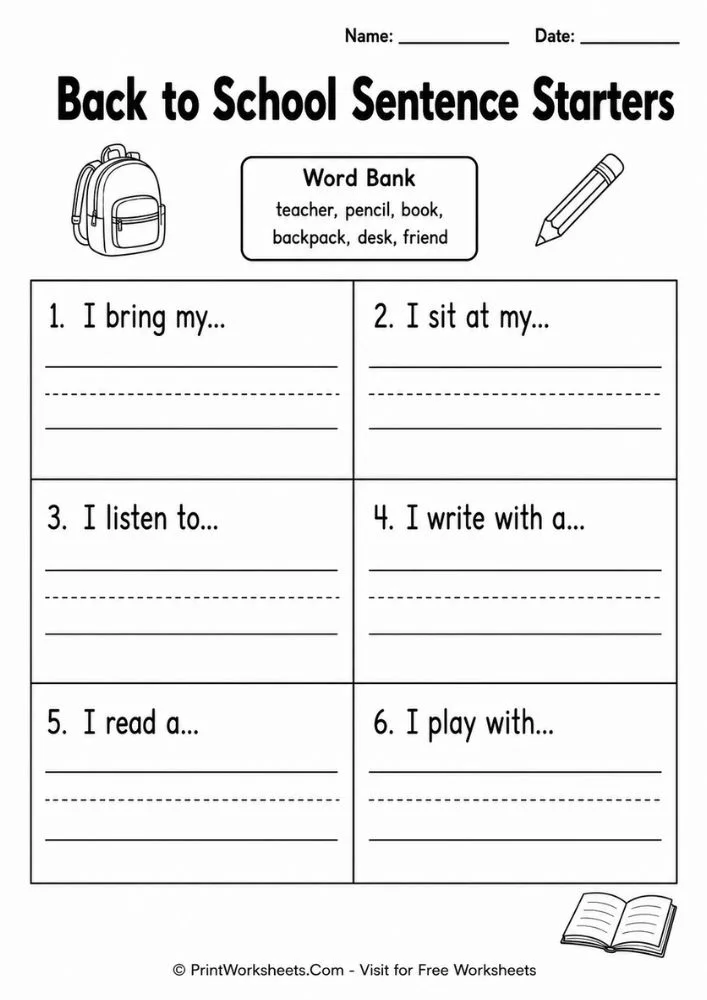
- Back to School Sentence Starters: A guided vocabulary builder containing a functional word bank (teacher, pencil, book, backpack). Kids complete six fundamental sentence stems such as “I bring my…” and “I read a…”.
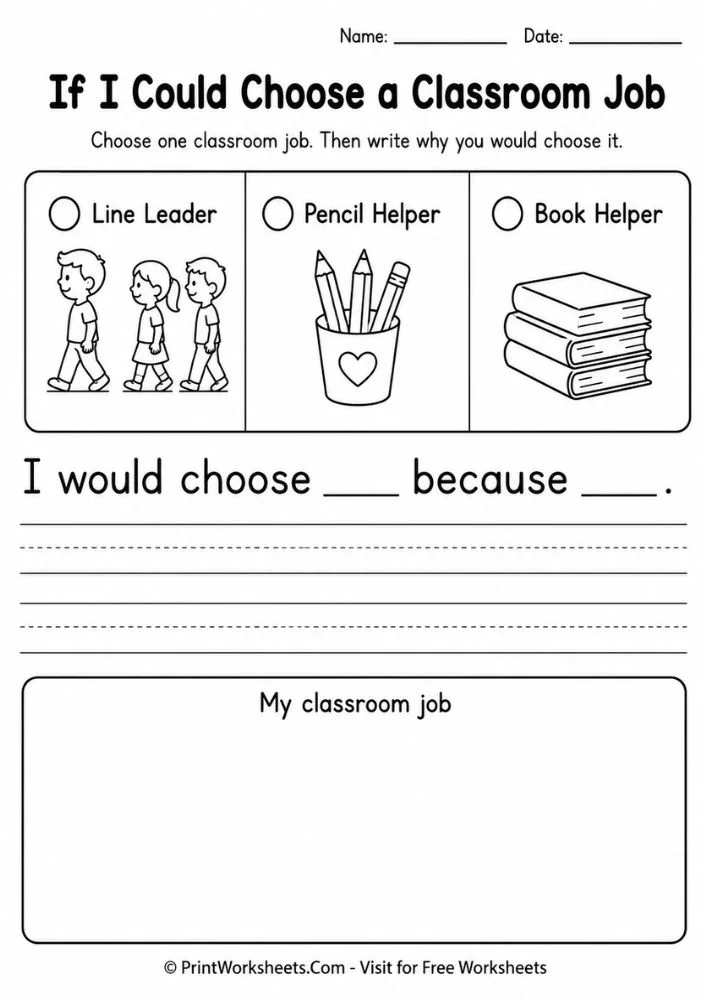
- If I Could Choose a Classroom Job: An introductory opinion writing template. Children select between being a Line Leader, Pencil Helper, or Book Helper, and must write a sentence defending their choice using the word “because”.
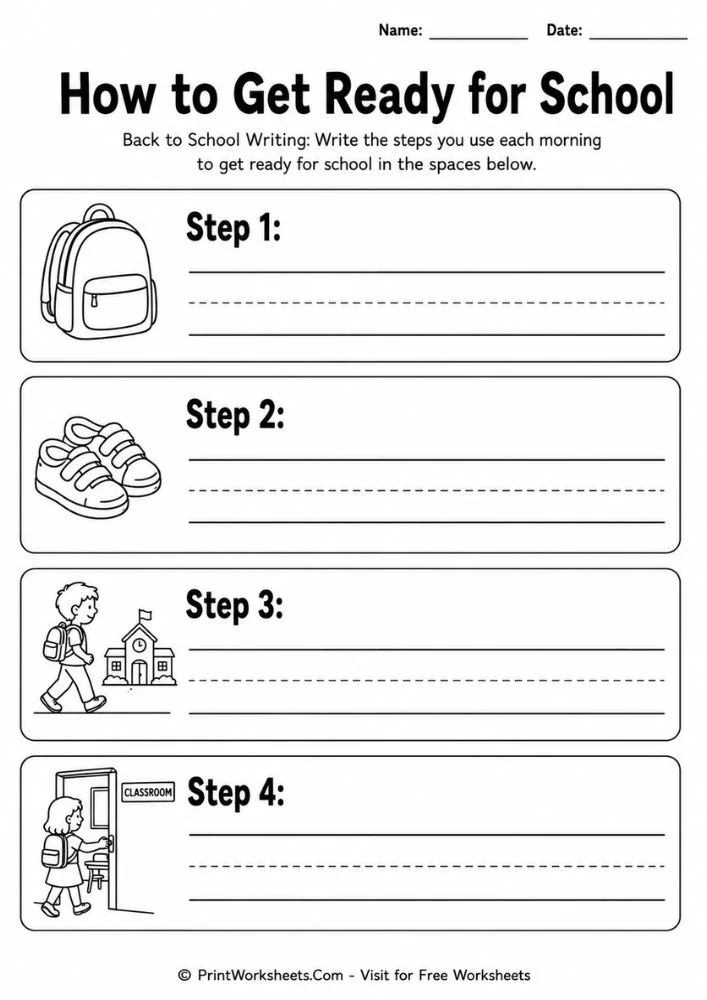
- How to Get Ready for School: A procedural writing activity where students break down their morning routine into four sequential steps, supported by relevant visual icons.
These frames provide immediate, raw data on a student’s spelling habits, letter spacing, and sentence structure capabilities before formal language arts lessons begin.
Practical Classroom Implementation
Deploy the “Sentence Starters” on the very first day to guarantee early success and build writing confidence. Move to the “Classroom Job” opinion writing later in the week right before you assign actual classroom roles; this connects the academic task directly to real-world classroom management. Use the “Morning Routine” steps as a collaborative whiteboard activity first, modeling how to turn daily habits into written instructions.
Print the high-resolution file on standard 8.5″ x 11″ copy paper. Verify that “fit to printable area” is checked in the print dialogue box to ensure the lower dotted writing guidelines print flawlessly.
Actionable Advice for Teachers & Parents
What if a student refuses to write because they can’t spell?
Teacher Tip: Direct them immediately to the “Sentence Starters” page. The provided word bank at the top removes spelling anxiety. Tell them to circle the word they want to use first, then copy it carefully onto the dotted line.
How can I use the First Day Story page effectively?
Teacher Tip: Have students draw their picture in the large top box first. Ask them to verbally explain their drawing to a partner using the words “First,” “Then,” and “At the end.” Once they verbalize the story, they will have a much easier time writing the sentences below.
Can these writing prompts be used for a bulletin board?
Teacher Tip: Yes. The “If I Could Choose a Classroom Job” sheet makes an excellent interactive bulletin board display for September. Hang the completed sheets under the title “Our Helpful Classroom Community.