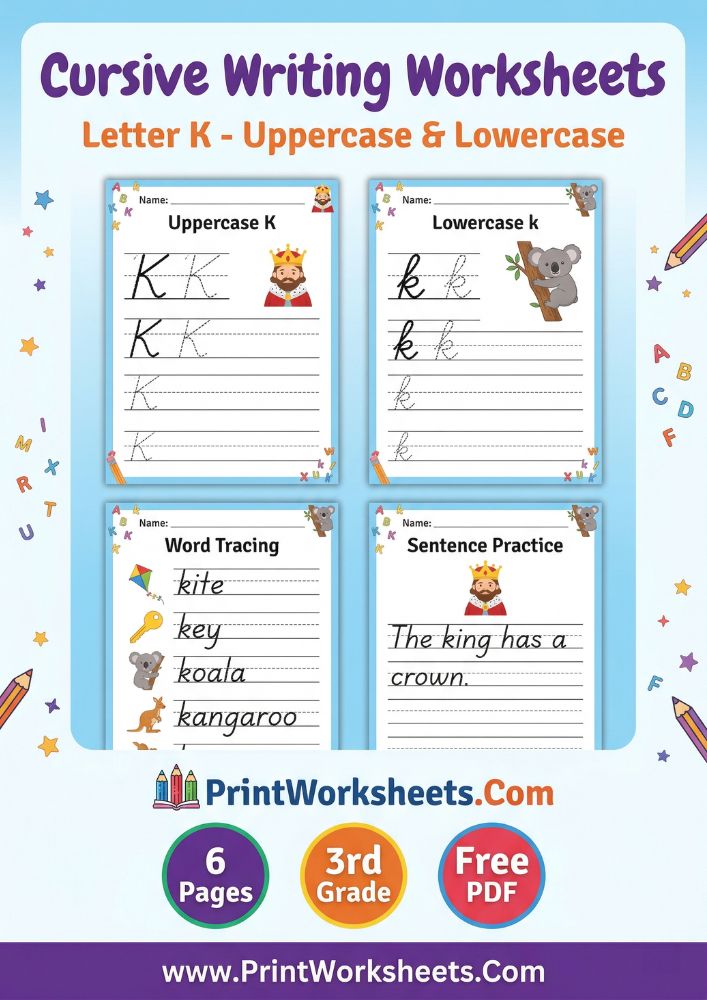
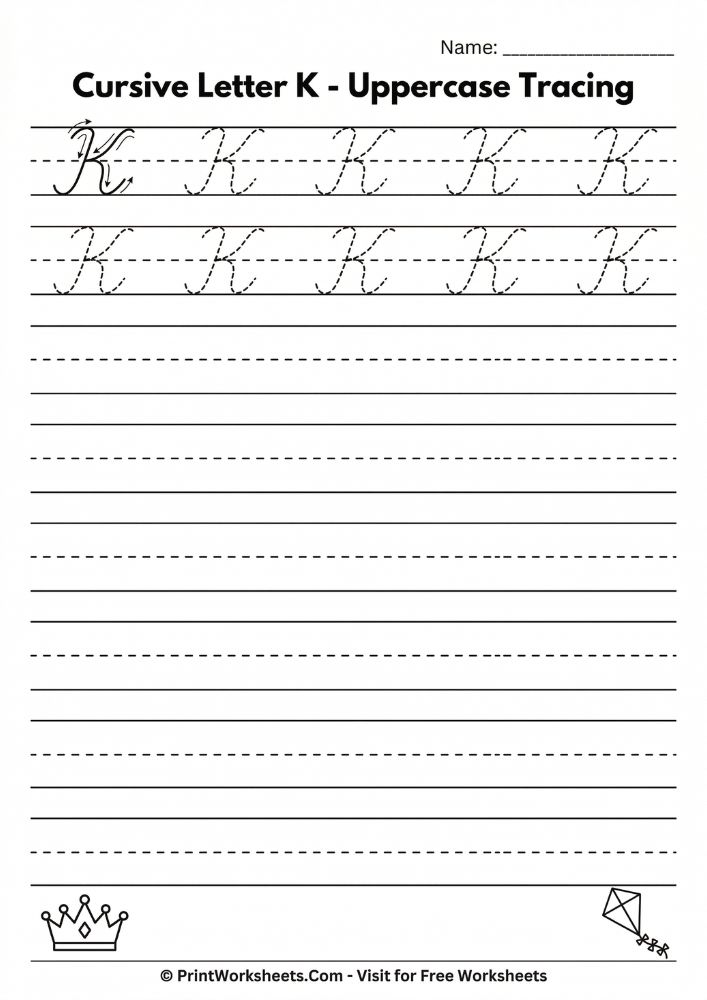
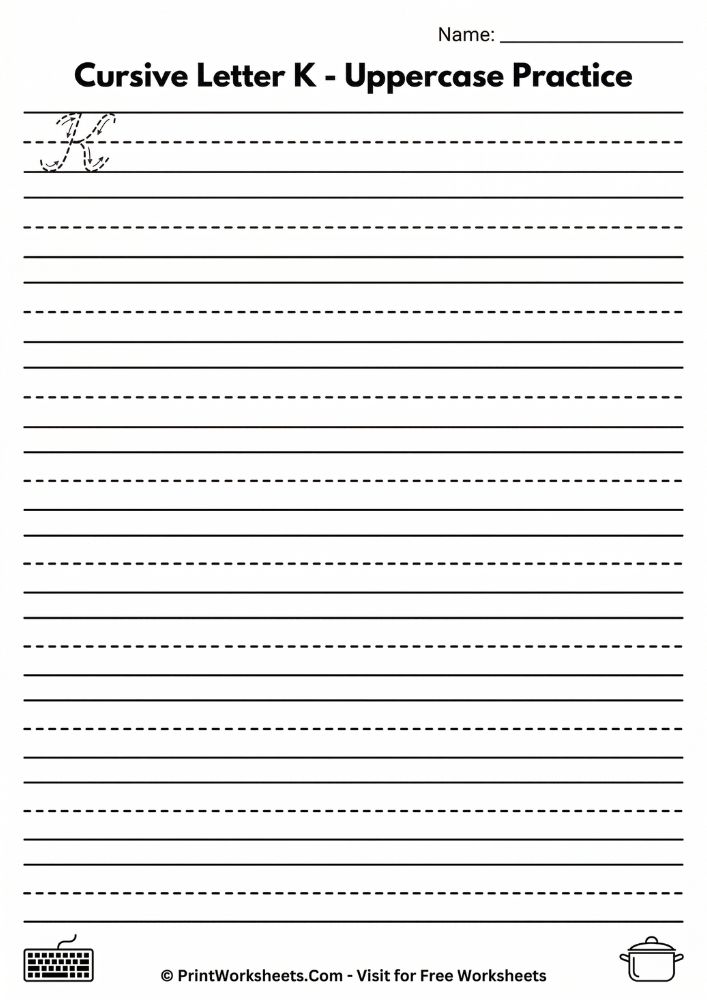
Teaching connected script often becomes incredibly frustrating for third-grade educators when students encounter letters with complex mid-line loops and bottom kicks. This comprehensive cursive letter k worksheet provides the exact mechanical scaffolding needed to master both uppercase and lowercase variations without cognitive overload. Instead of overwhelming young learners with entire paragraphs of connected text, this targeted printable PDF completely isolates the specific motor strokes required for the letter K. By utilizing explicit directional arrows, bold starting dots, and primary dashed lines, educators can actively prevent the development of improper muscle memory. Printing these specific handwriting practice pages ensures young writers build the spatial awareness required for fluid, highly legible penmanship.
Primary educators and occupational therapists consistently deploy these cursive handwriting materials during morning bell work, dedicated penmanship blocks, and targeted fine motor interventions. Transitioning from print (manuscript) to cursive requires intense concentration; therefore, focusing on a single, high-complexity letter prevents student burnout. To build a complete foundational curriculum for your classroom, pair this specific stroke practice with our extensive library of [BURAYA ALAKALI İÇ LİNK GELECEK] at PrintWorksheets.Com. Securing absolute mastery of isolated letters guarantees that students will not hesitate or stall when eventually asked to connect vowels and consonants in continuous, real-world writing tasks.
Inside the Cursive Letter K PDF
This 6-page resource intentionally eliminates distracting graphics to provide a highly focused academic workspace. The printable package is divided into precise pedagogical zones, gradually releasing responsibility to the student:
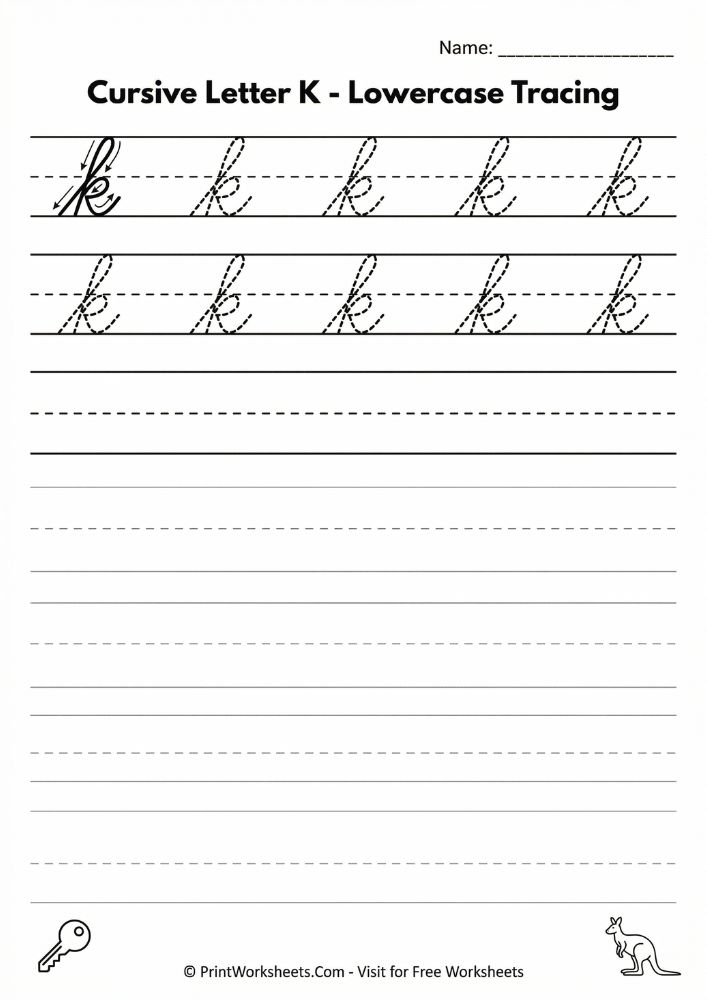
- Directional Tracing Guides: The introductory pages feature large, isolated uppercase “K” and lowercase “k” models. Inside the letters, step-by-step numbered arrows and starting dots explicitly dictate the sequence of the pencil stroke (pull down, retrace up, loop at the dashed line, and kick out to the baseline).
- Repetitive Tracing Rows: Students move to structured primary lines where they trace rows of letters. The dashed mid-line acts as a strict visual boundary to ensure the loops and kicks are sized proportionally.
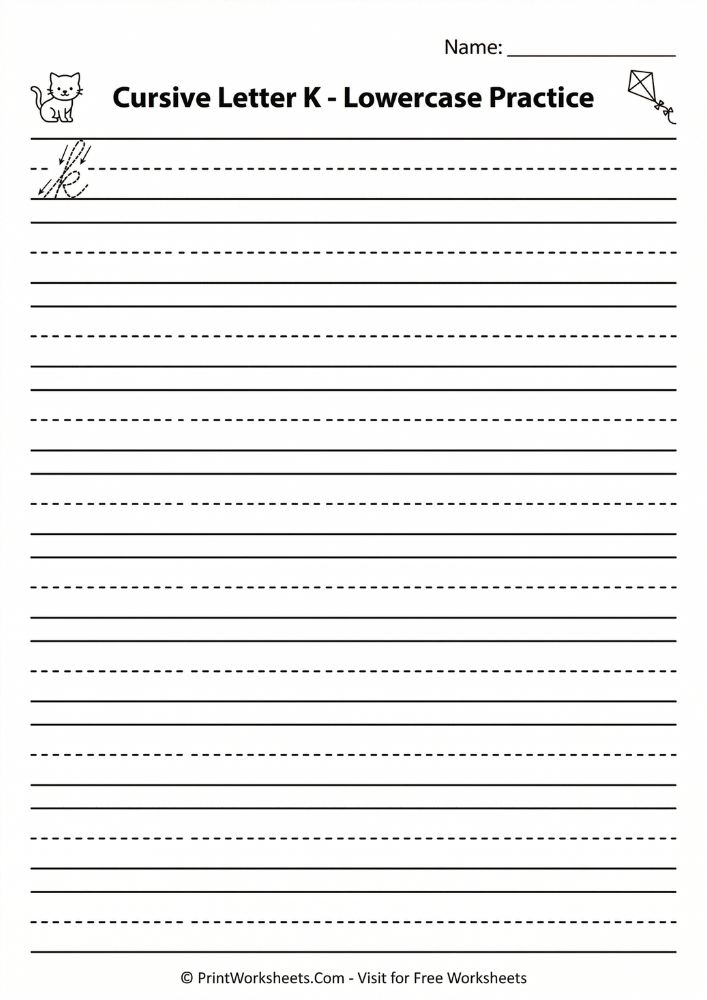
- Independent Practice Pages: After tracing, the visual scaffolding is removed. Students must independently write the uppercase and lowercase letters on blank primary lines, forcing them to rely on their newly established muscle memory.
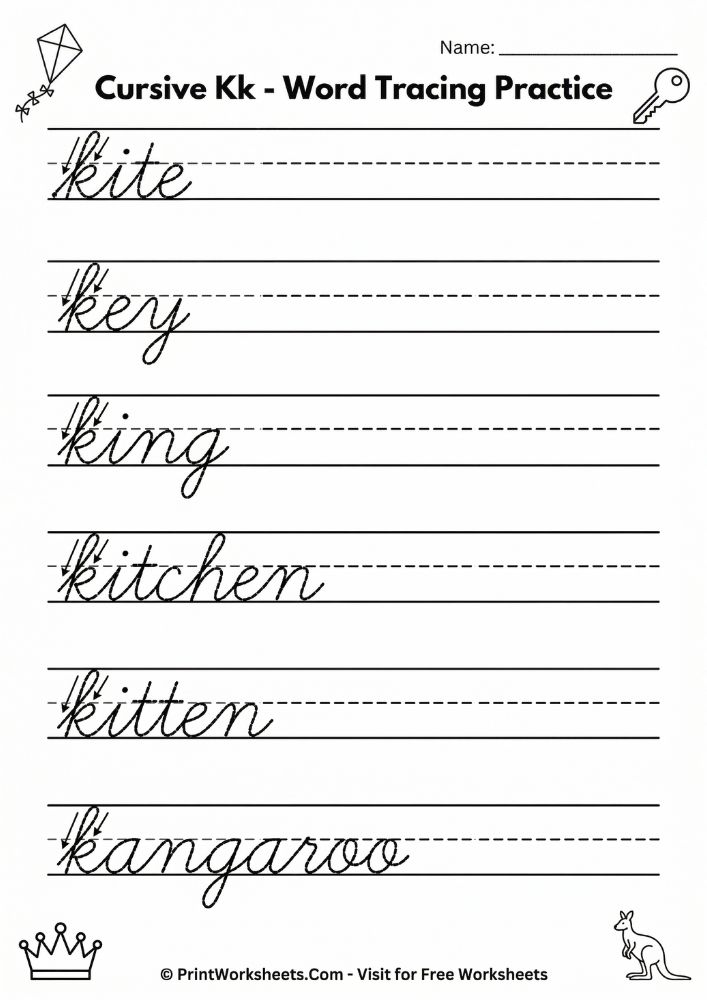
- Contextual Word Application: To prove mastery, students trace specific K-vocabulary words. The worksheets feature the words “kite,” “key,” “koala,” “kangaroo,” “king,” “kitchen,” and “kitten.” This directly bridges the gap between isolated strokes and connected cursive flow.
- Complete Sentence Execution: The final challenge requires students to read, trace, and independently write a full sentence: “The king has a crown.” This authentic writing task demands that the student connect the letter K to subsequent vowels seamlessly.
Differentiation Options for Teachers
When supporting dysgraphic students or tactile learners who chronically struggle with spatial boundaries, introduce sensory input before handing them a pencil. Provide a shallow tray of colored craft sand and ask the student to draw the uppercase K with their index finger while referencing the printed directional arrows. For students struggling to keep their lowercase loops below the mid-line, use a yellow highlighter to physically color the bottom half of the primary lines (between the solid baseline and the dashed mid-line). Instruct them that the “kick” of the lowercase k must stay inside the “yellow road.” For advanced third graders, challenge them to flip the paper over and write three original sentences utilizing the vocabulary words (e.g., kite, koala) in fully connected cursive without relying on any traceable guides.
Targeted Academic Skills
This targeted handwriting printable supports foundational ELA standards, aligning closely with expectations for mechanical writing fluency. While the Common Core State Standards (CCSS) focus heavily on composition, many state-specific standards strictly mandate penmanship. This resource fulfills state-level requirements for legibly writing all upper- and lowercase cursive letters and joining them sequentially, which directly impacts a student’s ability to produce written compositions efficiently under time constraints.
Frequently Asked Questions
Why is the lowercase k so difficult in cursive?
The lowercase cursive k requires a complex shift in directional momentum. Students must execute a tall ascending loop, drop straight down to the baseline, retrace upward, and form a tight mid-line curve before kicking out. This multi-directional path demands significantly higher fine motor control than standard manuscript letters, which is why isolated, guided practice is mandatory.
Should students learn uppercase or lowercase first?
Pedagogical best practices recommend teaching lowercase letters first. Lowercase letters make up the vast majority of connected text in everyday writing. Mastering the lowercase cursive k allows students to immediately begin writing common words and connecting to vowels, whereas uppercase K is typically only used for proper nouns and sentence starters.
How can I correct improper letter formation?
Immediate intervention with directional arrows is essential. If a student is starting the letter from the bottom baseline instead of the top, stop them immediately. Use the first page of this PDF to re-teach the starting dot and stroke sequence, as practicing incorrect pathways will only permanently solidify bad handwriting habits.