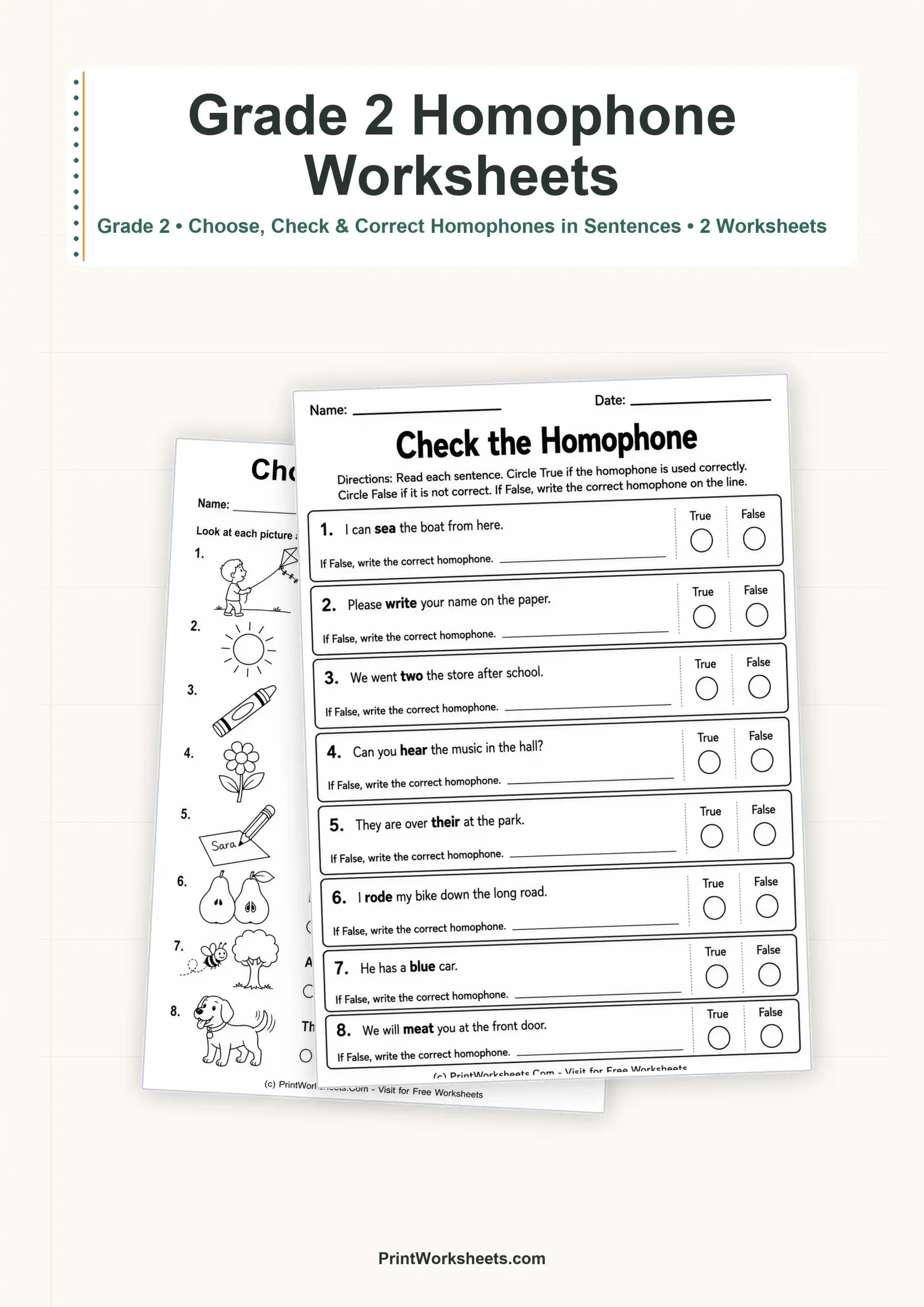
These Grade 2 homophone worksheets help children decide which spelling fits a sentence by paying attention to meaning. Instead of practicing confusing word pairs in isolation, students work with familiar examples such as see and sea, sun and son, one and won, flower and flour, write and right, and pear and pair. The activities combine visual clues, short everyday sentences, careful reading, and written corrections so children can connect what a word means with how it should be spelled.
Homophone Worksheets That Use Sentence Meaning
Homophones sound alike but have different meanings and spellings, which can make them especially challenging for developing writers. A child may know how a word sounds and still choose the wrong spelling unless the surrounding sentence provides a clear clue. These worksheets place that clue at the center of the task. Students are encouraged to read the complete sentence, think about what it means, and then select the word that makes sense.
This type of practice supports both spelling and reading comprehension. For example, the words flower and flour sound the same when spoken, but a picture of a flower and a sentence about what is being seen give students meaningful evidence for the correct choice. The same reasoning applies to word pairs such as pear and pair or write and right. Students learn that correct spelling depends on meaning, not sound alone.
Start with Picture-Supported Homophone Choices
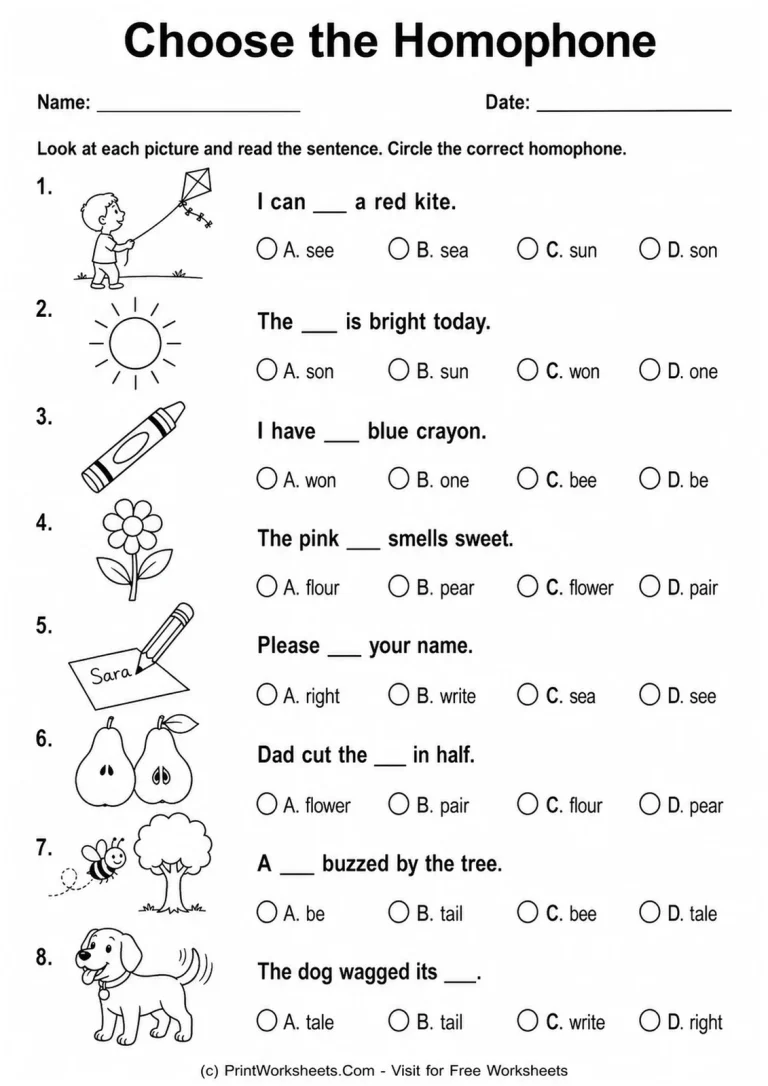
The first worksheet, Choose the Homophone, gives students eight illustrated sentence questions. Children look at each picture, read the sentence, and circle the correct word from four choices. The images provide an additional clue without replacing the reading task, making the page useful for Grade 2 learners who are still building confidence with vocabulary and sentence comprehension.
The examples include common homophones children are likely to encounter in early reading and writing. Students distinguish see from sea in a sentence about a red kite, choose between sun and son with a sun illustration, decide between one and won, and connect a flower picture with the correct spelling of flower. Other items practice write/right, pear/pair, be/bee, and tale/tail.
Check Whether the Homophone Fits
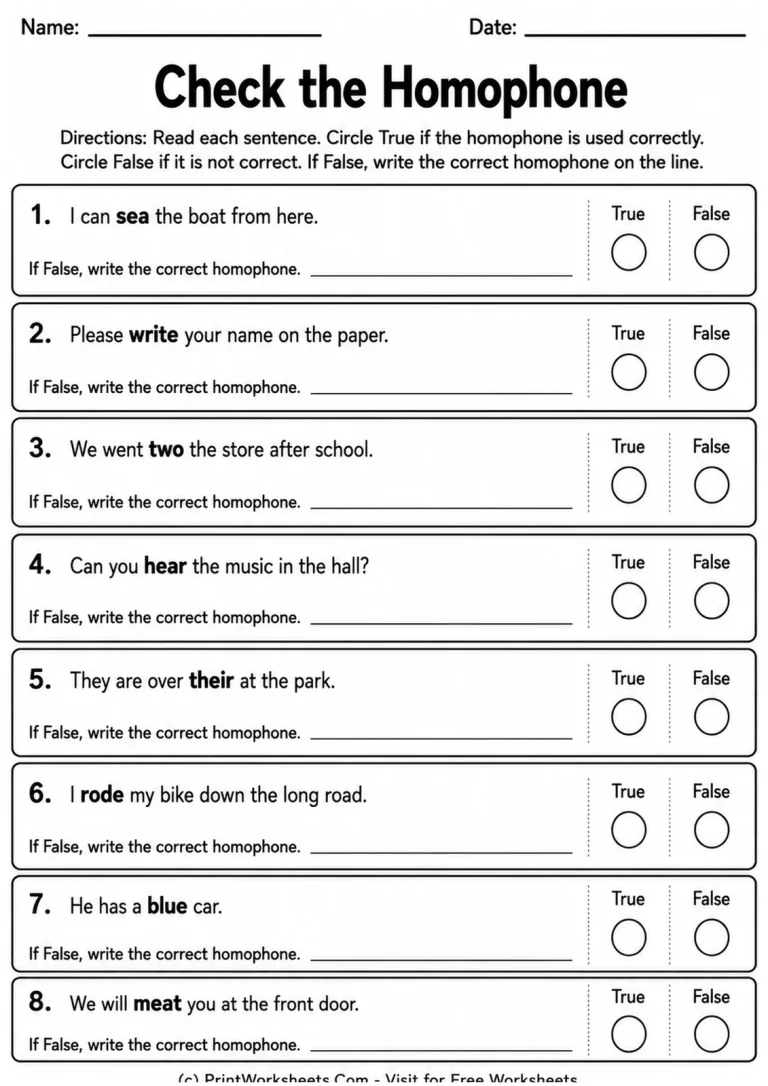
The second worksheet, Check the Homophone, shifts attention from choosing among options to judging word use inside complete sentences. Students read eight sentences and decide whether the highlighted homophone is being used correctly. They mark each sentence True or False. When a homophone is incorrect, they write the correct word on the line provided.
This format asks for more independent thinking because students must notice when a sentence contains a word that sounds right but does not match the intended meaning. Correcting the sentence also adds useful spelling practice. Rather than simply recognizing an error, students must supply the appropriate homophone themselves.
Useful Practice for Grade 2 Spelling Lessons
Teachers can use the two pages together or separately. The picture-supported activity works well as guided practice, a literacy-center task, or an introduction to homophone meaning. The True or False page can follow later as independent practice because students must rely more heavily on sentence context and their own knowledge of the word pair.
Parents can also use these printable pages for short review sessions at home. Before a child answers, ask questions such as, ‘What does this sentence mean?’ or ‘Which word matches the picture and the sentence?’ When correcting an incorrect homophone, having the child read the revised sentence aloud can reinforce the connection between spelling and meaning.
Skills Practiced in This Printable Set
Across the two worksheets, students practice identifying common homophones, using context clues, reading for meaning, choosing the correct spelling, recognizing incorrect word use, and rewriting a sentence with the appropriate homophone. These tasks make the set suitable for spelling review, English language arts practice, morning work, literacy centers, homework, or extra support with commonly confused words.
Use these Grade 2 homophone spelling pages when students are ready to move beyond memorizing word pairs and begin applying them in real sentences. The combination of visual support, sentence-level reasoning, and written correction gives children repeated opportunities to choose a spelling because they understand what the sentence is saying.