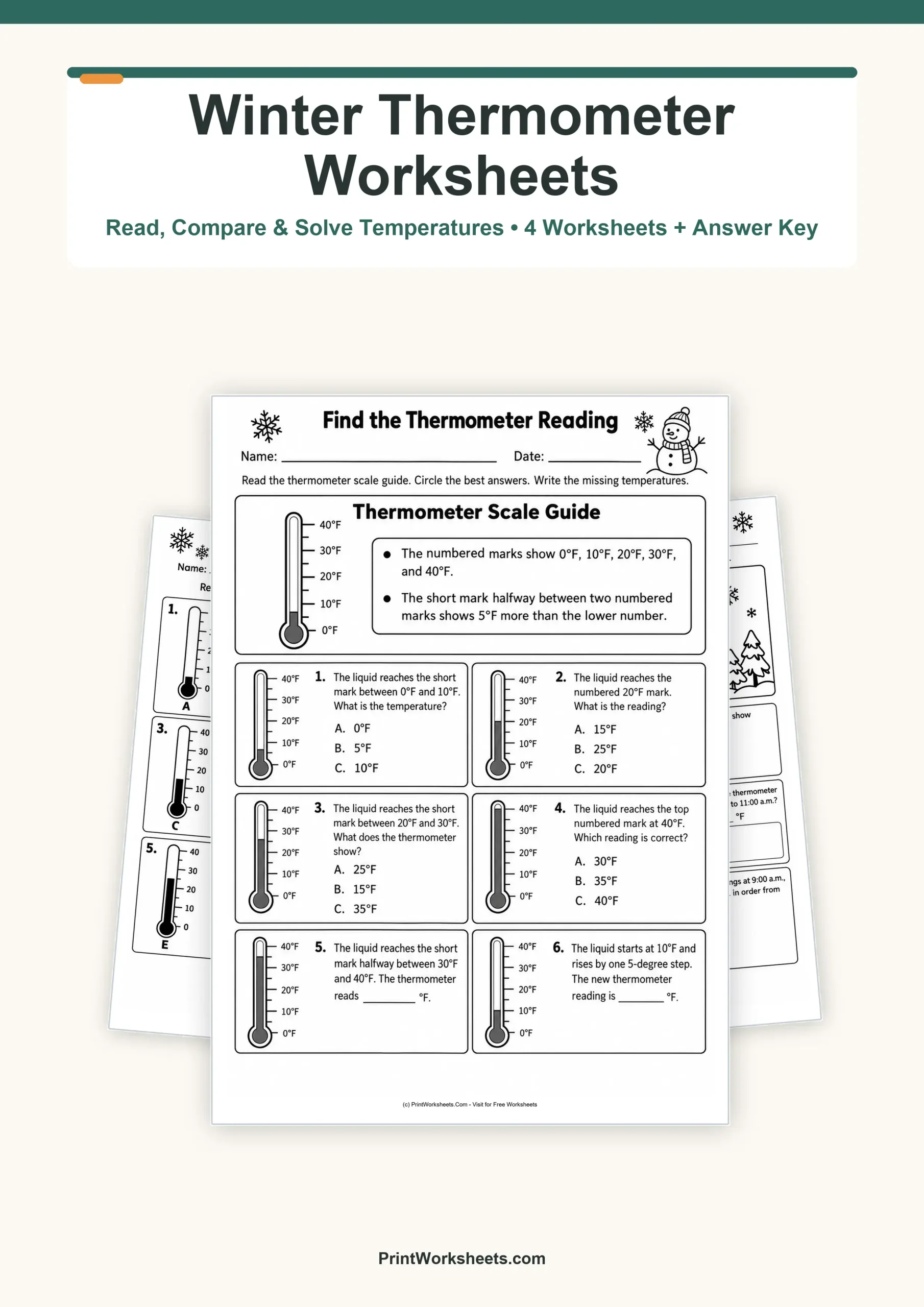
These winter thermometer reading worksheets give students several ways to practice reading and interpreting Fahrenheit temperatures. The set begins with clear thermometer scales and then moves into 5-degree intervals, multiple-choice questions, a winter weather log, temperature change, ordering values, and short word problems. Because the activities use the same winter temperature theme in different formats, students can build confidence with the scale before applying the skill to data and problem solving.
Winter Thermometer Reading Practice
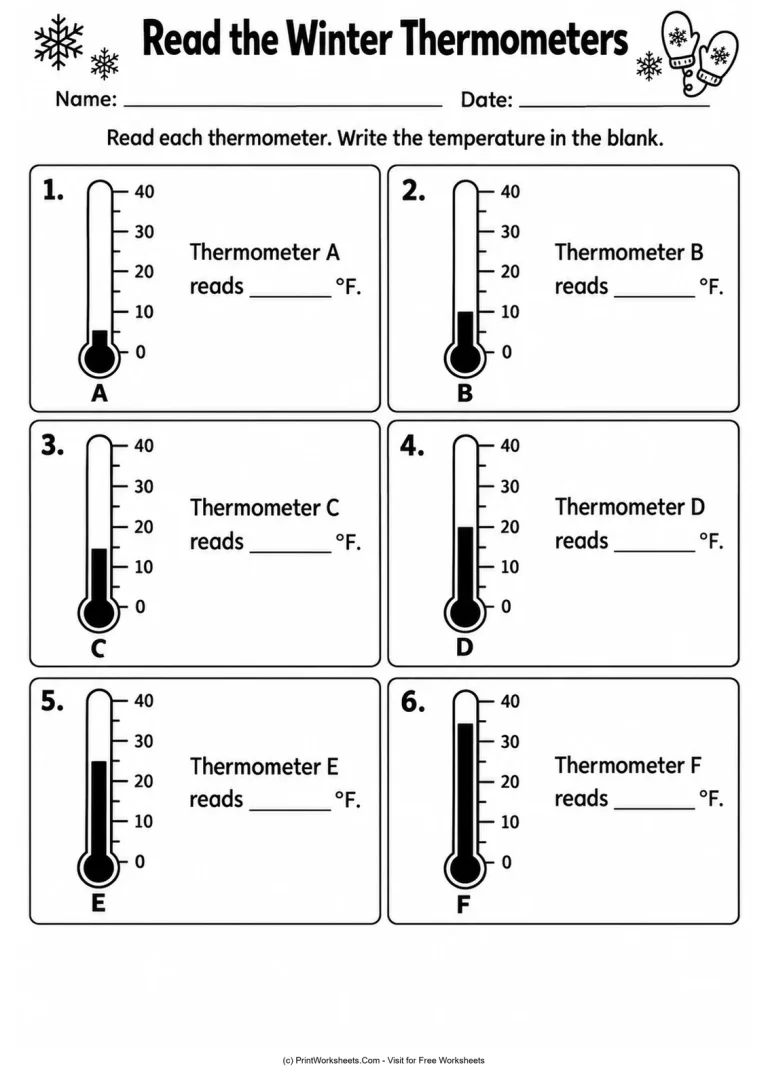
The first worksheet focuses on direct thermometer reading. Students examine six thermometers labeled A through F and write the temperature shown on each scale. The numbered marks are spaced in 10-degree intervals, while the shorter halfway marks represent 5-degree steps. The readings include 5°F, 10°F, 15°F, 20°F, 25°F, and 35°F, giving students practice with both numbered marks and midpoint marks.
This page works well as an introduction because the task stays consistent from problem to problem. Students can concentrate on identifying the liquid level, locating the nearest labeled values, and deciding whether the reading falls on a numbered mark or a halfway mark.
Reading 5-Degree Thermometer Scales
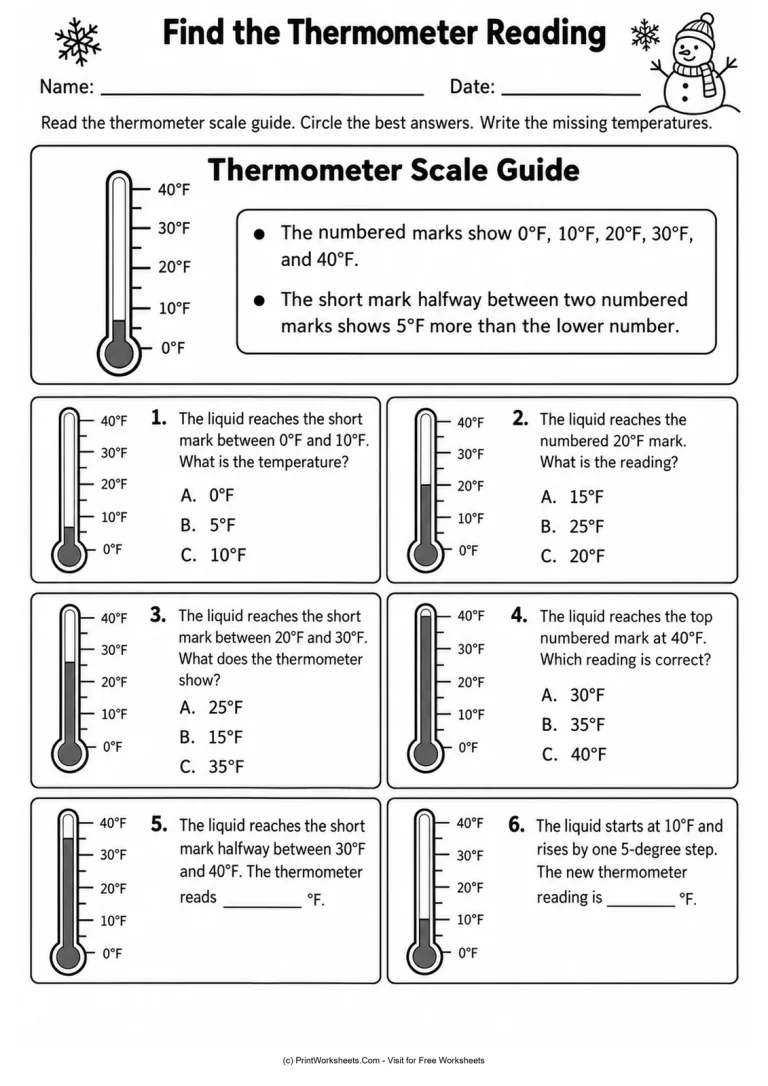
The next activity includes a visual Thermometer Scale Guide that explains how the Fahrenheit scale works from 0°F to 40°F. Students are reminded that the numbered marks show 0°F, 10°F, 20°F, 30°F, and 40°F, while the short mark between two numbered temperatures represents 5 degrees more than the lower number.
Students then answer a mix of multiple-choice and written-response questions. They identify temperatures such as 5°F, 20°F, 25°F, and 40°F, complete a 35°F reading, and determine that increasing 10°F by one 5-degree step produces 15°F. This combination helps students connect the visual thermometer scale with numerical reasoning instead of relying only on memorized labels.
Using a Winter Weather Log
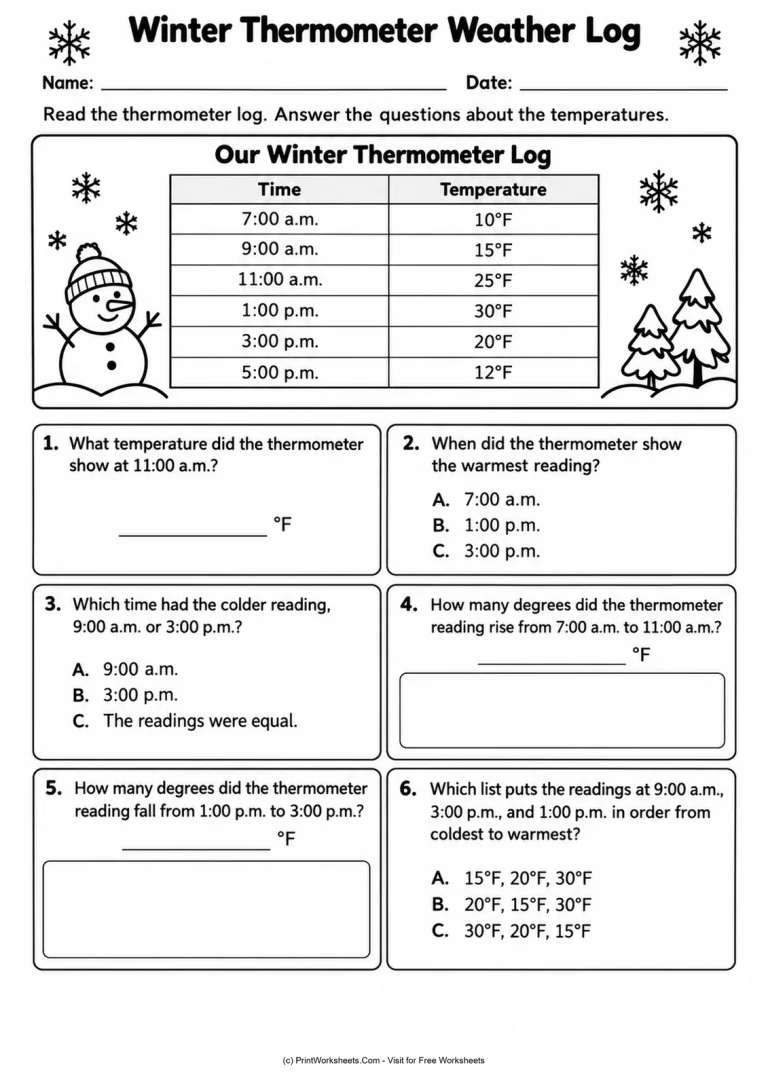
The third worksheet shifts from individual thermometers to a winter temperature table. A weather log records readings at six times during the day: 10°F at 7:00 a.m., 15°F at 9:00 a.m., 25°F at 11:00 a.m., 30°F at 1:00 p.m., 20°F at 3:00 p.m., and 12°F at 5:00 p.m.
Students use the table to answer questions about exact readings, the warmest time of day, colder temperatures, and temperature changes. They calculate a 15-degree rise from 7:00 a.m. to 11:00 a.m. and a 10-degree drop from 1:00 p.m. to 3:00 p.m. They also order selected temperatures from coldest to warmest. These tasks extend thermometer skills into practical data interpretation and comparison.
Winter Thermometer Challenges
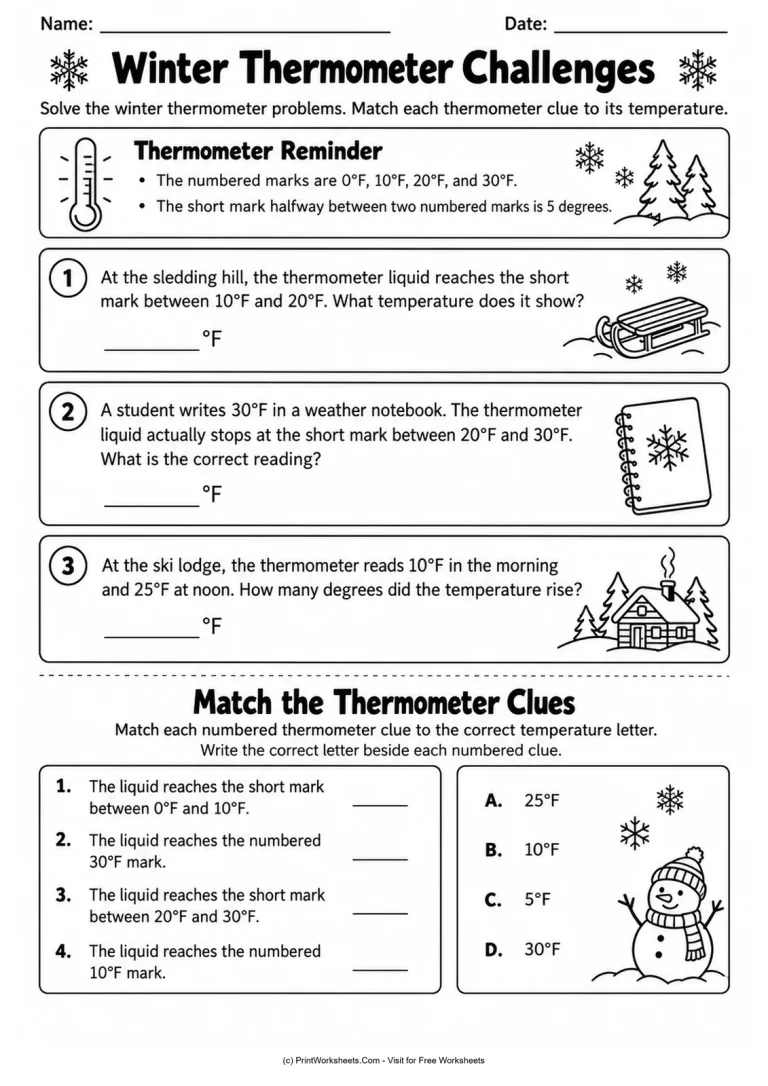
The final student worksheet adds short winter-themed problems and a matching activity. Students determine the temperature at a halfway mark between 10°F and 20°F, correct an incorrect 30°F reading when the liquid actually stops halfway between 20°F and 30°F, and calculate the rise from 10°F to 25°F.
A second section asks students to match thermometer clues with 5°F, 10°F, 25°F, and 30°F. This gives students another opportunity to distinguish between numbered marks and halfway marks while working from written clues rather than relying only on a displayed thermometer.
Ways to Use These Worksheets
The progression makes the set suitable for guided instruction, independent practice, math centers, homework, or a short skills check. Teachers and parents can begin with the direct-reading page, use the scale guide for reinforcement, and then move into the weather-log and challenge activities as students become more comfortable with 5-degree intervals.
For another winter classroom activity, students can also work with the winter reading comprehension worksheets for 3rd grade, which provides a different literacy-focused way to extend the seasonal theme.
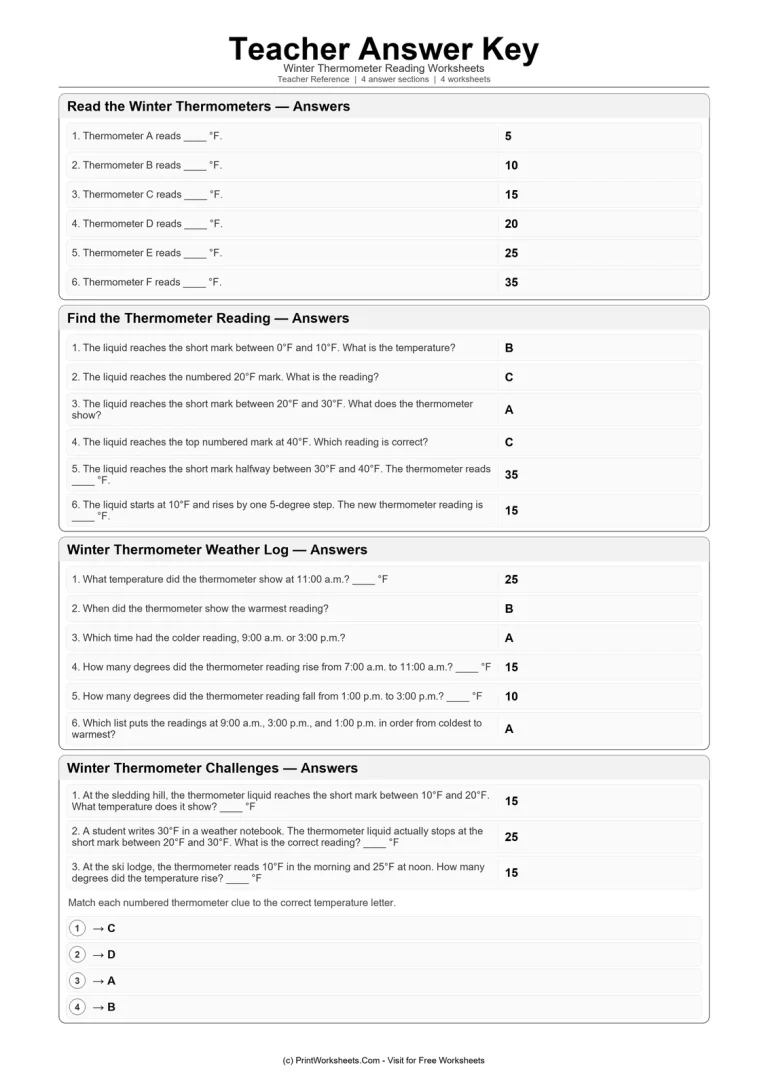
The included teacher answer key covers all four worksheet sections, making it easier to check direct thermometer readings, multiple-choice responses, temperature differences, ordering tasks, and the matching activity after students finish their work.