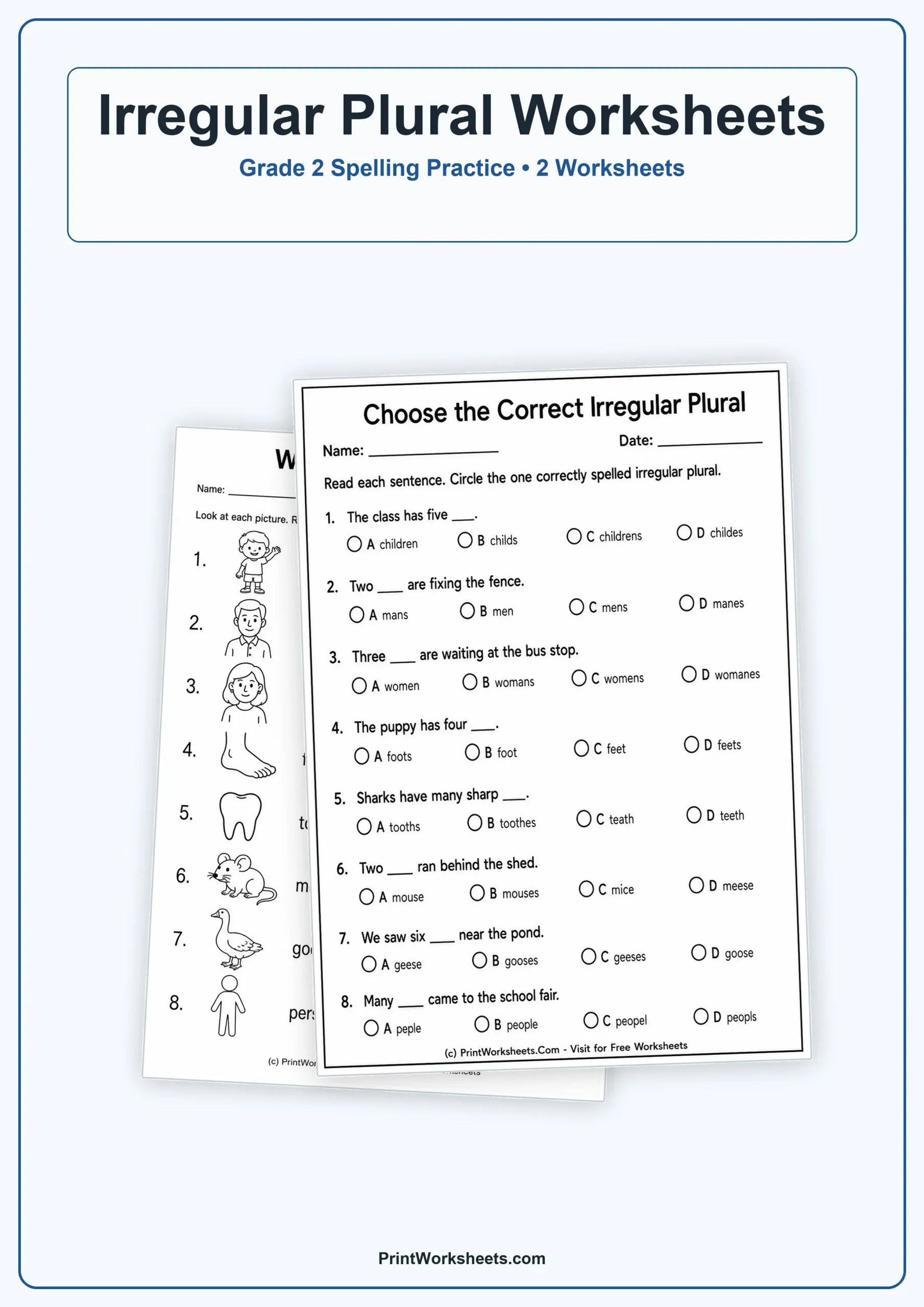
Some plural nouns do not follow the usual add-s or add-es pattern, so students need repeated practice with the words themselves. These irregular plural worksheets for Grade 2 focus on eight common examples: children, men, women, feet, teeth, mice, geese, and people. The two printable activities give students two different ways to work with the same vocabulary, beginning with independent spelling from singular nouns and moving into sentence-based recognition.
Irregular Plural Worksheets for Grade 2
This worksheet set is designed for students who are ready to move beyond regular plural endings and notice that some nouns change in less predictable ways. Instead of simply adding a letter at the end, students see changes such as child to children, man to men, foot to feet, and mouse to mice. Practicing these forms directly helps children build a stronger visual memory for spellings they will encounter often in reading and writing.
The repeated word set also keeps the lesson focused. Students do not have to learn a new group of nouns on every page. They can concentrate on recognizing and spelling the same eight irregular plurals accurately, which makes the second activity a useful follow-up rather than an unrelated exercise.
Write the Irregular Plural
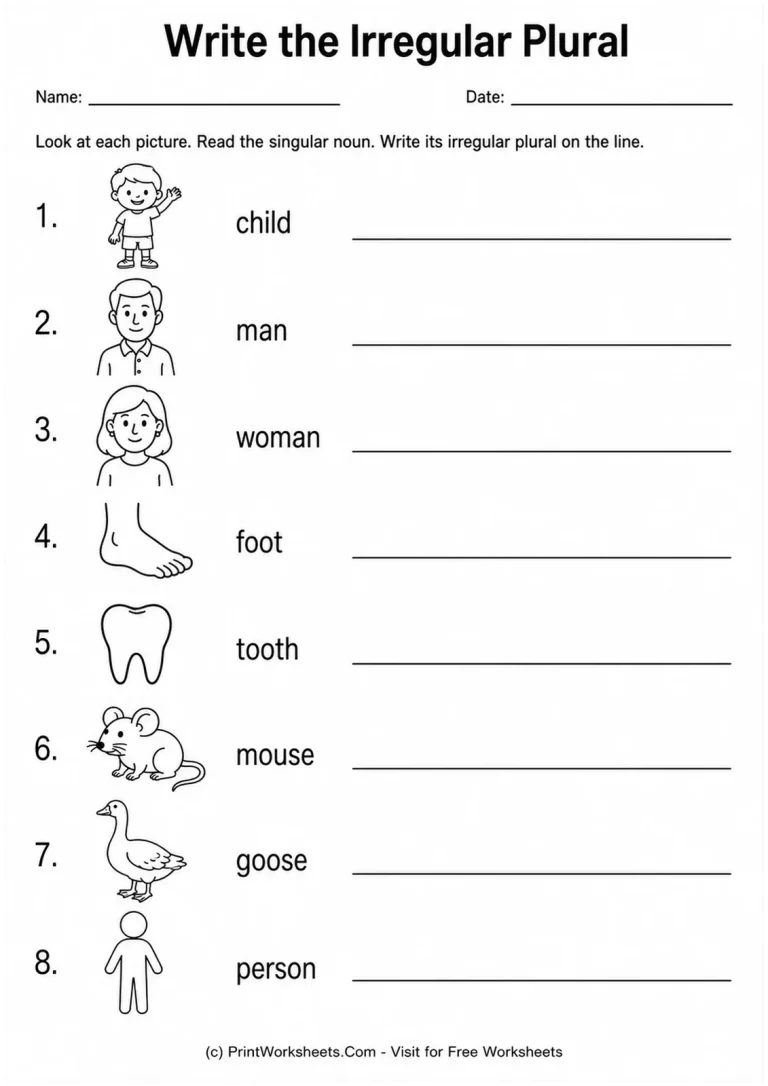
The first worksheet presents the singular nouns child, man, woman, foot, tooth, mouse, goose, and person. Each noun is paired with a simple black-and-white picture, giving students an extra clue while they think about the matching plural form. Students then write the irregular plural on the provided line.
This open-response format requires recall rather than recognition. A child must remember that the plural of tooth is teeth, for example, without choosing from a list of possible answers. That makes the page useful for checking whether students can produce the spelling on their own. The picture support keeps the task accessible while still requiring independent written work.
Choose the Correct Irregular Plural
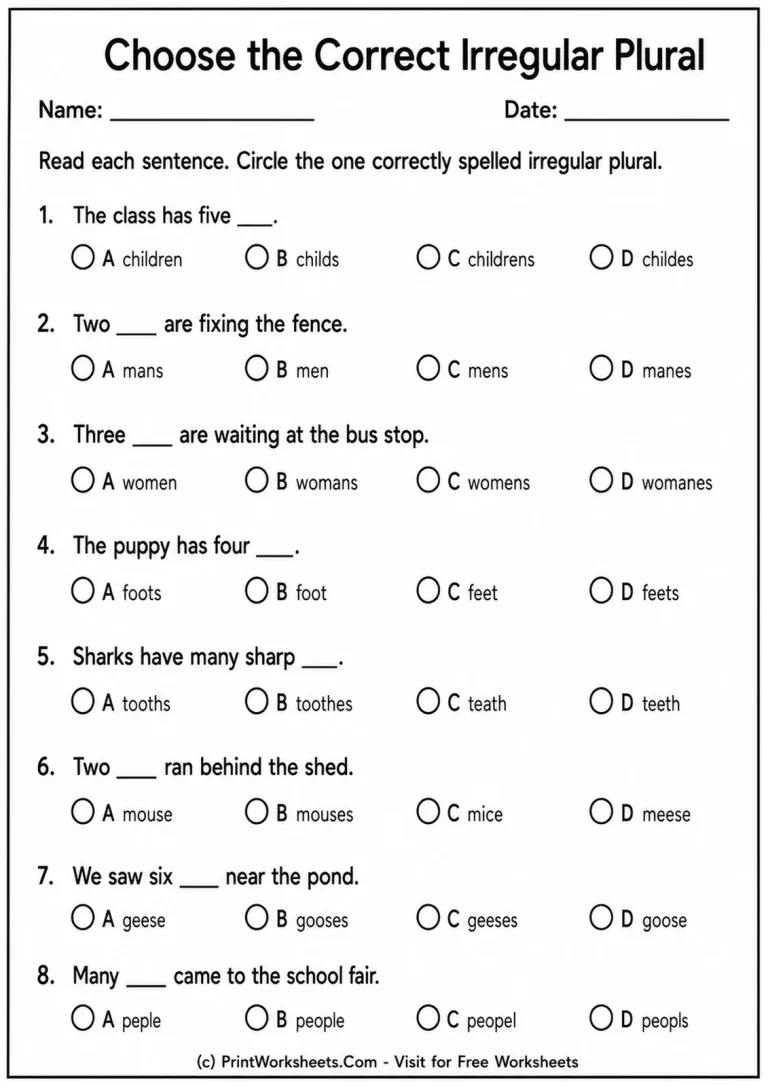
The second worksheet places the same target plurals inside short sentences. For each item, students read the sentence and choose the correctly spelled irregular plural from four options. The target answers include children, men, women, feet, teeth, mice, geese, and people.
Sentence context adds another layer of practice because students must connect meaning, number, and spelling. They are not simply copying a word from a model. They need to decide which form makes sense in the sentence and identify the accurate spelling. This makes the page suitable after direct instruction or after students complete the writing worksheet.
What Students Practice
These activities strengthen several closely related Grade 2 language skills. Students distinguish singular nouns from plural nouns, recall common irregular plural forms, compare possible spellings, and use sentence meaning to make a choice. Because the same vocabulary appears across both worksheets, students also get valuable repetition without completing the exact same task twice.
The word set includes several high-frequency irregular patterns. Students encounter vowel changes such as man to men and foot to feet, larger word changes such as person to people, and forms with additional letters such as child to children. Seeing these examples together can help students understand an important spelling idea: irregular plurals must often be learned as complete word forms rather than generated by one universal rule.
Ways to Use These Worksheets
Teachers can use the writing page during a spelling or grammar lesson, as independent practice, or as a quick review after introducing irregular plural nouns. The sentence page can work well as a second-day activity, literacy center task, homework assignment, or short check for understanding. Parents can also use the pair for focused at-home practice because the directions and vocabulary remain straightforward.
For additional oral practice, ask students to say each singular and plural pair aloud before writing. After the multiple-choice activity, students can reread each completed sentence and explain why the chosen plural is correct. Students who need extra support can practice the pairs verbally first, while students who are ready for an extension can write original sentences using several of the plural words.
Build Confidence with Common Irregular Plurals
Learning irregular plural spelling becomes easier when students meet the same important words in more than one format. This two-page set combines picture-supported recall with sentence-based recognition, giving second graders a compact way to practice eight useful noun pairs. Use the pages together for a short lesson sequence or separately whenever students need focused review of common irregular plural words.