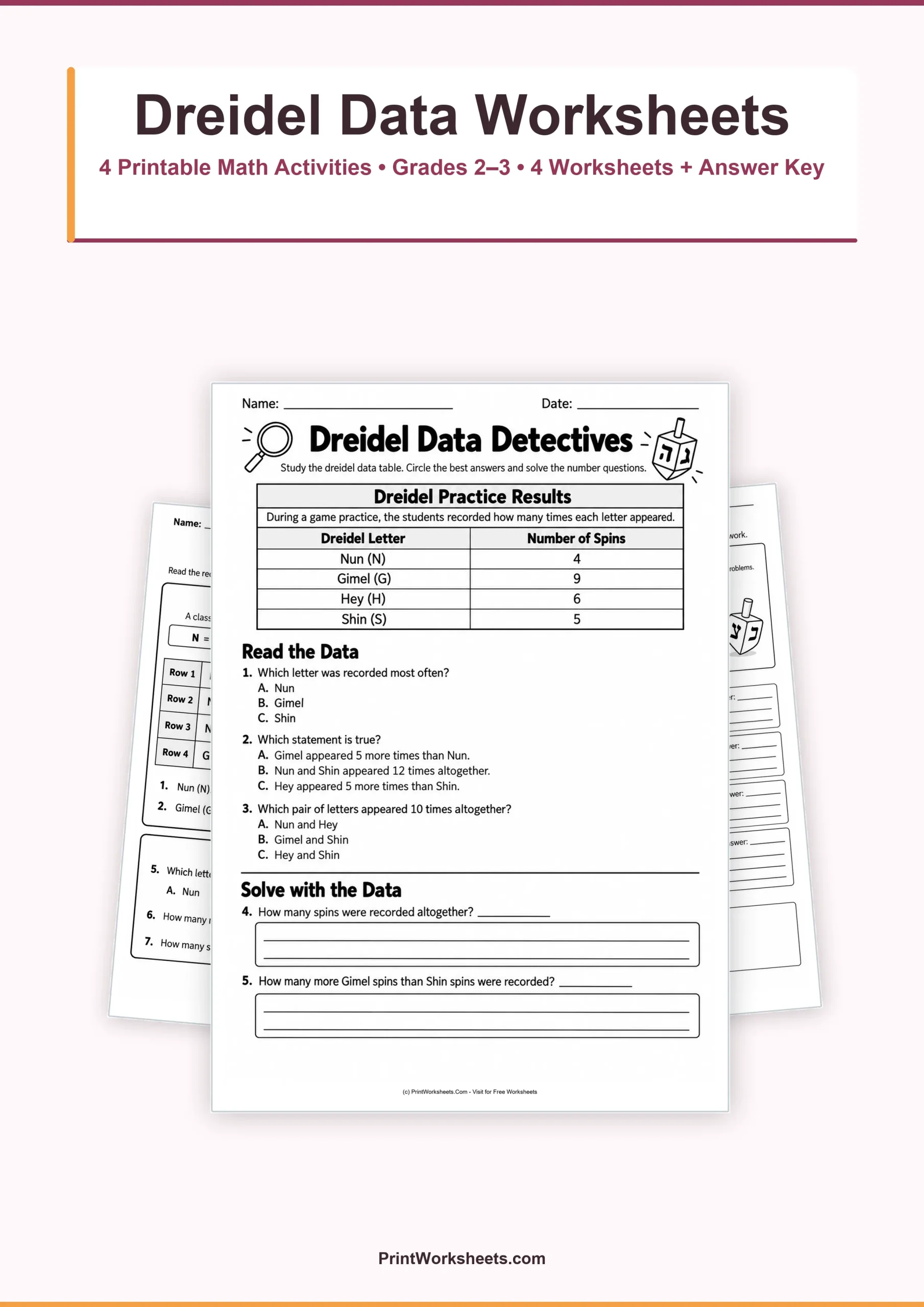
What can a collection of dreidel spins tell us about a game? These dreidel data worksheets help 2nd and 3rd grade students turn recorded game results into meaningful math questions. Instead of simply practicing addition and subtraction in isolation, children investigate the four dreidel letters—Nun, Gimel, Hey, and Shin—as they count results, read frequency tables, compare two rounds, and explain numerical relationships.
The printable set includes four different student worksheets and a teacher answer key. Each activity uses a dreidel-game situation to introduce another way of working with data. The pages are black and white, with clearly labeled tables, numbered questions, and room for written answers. They work well for Hanukkah-themed math lessons, independent practice, small-group activities, or learning at home.
Four Ways to Investigate Dreidel Game Data
Students move from counting individual observations to using organized data for mathematical reasoning. The worksheets can be completed in sequence or selected according to the skills your class is practicing.
1. Count the Dreidel Spins
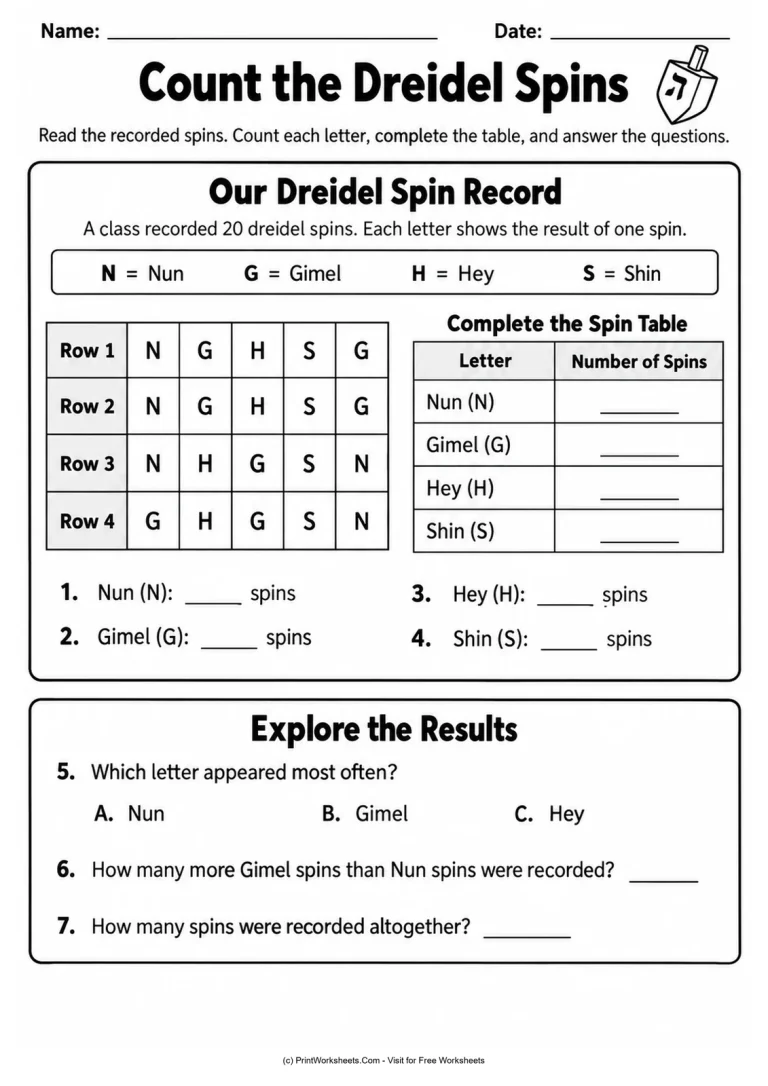
The first worksheet begins with a class record of 20 dreidel spins, displayed in four rows of five letters. A reference identifies N as Nun, G as Gimel, H as Hey, and S as Shin.
Children examine the entire record, count how often each letter appears, and enter their totals in a frequency table. They also write the number of spins for each letter, choose which result occurred most often, compare the counts for Gimel and Nun, and determine how many spins were recorded altogether.
This activity emphasizes careful counting and organization. Students can use tally marks on scrap paper before transferring their totals into the table. Checking that the four frequencies add up to 20 provides a useful introduction to verifying a dataset.
2. Dreidel Data Detectives
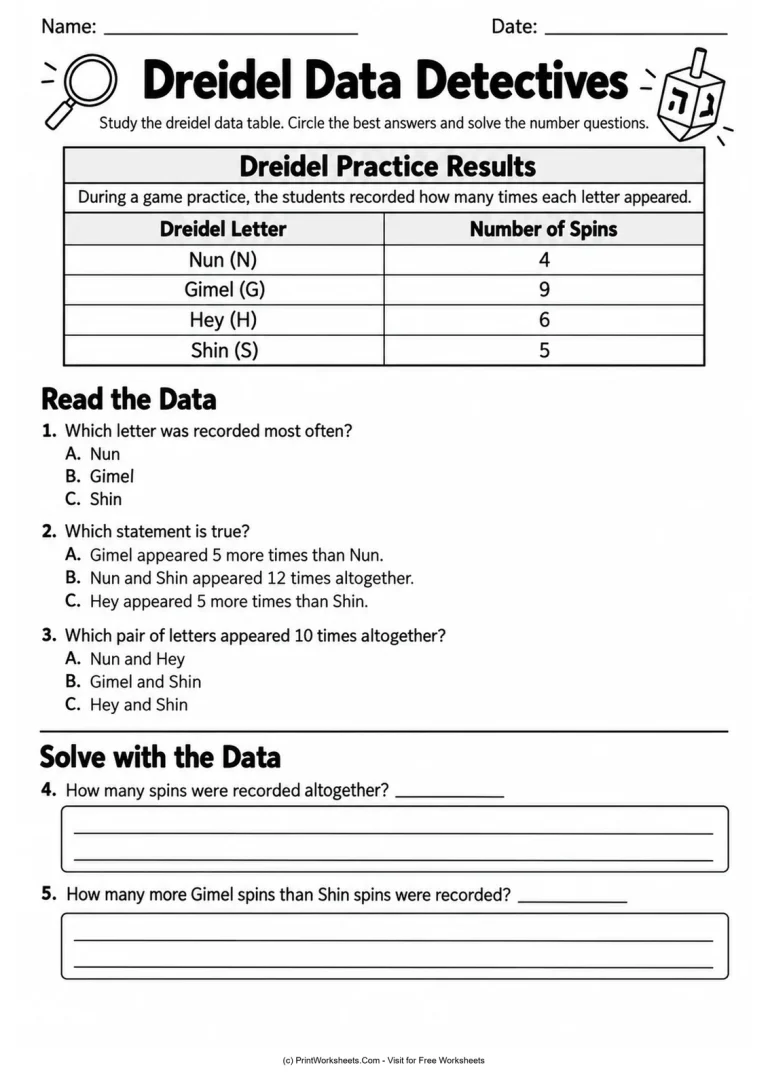
On the second page, the counting has already been completed. The dreidel practice table shows 4 Nun spins, 9 Gimel spins, 6 Hey spins, and 5 Shin spins. Students must interpret the numbers rather than create the table themselves.
Three multiple-choice questions ask children to identify the most frequent result, recognize a true comparison statement, and find two categories whose counts add up to 10. Two additional questions require students to calculate the total number of recorded spins and find the difference between Gimel and Shin.
The provided writing lines encourage children to show addition or subtraction work. This page is especially useful for practicing how to turn information in a table into an equation.
3. Compare Two Dreidel Rounds
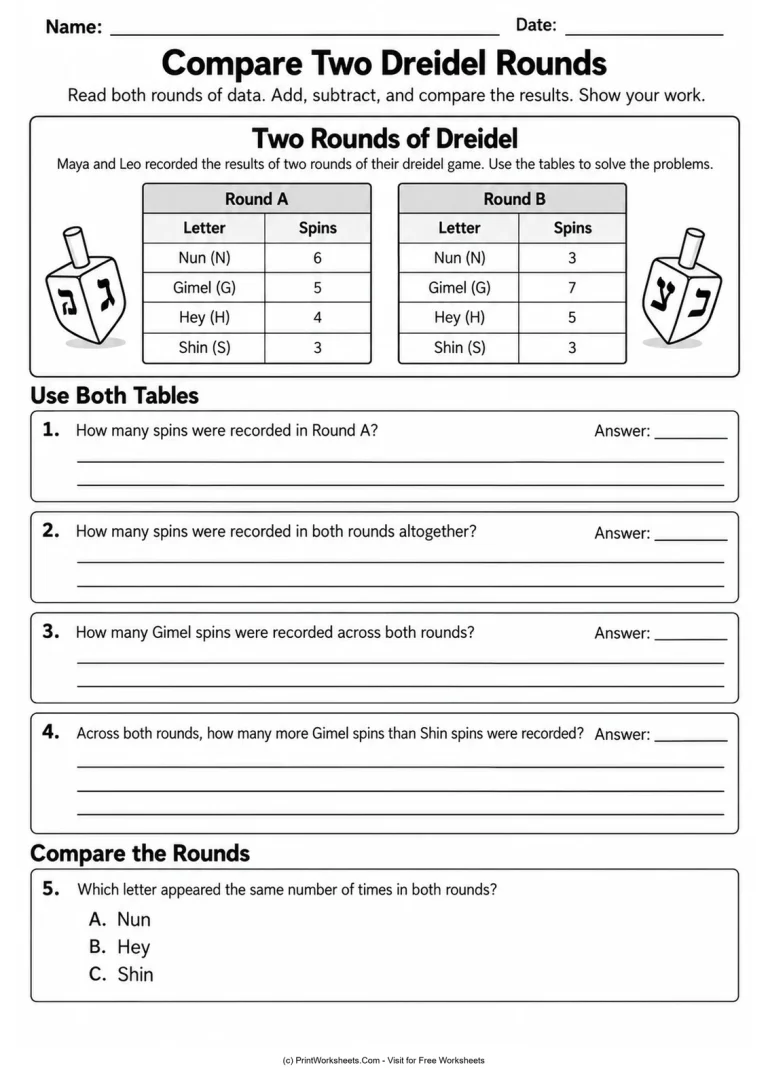
The third worksheet introduces a more challenging investigation. Maya and Leo have recorded results from Round A and Round B, with a separate table for each round. Both tables contain counts for all four dreidel letters.
Students first calculate the total number of spins in Round A. They then combine the two rounds, add the Gimel results from both tables, and compare the combined Gimel and Shin counts. A final multiple-choice question asks which letter occurred the same number of times in both rounds.
Because the information is divided between two tables, children need to select the correct values before calculating. This creates meaningful practice in multi-step addition, subtraction, and comparing categories across datasets.
4. Dreidel Data Match-Up
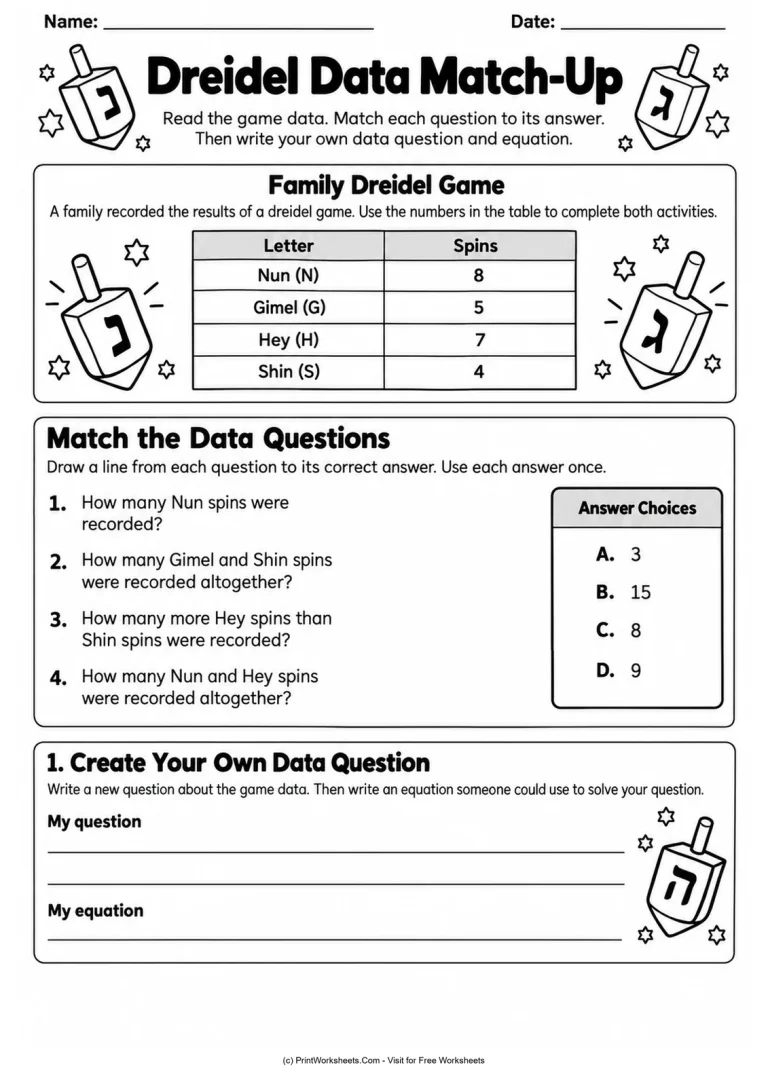
The final student page features a family dreidel game with recorded frequencies of 8 Nun, 5 Gimel, 7 Hey, and 4 Shin. Four questions ask students to find an individual count, combine two categories, or calculate the difference between two results.
Rather than filling in ordinary answer blanks, students draw lines connecting the questions to a separate bank of numerical answers. Each answer is used once, making this a focused activity for checking both number sense and data interpretation.
The page finishes with a creative challenge: students write their own question about the family game data and then provide an equation that someone could use to solve it. This moves beyond selecting answers and lets children demonstrate whether they understand how the numbers relate to one another.
Math Skills Practiced with the Dreidel Worksheets
Although each page has a different format, the activities reinforce a connected group of elementary data and arithmetic skills:
- Counting repeated outcomes and organizing results by category.
- Completing and interpreting frequency tables.
- Identifying greatest frequencies and comparing quantities.
- Adding category counts to determine totals.
- Subtracting to find how many more or fewer results were recorded.
- Combining information from two related tables.
- Selecting correct statements, matching numerical answers, and writing original equations.
These skills are appropriate for many 2nd grade data lessons and provide useful reinforcement or review for 3rd grade students. The problems use whole-number counts, so children can focus on reasoning about the data without needing advanced graphing or probability concepts.
Using the Pages in a Hanukkah Math Lesson
Begin by introducing the four letter names used throughout the worksheets. Explain that a dreidel has different lettered sides and that the recorded letters represent outcomes from spinning it. Students do not need to know the rules of the complete dreidel game to complete the math activities.
For a guided lesson, model how to count the first row of letters on the opening worksheet. Then ask students to work through the remaining rows independently or with a partner. Encourage them to explain how they know their table is complete.
Use the Data Detectives page to discuss the difference between finding a number directly in a table and calculating a new number from the information given. The two-round comparison can follow as a challenge for students ready to combine several values. Finish with the Match-Up page and invite children to share the different data questions they created.
Printable Pages and Teacher Answer Key
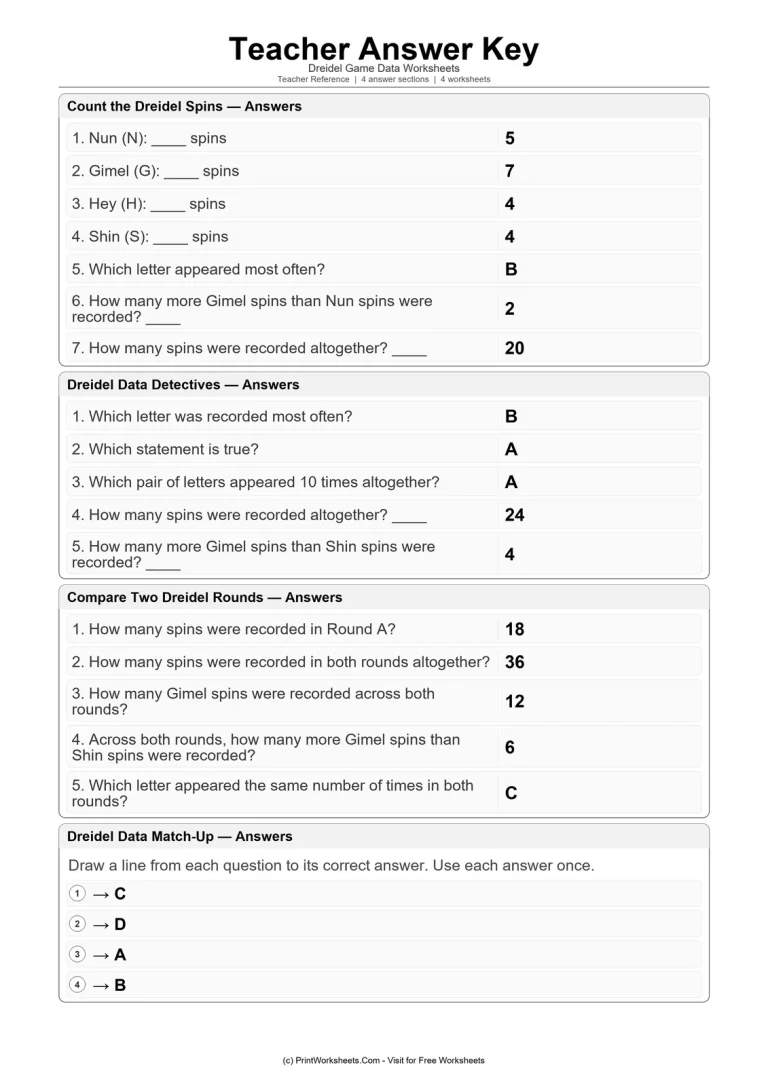
The download includes four student activities plus a separate teacher reference with answers to the counting, multiple-choice, computation, comparison, and matching questions. The final open-ended task allows students to create different valid questions and equations using the same recorded game data.
Print the full set for a short sequence of lessons or choose individual pages for math centers, homework, holiday review, or extra practice. These dreidel activities give students a concrete reason to read tables carefully, organize numbers, and explain their mathematical thinking.