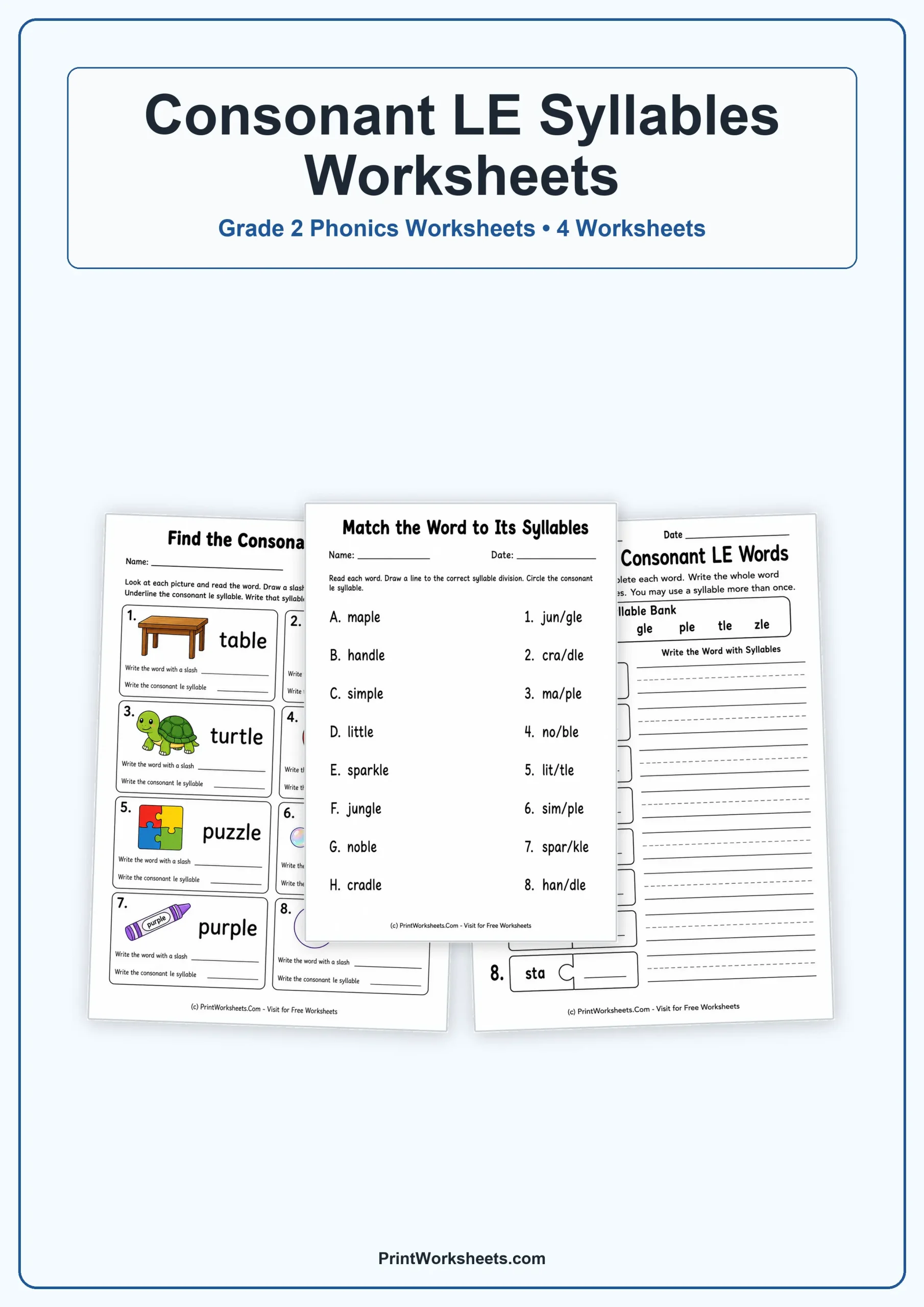
These consonant le syllables worksheets give second-grade readers focused practice with words that end in familiar consonant-le patterns. Instead of working with the pattern in only one format, students meet it through pictures, syllable matching, word building, and short sentences. The four printable activities help children notice the final syllable, divide two-syllable words correctly, and name the consonant-le part of each word.
Practice consonant le syllables in several ways
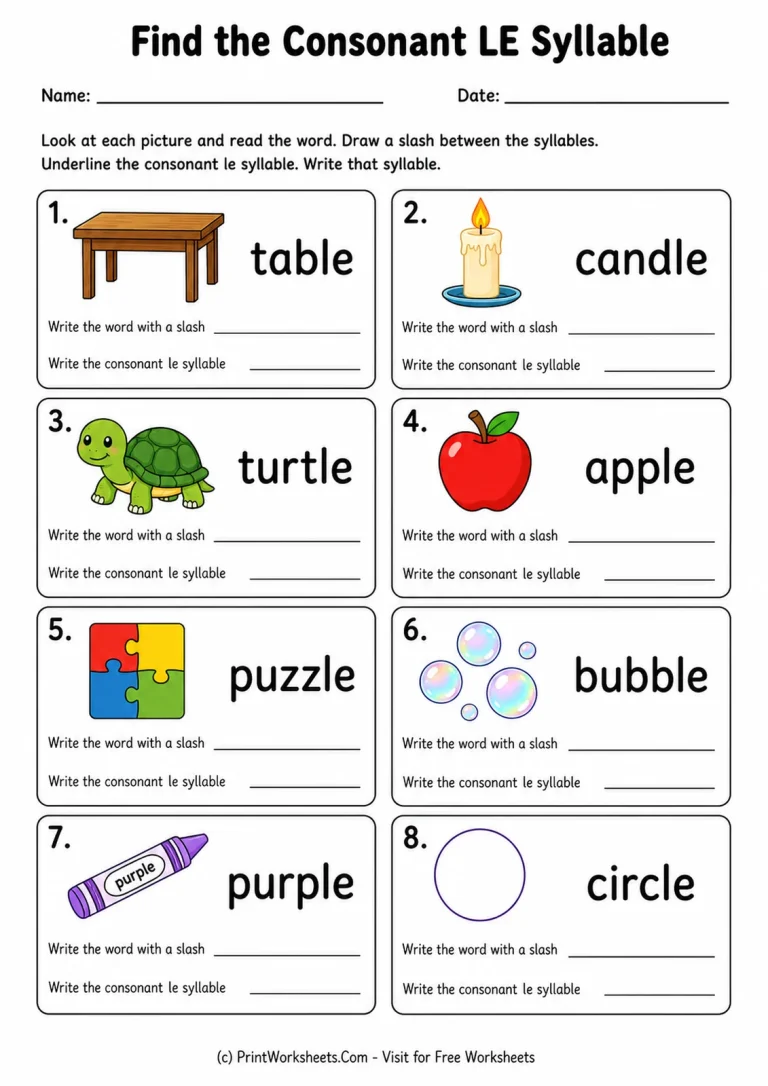
The set begins with a picture-supported activity that makes the pattern easy to spot. Students read words such as table, candle, turtle, apple, puzzle, bubble, purple, and circle. For each word, they mark the syllable break with a slash and then write the consonant-le syllable separately. This gives learners a clear routine: read the whole word, listen for its parts, divide it, and identify the final syllable pattern.
The visual support is especially useful when students are still gaining confidence with longer words. Familiar vocabulary keeps the decoding task manageable while the worksheet directs attention to the structure at the end of each word. Because students must both divide the word and identify the final syllable, they are doing more than simply copying a spelling pattern.
Match words to their syllable divisions
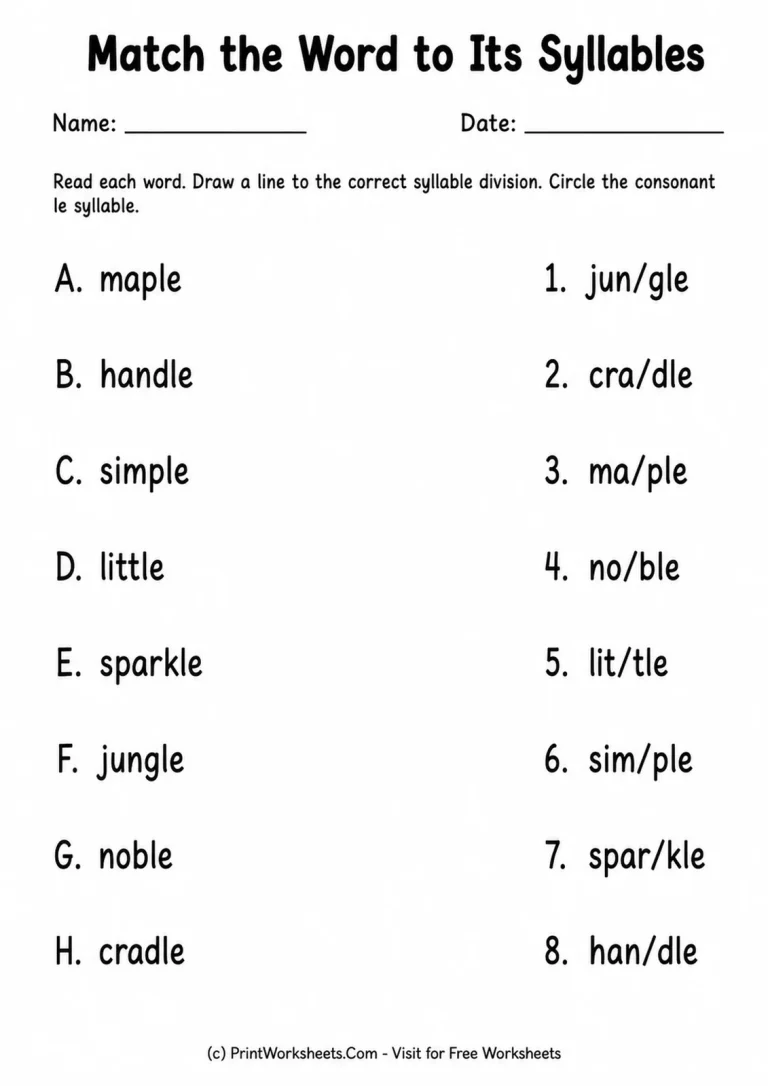
The next worksheet changes the task from producing a syllable break to recognizing the correct one. Students work with maple, handle, simple, little, sparkle, jungle, noble, and cradle. They match each complete word to its correct slash-separated syllable form and then circle the consonant-le syllable.
This matching format is useful for reinforcing accurate syllable division without requiring students to generate every answer from scratch. It also helps teachers see whether a child can distinguish between the whole word and its two spoken parts. The extra step of circling the target syllable keeps the phonics focus clear throughout the activity.
Build two-syllable words from a syllable bank
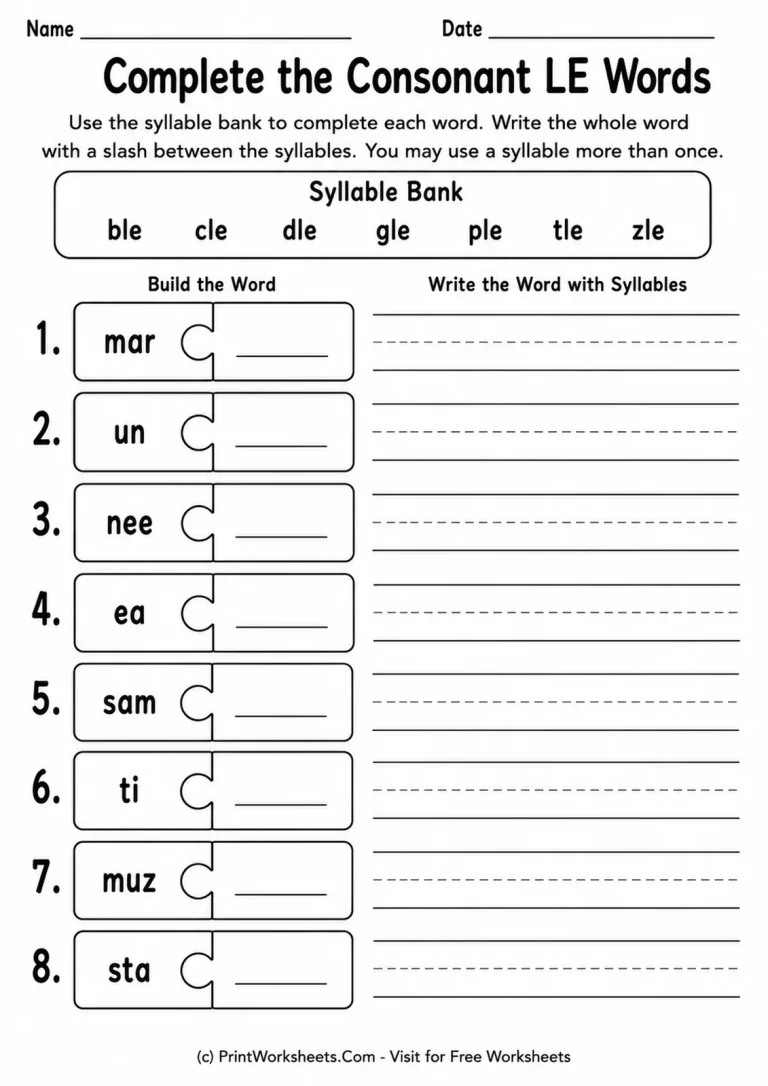
A third worksheet asks students to construct complete words from beginning parts and a bank of consonant-le endings. The syllable bank includes ble, cle, dle, gle, ple, tle, and zle. Students combine these endings with beginnings such as mar, un, nee, ea, sam, ti, muz, and sta to form words including marble, uncle, needle, eagle, sample, title, muzzle, and stable.
After building each word, students rewrite it with a slash between its syllables. This makes the activity both a word-building exercise and a syllable-analysis task. Learners must decide which ending creates a real word, read the completed word, and then show where the syllable boundary belongs. The variety of endings also prevents the practice from becoming limited to only one spelling form such as -ble or -tle.
Read consonant-le words in sentence context
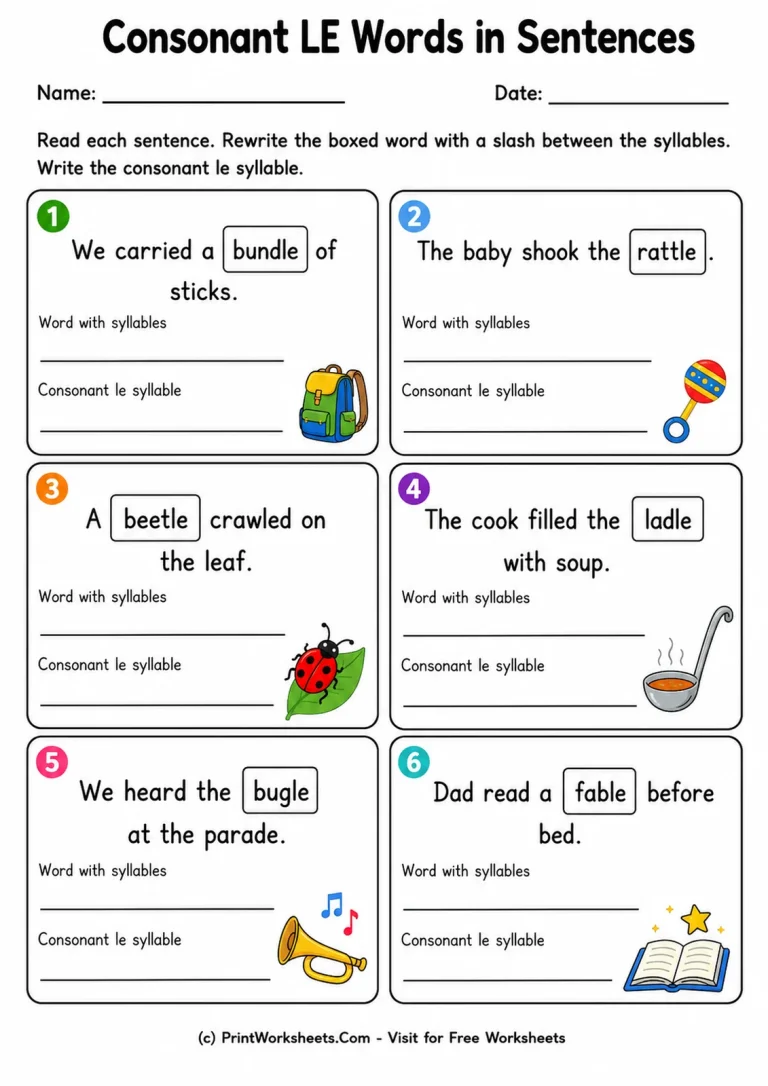
The final worksheet moves the skill into connected text. Students read six short sentences containing the target words bundle, rattle, beetle, ladle, bugle, and fable. They rewrite each boxed word with a slash between the syllables and identify its consonant-le syllable.
Using the words inside sentences adds an important layer of reading practice. Students can use sentence meaning to support word recognition while still concentrating on syllable structure. This makes the page suitable as a short independent task after direct instruction or as a quick check to see whether students can apply the pattern beyond isolated word lists.
Useful for phonics lessons, centers, and home practice
Because the four worksheets use different response formats, they can be used across more than one lesson. A teacher might introduce the pattern with the picture-supported page, use the matching activity during guided practice, place the word-building worksheet in a literacy center, and finish with the sentence page as an independent review. Families can also use the pages one at a time for extra reading practice at home.
The progression keeps the phonics target consistent while changing what students do with it. Children identify, match, construct, divide, and read consonant-le words rather than repeating the same exercise on every page. This makes the printable set a practical choice for Grade 2 learners who are beginning to handle longer words and need repeated practice recognizing how final consonant-le syllables work.