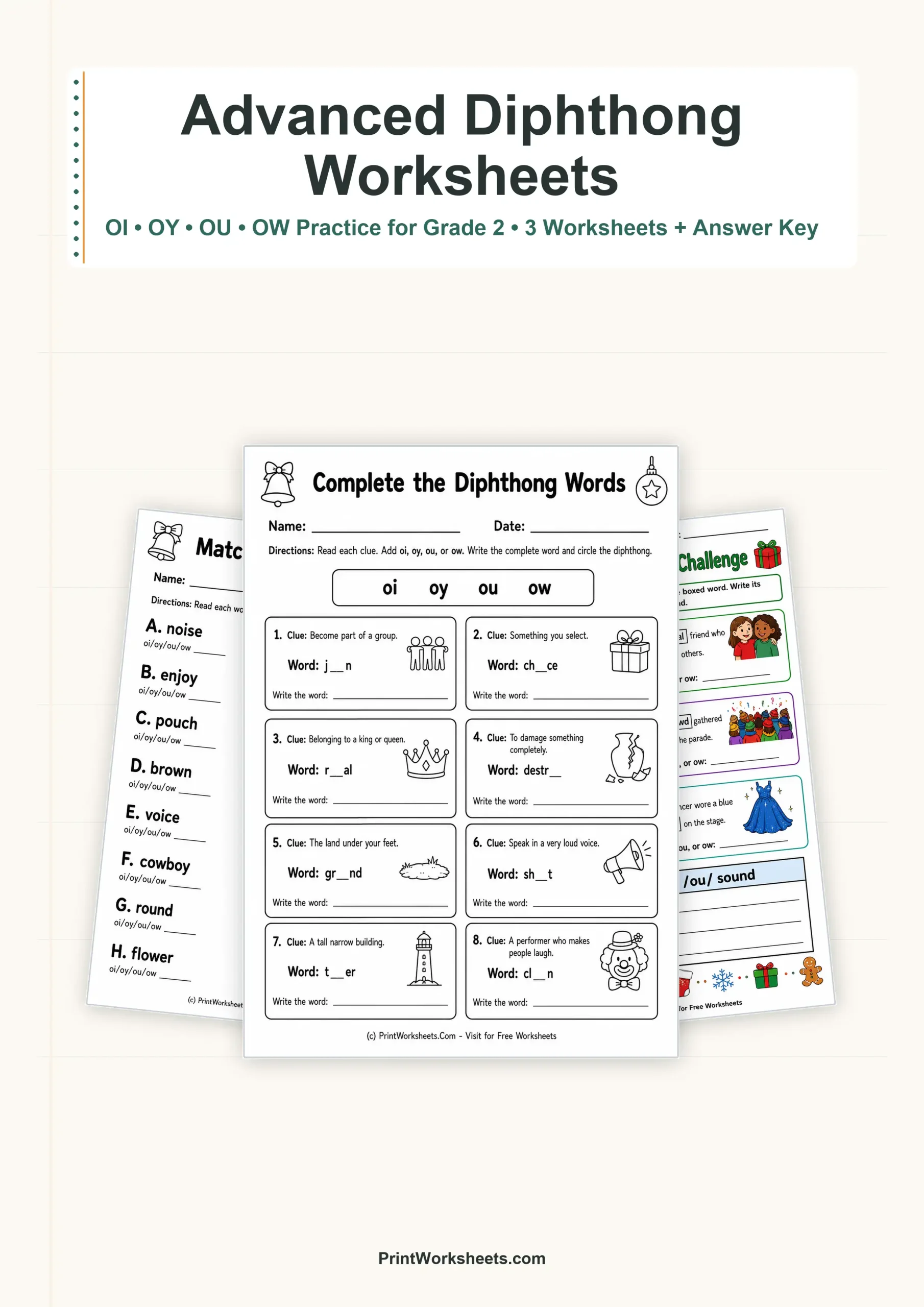
These advanced diphthong worksheets give second graders a more demanding way to work with oi, oy, ou, and ow. Instead of simply spotting a spelling pattern, students connect diphthong words to meanings, complete words from clues, identify the correct letter pattern, and classify words by sound. The three student activities move from complete-word recognition to active word building and then to diphthong analysis inside full sentences.
What Students Practice in These Advanced Diphthong Worksheets
The set focuses on four common diphthong spellings: oi, oy, ou, and ow. Students see these patterns in a varied group of words rather than repeating one narrow word family. That variety helps them notice that the same broad diphthong sound can appear with different spellings depending on the word.
Across the worksheets, students work with words such as noise, enjoy, pouch, brown, voice, cowboy, round, flower, join, choice, royal, destroy, ground, shout, tower, and clown. The activities also include contextual examples such as foil, loyal, sound, crowd, count, and gown. These words give students practice reading the whole word while still paying close attention to the vowel pattern in the middle.
Match Diphthong Words to Meaning Clues
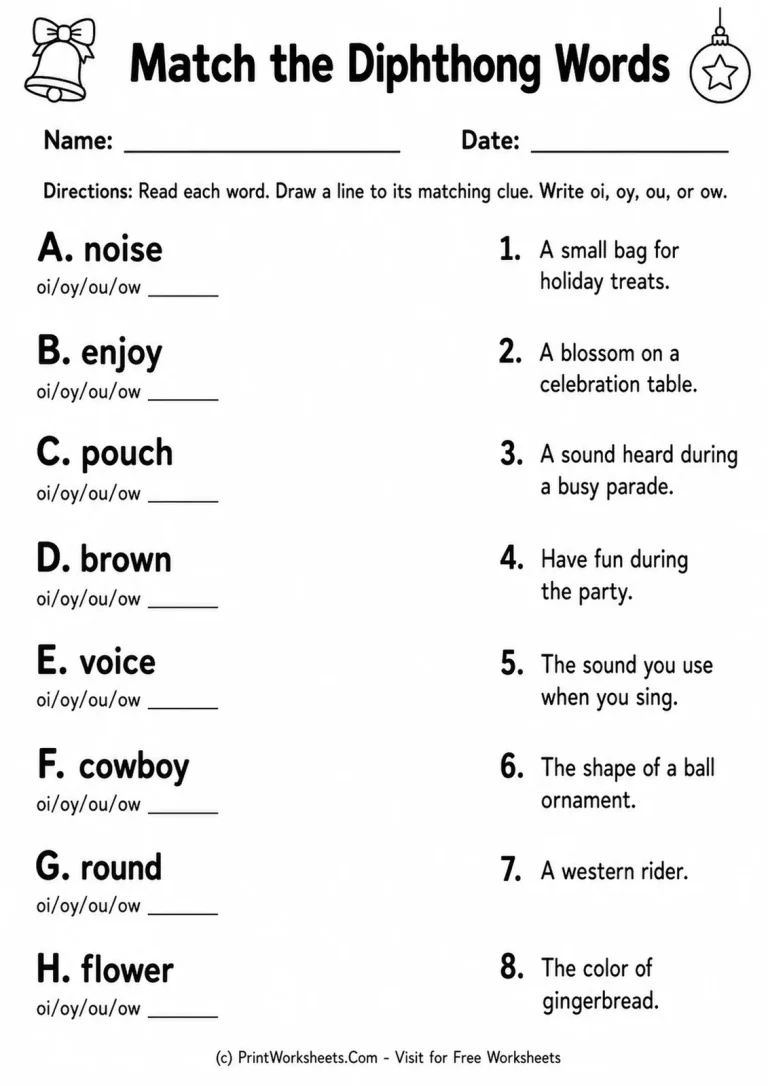
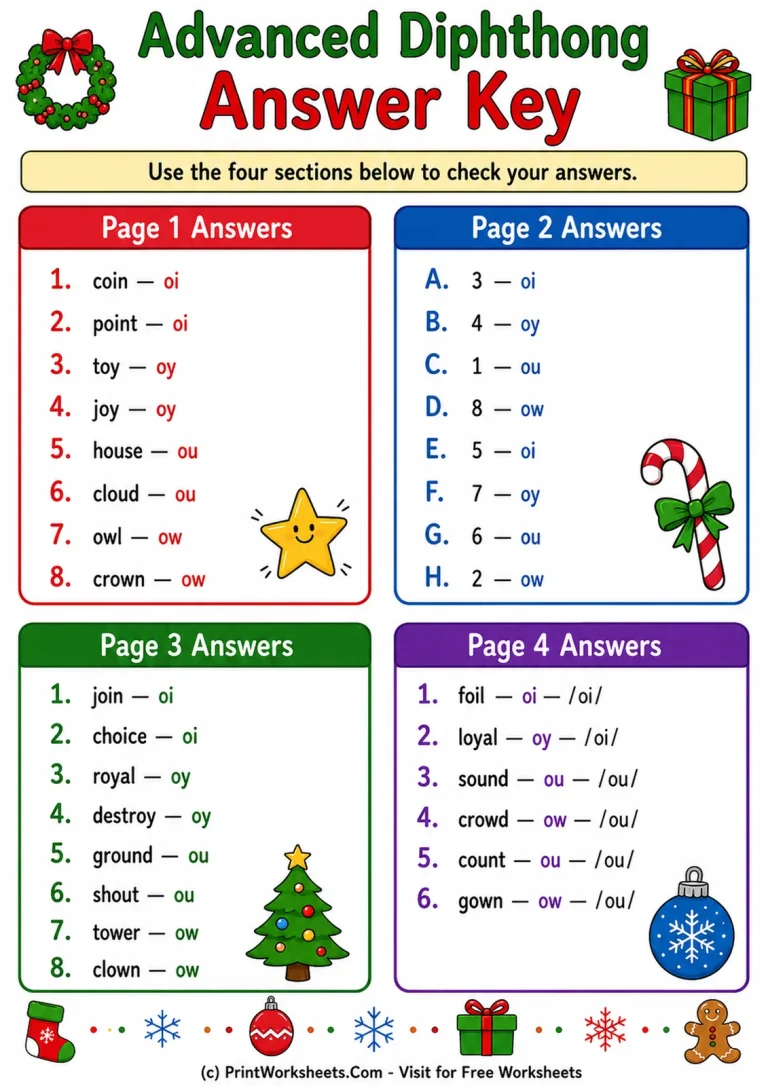
One worksheet begins with eight complete words: noise, enjoy, pouch, brown, voice, cowboy, round, and flower. Students read definition-style clues and match each clue to the correct word. After identifying the meaning, they record whether the diphthong spelling is oi, oy, ou, or ow.
This format asks students to use two kinds of information at once. They need enough vocabulary knowledge to choose the correct word, and they also need to examine the spelling carefully. A student who can read cowboy, for example, still has to recognize the oy pattern rather than treating the word as a single memorized unit.
Complete Words from Clues and Missing Patterns
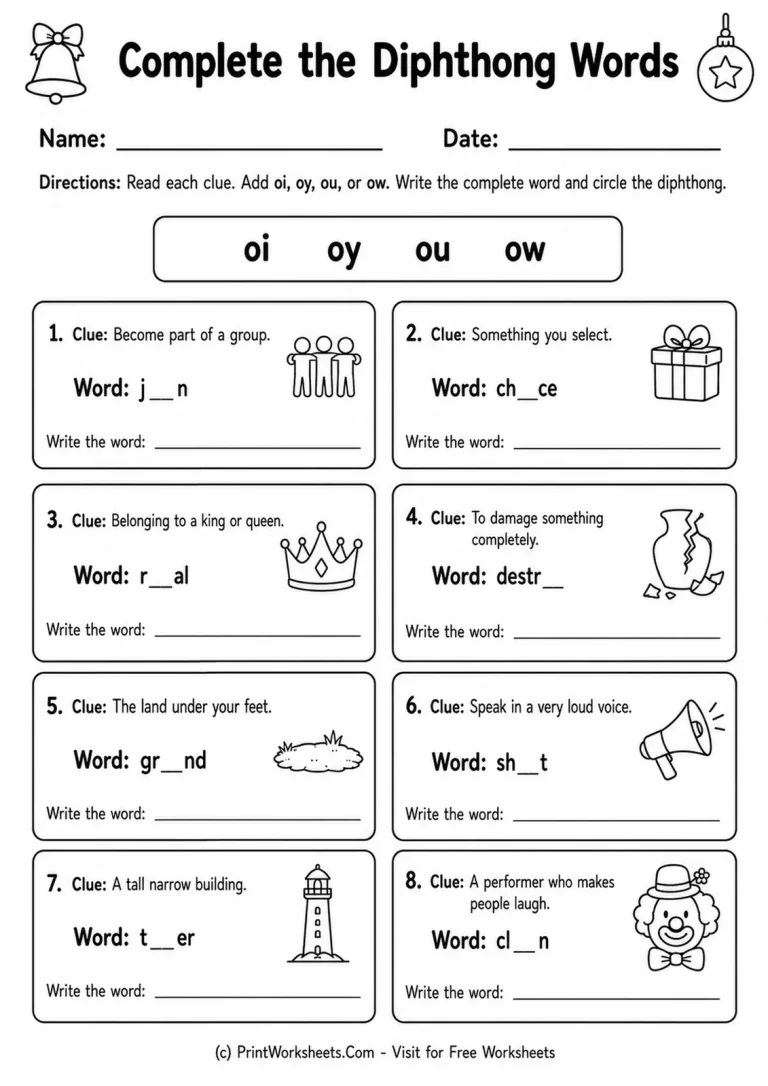
The next activity increases the challenge by removing the diphthong from each target word. Students use oi, oy, ou, or ow to complete clue-supported forms and then write the full word. Target answers include join, choice, royal, destroy, ground, shout, tower, and clown.
Because the whole word is not supplied, students must combine the clue with their phonics knowledge. They are not only identifying a pattern after seeing the answer; they are selecting the letters needed to construct the word. Circling the completed diphthong gives an additional visual check that keeps attention on the spelling feature being practiced.
Sort Diphthongs by Sound in Sentence Context
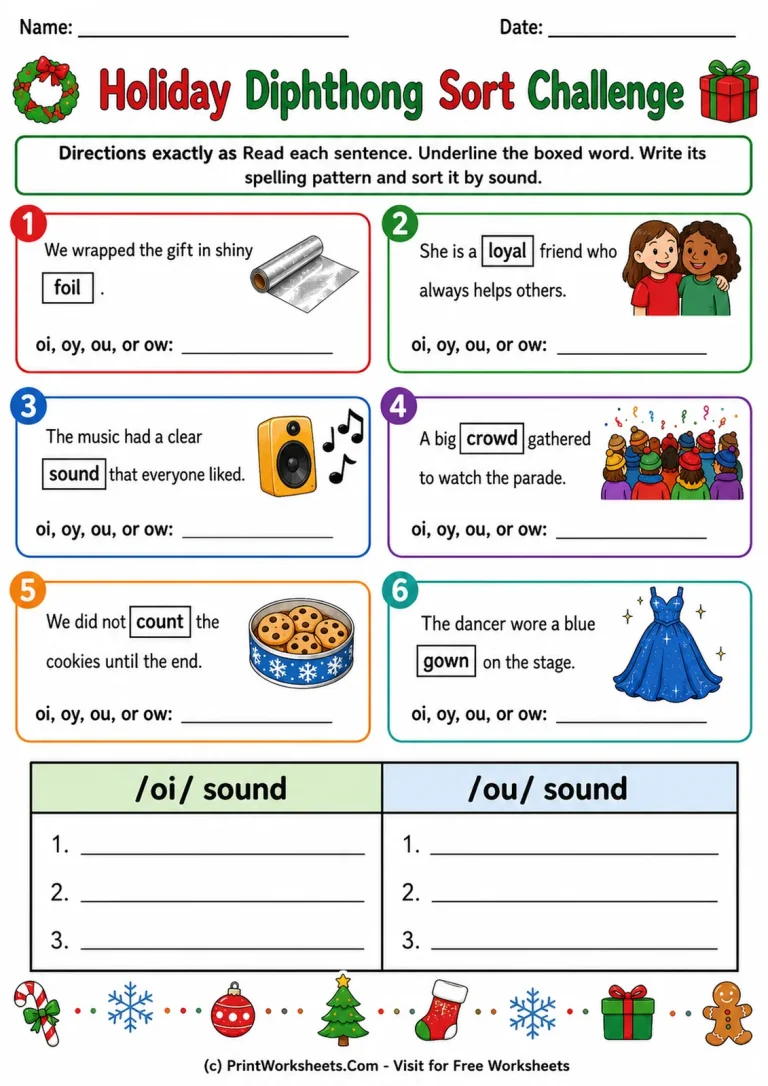
The holiday-themed challenge places six target words inside complete sentences: foil, loyal, sound, crowd, count, and gown. Students identify whether each word contains oi, oy, ou, or ow and then sort the words into /oi/ and /ou/ sound groups.
This task is especially useful after students can already recognize the individual spellings. It requires them to separate spelling from sound: oi and oy belong together as one sound group, while ou and ow are sorted together in the other group. Reading the words in sentences also adds context, so students are working with phonics as part of real reading rather than as isolated letter combinations.
A Useful Progression for Grade 2 Phonics Practice
The sequence works well because each worksheet changes what the student must do with the same phonics concept. The first activity emphasizes meaning plus pattern recognition. The second asks students to generate the missing spelling from a clue. The third moves the skill into sentence context and asks students to compare spellings by sound.
This progression makes the set suitable for students who already have some familiarity with common diphthongs and are ready for deeper practice. It can be used after introductory oi, oy, ou, and ow lessons, as targeted review for students who confuse the spellings, or as independent practice for readers who need more experience applying phonics knowledge to unfamiliar words.
Ways Teachers and Parents Can Use the Set
The pages can be assigned in order as a short diphthong review sequence, or used separately depending on the student’s need. The matching activity is a good choice when vocabulary and decoding both need reinforcement. The completion page provides more direct spelling practice because students must choose and write the missing vowel pattern. The sentence sort works well as a follow-up lesson when students are ready to compare spelling patterns by sound.
The included answer key supports quick checking after independent work, small-group phonics instruction, homework, or extra practice. Students can also use the key after completing a page to review which spelling pattern they selected and correct any words they confused.
Build Stronger Diphthong Pattern Awareness
By moving beyond simple identification, this printable Grade 2 set helps students pay attention to meaning, spelling, pronunciation, and context at the same time. Working repeatedly with oi, oy, ou, and ow in different task formats gives learners several chances to notice how diphthong patterns behave in real words. The result is focused practice that strengthens both decoding and spelling while keeping each activity meaningfully different from the one before it.