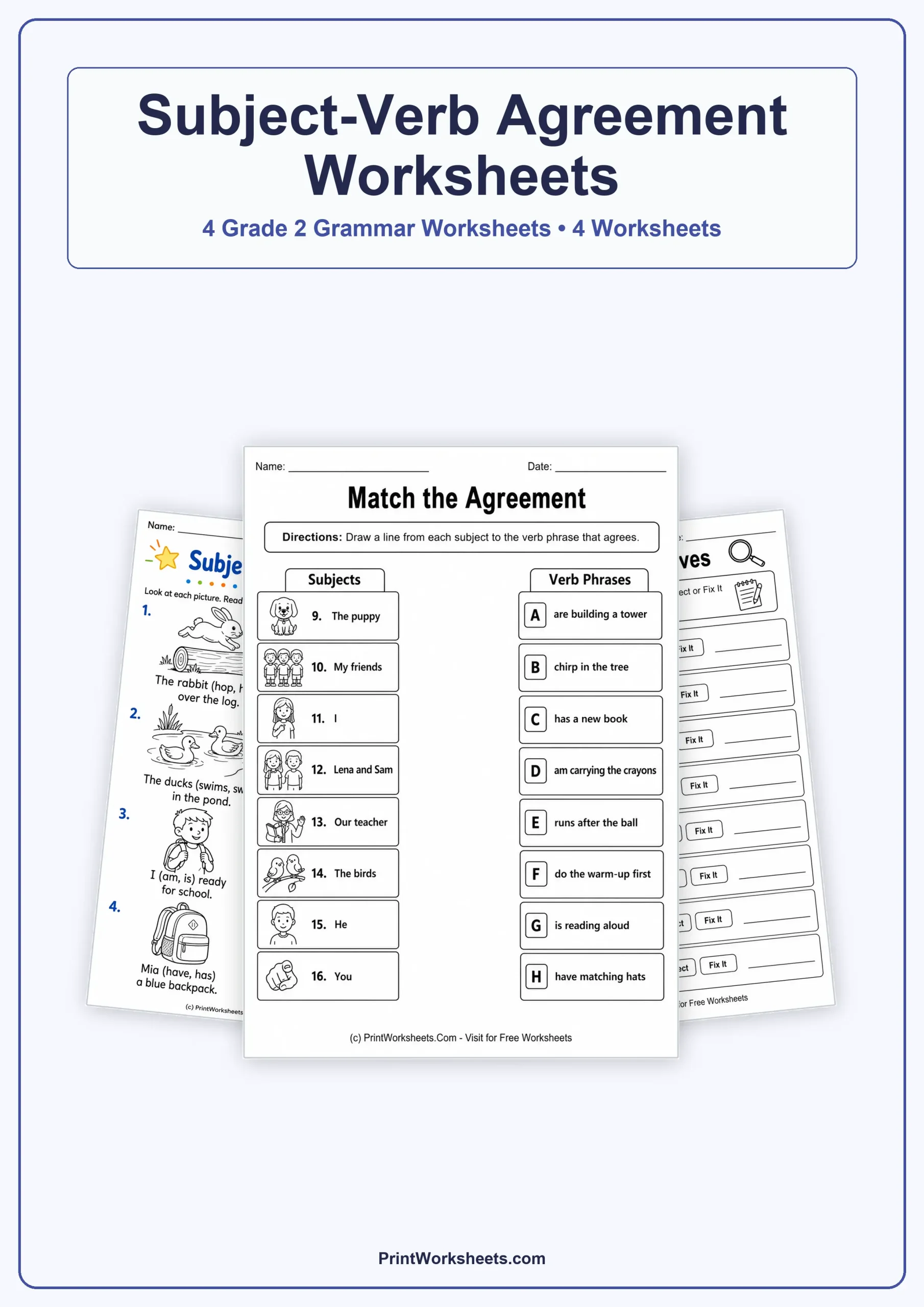
Subject verb agreement becomes easier for second graders when they can see how the subject of a sentence controls the verb that follows it. This printable four-page set gives students several ways to practice that relationship, beginning with clear choices and moving toward correction and independent application. Across the activities, children work with singular and plural nouns, common pronouns, compound subjects, and useful verb forms such as am, is, are, has, have, do, and does.
Practice Subject Verb Agreement in Four Different Ways
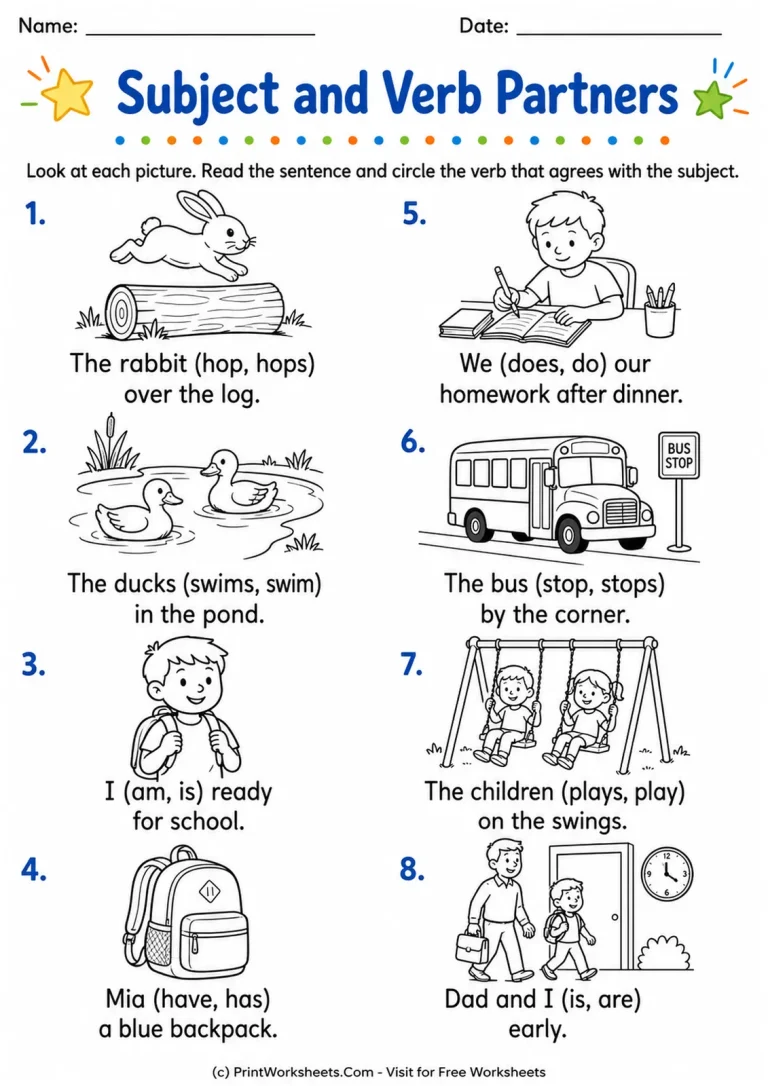
The first worksheet, Subject and Verb Partners, uses eight illustrated sentences to make the grammar decision concrete. Students read each sentence and circle the verb that correctly agrees with its subject. Pictures of familiar subjects such as a rabbit, ducks, a bus, children, a backpack, and a family help younger learners connect the sentence to a clear mental image. The page includes both noun subjects and pronouns, so students are not practicing only one predictable sentence pattern.
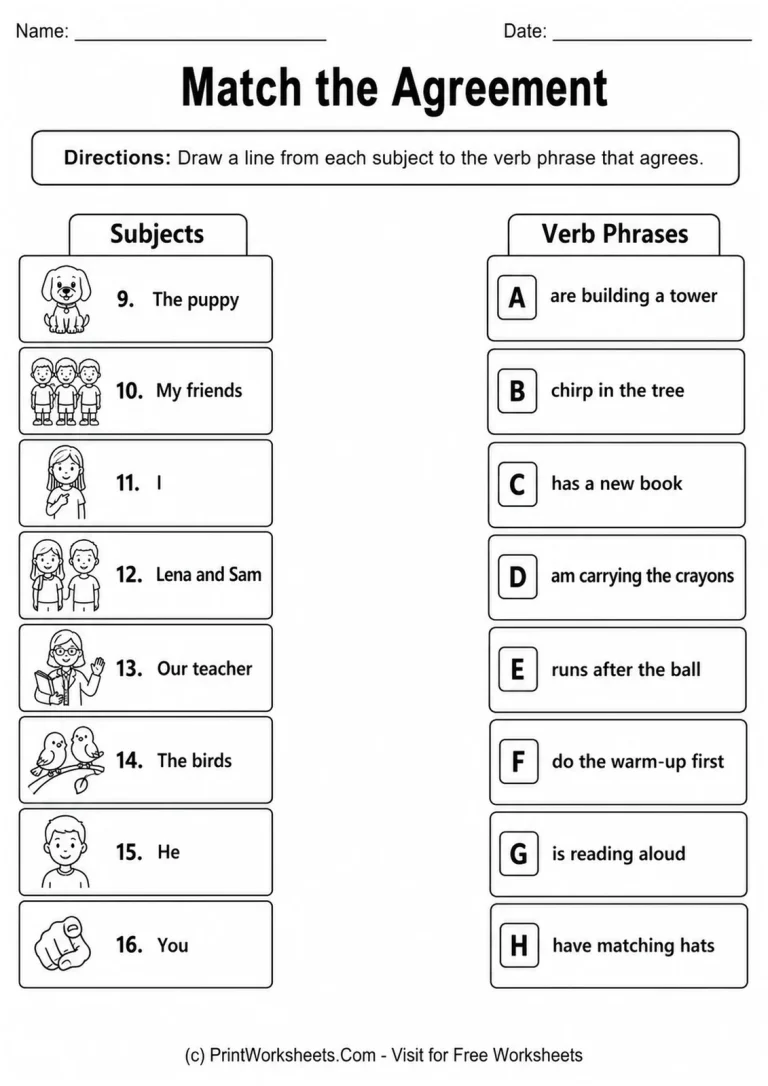
The second worksheet, Match the Agreement, changes the task from choosing between two forms to building complete subject-and-verb partnerships. Students draw lines from eight subjects to eight lettered verb phrases. Subjects include The puppy, My friends, I, Lena and Sam, Our teacher, The birds, He, and You. Because each subject has a unique grammatically and logically appropriate partner, students must pay attention to both meaning and agreement rather than matching by appearance alone.
Move from Recognition to Grammar Error Correction
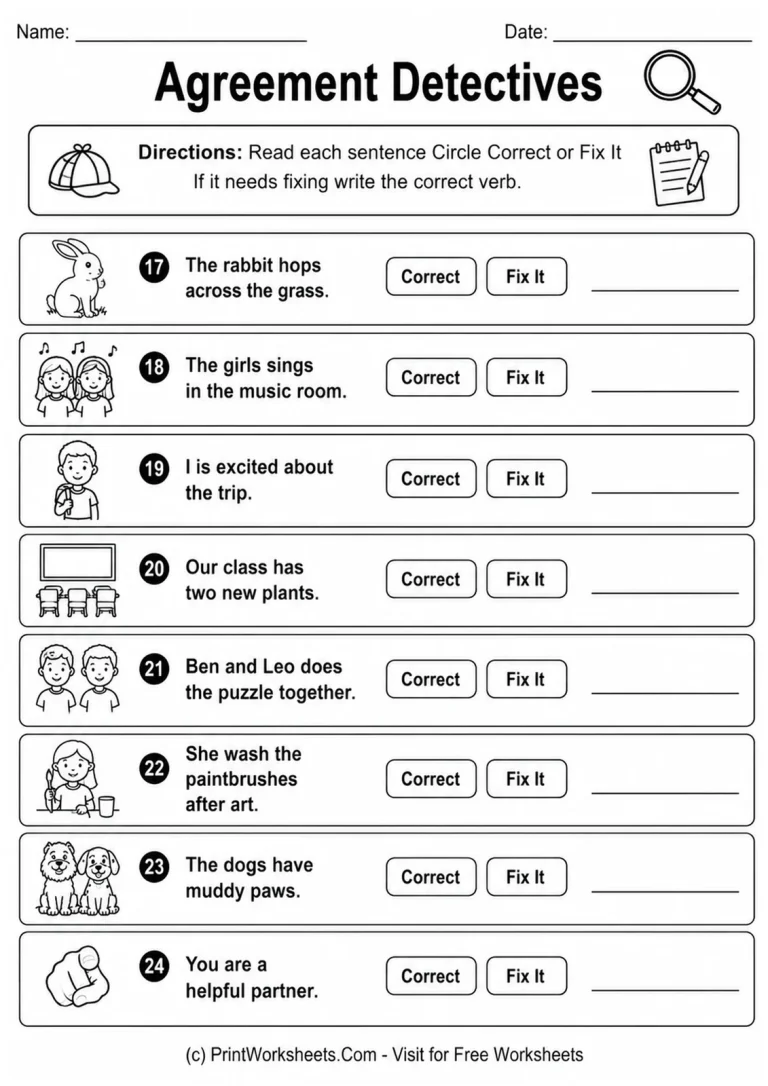
On Agreement Detectives, students become editors. They read sentences numbered 17 through 24, decide whether each sentence is correct or needs to be fixed, and write the corrected verb when necessary. This page is especially useful because children must notice an agreement problem without being shown two ready-made answer choices. Examples target errors such as a plural subject paired with a singular verb, the pronoun I used with the wrong form of be, and compound subjects paired with an incorrect form of do.
The activity also introduces a useful sentence with the collective noun class: Our class has two new plants. This gives students another type of subject to examine while keeping the sentence meaning familiar and age appropriate. Other examples use pronouns including I, you, and he, along with compound subjects such as Ben and Leo. The variety helps students understand that agreement depends on the actual subject, not simply on the word nearest the verb.
Apply Agreement in Everyday School Sentences
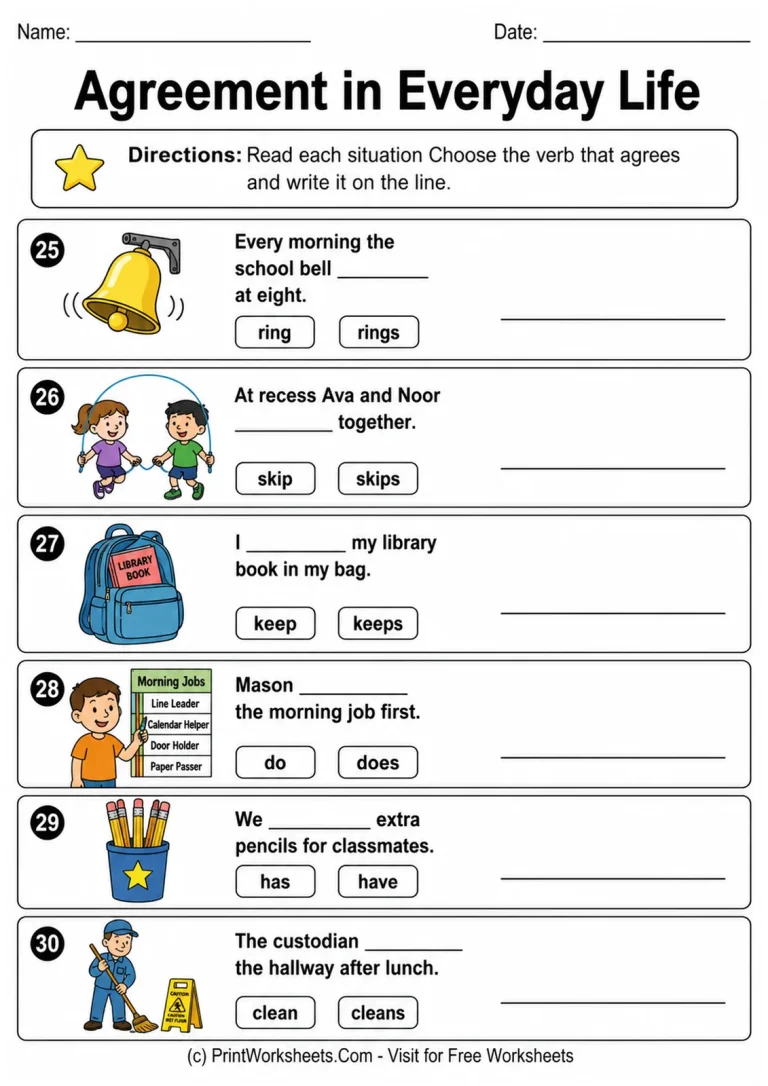
The final student worksheet, Agreement in Everyday Life, places the skill inside six short school-related sentences. Students choose between two verb forms and write the one that agrees with the subject. The contexts include a school bell, two children at recess, a library book, morning jobs, pencils, and a custodian. These familiar situations let students concentrate on the grammar while still reading sentences that sound connected to daily experience.
Together, the four worksheets create a useful progression. A learner can begin by identifying the correct verb in a supported sentence, then connect subjects to complete predicates, inspect sentences for mistakes, and finally apply the rule in ordinary contexts. The set also revisits compound subjects such as Dad and I, Lena and Sam, Ben and Leo, and Ava and Noor, reinforcing the idea that two joined people or things generally require a plural verb form.
Ways to Use These Grade 2 Grammar Worksheets
Teachers can use the pages in sequence during a short grammar unit or select individual worksheets for targeted review. The illustrated multiple-choice page works well for initial guided practice, while the matching page can be used in centers or partner work. The detective-style correction activity is suitable for checking whether students can spot agreement errors independently, and the everyday-life page can serve as follow-up practice or a brief assessment.
Parents can also use the set for home practice because the directions are short and the sentences stay focused on one skill at a time. Students get repeated exposure to singular and plural subjects, pronouns, compound subjects, and several high-frequency irregular verb forms without completing the same exercise format over and over. Print the pages you need and use them to strengthen accurate sentence building, careful reading, and confident verb choice in Grade 2 writing.