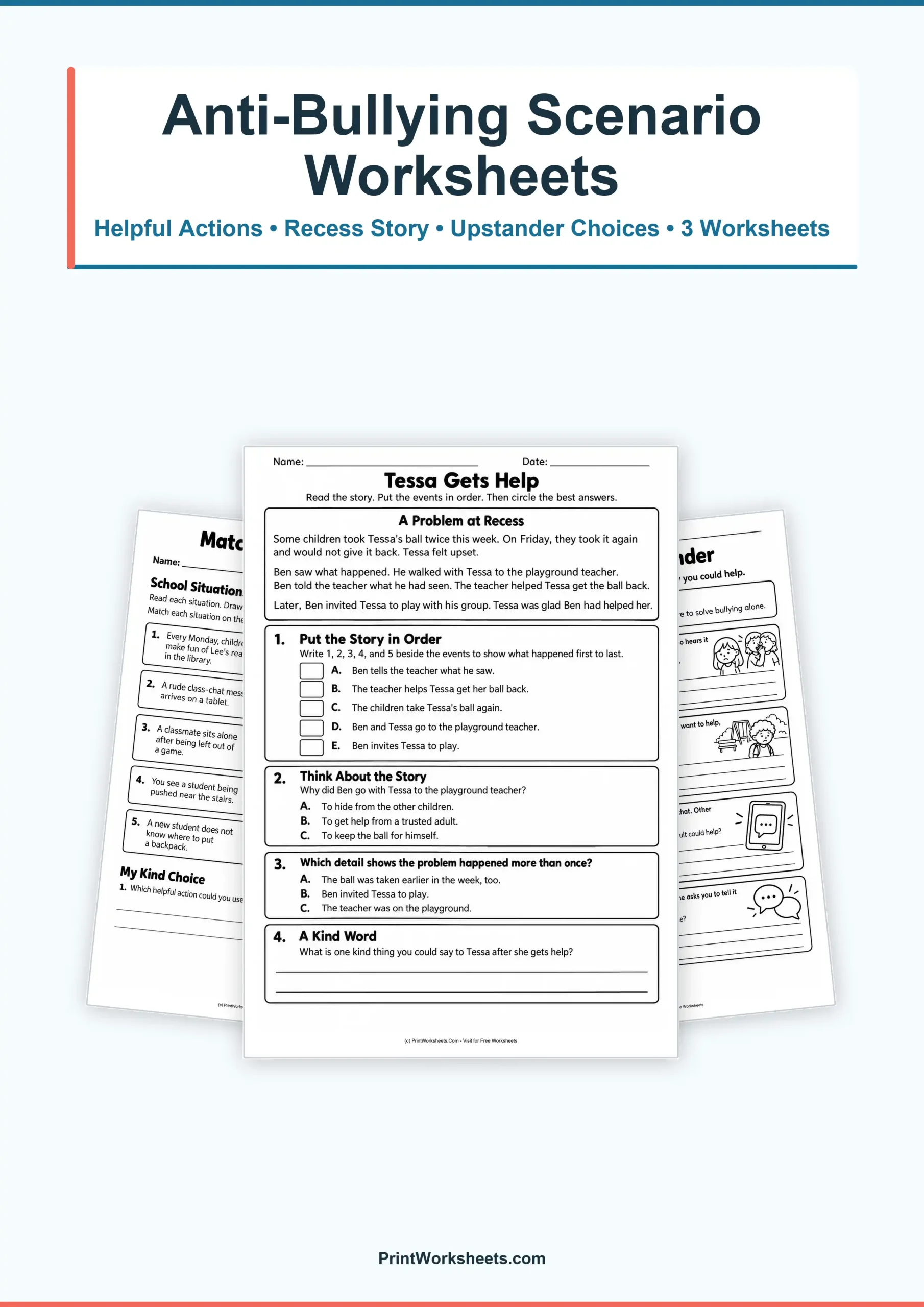
What should a child do when classmates repeatedly make fun of someone’s reading, a student is left out of a game, or an unkind message appears in a class chat? These anti-bullying scenario worksheets give students realistic school situations to think through before they encounter similar choices themselves. Designed especially for second and third graders, this printable collection combines helpful-action matching, a short recess story, reading comprehension, and written responses about being a supportive classmate.
Anti-Bullying Scenario Worksheets: Three Ways to Practice
The activities move from recognizing an appropriate action to explaining a personal response. Children begin with clear choices, examine how someone receives help in a story, and finish by writing their own ideas for handling difficult situations. This progression makes the worksheets suitable for a focused social-emotional learning lesson or several shorter classroom discussions.
Match School Situations with Helpful Actions
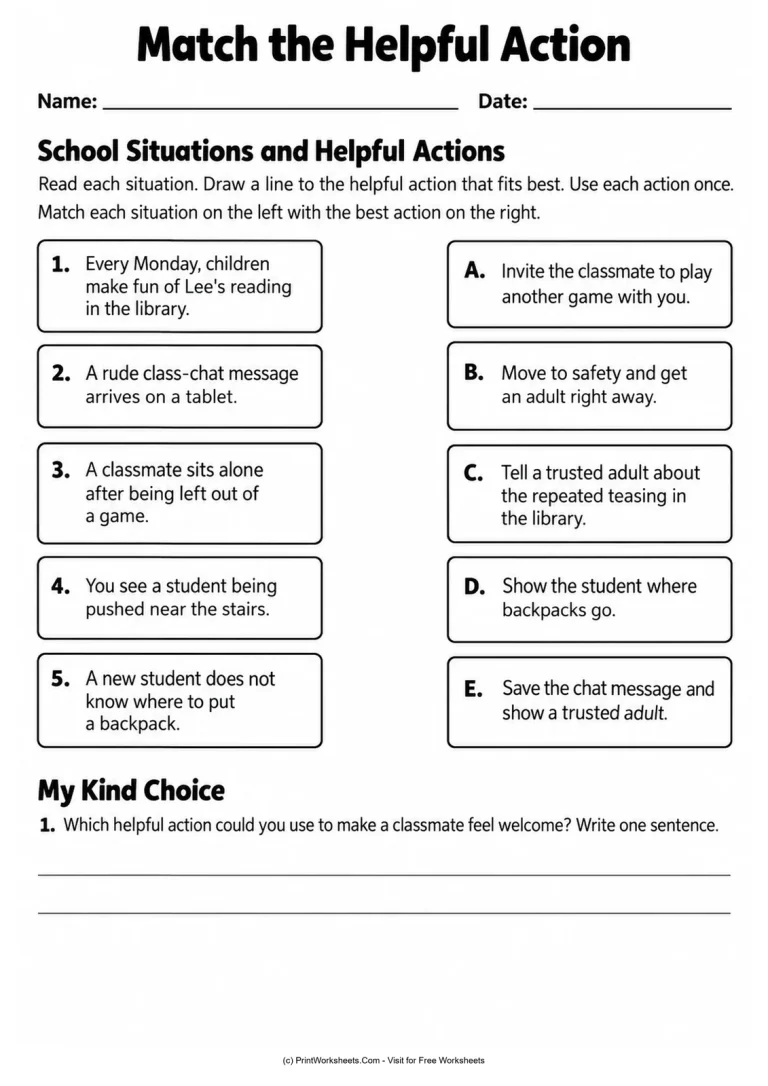
The first activity, Match the Helpful Action, presents five situations on the left and five possible responses on the right. Students draw lines to connect each situation with the action that fits best, using each action once. The examples include repeated teasing about Lee’s reading in the library, a rude class-chat message arriving on a tablet, and a classmate sitting alone after being excluded from a game.
Two additional situations ask students to consider what to do when someone is pushed near stairs and how to help a new student who does not know where to put a backpack. The response choices distinguish everyday kindness from situations that require immediate adult assistance. Children practice recognizing when to invite someone to participate, when to offer simple guidance, and when to move to safety and involve a trusted adult. A final question, My Kind Choice, invites students to write one sentence about making a classmate feel welcome.
Read About Bullying, Friendship, and Asking for Help
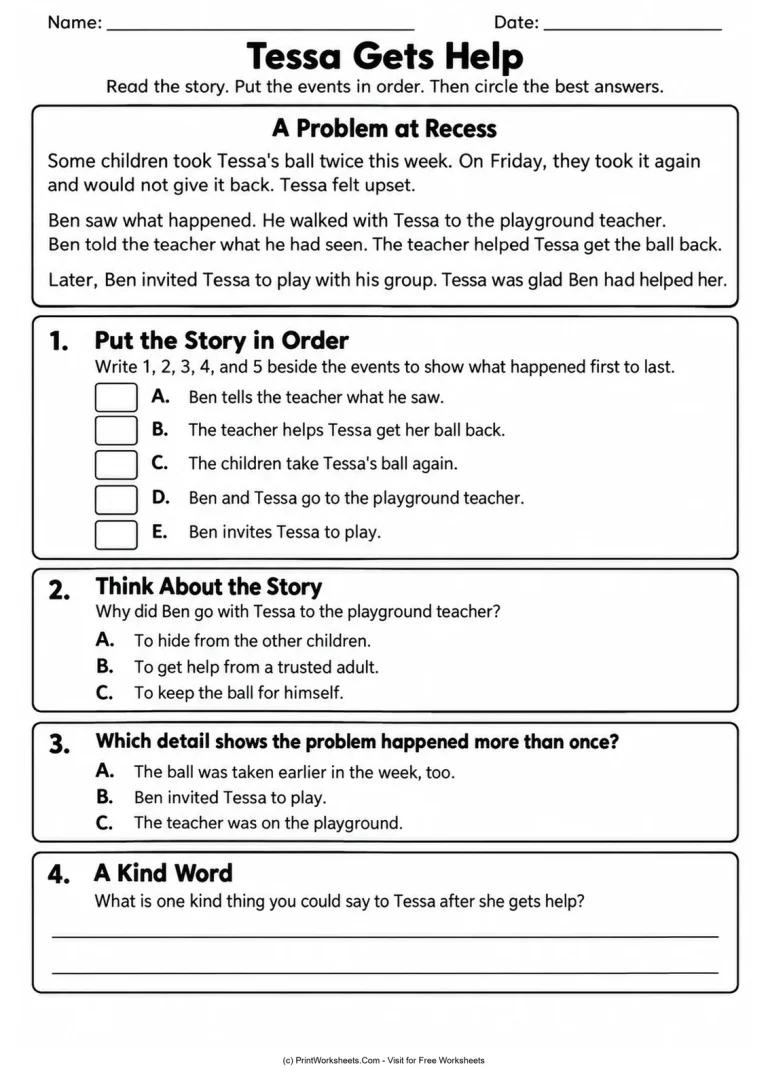
The second worksheet, Tessa Gets Help, features a short story called A Problem at Recess. Some children have taken Tessa’s ball more than once during the week. When they take it again on Friday and refuse to return it, Tessa feels upset. Ben witnesses what happens, walks with her to the playground teacher, and explains what he saw. The teacher helps Tessa recover her ball. Later, Ben invites her to play with his group.
After reading, students put five story events into chronological order. This task checks whether they can follow the sequence from the repeated problem to getting help and being included in play. Two multiple-choice questions ask why Ben approached the playground teacher and which story detail shows the problem happened more than once. Both answers can be found in the passage, making the questions useful for practicing text-based reasoning rather than guessing.
The final prompt asks students to write something kind they could say to Tessa after she receives help. Teachers can use this response to connect reading comprehension with empathy, reassuring language, and the importance of supporting someone who has been treated unfairly.
Be an Upstander: Four Situations to Think Through
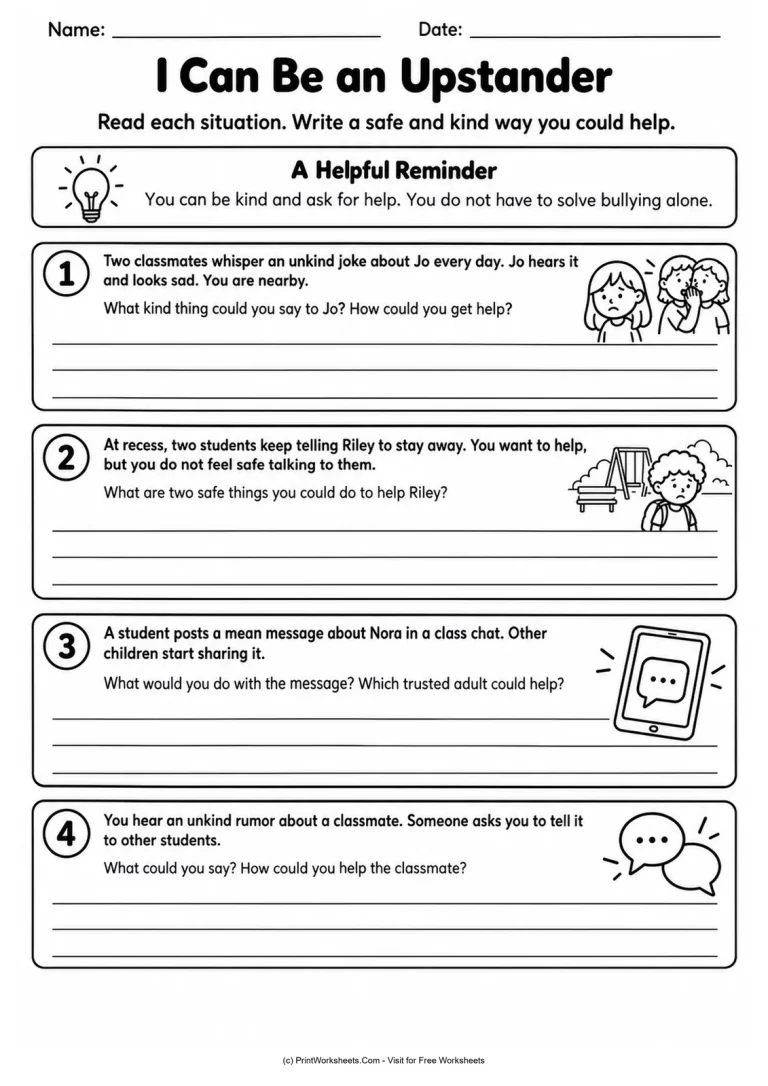
The third worksheet, I Can Be an Upstander, gives students four open-ended situations. A reminder at the top explains that children can be kind and ask for help without having to solve bullying alone. Instead of selecting a prepared answer, students consider what they could safely say or do and write their responses on the provided lines.
In the first situation, classmates whisper an unkind joke about Jo every day, and Jo appears sad. Students consider both a kind statement and a way to seek help. In the second, Riley is repeatedly told to stay away at recess. The prompt acknowledges that a student may not feel safe confronting the children involved and asks for two safer ways to help.
The remaining situations address digital communication and rumors. One describes a mean class-chat message about Nora that other children begin sharing. Students decide what to do with the message and identify a trusted adult who could help. Another asks how to respond when someone wants them to spread an unkind rumor. Together, these prompts encourage children to avoid amplifying harmful messages, support affected classmates, and recognize appropriate times to involve adults.
Using the Printables in Grades 2 and 3
Start with the matching activity as a short individual exercise or guided discussion. Ask children to explain why a particular action fits its situation. This helps them understand that helpful behavior depends on whether someone needs inclusion, practical assistance, or protection from harm. For the pushing scenario, emphasize getting to safety and alerting an adult rather than attempting a physical confrontation.
Next, read Tessa’s story aloud or let students read independently. After they complete the sequencing boxes and comprehension questions, discuss why it mattered that Ben described what he witnessed. The story also offers an opportunity to talk about repeated mistreatment and how welcoming someone into a group can help them feel included.
Use the upstander worksheet after students have practiced identifying helpful responses. Children can write independently, discuss possible actions with a partner, or share appropriate ideas during a teacher-led conversation. Because the questions are open-ended, more than one safe, thoughtful response may be reasonable. Focus on kindness, realistic choices, and knowing when adult support is necessary.
Encouraging Safe Choices Beyond the Worksheet
These printable activities can support classroom community lessons, school counseling conversations, and parent-child discussions about friendship and bullying. They offer several opportunities to practice the same essential principle in different contexts: a child can support someone who is being mistreated without taking unsafe action or handling the problem alone.
Download the free printable PDF to help students recognize unkind behavior, respond thoughtfully to exclusion and online messages, and practice becoming supportive upstanders at school.