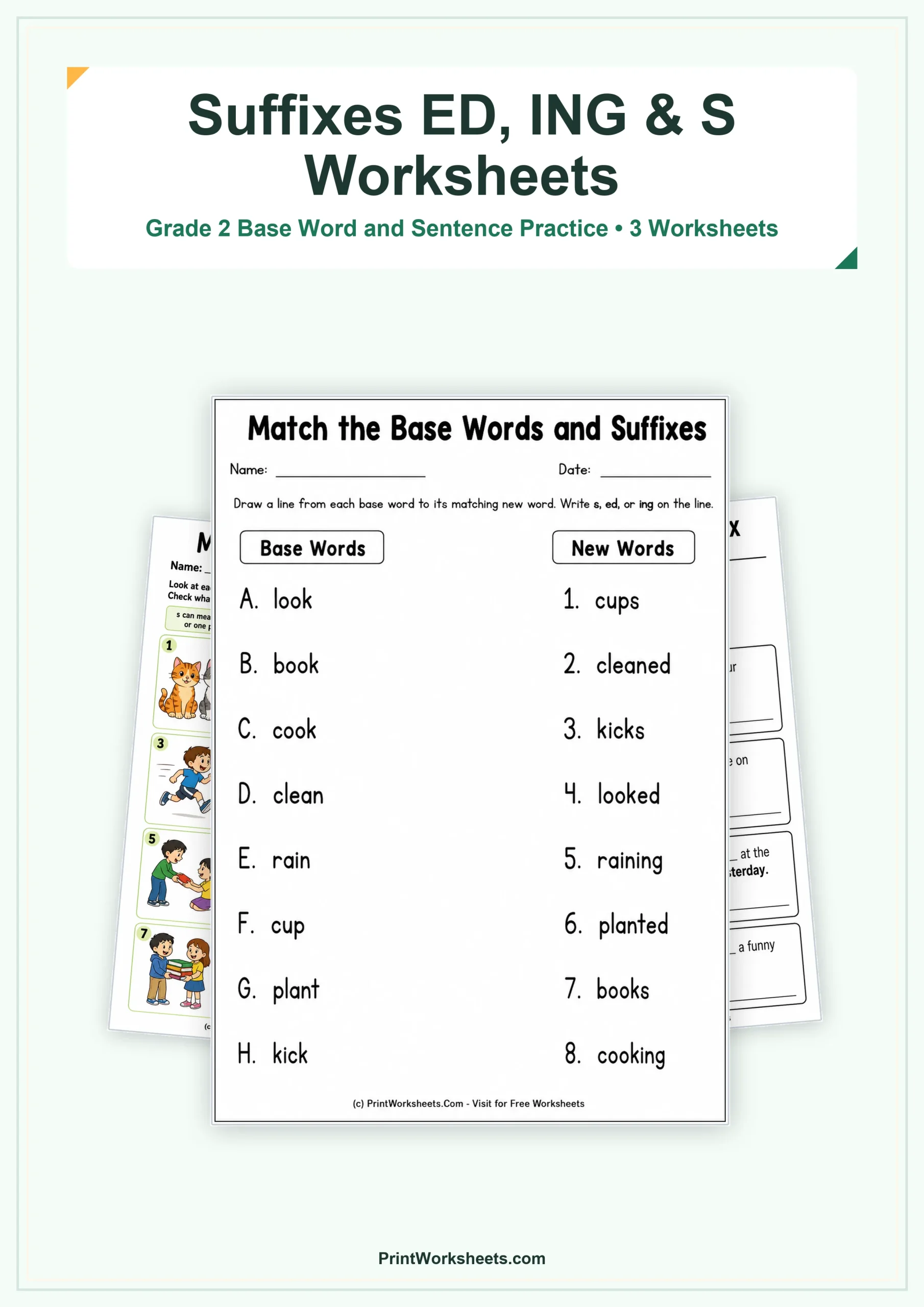
These suffixes ed ing and s worksheets give Grade 2 students focused practice with three common word endings and the clues that help explain what each ending means. Instead of treating suffixes as letters to copy onto a word, the activities ask children to notice the base word, identify the added suffix, and connect that ending with meaning. Students work with plural nouns, present-tense actions, past actions, and actions happening now while moving from supported examples to independent sentence choices.
Practice Suffixes ED, ING and S with Base Words
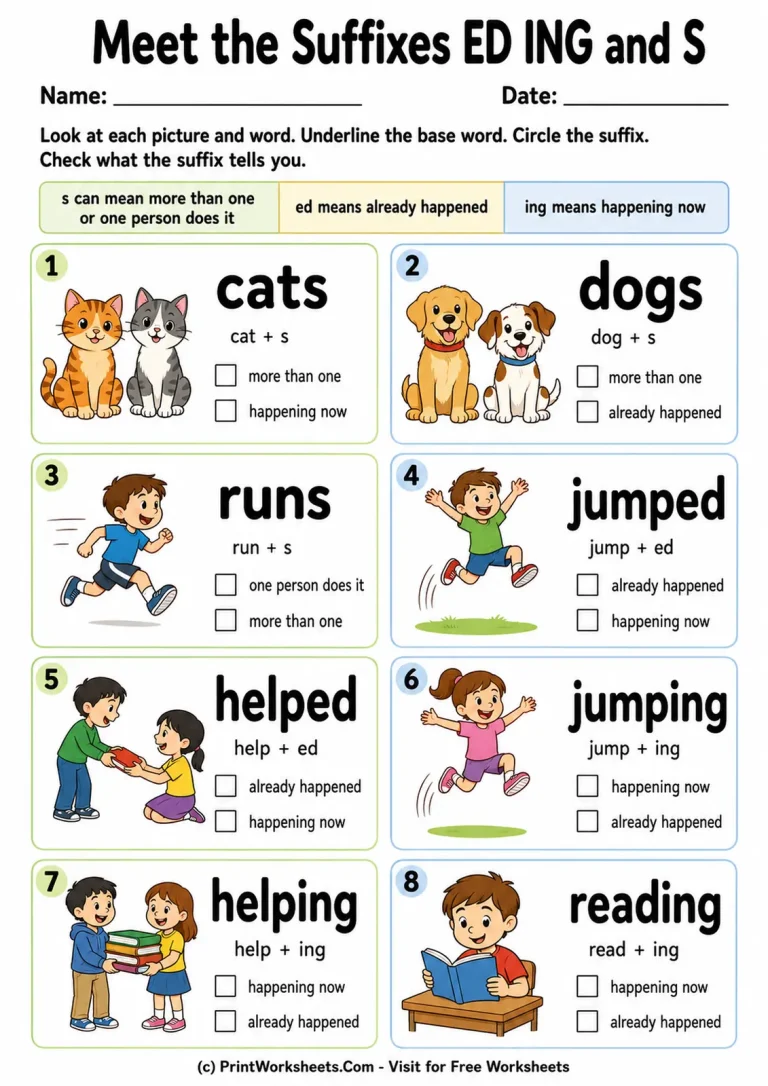
The first activity introduces the three endings through illustrated examples such as cats, dogs, runs, jumped, helped, jumping, helping, and reading. Students underline the base word, circle the suffix, and decide what the suffix is telling the reader. This structure helps make the word parts visible. A child can see that the main word remains recognizable while the ending changes the meaning or grammatical job of the word.
The worksheet presents s in two useful Grade 2 contexts: showing more than one and showing an action performed by one person in the present tense. It connects ed with actions that already happened and ing with actions happening now. Because students identify both the base and the ending, teachers and parents can check whether a child understands the word structure rather than simply recognizing the completed word.
Match Base Words to Their Suffixed Forms
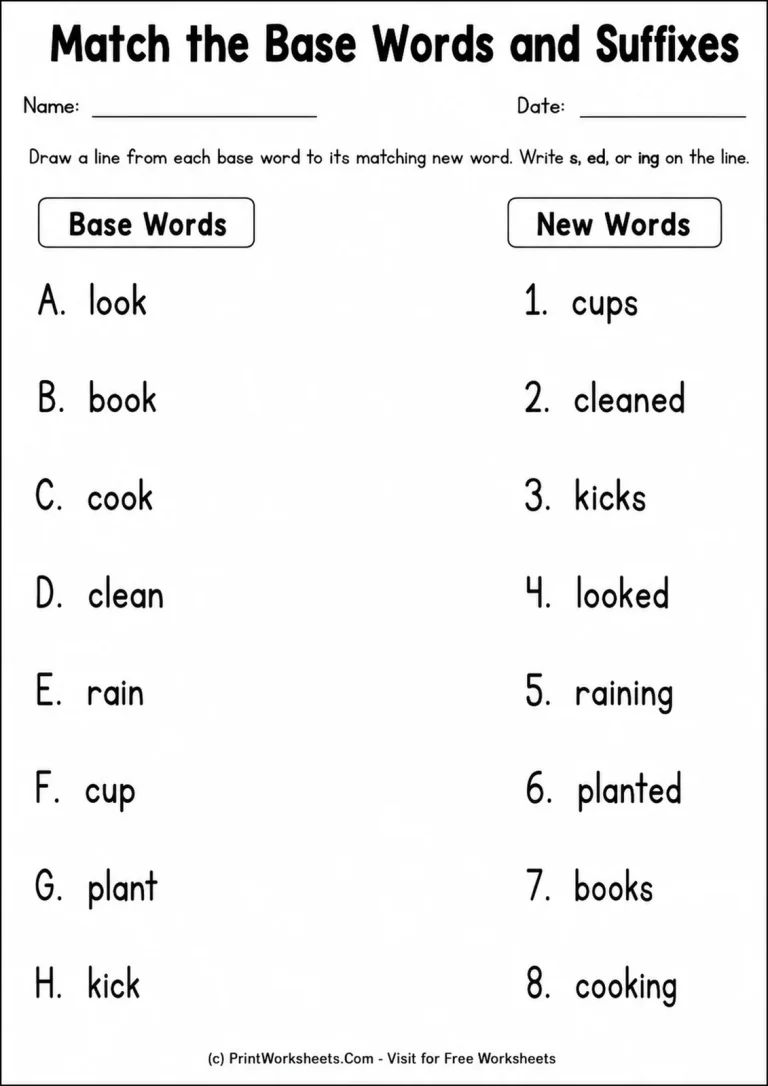
The next worksheet shifts from recognizing examples to building relationships between base words and new words. Students match eight base words with their suffixed forms and write whether s, ed, or ing was added. The practice includes look/looked, book/books, cook/cooking, clean/cleaned, rain/raining, cup/cups, plant/planted, and kick/kicks.
This matching format is especially useful for discussing what stays the same when a suffix is added. Students can compare each base word with its new form and name the ending that created the change. The mixture of nouns and verbs also prevents the activity from becoming a single-pattern exercise. Some examples use s for more than one item, while another uses s with a present-tense action. Other pairs show completed actions with ed or ongoing actions with ing.
Choose the Correct Suffix from Sentence Clues
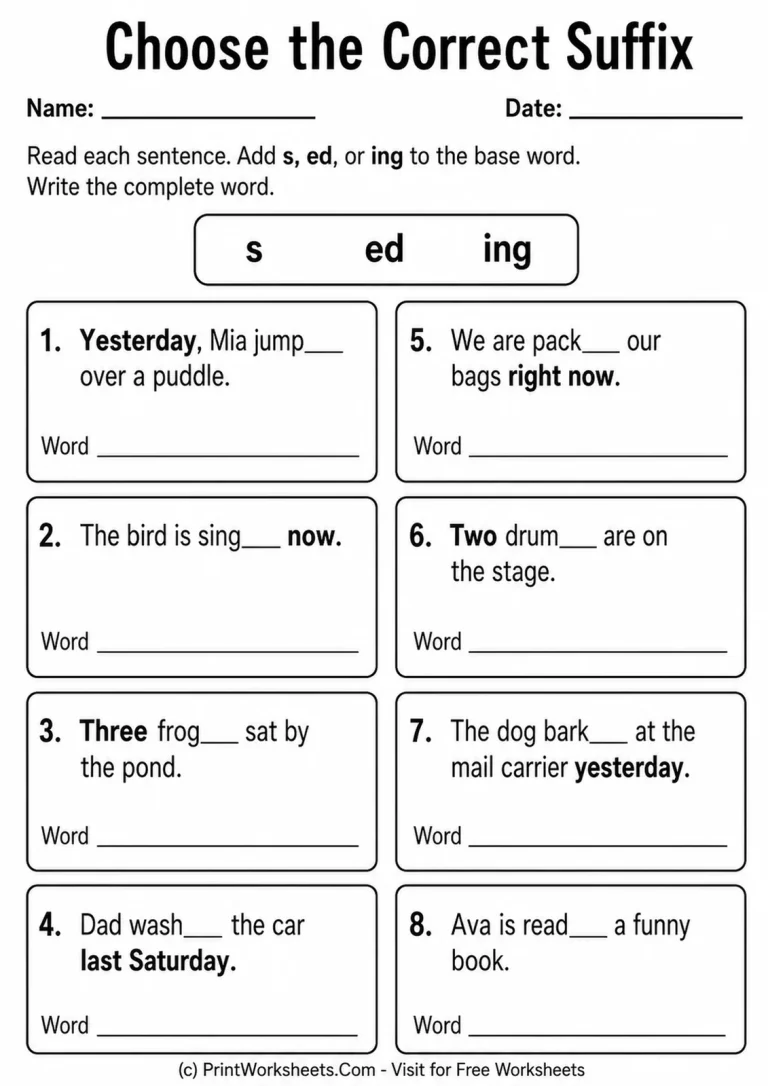
The final activity asks students to apply the same suffix knowledge inside complete sentences. Each item provides a base word, and students choose s, ed, or ing before writing the full word. Context clues such as Yesterday, now, Three, last Saturday, right now, Two, and yesterday help students determine which ending makes sense.
This stage adds an important reasoning step. Students are no longer matching a word they can already see; they must interpret the sentence. A quantity clue such as Three or Two can point toward an s ending for a plural noun. A time expression such as Yesterday or last Saturday signals that an action has already happened and supports ed. Phrases such as now or right now indicate an action in progress and support ing. These clues make the grammar meaning of each suffix concrete and observable.
How to Use These Grade 2 Suffix Worksheets
The three worksheets work well as a short progression across a lesson or several practice sessions. Begin with the illustrated identification page so students can separate base words from endings and discuss what each suffix means. Continue with the matching page to reinforce how a familiar base word changes when a suffix is added. Finish with the sentence-context page to see whether students can use number and time clues independently.
For extra discussion, ask students to explain why they chose an ending instead of only reading their completed word. Prompts such as “What clue tells you the action already happened?” or “Which word tells you there is more than one?” encourage students to connect suffix forms with sentence meaning. This makes the set useful for whole-group phonics and word study, small-group instruction, literacy centers, homework, or targeted review with a parent or teacher.
By the end of the set, students have practiced identifying suffixes, connecting base words with new forms, and selecting endings from meaningful sentence clues. That combination gives Grade 2 learners repeated practice with the forms and functions of s, ed, and ing while keeping attention on how each suffix changes what a word communicates.