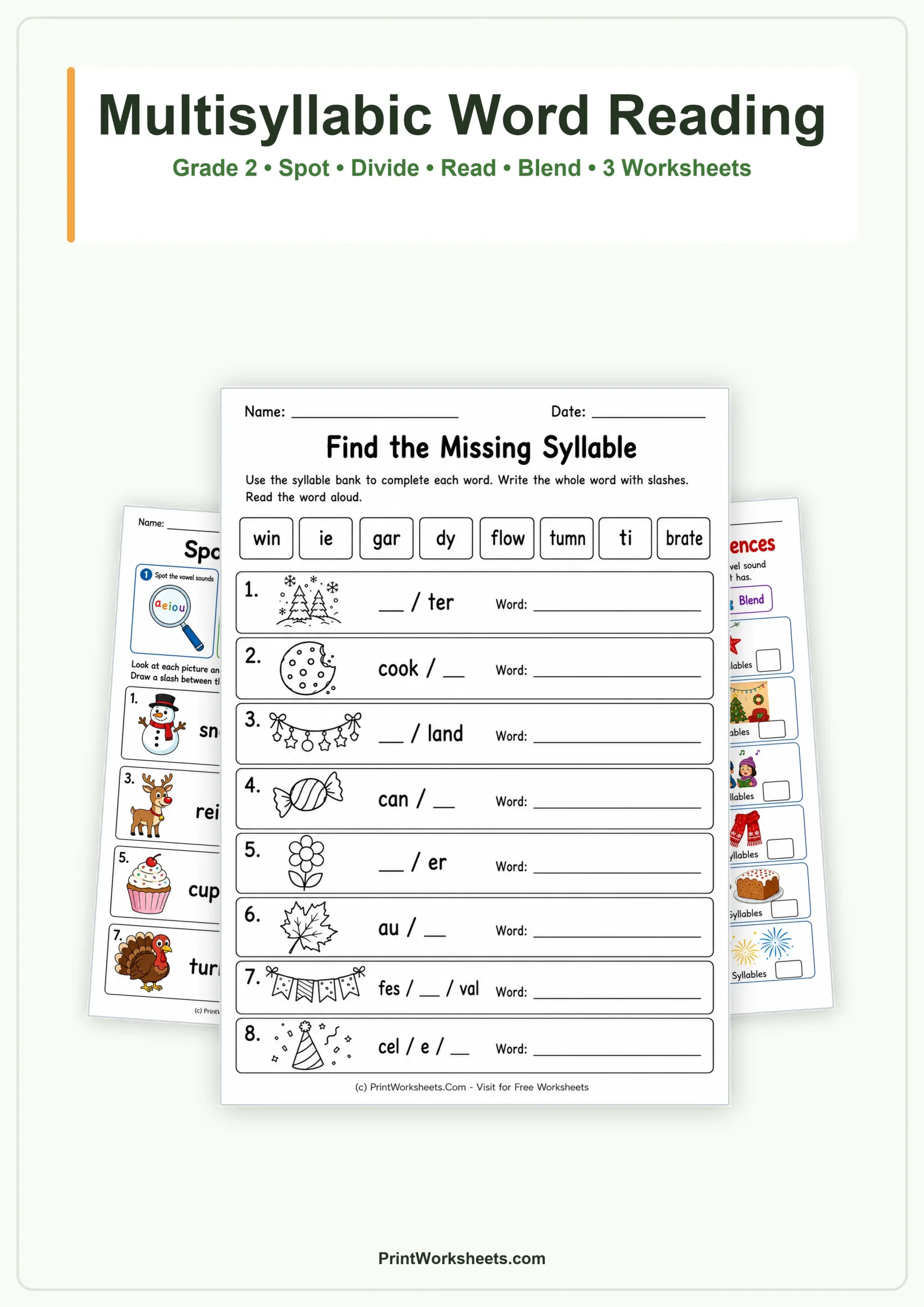
Longer words can feel much easier when children know exactly what to look for before they try to read the whole word. These Grade 2 worksheets build multisyllabic word reading around a practical sequence: notice vowel sound spellings, divide the word into manageable syllables, read each part, and blend the parts back together. Across three student activities, children move from heavily supported picture words to missing-syllable work and finally to decoding longer words inside short sentences.
Multisyllabic Word Reading with Spot, Divide, Read, Blend
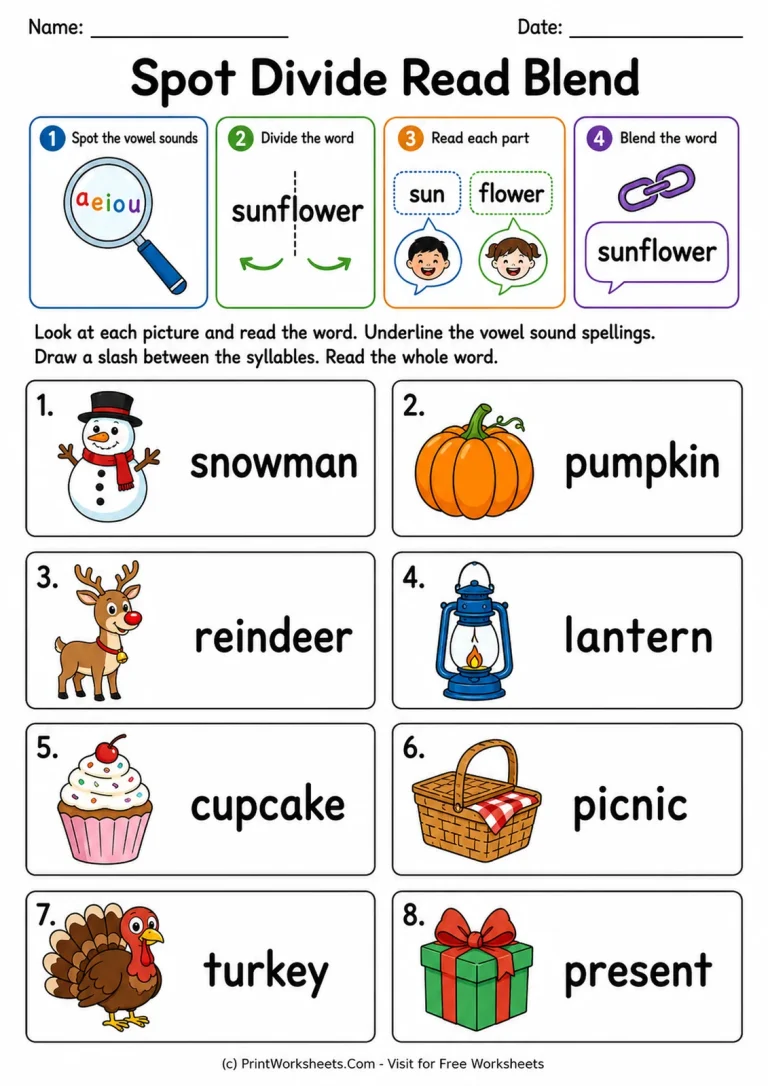
The first worksheet introduces a four-step routine called Spot, Divide, Read, Blend. A worked sunflower example shows students how to look closely at a longer word instead of guessing from its first few letters. Students then work with picture-supported words including snowman, pumpkin, reindeer, lantern, cupcake, picnic, turkey, and present.
For each word, children identify the spelling that represents the vowel sound, mark the syllable break with a slash, and then read the complete word. The pictures provide helpful meaning support, but the task still requires students to examine the printed word and apply the decoding routine. This makes the page useful for children who can read many one-syllable words but need a consistent method for approaching two- and three-syllable words.
Complete Longer Words One Syllable at a Time
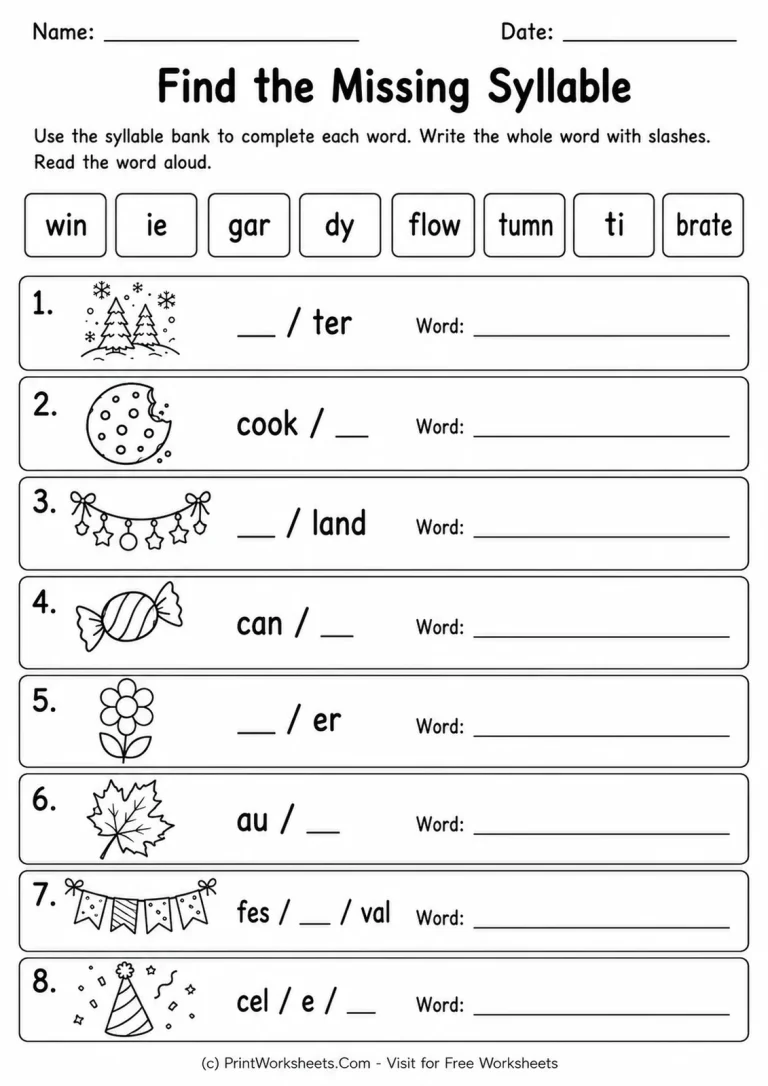
The second activity changes the kind of support instead of simply repeating the first task. Students use a syllable bank containing pieces such as win, ie, gar, dy, flow, tumn, ti, and brate. They choose the missing part needed to complete words such as winter, cookie, garland, candy, flower, autumn, festival, and celebrate.
After completing each word, students write it with syllable divisions and read it aloud. This forces them to think about how smaller spoken and written chunks combine to form a complete word. It also gives useful practice with words that do not all follow the same spelling pattern, so children must pay attention to the structure of each individual word rather than applying one narrow phonics rule.
Why the Syllable Bank Adds Useful Practice
A syllable bank reduces the writing load while keeping the decoding decision meaningful. Instead of generating every missing part from memory, students compare possible chunks, decide which one creates a real word, and then reconstruct the full word. Teachers can ask students to read each syllable separately before blending, while parents can use the same routine during home reading practice.
Decode Multisyllabic Words in Sentences
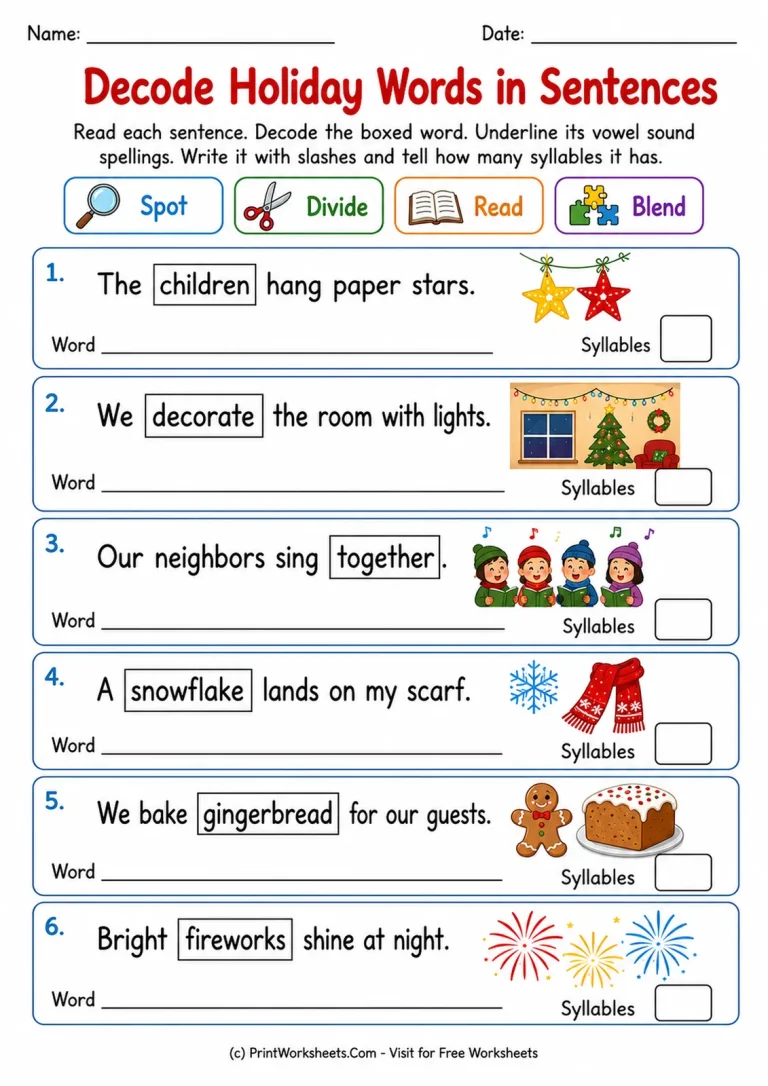
The final worksheet places longer words into six short holiday-themed sentences. Target words include children, decorate, together, snowflake, gingerbread, and fireworks. Students decode each boxed word, underline the vowel sound spellings, divide the word into syllables, and record how many syllables they hear.
This step is important because successful word reading must eventually happen during connected reading, not only on isolated word lists. A sentence gives students meaning and grammar clues, but they still need to inspect the target word carefully. The activity therefore combines contextual support with explicit attention to word structure.
A Useful Progression for Grade 2 Phonics Practice
The three worksheets can be used in order as a short instructional sequence. Begin with the picture-supported Spot, Divide, Read, Blend page when introducing or reviewing the strategy. Move to the missing-syllable activity once students understand that longer words can be broken into readable chunks. Finish with the sentence page when students are ready to apply the same habits with less visual support.
This progression works well for a small phonics group, reading intervention, literacy center, tutoring session, or home review. A teacher might model the first one or two examples aloud, then ask students to explain where they see a vowel spelling or why they chose a particular syllable break. During independent work, children can quietly tap or clap the syllables before writing the slash marks.
Skills Practiced in This Worksheet Set
Students practice locating vowel sound spellings, separating longer words into syllables, blending syllables into complete words, completing missing syllables, reading two- and three-syllable vocabulary, using sentence context, and counting syllables. Because the same core strategy appears in several different task types, children get repeated practice without doing the same worksheet three times.
Use these Grade 2 multisyllabic word reading worksheets when students are ready to move beyond short-word decoding and need a visible, repeatable process for handling longer words. The goal is to help readers approach an unfamiliar word in manageable parts, combine those parts accurately, and carry the strategy into everyday reading.