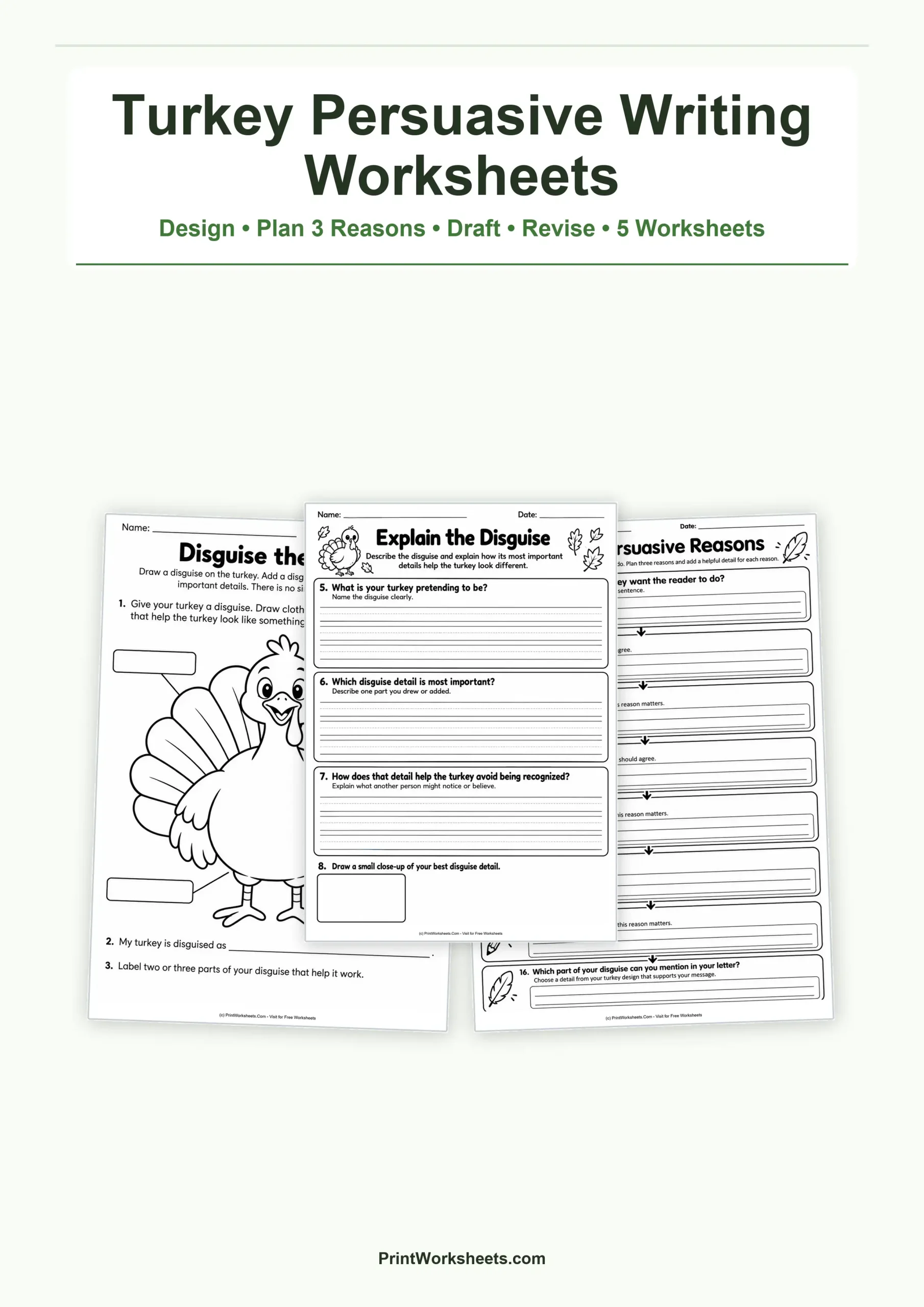
These turkey persuasive writing worksheets turn the familiar disguise-the-turkey idea into a complete writing project instead of stopping after the drawing. Across five printable pages, students create a disguise, explain why its details work, plan three persuasive reasons, draft a letter asking the reader to keep the turkey safe, and revise their ideas into a final persuasive message. The sequence gives children a concrete character and situation to write about while still requiring clear reasons, supporting details, organization, and editing.
Turkey Persuasive Writing That Starts With a Visual Idea
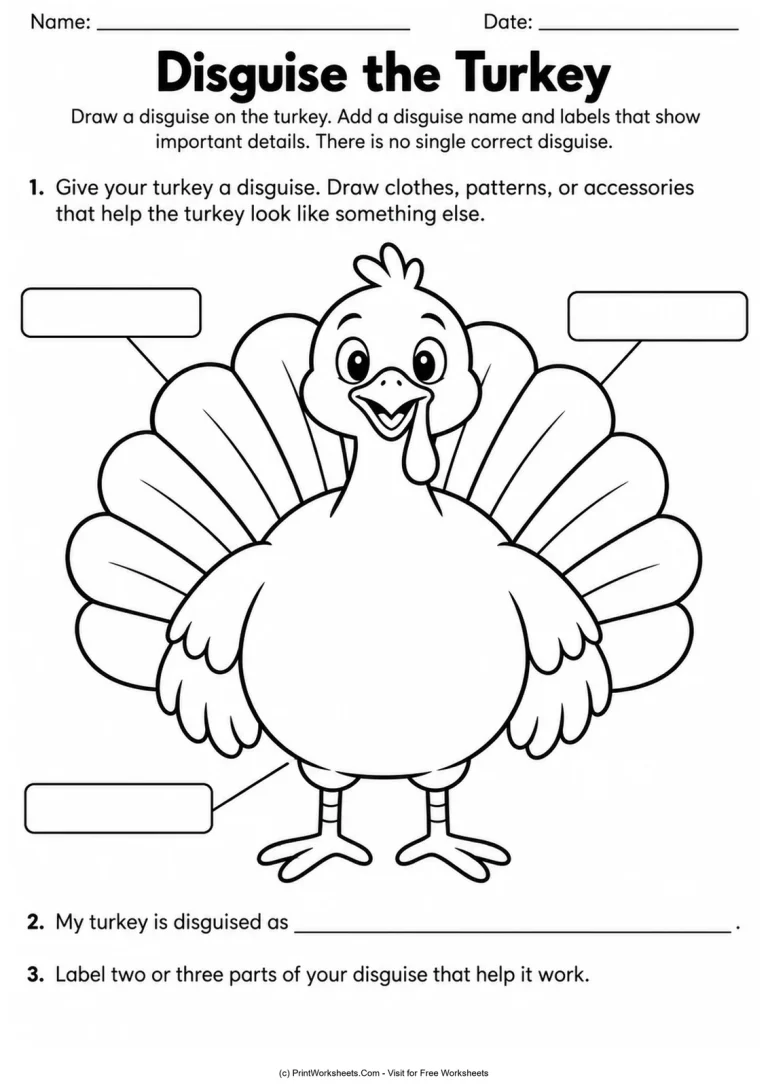
The first worksheet gives students a large turkey to transform with clothes, patterns, or accessories. Children decide what the turkey is pretending to be, write the disguise name, and label two or three parts that make the disguise convincing. Because the page states that there is no single correct disguise, students can make individual choices while still being asked to communicate their ideas clearly through labels.
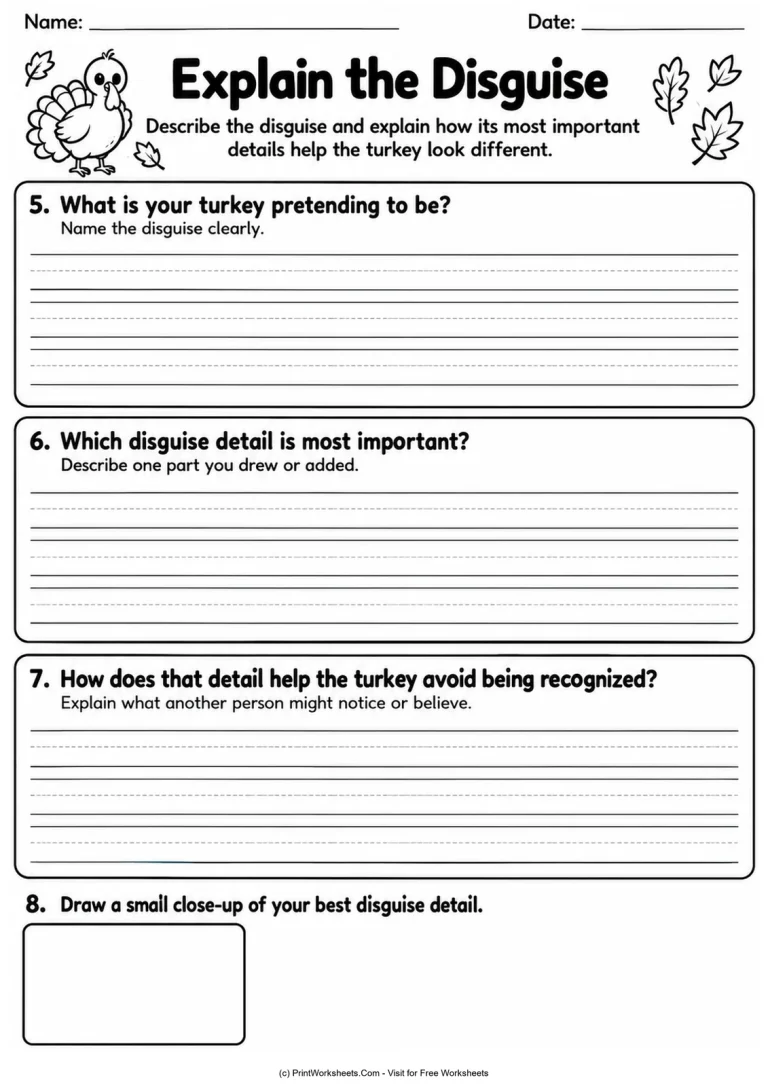
The second page shifts from drawing to explanation. Students name what the turkey is pretending to be, identify the most important disguise detail, and explain how that feature might stop another person from recognizing the turkey. A small close-up drawing box lets them focus on the feature they think works best. This creates a useful bridge between a visual project and written reasoning: students are not simply decorating a turkey, but thinking about why particular details support their idea.
Teachers who want a simpler design-only activity can also use our disguise a turkey template printable. This five-page set is better suited when the goal is to extend the disguise concept into a structured writing lesson.
Plan Three Reasons Before Writing the Letter
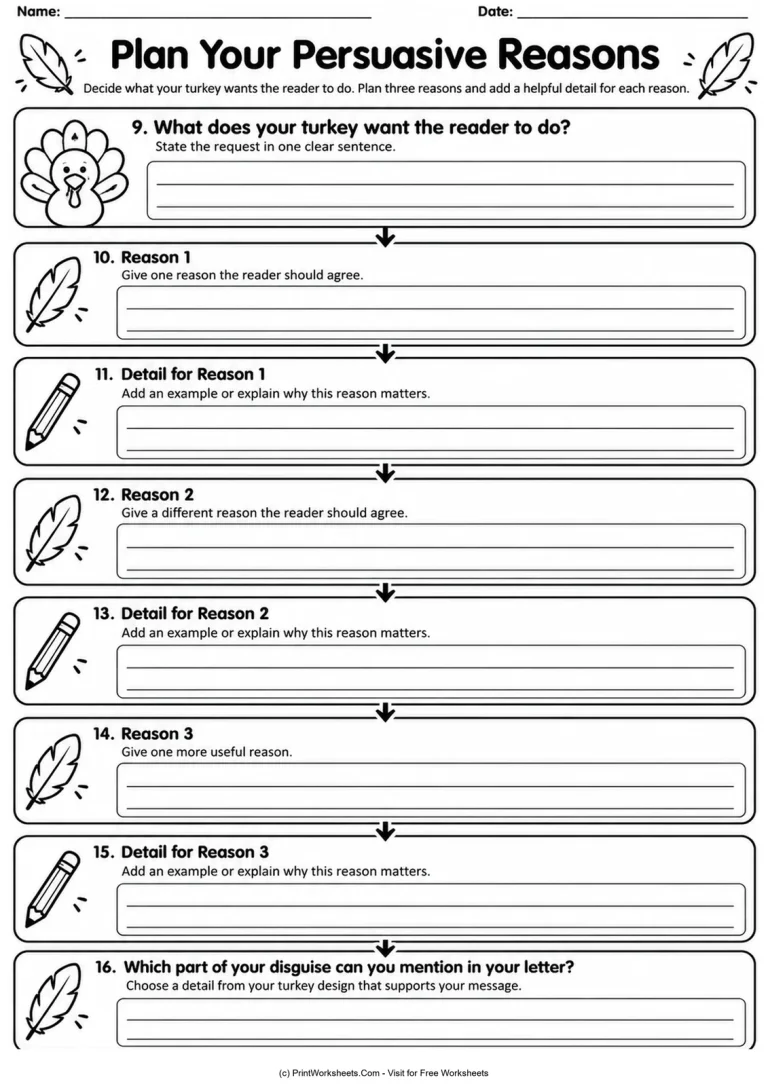
The planning worksheet helps students organize the persuasive part before they begin a full draft. First, they state exactly what the turkey wants the reader to do. Then they develop three different reasons the reader should agree. Each reason has its own space for an example or explanation, encouraging students to support an opinion rather than list disconnected statements.
The organizer also asks students to choose one detail from the turkey disguise that can strengthen the message. That connection matters because it keeps the letter tied to the project students created on the earlier pages. A child might choose a hat, costume, pattern, or another disguise feature and explain how it helps the turkey look like something else. The page therefore combines persuasive structure with evidence drawn from the student’s own design.
Draft a Complete Persuasive Turkey Letter
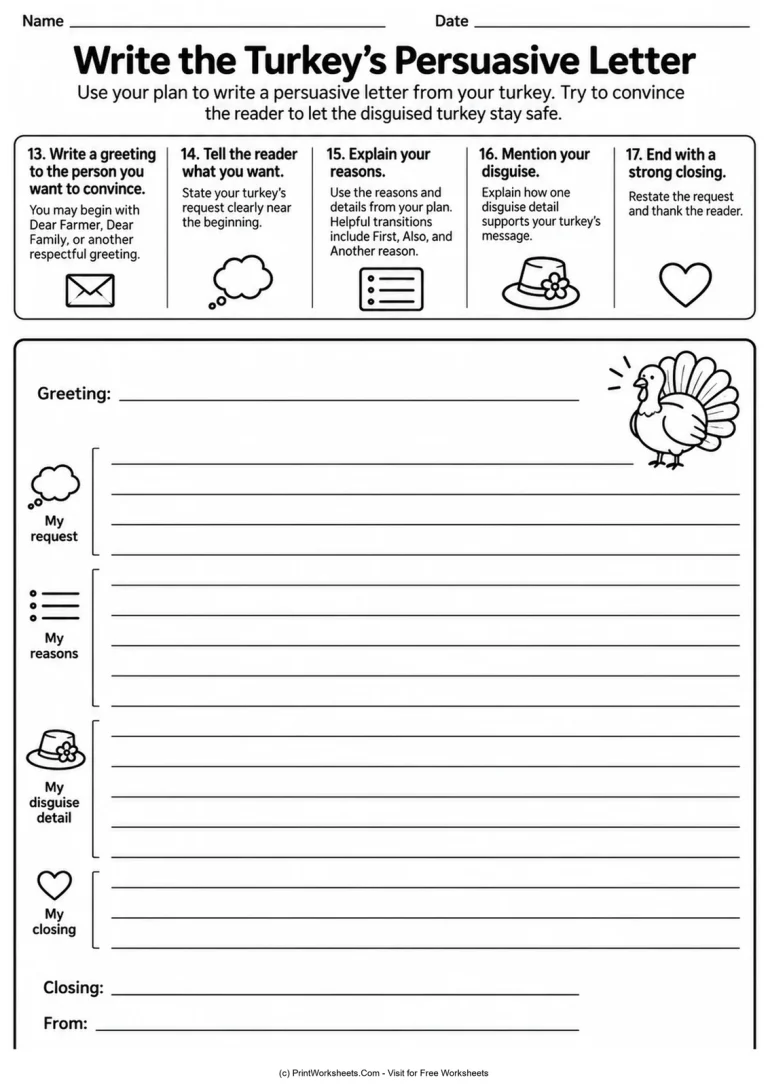
The fourth worksheet provides a guided letter-writing page with reminders for five important parts: greeting the reader, stating the request, explaining reasons, mentioning the disguise, and ending with a strong closing. The main writing space is divided into labeled sections for the request, reasons, disguise detail, and closing, so students can see how their earlier planning fits into a complete piece of writing.
Helpful transition suggestions such as First, Also, and Another reason support students who are learning to connect ideas in sequence. The dedicated Greeting, Closing, and From lines also make the activity useful for teaching basic friendly-letter conventions alongside persuasive writing. Because the prompt asks students to convince a reader to let the disguised turkey stay safe, the writing has a clear audience and purpose rather than functioning as an isolated list of sentences.
Revise and Write a Polished Final Message
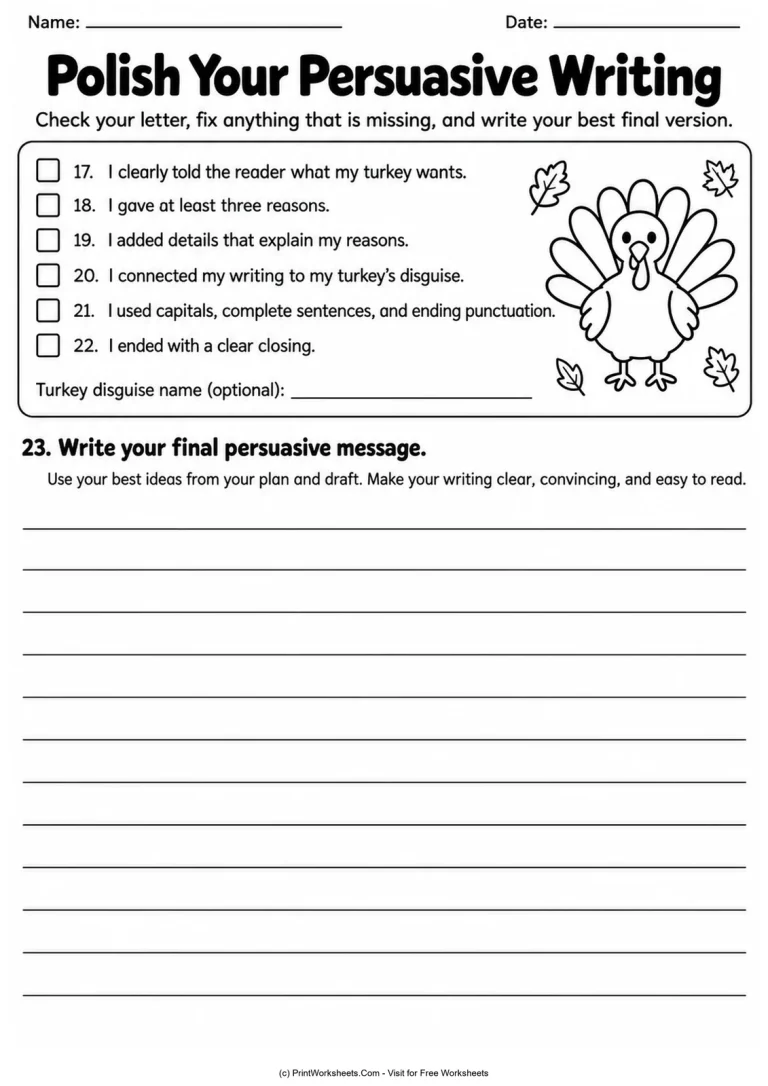
The last page functions as both a revision checklist and a final-copy sheet. Students check whether they clearly stated what the turkey wants, included at least three reasons, explained those reasons with details, connected the writing to the disguise, used capitals and complete sentences with ending punctuation, and finished with a clear closing. They can also record the turkey’s disguise name before writing the final version.
This final step makes the set especially useful for a multi-day Thanksgiving writing lesson. One session can focus on designing and explaining the disguise, another on planning reasons, and a later session on drafting and revising. It can also be used as a small writing-center sequence for students who benefit from completing one stage at a time.
Who Can Use These Thanksgiving Writing Worksheets?
The amount of scaffolding and writing space makes the set a practical fit for many students in grades 2 through 4. Younger writers can use shorter sentences in each section, while more confident writers can expand their supporting details and final message. The combination of drawing, labeling, planning, letter writing, and revision also gives teachers and parents multiple ways to observe how a student develops an idea from an initial visual concept into an organized persuasive composition.
Print all five pages for the full project, or use selected pages when students already have a turkey disguise design. The strongest learning experience comes from keeping the same disguise idea throughout the sequence so students can see how one creative choice can grow into reasons, evidence, a draft, and a polished piece of persuasive writing.